
Home » Policy (Page 17)
Category Archives: Policy
On an ‘induced demand calculator’
Induced demand or traffic is a popular topic these days thanks to the proposal of a private company to build an elevated tollway along the Pasig River. The topic is also much in circulation the past few years as the DPWH’s part in the government’s Build, Build, Build program has road widening as a major component. There are many completed, ongoing and planned projects across the country that involves road widening, particularly increasing the number of lanes of typical national roads from 2 to 4, not counting the shoulders (paved or unpaved). The results are mixed as there are roads that definitely required capacity increase in the form of additional lanes, and there were roads that did not require them. The latter were still expanded and perhaps the agency did so because their key performance indicators basically obliged them to undertake such projects regardless of the need. Somehow, these were justified and yet there were and are many questionable road widening projects especially those that involved the cutting of decades if not century old trees (e.g., the Kamatchile and Acacia trees that used to line up long sections of national roads in Tarlac are no more) or the demolition of heritage structures such as houses.
A came upon this article about an “Induced Demand Calculator” developed in the US. I have not gone through the calculator itself but such a tool could be quite useful in quantifying the impacts of road widening while pushing for other options to improve transportation and traffic that is not the typical “solving traffic” type of approach. Here is the article in Streets Blog:
I am not aware if there are similar tools being developed here. Such a calculator will require data from various sectors including construction costs, operations and maintenance costs, value of time and current and projected vehicular and person trips that can be translated into traffic volumes.
–
Safe streets for children
We have been working with UNICEF and several partner organizations on a project on Child Road Traffic Injury Prevention (CRTIP). The Final Reports for the two pilot cities, Valenzuela City and Zamboanga City, have been submitted and represents over 2 years work including during the lockdowns due to the Covid-19 pandemic. The latter part of project implementation indeed became a challenge as we couldn’t travel and engage face-to-face or conduct field surveys like how we did in the first part of the project. Still, I believe we were able to accomplish much and most of what we initially set out to do. Here are the covers of the Final Reports we submitted to UNICEF and we understand will be officially or formally transmitted to the two cities.


The reports narrate the surveys conducted for 25 schools in Zamboanga and 41 schools in Valenzuela. Each initially had selected 25 schools but Valenzuela pushed for an additional 16 schools midway into the project. The SR4S tool developed by iRAP was used for the assessments of critical areas around the schools. The initial assessments were used to identify interventions to improve safety in these areas and recommendations were submitted for consideration of the cities as well as the DPWH where applicable (i.e., the DPWH has jurisdiction over national roads and improvements proposed along these). While some interventions were implemented, others and many were delayed mainly due to Covid-19.
We also conducted a survey to determine the commuting characteristics of schoolchildren in both cities. Since most schools were public schools, it was no surprise that most children lived near the schools or within the school district (which is basically the catchment area for these schools). Thus, it also came as no surprise that most schoolchildren came by foot (walking), motorcycles (riding with a parent) or motor tricycle. There’s a lot of information and takeaways from the data but unfortunately, we could get the bigger, more complete picture of Valenzuela City because they selected only elementary schools covering students from Grades 1 to 6. Zamboanga had a more robust data set with both elementary and high schools, covering Grades 1 to 12. The information derived from these surveys were also analyzed and related to the SR4S assessments. The commuting survey results and SR4S assessment are subject of two technical papers presented in the recent EASTS 2021 conference hosted by Hiroshima University.
What’s next? We are now drafting a proposal for a Phase 2 of the project. We hope to continue and reinforce and follow-up on the recommended interventions from Phase 1. We also hope to be able to work on the CRTIP data hub that was only partly completed due to the many constraints faced by that part of the project. I will post here from time to time about some of the outcomes from the surveys and assessments.
–
Is it difficult to understand the phenomena of induced demand?
I’m sharing a recent article that laments about how transport departments in the US seemingly don’t understand the concept and phenomena of induced demand. Is it really difficult to understand or are transport officials including highway planners and engineers deliberately ignoring what’s staring them in the face?
Zipper, D. (September 28, 2021) “The Unstoppable Appeal of Highway Expansion,” Bloomberg City Lab, https://www.bloomberg.com/news/features/2021-09-28/why-widening-highways-doesn-t-bring-traffic-relief [Last accessed: 10/10/2021]

The topic in the article is very much applicable to our own Department of Public Works and Highways (DPWH). The DPWH’s key performance indicators (KPIs) need to change from the typical “kilometers of road constructed” or “lane-kilometers of roads widened” to something like “travel time between points A and B”. Agencies like the DPWH always like to claim they are for solving traffic congestion but we already know widening roads just won’t cut it. It has to be more comprehensive than that and involve the entire transport system rather than just a part (i.e., the road). And it has to be a collaborative effort with various other agencies like the Department of Transportation (DOTr) and local government units. Unfortunately, too, these agencies like the DOTr and those under it, and many (not all) LGUs also like to go at it solo so we end up with piecemeal solutions that are also often out of context.
–
Why not rationalize other routes now?
There is an enduring discussion in various forums and platforms about the lack of supply of public transportation. I can’t help but notice though that many discussions consciously or unconsciously leave out the part of public transport rationalisation that calls for phasing out lower capacity vehicles in favour of higher capacity ones. I have written about this and explained the necessity particularly along corridors with high transport demand. Delaying what is required (not necessarily what is inevitable) means we fall short of transforming public transport services in this context.
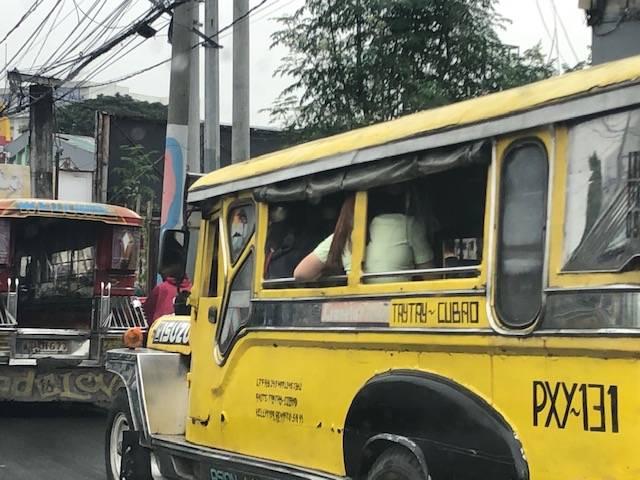
There are definitely missed opportunities here but the current discussions and proposed resources for 2021 including funds for service contracting seems to suggest a status quo in terms of vehicles with the exception of the modernisation part. Perhaps this is because we are still in pandemic mode and survival is still the name of the game? Nevertheless, there should be initiatives and continued dialogue about ‘graduating’ from lower capacity vehicles to higher capacity ones. Of course, this discussion is more urgent for highly urbanised cities than smaller ones.
–
On Transit, Urban Equity and Sustainability
Here is another quick share of an article about public transport, urban equity and sustainability:
Descant, S. (September 2021) “How Can Transit Deliver Urban Equity and Sustainability?”, Government Technology, https://www.govtech.com/transportation/how-can-transit-deliver-urban-equity-and-sustainability [Last accessed: 9/21/2021]
The article discusses how the Covid-19 pandemic clearly shows the role of public transportation in the lives of a lot of people. There is that opportunity to significantly if not radically improve public transportation now more than ever. Surely governments and their transit or regulating agencies have thought about this. While the pandemic led to situations that are not necessarily clean slates for many, there are definitely opportunities here and there to implement change that will increase benefits for transit users while attracting non-users to shift from their preferred modes (i.e., private vehicles). Here’s a takeaway from the article:
“We know that public transportation is the solution. So there needs to be a commitment at the federal level, not just in terms of funding, but also integrating public transportation deeper into the fabric of society, through land use policy and through other transportation access policies — the sidewalk and bike lane piece — with the data and payment apps as well…”
What improvements do you think should and can be done now given the pandemic situation? Are these still timely or have we figuratively “missed the bus”, so to speak?
On electric vehicles in the Philippines – current situation and prospects
Here’s a quick share of an article on electric vehicles in the Philippines:
Fernandez, H.A. (September 7, 2021) “Electric vehicles in the Philippines: a mottled green solution,” Eco-Business, https://www.eco-business.com/news/electric-vehicles-in-the-philippines-a-mottled-green-solution/ [Last accessed: 9/8/2021]

It is interesting that the article cites past studies that covered not just e-vehicles but the bigger picture for transport. I think most if not all people who were doing work on low carbon transport including the modeling of scenarios for the long term were not able to anticipate something like Covid-19 disrupting activities around the world and curbing emissions so drastically in the last year. The so-called ‘old normal’ situation has not returned but some say that even with the pandemic affecting transport, we still won’t be able to attain the targets necessary to stave off global warming. The bottomline is that we need more aggressive actions and probably, shifting to e-vehicles is one of those that combined with others will help achieve targets.
–
On current health protocols applied to public transport
The current surge of infections attributed to the Delta variant of Covid-19 has been alarming. The recent quarantine issuances by national government have not been effective as there was basically lax enforcement or implementation. Granted, there were just a lot of loopholes designed to allow so-called “economic frontliners” to go to work and under conditions that made their commutes risky in the context of the pandemic. The same laxity and loopholes apply too, to people who have no business roaming around and yet travel with their motor vehicles (especially motorcycles) and bicycles across cities, towns and provinces in the guise of exercise or essential travel.
Meanwhile, the practice and enforcement of public health protocols in the country has been lax and misguided (e.g., do we really need to wear face shields?). In public utility vehicles, people are now crowding inside with usually only a sheet of plastic separating one from another. This is not exactly reassuring in as far as spreading the virus is concerned. And we shouldn’t pretend that we are not aware that there are asymptomatic people going around and infecting others whether knowingly or not. It’s no wonder, really, why people who have the private vehicle or active transport option use these instead of public transport.


Much has been said about government failing to address the Covid-19 pandemic from the start. And it continues to bumble through this health crisis (if you don’t want to call it one then either you don’t understand the gravity of the problem or just refuse to do so – the latter is worse). Tagging workers as ‘economic frontliners’ is probably at least as bad as calling BPO workers ‘Bagong bayani’, adding them to the Overseas Foreign Workers (OFWs) who had been branded as so in the past. This becomes a convenient excuse to ease health-related restrictions for people to travel/commute to work. It is a form of gaslighting the very same workers to believe they need to go out and work. Meanwhile, precious funds are being diverted elsewhere including the dolomite beach at Manila Bay and money spirited away in preparation for next year’s elections.
I got it from recent surveys that people give a higher priority to employment and earning income over Covid-19. Perhaps most have not had direct experiences with the frightening cases of Covid-19 (i.e., they’re asymptomatic or have encountered only asymptomatic cases with friends and families). I hate to say it but it seems like the same thinking pertaining to extra judicial killings (EJK). I can already imagine hearing the usual comments: “Malayo sa bituka.” “Wala akong pakialam diyan.” “Okay lang yan. Hindi naman kami apektado niyan.” These comments reflect an absence of empathy. Empathy I think is very much needed today in order for people to understand what’s going about. And that’s not just about us but businesses as well that definitely, likely lost a lot during this pandemic but still need to empathize if not call out those who are really responsible about the mess we are in. Do your employees really need to go to the office? Or can they continue working from home? The answer to these questions affect commuting in the time of Covid-19 and relates strongly to the protocols applied to public transport.
–
On priority lanes for public transport
I am currently part of an International Research Group (IRG) involved in studies on bus priority. Yesterday, we had a meeting where one professor mentioned the importance of being able to clearly explain the advantages of having priority lanes for buses in order to improve their performance (i.e., number of passengers transported and improved travel times). There was a lively discussion about how the perception is for bike lanes while transit lanes have also been implemented for a long time now though with mixed results.
There are very familiar arguments vs. taking lanes away from cars or private motor vehicles and allocating them for exclusive use of public transport and bicycles. It may sound cliche but ‘moving people and not just cars’ is perhaps the simplest argument for priority lanes.
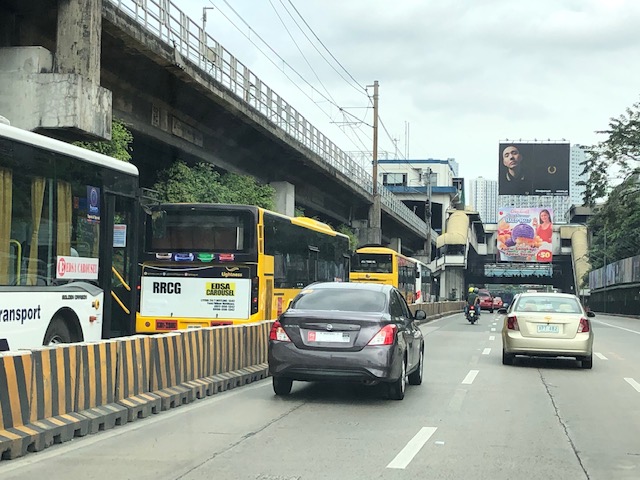 EDSA carousel buses lining up towards a station
 Bike lane along Katipunan Avenue – is this a temporary thing? a fad because traffic is really not back to the old normal? Katipunan is infamous for being congested with cars generated by major trip generators in the area such as schools/universities and commercial establishments.
 The bike lane along Commonwealth Avenue proves there’s just too much space for private motor vehicles. And with the Line 7 in the horizon, perhaps more lanes can be taken and made exclusive to road public transport. [Photo credit: Cenon Esguerra]
–
On defining the 15-minute city
I have shared articles and briefly written about the concept of the 15-minute city on this blog. Here is another discussing how a 15-minute city is defined:
(February 8, 2021) “Defining the 15-minute city,” Public Square, https://www.cnu.org/publicsquare/2021/02/08/defining-15-minute-city [Last accessed: 8/10/2021]
Here is an image from the article:
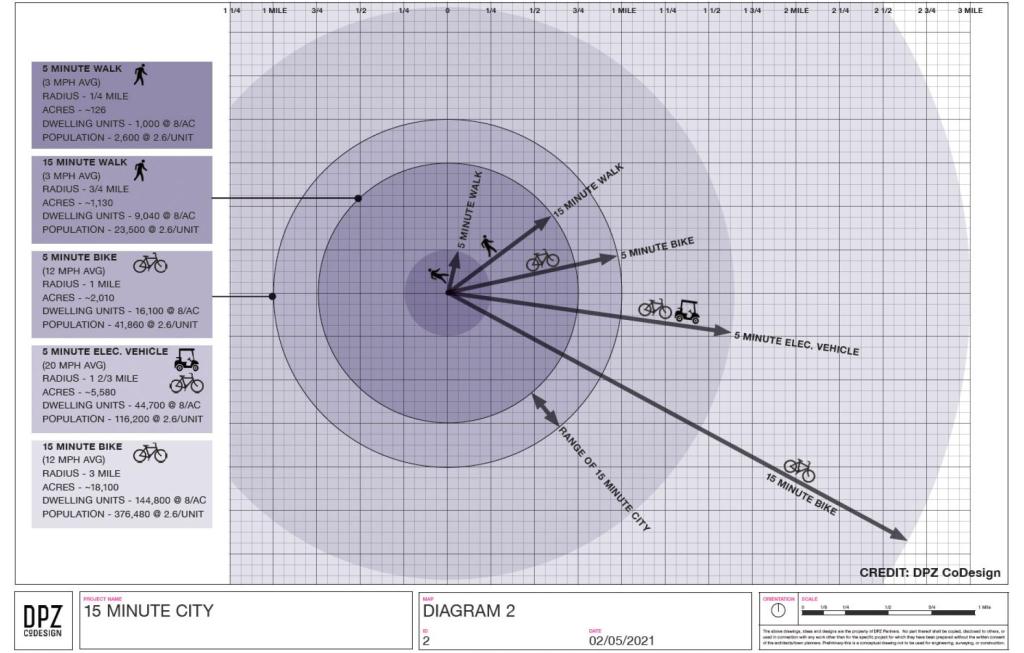
Again, it is important to contextualize these concepts. I share these as references and topics for discussion. Of course, I have my own opinions about this and I have written about those in previous posts. I guess in the Philippine context, we can include the pedicab or non-motorized three-wheelers in the discussion. These are also very popular modes in many cities and municipalities despite their being also prohibited along national roads like their motorized counterparts. It would be nice to have more visuals in the form of maps that show travel times for essential destinations or places like hospitals, markets, grocery stores, workplaces and, of course, homes. I assume there is at least someone, somewhere who perhaps have made multi-layer maps of this sort and attempted to related them along the lines of this concept of a 15-minute city (or perhaps the even older “compact cities”).
–
Tinkering with decentralization of public transportation planning, franchising and regulations
I recall an informal discussion my colleagues and I had about the then Department of Transportation and Communications (DOTC) more than a decade ago. We were comparing the Department of Public Works and Highways (DPWH)’s and DOTC’s structures. DPWH has regional offices but also District Engineering Offices (DEO). These DEOs were practically mini me’s of the DPWH with the District Engineer calling the shots. Under him were a Design Engineer, Planning Engineer, Maintenance Engineer, etc. who were the equivalent at that level of the Bureaus. DOTC didn’t have the equivalent even though there were Land Transportation Office (LTO) and Land Transportation Franchising and Regulatory Board (LTFRB) regional offices. So if there were regional development council (RDC) meetings, the DOTC’s representatives are usually from the regional offices of LTO and LTFRB plus other offices of agencies under DOTC – Maritime Industry Authority (MARINA), Air Transportation Office (ATO now CAAP) and the Philippine Ports Authority (PPA).
I mention these because perhaps one vision for the future is to have something like Metropolitan, City or Municipal Transit Authorities similar to those you’ll find in other countries. And these should have the capacities for route planning and assessment that are currently centralized in DOTr (i.e., Road Transport Division). But perhaps these transit authorities should not only have road based public transport under them but also rail, too. This is especially applicable to metros like MM, the loosely defined Metro Cebu and Metro Davao and other HUCs that maybe ripe for some form of urban rail transport. In some cases, I would even dare include maritime transport as well since modes like the Pasig River Ferry should also be included.
This idea of decentralization is something worth considering as local government units build capacity and capability for public transportation planning, operations and management. Some are already capable though mainly concern themselves with tricycles and pedicabs. These two modes are not under the LTFRB but are arguable the most in number around the country. There are already best practices about their management including those that have been documented in past studies on sustainable transport (e.g., San Fernando, La Union, Quezon City, Olongapo City, Davao City, etc.). Many of these cities are highly urbanized and would need to deal with all public transport and might just be the most knowledgeable and experienced in their jurisdictions. National government should at least identify pilot cities where bus, jeepney and van transport planning, franchising and management (including operations and enforcement) can be devolved or delegated. That is so we can already have an idea how these local transit authorities can be operationalized. Many already have their Local Public Transport Route Plans (LPTRP) so that is a good starting point for LGUs to establish their transit units around.
–
 Caught (up) in traffic