
Home » Policy (Page 17)
Category Archives: Policy
On roadway expansions and induced demand
We start December with another shared article. Here is another excellent article from Todd Litman about roadway expansions and induced demand:
Litman, T. (November 28, 2021) “The Roadway Expansion Paradox,” Planetizen.com, https://www.planetizen.com/blogs/115395-roadway-expansion-paradox?utm_source=newswire&utm_medium=email&utm_campaign=news-12022021&mc_cid=89cc0b2638&mc_eid=9ccfe464b1 [Last accessed: 12/3/2021]
Note the list of references at the end of the article for further reading.
–
Vaccines for road safety
If there is the current vaccination drive vs. Covid-19, there is also something like this for road safety. The International Road Assessment Program (iRAP) developed many tools and resources to address road safety issues. I am sharing the link to the Vaccines for Roads site of iRAP here:
Because Every Life Counts
It is always good to know about these resources whether you are a practitioner, a researcher. a teacher or perhaps an advocate of road safety. There are many examples here of interventions for various scenarios or conditions that will hopefully lead to safer roads for all.
–
TSSP 2021 [27th Annual Conference]
The Transportation Science Society of the Philippines (TSSP) held its 27th Annual Conference last November 19, 2021. Here are the poster and program for the conference:
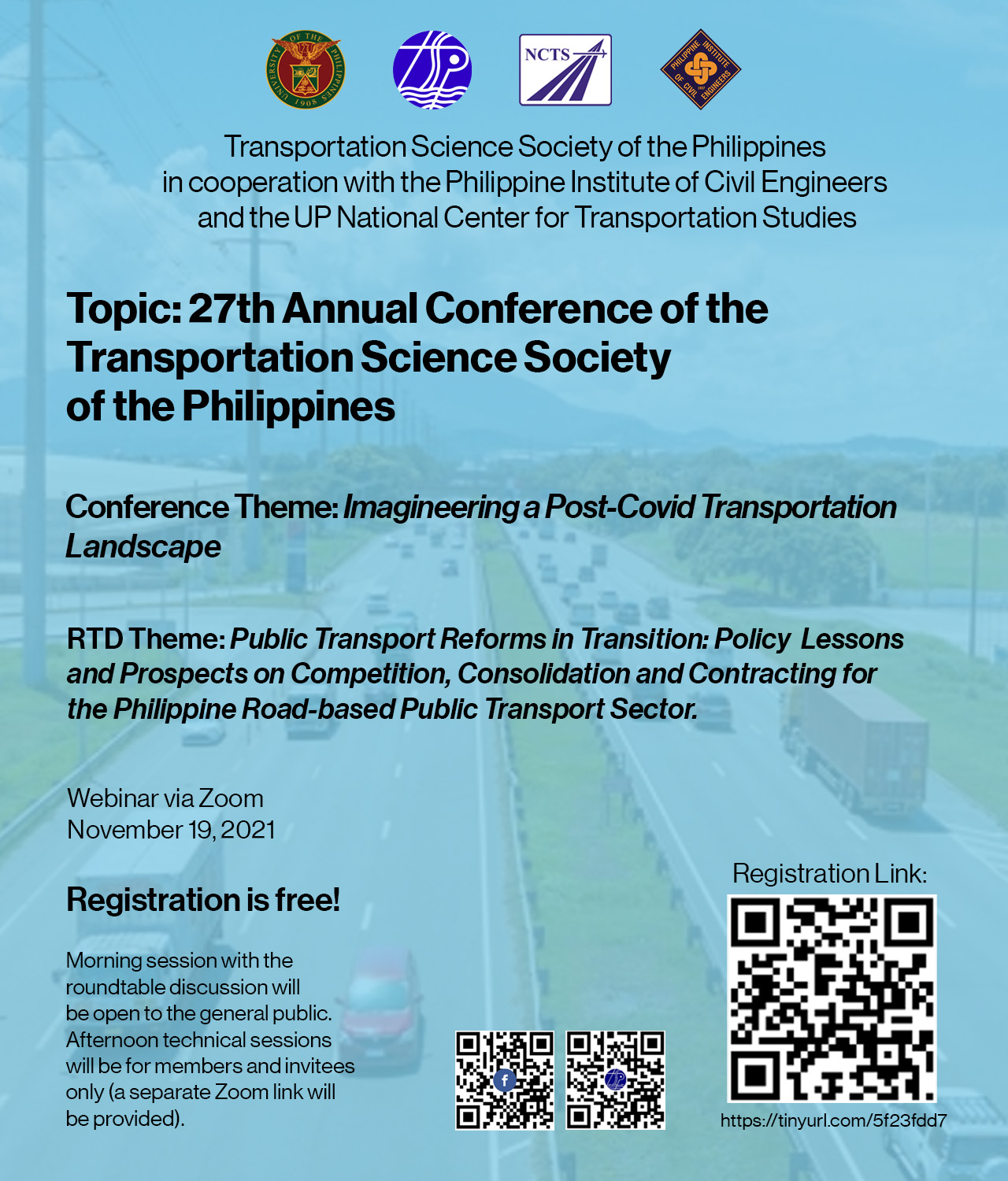
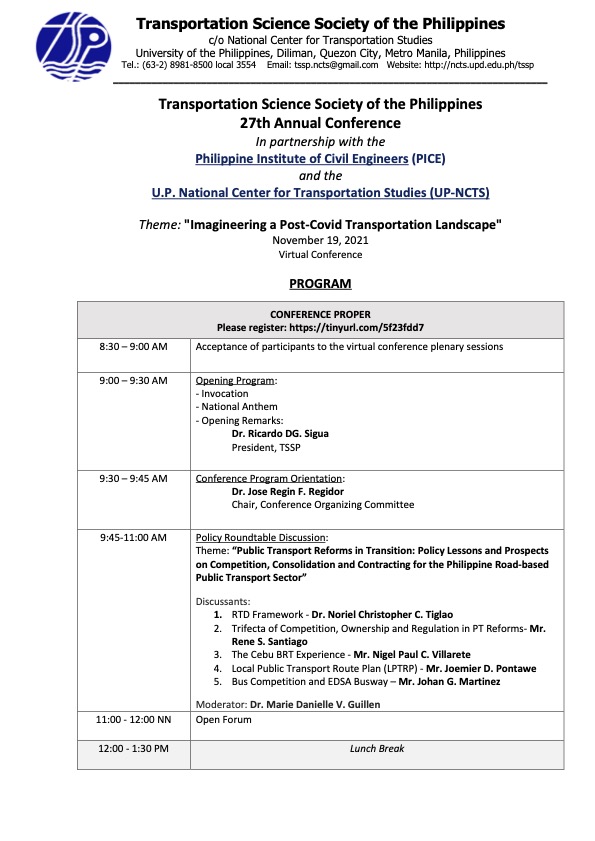
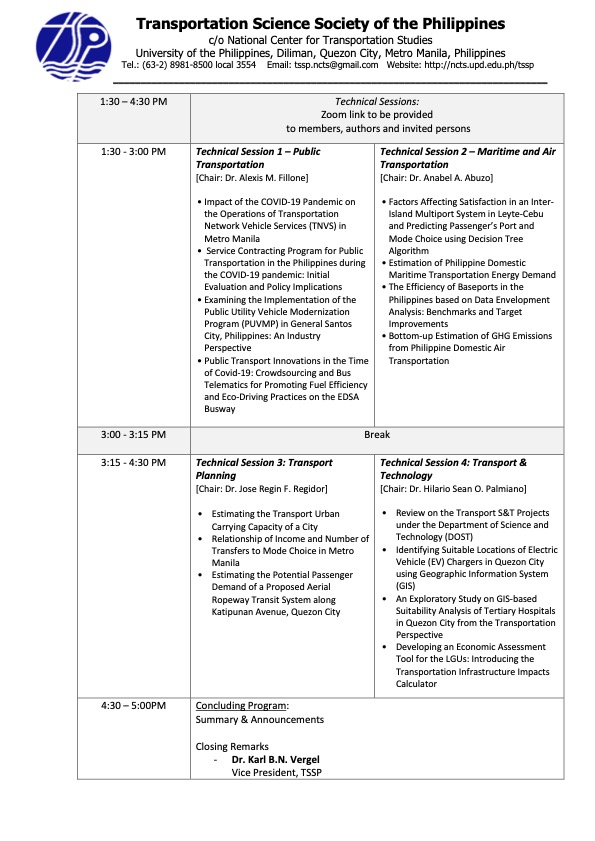
I initially intended to write about the conference before it was held but things got pretty busy last week so this is a post conference write-up. The organizers also announced the final program late (i.e., just a few days before the conference proper) so it seemed sort of anti climactic to post about it. Nevertheless, the conference proceeded as planned and the TSSP has announced it will be posting the proceedings on their official website. It is not yet there but here’s a link to the TSSP official website: http://ncts.upd.edu.ph/tssp/
–
On the key transformations needed to achieve sustainable, low carbon transport
Also related to COP26, I am sharing material from the Sustainable Low Carbon Transport (SLOCAT) partnership, of which our center is part of. SLOCAT recently released the 11 key transformations for sustainable low carbon land transport urgently needed to meet the climate targets. Here’s a link to their site:
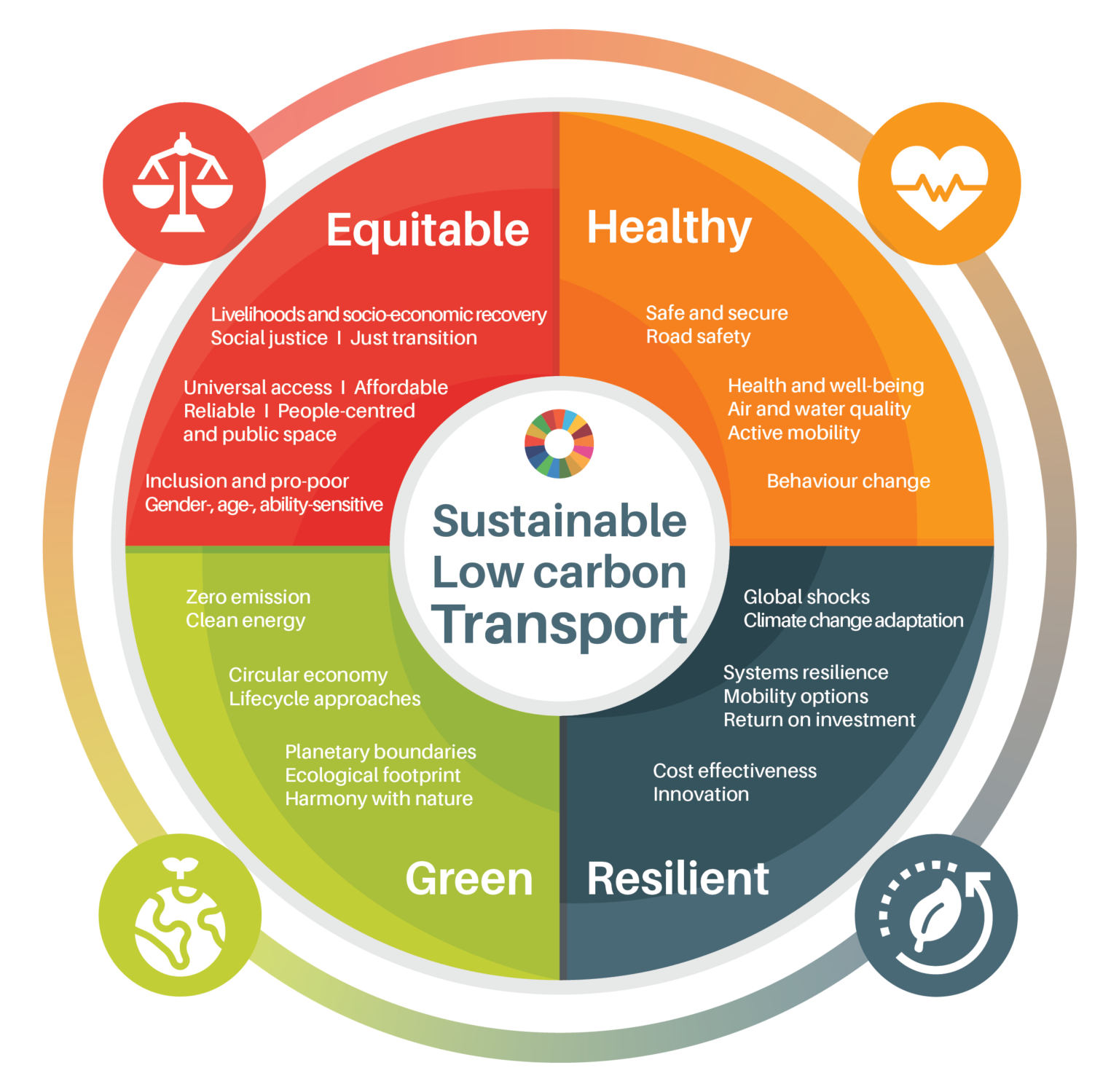
SLOCAT also has the following Wheel of Transport and the Sustainable Development Goals (SDG’s) on the same site. The Wheel illustrates the four cross-cutting themes: equitable, healthy, resilient and green.
In the SLOCAT site, they list the following to support the transformations:
Overarching approaches to apply across transport modes and sub-sectors overtime
- Put people first, not vehicles and technology
- Co-create and communicate a compelling vision and targets
- Guide short- and medium-term action with clear, coherent political messages
- Combine push and pull measures: Regulate and incentivise
- Link policies within and beyond transport for synergies
- Prioritise resources by social and sustainable value for money
- Engage, empower and coordinate stakeholders across government levels and sectors
- Build capacity and improve data
- Implement pilots to learn and share, then roll out at scale
–
On housing and transportation
I’ve written about how we should not be trying to isolate transportation as if it is singly at fault for the transport and traffic mess many of us are in at present. There are many factors affecting travel behavior including mode choice. Travel distances, travel times and mode choices are not a consequence of transportation system (including infrastructure) alone. Land development and pricing especially those pertaining to housing are critical in how people decide where to live. These are intertwined with transportation and can be quite complex without the proper data or information to help us understand the relationship. That understanding, we are to assume, should lead us to the formulation of policies intended to correct unwanted trends and perhaps encourage more compact developments that are closer to desirable concepts such as the 15-minute city.
Here is an interesting article to enrich the discussion on this topic:
Dion, R. (October 28, 2021) “Coupling Housing and Mobility: A Radical Rethink for Freeways,” Planetizen.com, https://www.planetizen.com/features/115126-coupling-housing-and-mobility-radical-rethink-freeways?utm_source=newswire&utm_medium=email&utm_campaign=news-11012021&mc_cid=85ec2b565f&mc_eid=9ccfe464b1%5BLast accessed: 11/3/2021]
The first thing that came to my mind are residents of northern and southern Metro Manila and the surrounding provinces. Many chose to buy houses there and beyond (i.e., Bulacan, Laguna and Cavite) and yet work or study in Metro Manila CBDs like Makati, Ortigas and BGC. And they do use the tollways (e.g., NLEX, SLEX, CaviTEX, Skyway) to get to their workplaces and schools.
This is also a relevant and timely topic in the Philippines as many cities are already headed for sprawls that will inevitably put more pressure on transportation infrastructure development that usually leans towards car-oriented projects (e.g., road widening, new roads, flyovers, etc.) rather than people-oriented ones (e.g., modern public transportation systems, bikeways, pedestrian infrastructure). Note that only Tokyo has developed an extensive enough railway system to cover the sprawl that is the Tokyo Metropolitan Area, which if interpreted loosely also includes Yokohama, Kawasaki and Chiba in the sprawl. No, we cannot build as fast to have as dense a railway network as Tokyo’s or other cities with similar rail systems. And so we have to figure out another way to address this problem.
–
Parking: minimum or maximum
The National Building Code (NBC) of the Philippines stipulates the minimum number of parking spaces or slots per type of establishment and intensity of development (i.e., according to area or other parameters). These established provisions are generally called parking minimums. The NBC’s provisions are already archaic by current standards and need to be revised but not in the way it was apparently developed. The NBC needs supporting evidence from studies (are there any dependable ones around?) on parking requirements including those for bicycles and motorcycles. These should clearly not include or impede the requirements of pedestrians. And local government units must be required to enforce these NBC provisions.
Here is an article that discusses the proposal for new limits on parking, particularly in large developments in Boston, Ma. in the US:
The article points to this one:
City of Boston (September 20, 2021) Maximum Parking Ratios, https://www.boston.gov/departments/transportation/maximum-parking-ratios [Last accessed: 10/19/2021]
I must admit that I still have to do a lot of reading on this. There are some who are calling for the abolition of parking minimums but you just can’t do this so abruptly without understanding the context and current set-up. We are not Boston or San Francisco or Hong Kong or Singapore in terms of the transport infrastructure and services and the progressiveness of policies including those governing or covering housing and other factors that come into play with transportation. Sprawl and the resulting pressures (requirements for efficient travel) on the transportation system is not transport’s fault or responsibility alone like what some articles or infographics make it appear to be. It is very much about land use and land development, and the policies and the political economy behind these developments.
–
On the 12 global road safety performance targets
The UN recently released the Global Plan for Road Safety. I’m just sharing their graphic on the global road safety performance targets:

I will try to discuss each one in future posts especially as I am involved one way or another in trying to realize these targets. Note, too, that these targets are further categorized among the five pillars mentioned at the foot of the graphic. These are (1) Road safety management; (2) Safer roads and mobility; (3) Safe vehicles; (4) Safe road users; and (5) Post-crash response.
–
We need to do more to reduce transport emissions
I did some work on long term action plans on low carbon transport for the ASEAN region before. We were able identify many of interventions that were being implemented as well as those that can be done to reduce transport emissions. Such reductions for the region would ultimately contribute to alleviating global warming. Unfortunately, while ASEAN is a significant contributor to emissions, it pales in comparison to emissions by individual countries like China and the US. If these two and others in the industrialized world do not commit to reducing their emissions, all work will come to naught. Here is an article that serves as a pre-event write-up for COP26, a major climate summit that will be held in Glasgow in the coming days.
–
On an ‘induced demand calculator’
Induced demand or traffic is a popular topic these days thanks to the proposal of a private company to build an elevated tollway along the Pasig River. The topic is also much in circulation the past few years as the DPWH’s part in the government’s Build, Build, Build program has road widening as a major component. There are many completed, ongoing and planned projects across the country that involves road widening, particularly increasing the number of lanes of typical national roads from 2 to 4, not counting the shoulders (paved or unpaved). The results are mixed as there are roads that definitely required capacity increase in the form of additional lanes, and there were roads that did not require them. The latter were still expanded and perhaps the agency did so because their key performance indicators basically obliged them to undertake such projects regardless of the need. Somehow, these were justified and yet there were and are many questionable road widening projects especially those that involved the cutting of decades if not century old trees (e.g., the Kamatchile and Acacia trees that used to line up long sections of national roads in Tarlac are no more) or the demolition of heritage structures such as houses.
A came upon this article about an “Induced Demand Calculator” developed in the US. I have not gone through the calculator itself but such a tool could be quite useful in quantifying the impacts of road widening while pushing for other options to improve transportation and traffic that is not the typical “solving traffic” type of approach. Here is the article in Streets Blog:
I am not aware if there are similar tools being developed here. Such a calculator will require data from various sectors including construction costs, operations and maintenance costs, value of time and current and projected vehicular and person trips that can be translated into traffic volumes.
–
Safe streets for children
We have been working with UNICEF and several partner organizations on a project on Child Road Traffic Injury Prevention (CRTIP). The Final Reports for the two pilot cities, Valenzuela City and Zamboanga City, have been submitted and represents over 2 years work including during the lockdowns due to the Covid-19 pandemic. The latter part of project implementation indeed became a challenge as we couldn’t travel and engage face-to-face or conduct field surveys like how we did in the first part of the project. Still, I believe we were able to accomplish much and most of what we initially set out to do. Here are the covers of the Final Reports we submitted to UNICEF and we understand will be officially or formally transmitted to the two cities.


The reports narrate the surveys conducted for 25 schools in Zamboanga and 41 schools in Valenzuela. Each initially had selected 25 schools but Valenzuela pushed for an additional 16 schools midway into the project. The SR4S tool developed by iRAP was used for the assessments of critical areas around the schools. The initial assessments were used to identify interventions to improve safety in these areas and recommendations were submitted for consideration of the cities as well as the DPWH where applicable (i.e., the DPWH has jurisdiction over national roads and improvements proposed along these). While some interventions were implemented, others and many were delayed mainly due to Covid-19.
We also conducted a survey to determine the commuting characteristics of schoolchildren in both cities. Since most schools were public schools, it was no surprise that most children lived near the schools or within the school district (which is basically the catchment area for these schools). Thus, it also came as no surprise that most schoolchildren came by foot (walking), motorcycles (riding with a parent) or motor tricycle. There’s a lot of information and takeaways from the data but unfortunately, we could get the bigger, more complete picture of Valenzuela City because they selected only elementary schools covering students from Grades 1 to 6. Zamboanga had a more robust data set with both elementary and high schools, covering Grades 1 to 12. The information derived from these surveys were also analyzed and related to the SR4S assessments. The commuting survey results and SR4S assessment are subject of two technical papers presented in the recent EASTS 2021 conference hosted by Hiroshima University.
What’s next? We are now drafting a proposal for a Phase 2 of the project. We hope to continue and reinforce and follow-up on the recommended interventions from Phase 1. We also hope to be able to work on the CRTIP data hub that was only partly completed due to the many constraints faced by that part of the project. I will post here from time to time about some of the outcomes from the surveys and assessments.
–

