
Home » Policy (Page 21)
Category Archives: Policy
It’s not that simple: the math on vehicle sales and registration
I read the statement of a government official about vehicle sales, and the subsequent responses it got. He cited math and seemingly joked about not being good at it while trying to make sense of the numbers. It is not as easy as he supposes. And I think that is partly why we fail to address the transport problems. For one, we think it is just about road capacities. For another, it may be about public transport supply. These are not mutually exclusive but rather intertwined along with so many other factors.
Housing, for one, (i.e., its availability, affordability and location) is among the most important factors that affect or influence how we commute. I have been asking the question about housing affordability in CBDs such as Makati, Ortigas and BGC. Lucky for those who already reside at or near those places but most people working there have to contend with expensive mortgages, leases or rents. How much is a condo unit in BGC, for example? If you have a family of 4, you certainly can’t and won’t opt for a studio unit just because its near your workplace. It’s obvious here that you also would have to consider where your children will be going to school as well as the workplace location of your partner if he or she is also working. No schools for now but imagine how it was and would be once our children go back to physical school. Such facts of life seem lost to many pundits commenting or offering opinions about transportation.
I think to be fair this should also be framed from various perspectives. For example, those vehicle purchases don’t necessarily mean additional vehicles on certain roads. like what one MMDA official claims. These will be distributed across the network of roads, and these will be operating during certain times of the day. Some of these vehicles were purchased by new car owners. Others as replacements to older or unserviceable units (e.g., upgrades). It would be nice to see, for example, the stats from 2008, 2009 & 2010. Thousands of vehicles were doomed by Ondoy in the greater Metro Manila in 2009 resulting in their replacements late that year until 2010. Then there was the boom in sales in the following years as people ventured into TNCs (Uber and Grab). The recent surge in private car use and what seems to be strong sales of these vehicles in the wake of the Covid-19 pandemic is more out of necessity (why do you think people aren’t taking to cycling for their commutes as much as is desired?)
The question why people still prefer to purchase and use their own vehicles has not been answered in the most honest way because different people with their own agenda tend to paint different pictures of the car owner. In some cases, car owners are being portrayed as ‘evil’ while those taking the more environment-friendly modes as ‘good’. Again, it should be obvious that this is not a ‘good’ vs. ‘evil’ discussion nor is it something that is black and white. We should pay (a lot of) attention to the grays, which can have so many different shades when it comes to transportation. No one really wins a “holier than thou” exercise where people on opposite sides tend to take hard line stances and close their minds to constructive ideas from either side.
–
Lessons on housing we need to talk about
There’s this recent article on housing that presents and discusses lessons from Singapore housing that
Fischer, R. (February 2, 2021) “Singapore Housing Lessons for the Biden Administration,” Planetizen, https://www.planetizen.com/node/112077?utm_source=newswire&utm_medium=email&utm_campaign=news-02082021&mc_cid=4fac9821d0&mc_eid=9ccfe464b1 [Last accessed: 2/15/2021]
 I’m not an expert on housing but I’ve experienced living in Singapore. Here’s a photo of the wife as she walked ahead of me on our way to the MRT station near our place back in 2012. One of the factors we considered when we chose this place for our residence was its proximity to the orange line station that meant only one ride (no transfers) between our home station and the station closest to the wife’s office. We could also take the train to the nearest mall if we didn’t feel like walking 15 minutes.
To quote from the article:
“…the secret to Singapore’s success is that their housing projects are carefully designed to support mixed-incomes, beautiful green spaces, and access to high-quality public transportation that conveniently links residents to education and community centers. And last but not least, couple all that with the famous Singapore hawker centers (food courts) where all income classes and ethnicities meet, socialize, and dine on Singapore’s famously delicious and affordable cuisine.”
–
On the need for more public spaces
Here’s a quick share of an article discussing the pandemic’s exposing the need for more public spaces:
Ionescu, D. (February 5, 2021) “The Pandemic Revealed Public Space as ‘Essential Infrastructure'”, Planetizen.com, https://www.planetizen.com/node/112044?utm_source=newswire&utm_medium=email&utm_campaign=news-02082021&mc_cid=4fac9821d0&mc_eid=9ccfe464b1 [Last accessed: 2/9/2021]
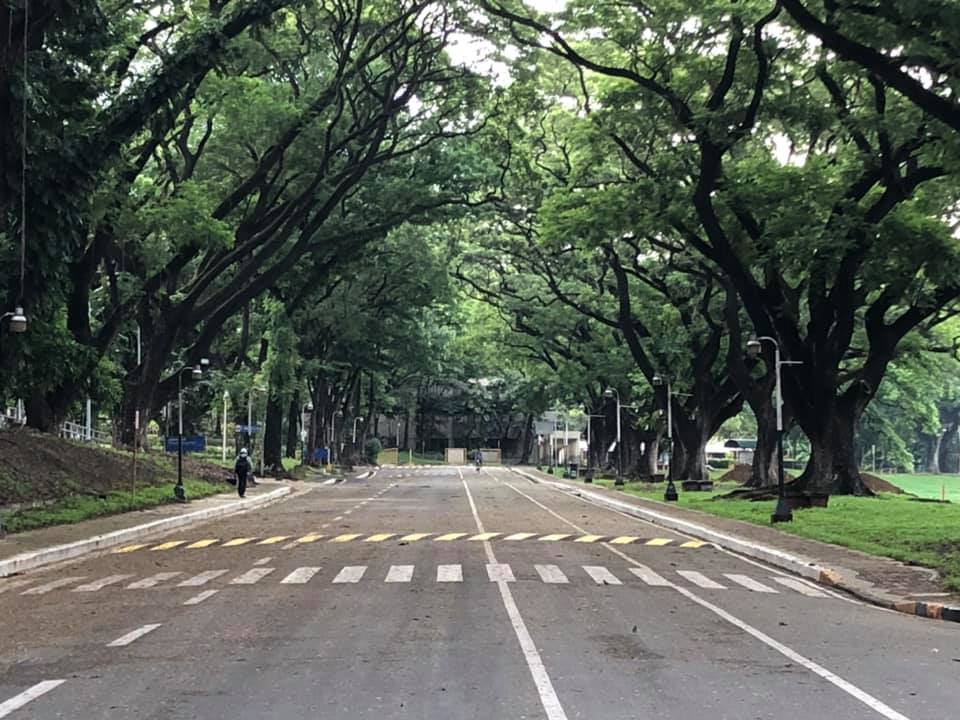 Quezon City is lucky to have the Quezon Memorial Circle, Parks and Wildlife and the University of the Philippines Diliman campus but it needs more public spaces given its size. UP should not technically be regarded as a public space as it is a school first and just happens to be blessed with a spacious campus. Pictured above is its academic oval with the Sunken Garden to the right.
Public spaces include parks and other open spaces that serve as breathing spaces or lungs for our cities and municipalities. A lot of people complained about being cramped up during the lockdowns and are now going out (others quite recklessly) even with the specter of Covid-19 still about us. In many old towns around the country, there are plazas and of course fields where people can go to while maintaining safe physical distancing. We certainly lack for these especially in highly urbanized cities. Rizal Park and its surrounding areas including Intramuros are not sufficient for dense Manila. In Taguig, you see a lot of people taking walks or exercising along the C5 service road. Its good that they actually have a linear park in Lower Bicutan and maybe parts of BGC where people can “decompress” from their cramped conditions where they reside but again, these may not be enough. Cities and municipalities need to allocate or build more public spaces. These should be deliberate developments to create such spaces (even small playgrounds scattered around a city would be a good start) for everyone’s well-being.
–
What type of seat is appropriate for your child?
I wrote yesterday about the new law requiring child seats for children 12 and under or under 4’11” in height in the Philippines. The implementation has been postponed after government received a lot of flak about it. To be fair, the info campaign started months ago but it seemed to be limited to social media and not really disseminated as widely as is ideal. The material while catchy at first glance, is not as clear in the info or message as already evidenced from the flak about the law and its provisions.
Here is a graphic from the US National Highway Traffic Safety Administration (NHTSA) that is quite easy to understand:
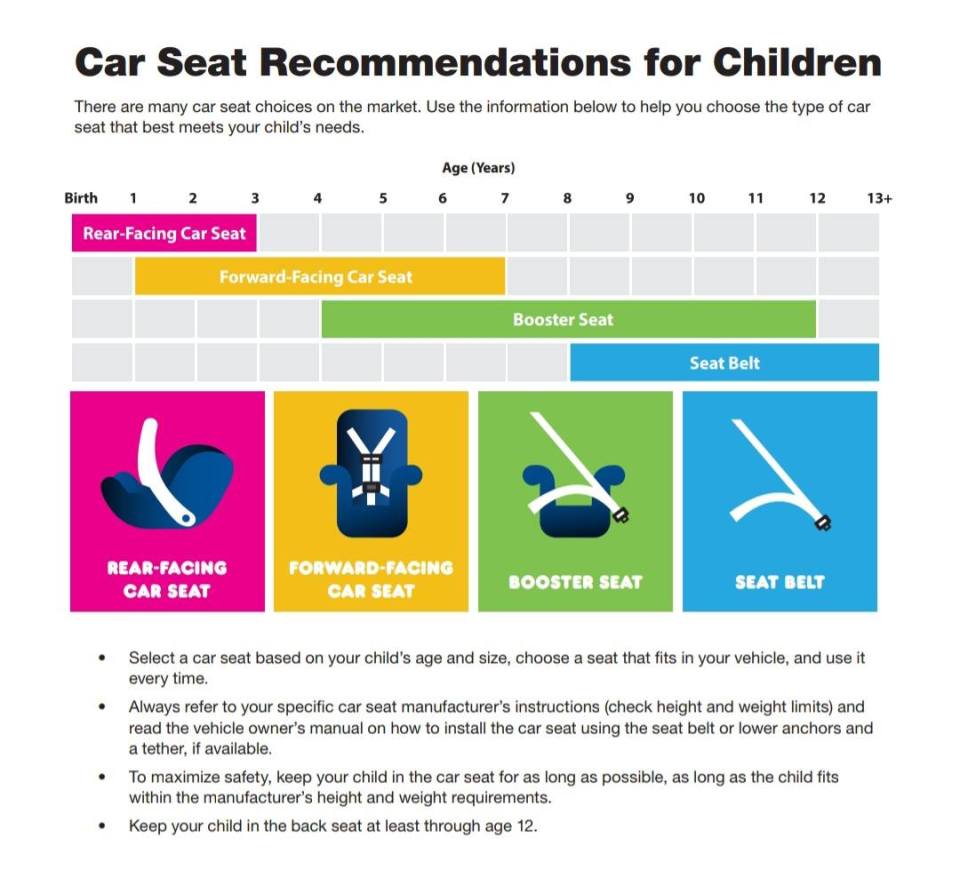
Based on the information from the NHTSA, the CDC came up with the following graphic:

It would have been clearer and more effective in communications if the agencies-in-charge came up with similar material rather than the one I shared in yesterday’s post. There are also many designs for child seats and so far there are no specifics about these that people could refer to. Ultimately, I believe there should be a list of what are allowed or not allowed including brands. Perhaps its better to have a list of what are not allowed with the reasons for these, and then let the manufacturers challenge these. Having a list of allowed products might come off as advertising or favoring certain manufacturers. Of course, it will be up to the Bureau of Product Standards (BPS) of the Department of Trade and Industry (DTI) to determine which seats will be allowed based on their specs and the standards they conform to. European and US standards are among the most stringent so perhaps these can be reviewed and determine whether they can be adopted in the Philippines.
–
On R.A. 11229 and the requirement of Child Seats
There seems to be a lot of feedback (mostly negative) on the new law and its implementing rules. RA 11229 is the “Child Safety in Motor Vehicles Act” that requires the use of child car seats. There seems to be a confusion about who are supposed to be using child seats particularly about the age and height limits mentioned. In one “controversial” interview, a government transport official was recorded replying to a question about tall children that the parents would have to get a bigger vehicle. That was obviously uncalled for but also probably what can be considered as a “snappy answer to a stupid question[see note below]” type of situation. What is clear now is that a lot of people are not aware of the provisions and implications of the new law (for various reasons including their choosing to ignore it) and there needs to be a more comprehensive and effective info campaign on this topic. Not yet mentioned in discussions are the models of car seats that are approved or certified for use.
 Screenshot of a graphic explaining who are required to use child car seats
Here are examples of the opinions and comments in one of the group discussions I am part of [I will just leave these without specific attribution or anonymous.]:
- “RA#11229 was badly written. Authored by Sen JV Ejercito, trying to copy laws in the USA. In California, the Child Safety Seat is only required for child 2 years old and below, 4 years old in NY, and 3 years old in Europe. Additional parameters: height limit of 40″ (101 cm) and weight limit of 40lbs. They differentiate rules for children up to 8 years in NY & CA.”
- “The Philippine version lumps all kids into one group below 12 years old, requiring child restraint system. Additional parameter is 150 cm height, none on weight. Two wrong premises of our law: 1) that Filipinos children are taller than Europeans and Americans of same age, and 2) Filipino children mature later at 12.”
- “They lumped it into one class because its the simplest and easiest thing to do, without going into a lot of uncertainty. Na controversial na nga yung 12 yr. old catch-all, ano pa kaya kung they broke it down into numerous classifications.”
[Note: To those who are not familiar with the term “snappy answers to stupid questions”, google it together with Mad Magazine.]
–
On airline travel in the time of Covid-19
I haven’t been on a plane since February 2020. That is almost one year next month. I have friends though who have traveled by air recently. They had to follow certain protocols before departing and upon arrival at their destination. These include testing for the virus and observing quarantine especially upon their return to Metro Manila and prior to returning to their respective homes. Fortunately, all have been testing negative for Covid-19 and were able to come home safely.
Here is an interesting article on air travel, particularly how airlines and airports are handling passengers during this time when processes need to consider the prospects of getting infected by Covid-19:
Marshall, A. (January 21, 2021) “The Art and Science of Boarding an Airplane in a Pandemic,” Wired, https://www.wired.com/story/art-science-boarding-airplane-pandemic/ [Last accessed: 1/26/2021]
I am anxious about being required to travel for a project we are currently doing for a major city in Mindanao. While our clients have been very understanding about our health concerns, it might be inevitable for some of us in the project team to travel by March 2021 to present the findings and recommendations of our study. I will continue to update myself about travel guidelines in preparation for that likely travel.
–
On the plastic barriers for jeepneys
The minimum requirements for conventional jeepneys prior to their returning to operations include the installation of barriers so as to have physical separation between passengers. Ideally, such separation should be a distance of at least one meter, which was initially relaxed to ‘one seat apart’, and then further relaxed to just the barrier separating passengers. You see various designs installed in jeepneys. I posted a couple in an earlier post showing examples of customized and DIY barriers. Here is another that looks like there was more effort involved in the making of the plastic barriers:
 Specially made plastic barriers with messages and graphics on social distancing printed on them.
 Jeepney drivers are obliged to reject or unload passengers not adhering to the protocols including those refusing to wear face masks and shields while commuting using public transportation modes. I assume that they are really doing this for their and their passengers’ safety and well-being.
–
On planning our cities from a child’s perspective
Wouldn’t it be interesting to find how children would plan their cities? No, this is not the lego building kind of exercise but something closer to actual planning exercises where children not only act as planners but stakeholders themselves. We always say they are the future and that know that they will inherit whatever good or bad we are doing now, and yet they have little say in that future. Perhaps we should heed what they think our cities require?
Ergler, C. (January 4, 2021) “Young children are intuitive urban planners — we would all benefit from living in their ‘care-full’ cities”, The Conversation, https://theconversation.com/young-children-are-intuitive-urban-planners-we-would-all-benefit-from-living-in-their-care-full-cities-151365 [Last accessed: 1/15/2021]
–
On housing and transport
I am always amused about discussions and posts about transport and traffic where people appear to isolate the traffic as what needs to be solved, and where people criticize the latter and state that it is a transport and not a traffic problem. Both do not have the complete picture if that is what we want to start with. Land use, land development and the choices people make based on various other factors (including preferences) are among the other ingredients of the proverbial soup or dish that need to be included in the discussion. Remember land use and transport interaction? That’s very essential in understanding the big picture (macro) before even going into the details at the micro level. Why are there many car users or those who prefer to use private modes over public transport modes? Why do people prefer motorized over non-motorized modes? Maybe because people live far from their workplaces and schools? Why is that? Maybe because of housing affordability and other factors influencing choices or preferences?
Here’s a nice recent article on housing and transportation to enrich the discourse on this topic:
Litman, T. [January 7, 2021] “Housing First; Cars Last”, Planetizen, https://www.planetizen.com/node/111790?utm_source=newswire&utm_medium=email&utm_campaign=news-01112021&mc_cid=2985a82f48&mc_eid=9ccfe464b1 [last accessed: 1/13/2021]
–
On the RFID fiasco
Early December 2020, Metro Pacific Corporation suddenly had to deal with jam-packed toll plazas and queues that affected roads connecting to the North Luzon Expressways. Fast-forward and Valenzuela City apparently had enough of it and revoked the tollway corporation’s business permit. Later, matters were resolved with the tollways reverting to mixed toll collection to manage the queues at the toll plazas.
Prior to this, tollways corporation scrambled to meet the deadline set and re-set by the Department of Transportation (DOTr) through the Toll Regulatory Board (TRB) for contactless, cashless toll payments. The question is if there was enough time for tollway operators to acquire the best (not just the minimum required) system for this endeavor. There are some opinions that this was basically required on short notice and for the government to get some brownie points for this.
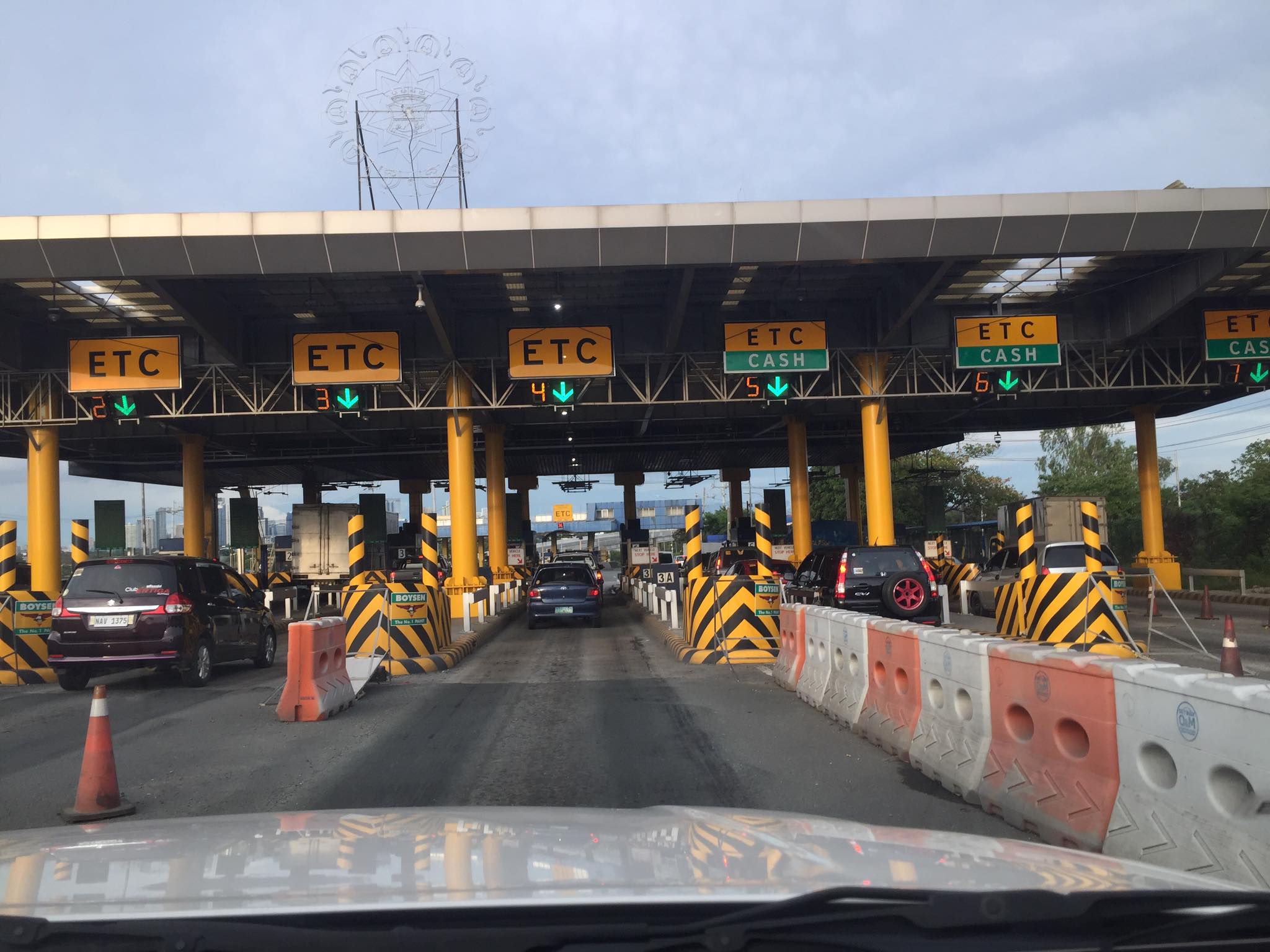
Were there issues about technology and the corresponding costs to the acquisition and deployment of the necessary devices for seamless, contactless, delay-free (in relative terms) transactions for tollways? Probably so. Those RFIDs and the readers installed at strategic locations along tollways (i.e., entries and exits) were certainly not state of the art or the best available out there. Singapore, for example, uses a more sophisticated system for their expressways where you no longer have toll plazas and you won’t have to slow down to be detected by the system. That system has corresponding costs but is perfect for the city state given that most roads are tolled anyway because of their road pricing policy. In the case of our tollways, not all travelers are actually going to utilize the tollways as frequently as it would necessitate them having to get either the Easy Trip or Auto Sweep tags. That is obvious from the relatively low penetration rates for electronic toll collection (ETC). So it still makes sense to have hybrid booths for those not availing the ETC option. Anyway, travelers will have to exercise disinfection protocols to ensure infections are prevented.
–

