
Home » Policy (Page 25)
Category Archives: Policy
On the DOTr Guidelines for Public Transport – Layouts for Distancing
Here again, for reference, are the guidelines issued by the DOTr in relation to the transition from ECQ to GCQ and beyond (immediate rather than far future). The following images show the physical distancing prescribed for road transport.


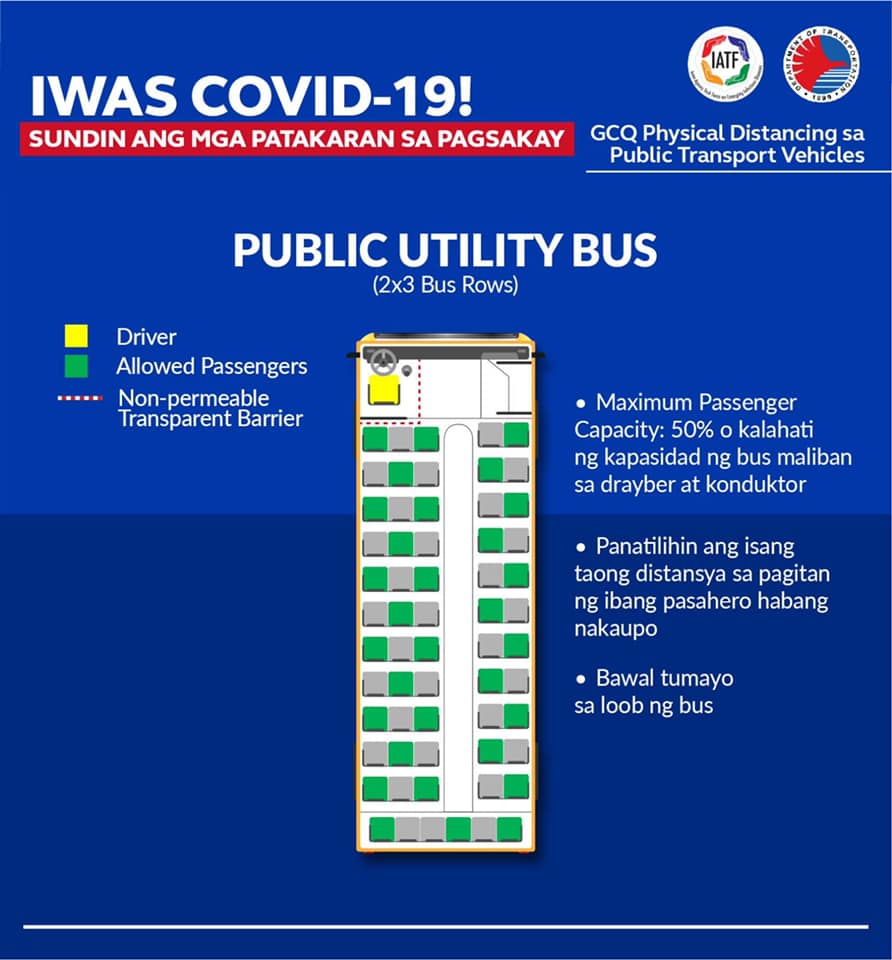


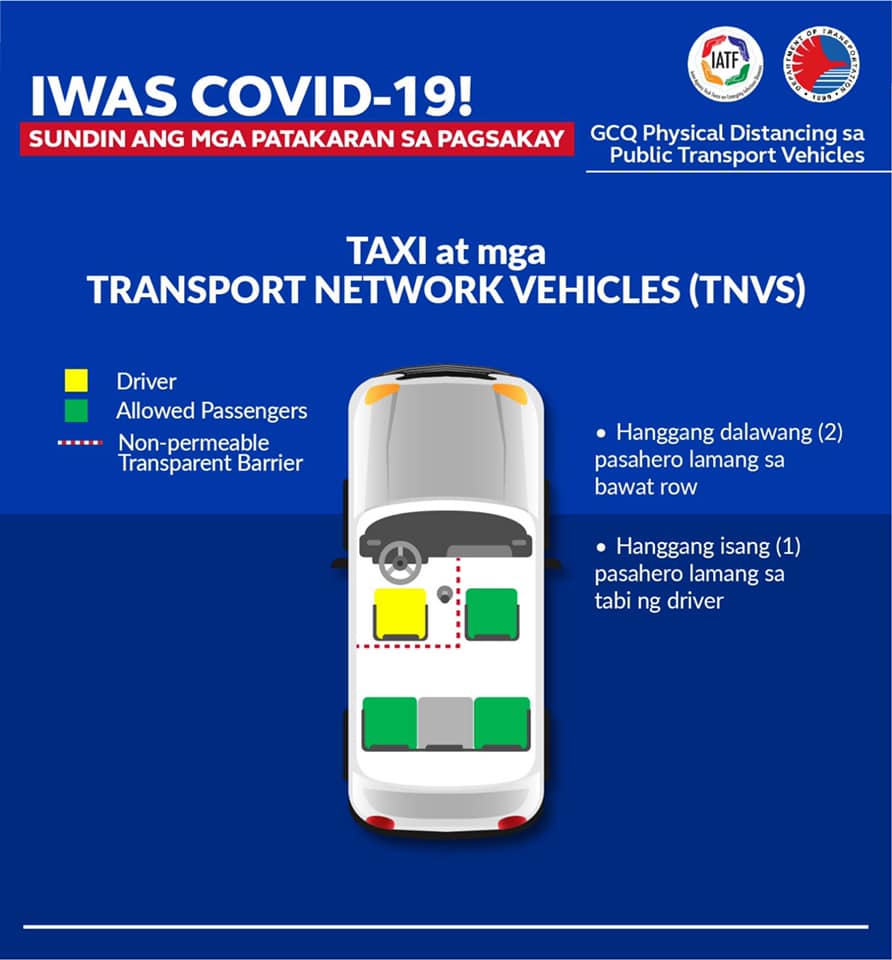

The last image for the tricycle is something that should have been allowed at least for a limited number of tricycles during the ECQ period. That could have eased transport woes for many people especially those who had to walk long distances in order to get their supplies. Some LGUs like Davao were able to issue Executive Orders to that effect that the IATF did not contend (or is Davao a special case?). Now, we see a lot of LGUs issuing EO’s and ordinances allowing public utility tricycles to operate again but limiting their numbers through odd-even schemes. Perhaps the same should be applied to pedicabs or padyak (non-motorized 3-wheelers), too.
–
On the proposed single bus route along EDSA
A friend posted this on social media as news came out about the government’s statement on its considering a single bus route for EDSA. EDSA, of course, is Circumferential Road 4 and perhaps the busiest road in Metropolitan Manila in terms of volumes of people and vehicles traversing this road. Public transportation along EDSA is mainly by buses and the MRT Line 3. Line 3’s capacity is already diminished despite the high demand for it mainly because of the number of train sets that are currently in operation. Buses, meanwhile, are split among the many routes converging along much of EDSA. These routes are shown in the map on the left where you can see the overlapping routes that have various end points.


Of course, it is best to read the Final Report of this study. That way, one is able to see the overall context for this section that is part of the concluding part of the report. I recall that the consulting team from UP was able to map the routes of other public utility vehicles like jeepneys and UV Express from that time. Perhaps the DOTr still has a copy somewhere? The NCTS Library in UP Diliman is currently closed so one may have to search the internet first for a copy of the study or perhaps snippets of it here and there. Perhaps related to this is a proposal to revive (or maybe the right word is ‘resurrect’?) the now defunct Metro Manila Transit Corporation or MMTC that used to dominate EDSA and other major roads in direct competition with the few private bus companies during its heydays as well as the jeepneys.
–
On the DOTr Guidelines for Public Transport – Aviation Sector
Here are the guidelines for the Aviation Sector. My only comment here is that many people are anxious about when they can travel again, particularly to other parts of the country mainly for business or to go home (e.g., many students have been stranded in the cities where they go to school and away from their hometowns). Part of this anxiety is the thinking that airfares will increase significantly as airlines are forced to reduce capacities for their aircraft to adhere to physical distancing guidelines. Gone, probably, are the discount fares like the Piso fare promos.
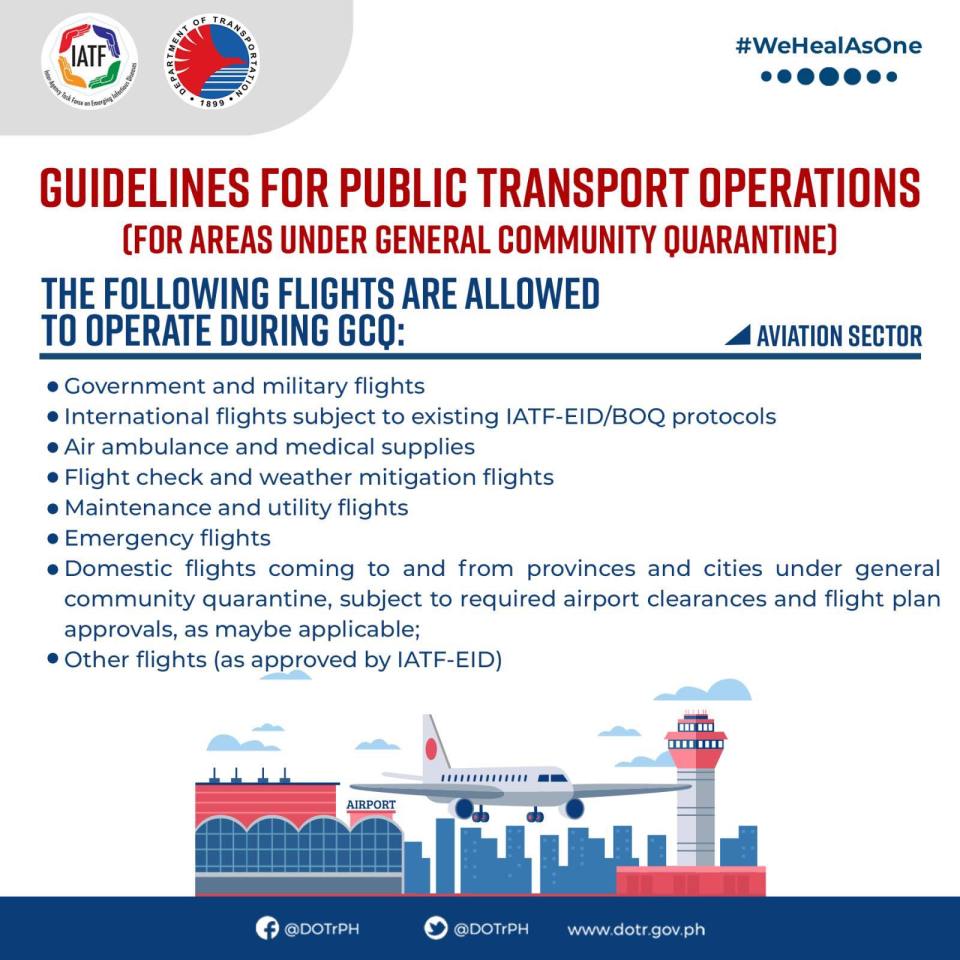

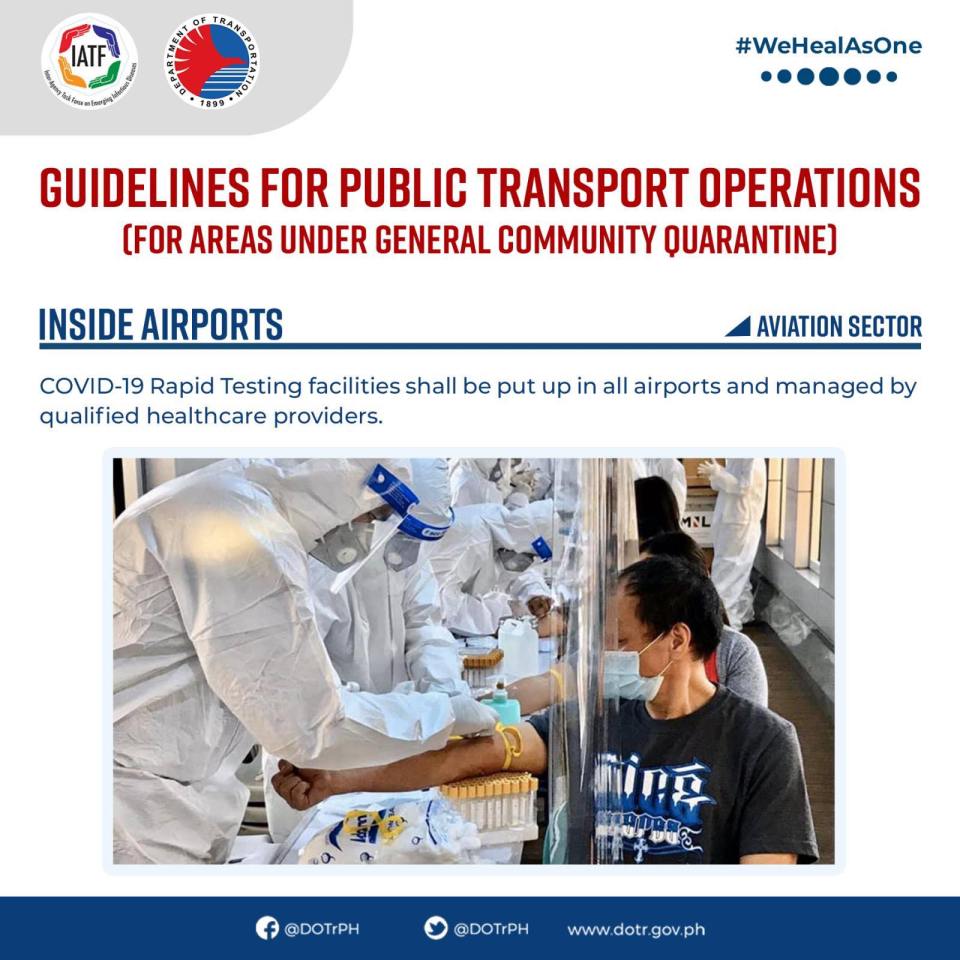


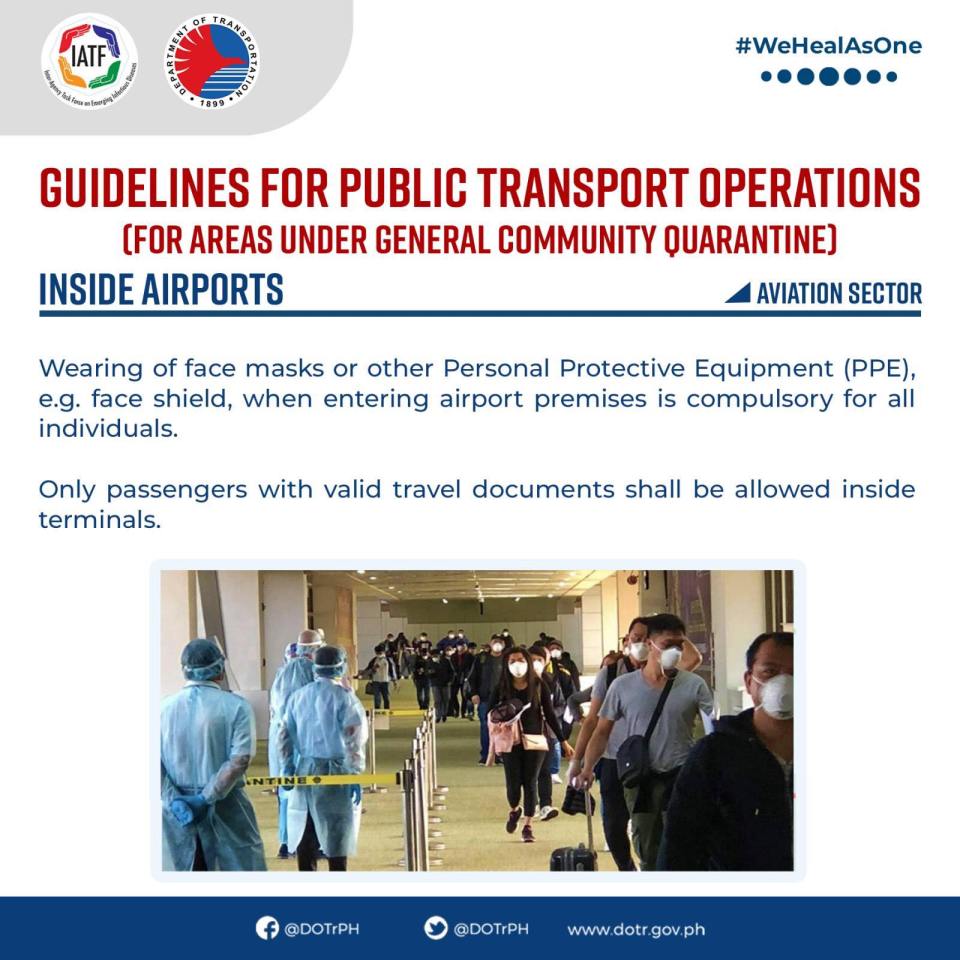

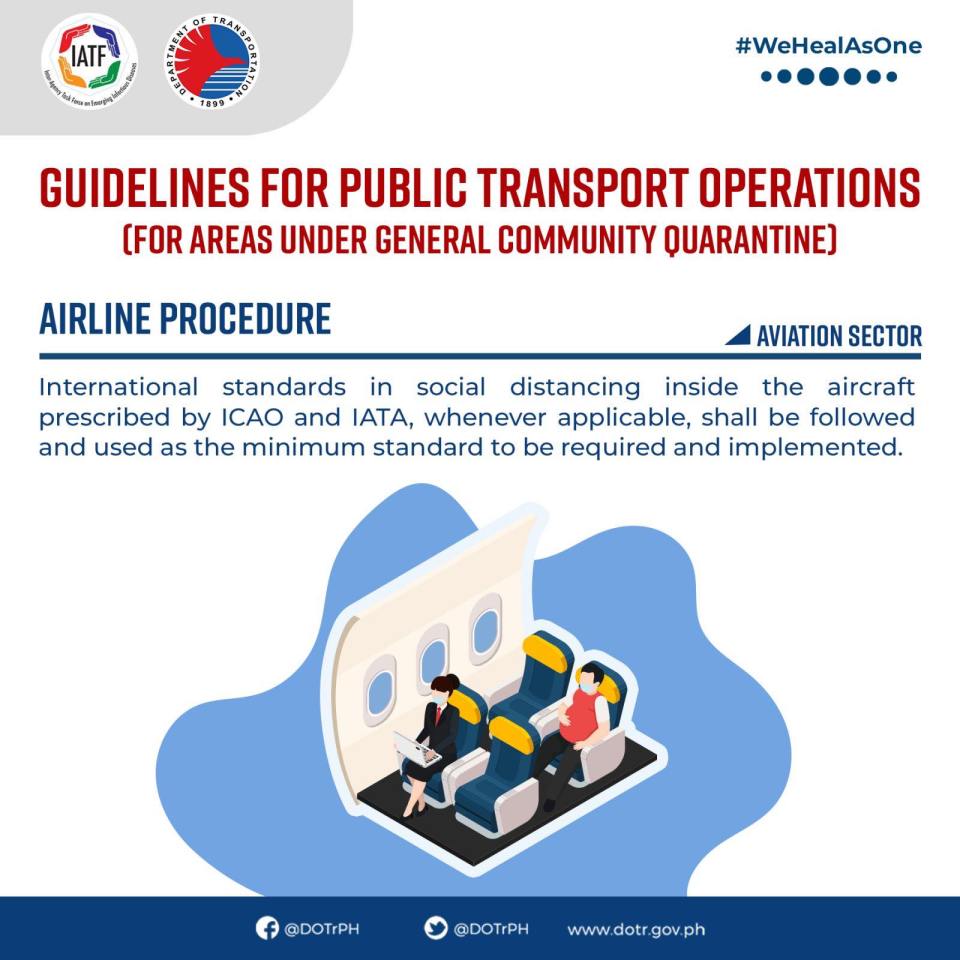

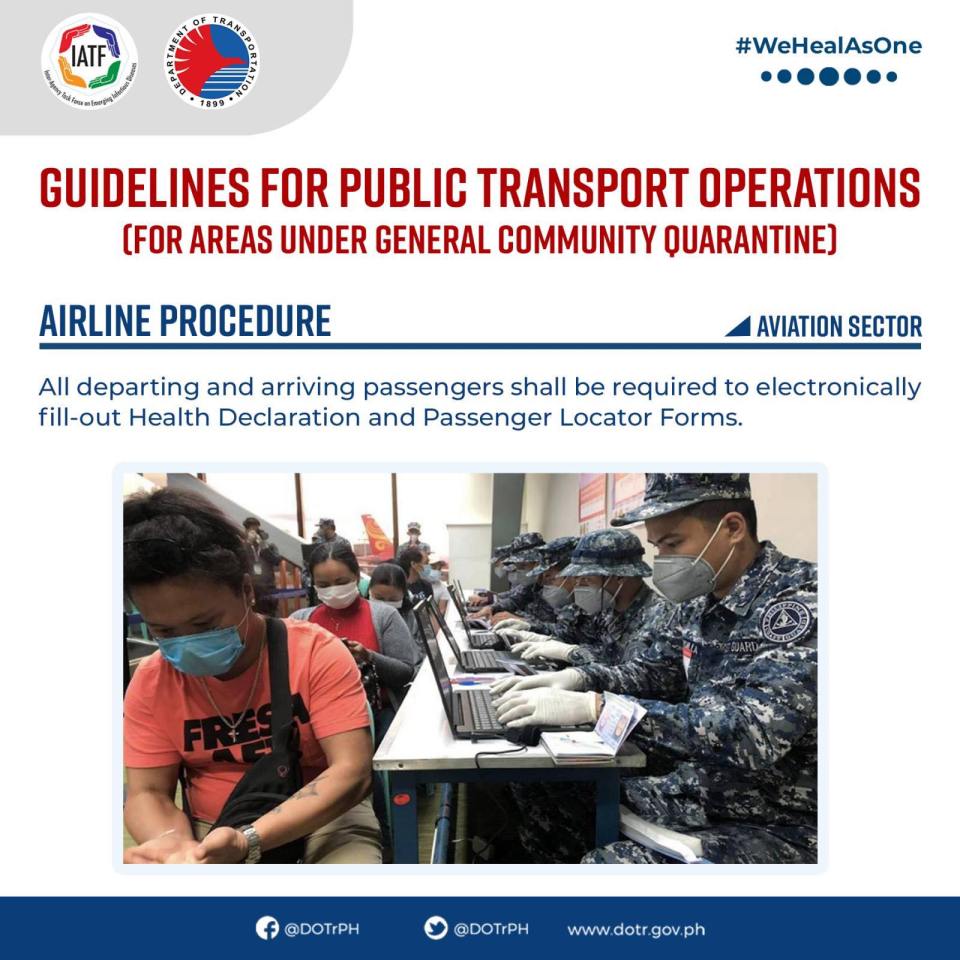

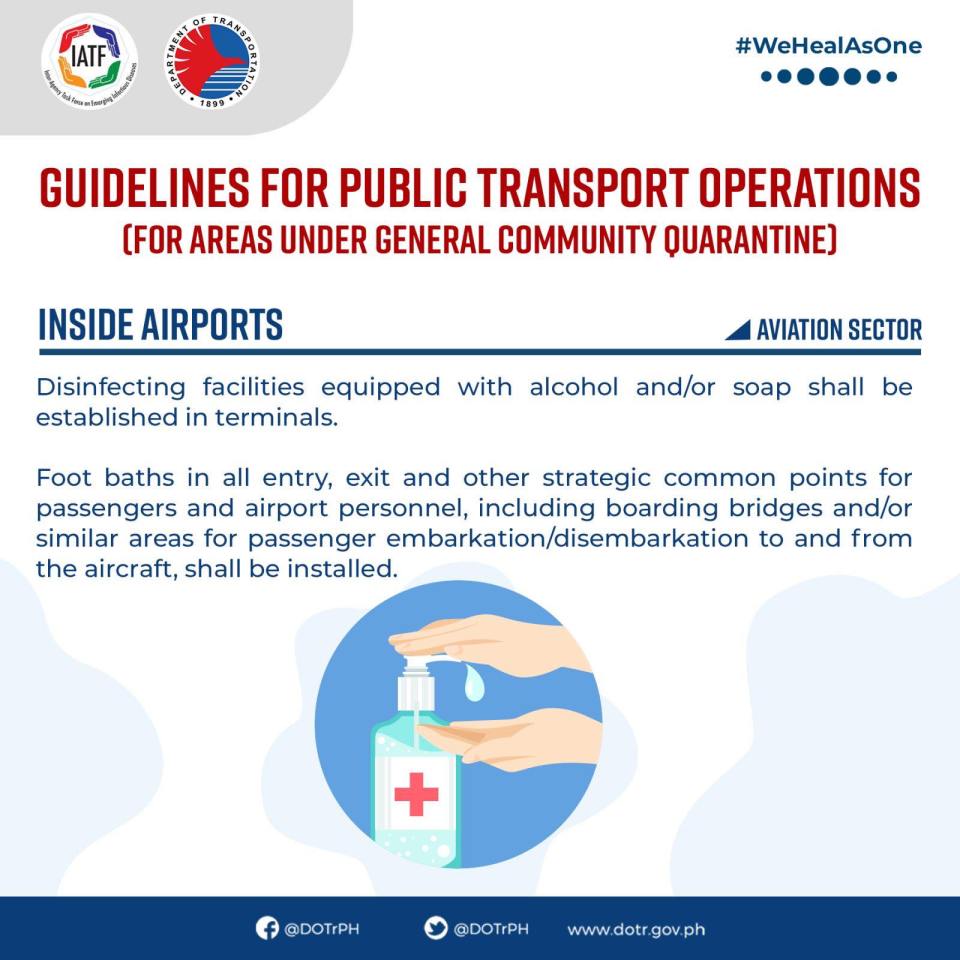
Related to this, I have received emails from 4 airlines I frequently used – Cebu Pacific, Philippine Airlines, Singapore Airlines and Japan Airlines. All provided updates on their respective efforts to ensure the future air travel will be safe, health-wise. As for the airport terminals, that’s another story…
–
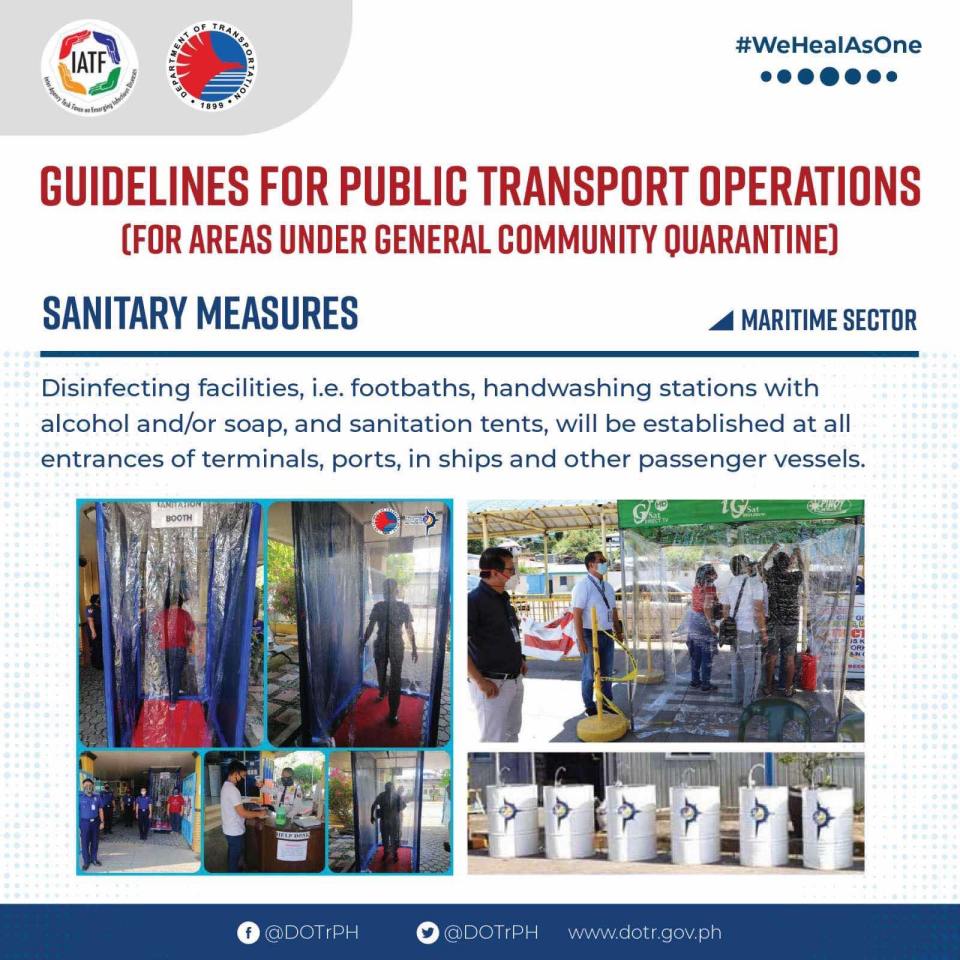
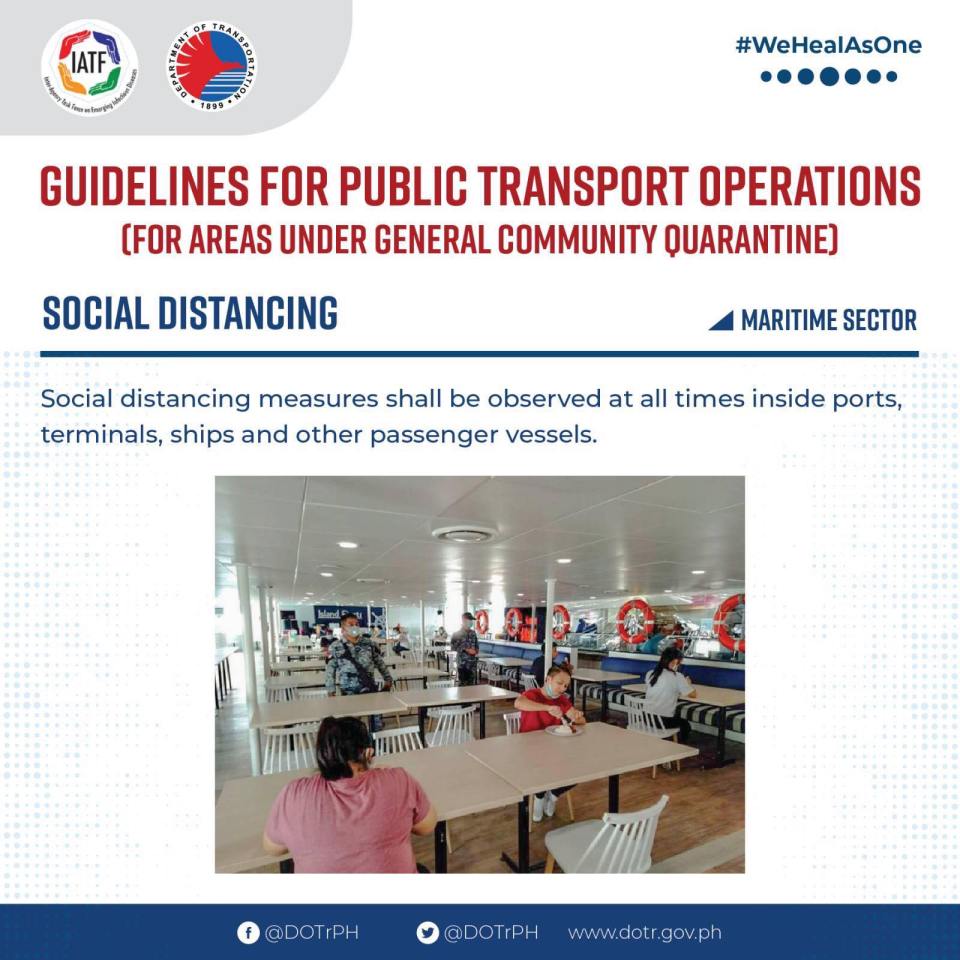
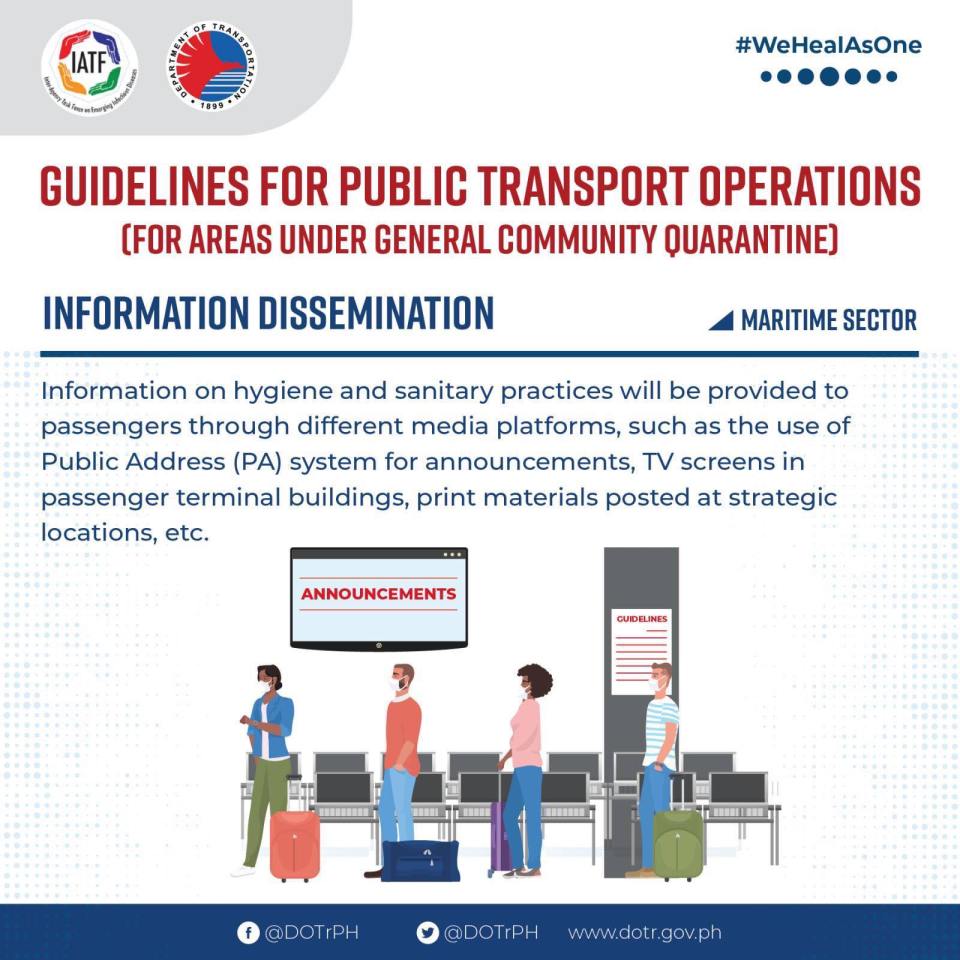
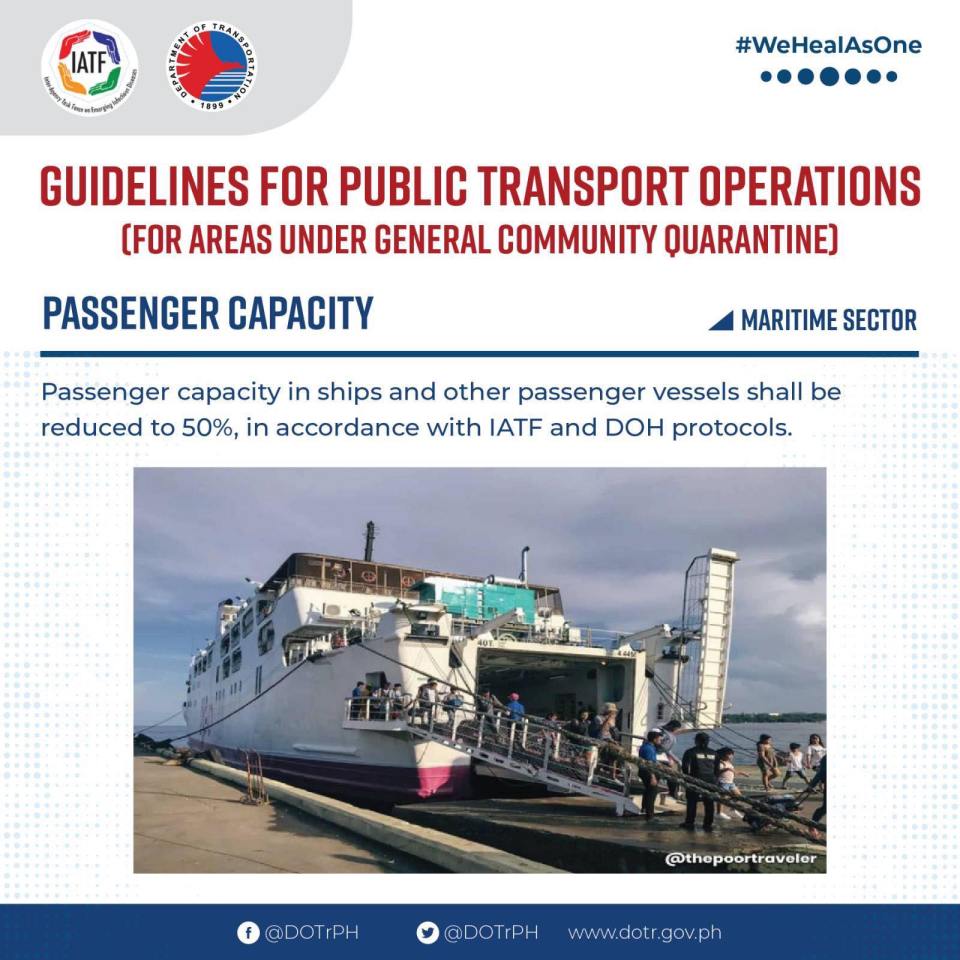
On the DOTr for Public Transport – Maritime Sector
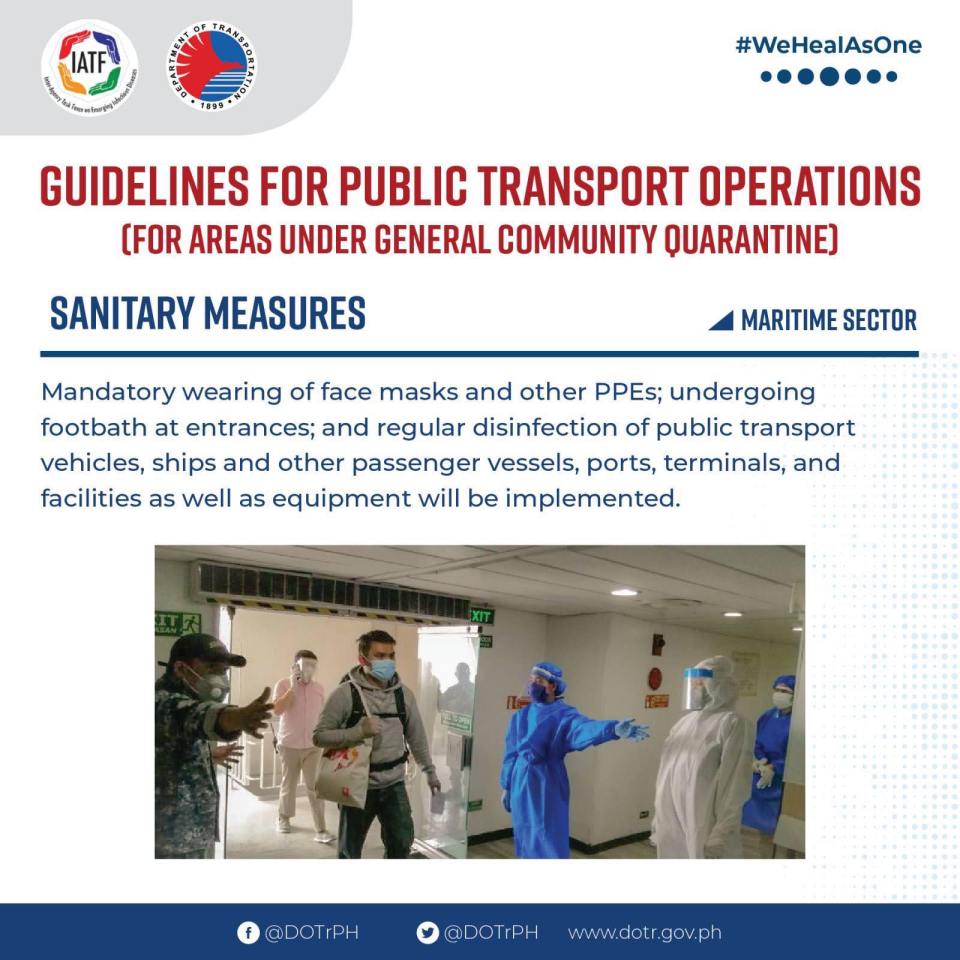
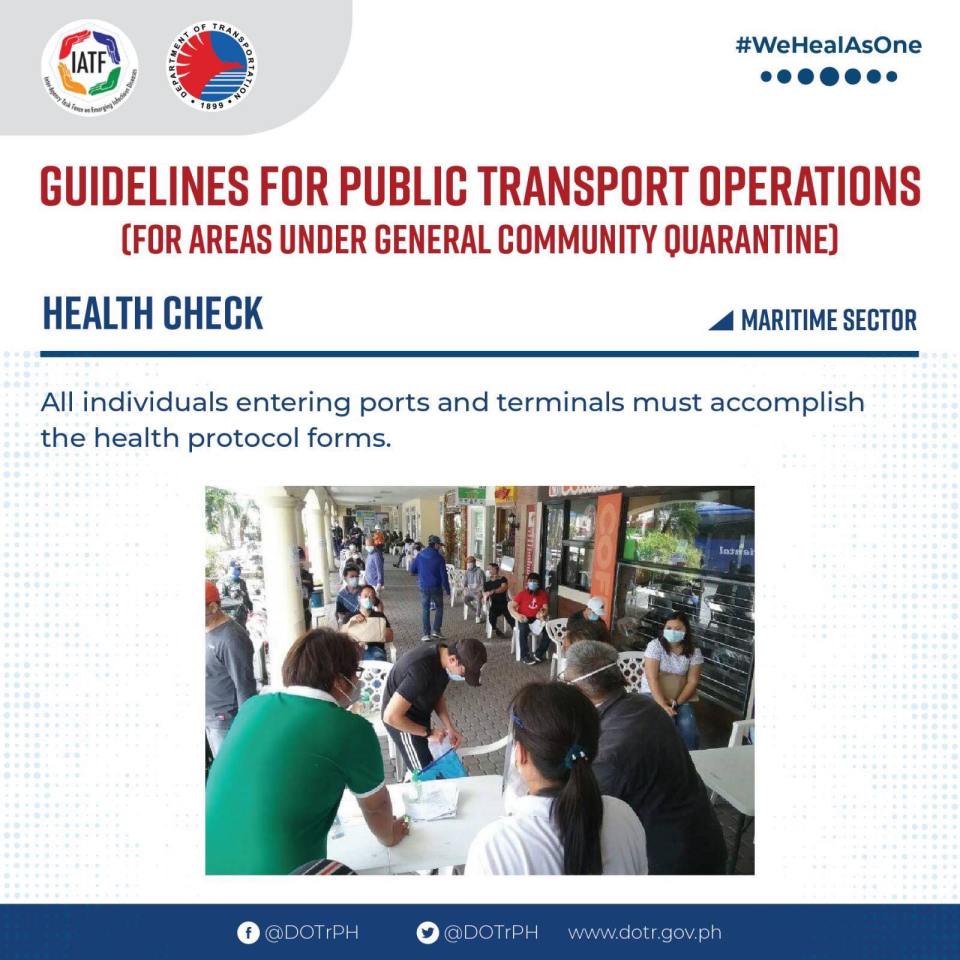
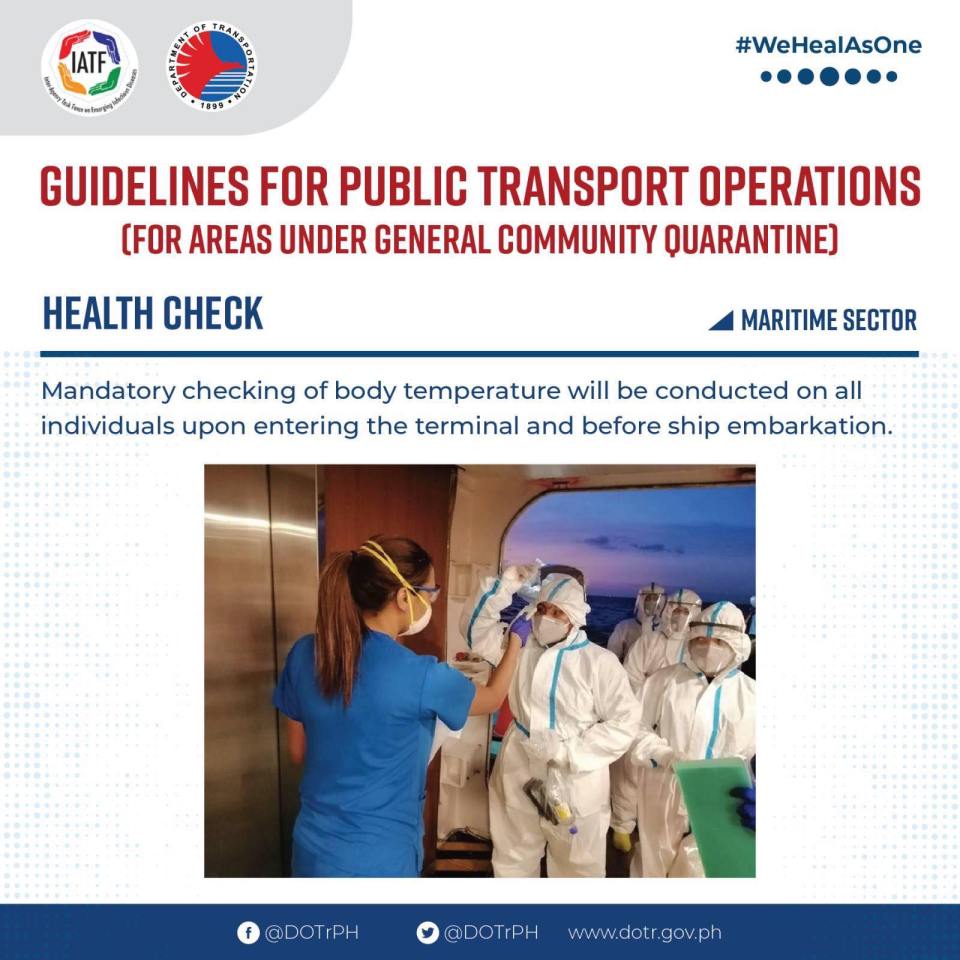
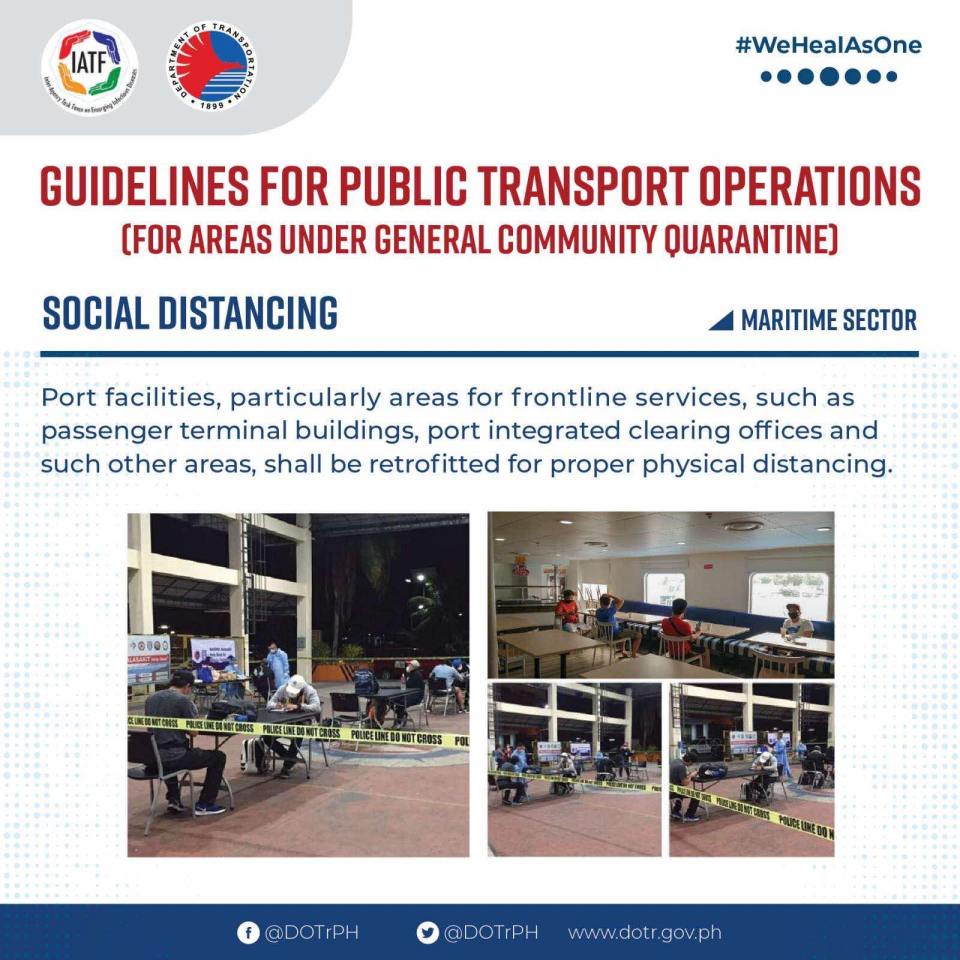
Here’s a continuation of the set of guidelines issued by the Department of Transportation for transport operations for areas that are or will be under the General Community Quarantine (GCQ). Again, I try to refrain from making any critiques or comments, and post this for information and reference.
–
On the DOTr GCQ Guidelines for Public Transport Operations – Rail Sector
I had previously posted for information and reference the Department of Transportation’s (DOTr) guidelines for road public transportation. Here are the guidelines for rail public transportation:
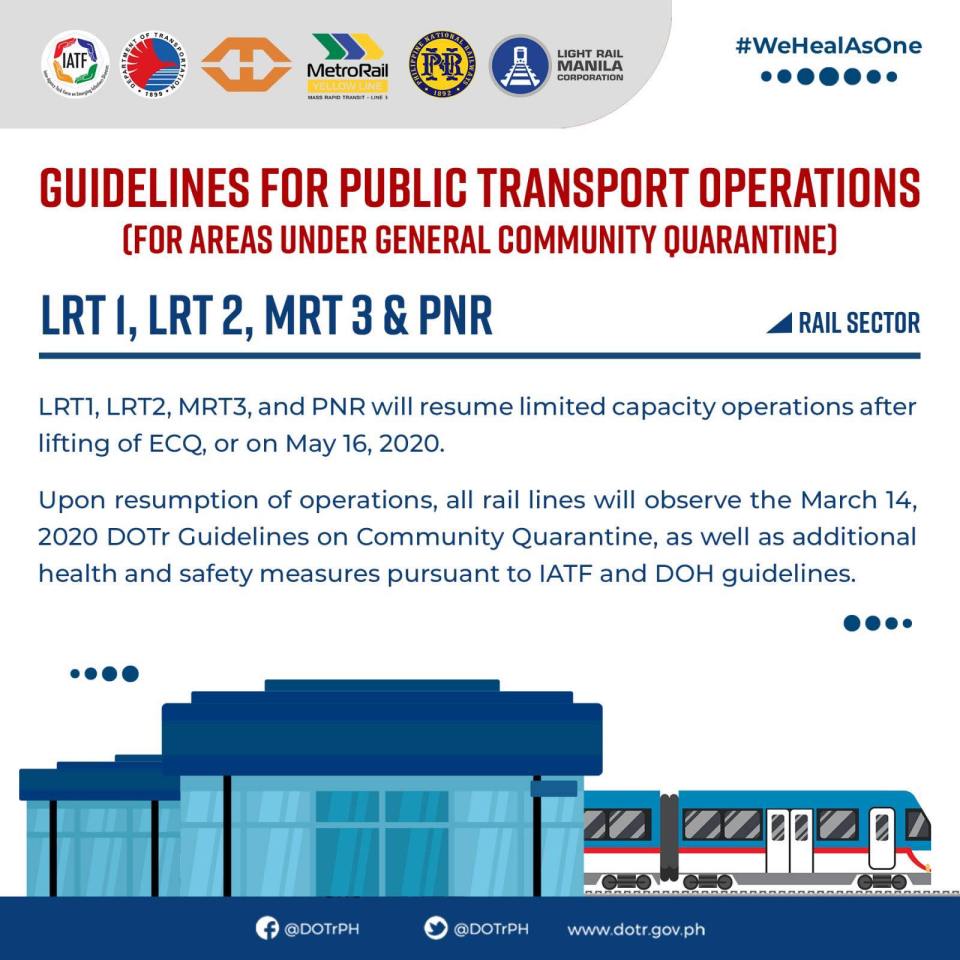
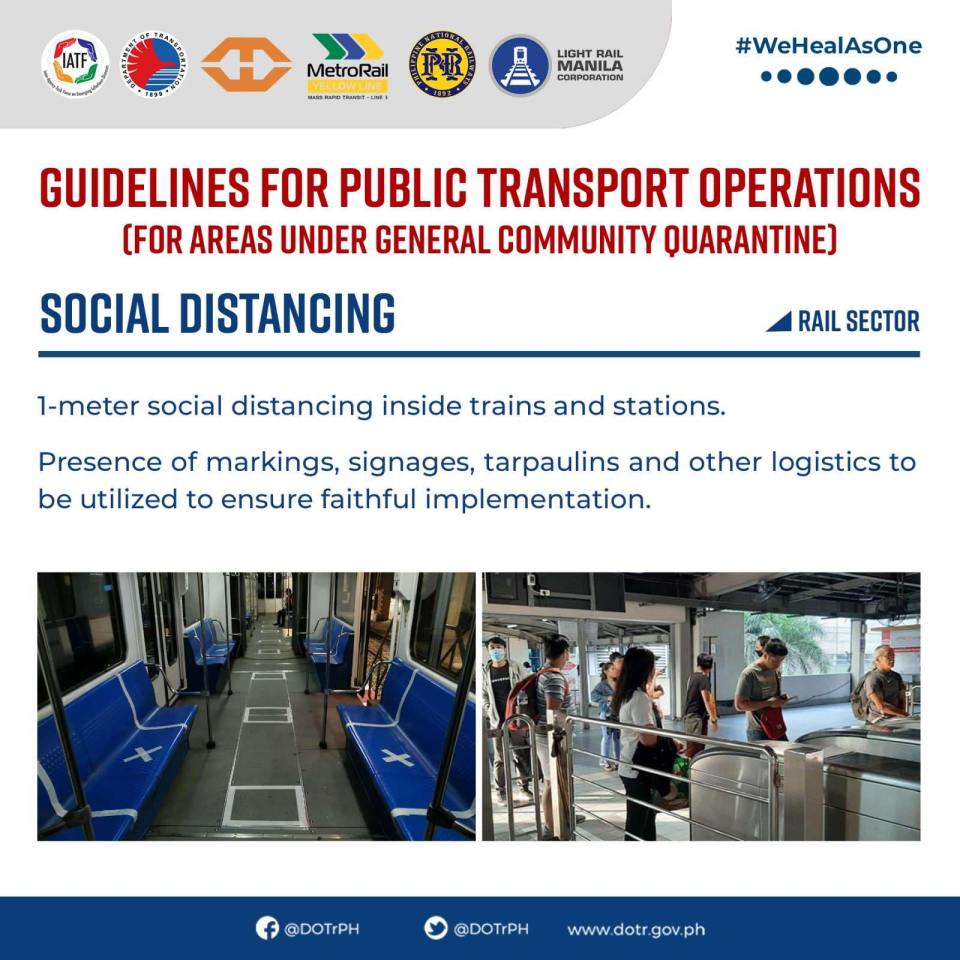

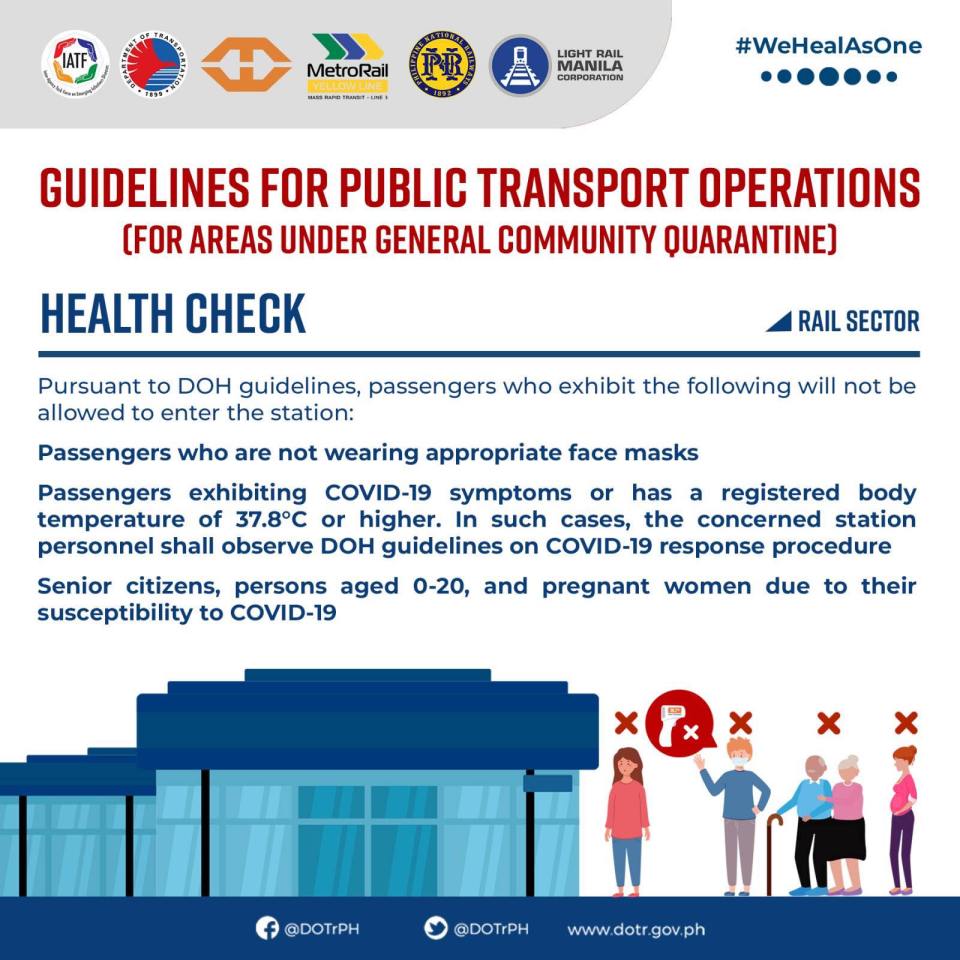

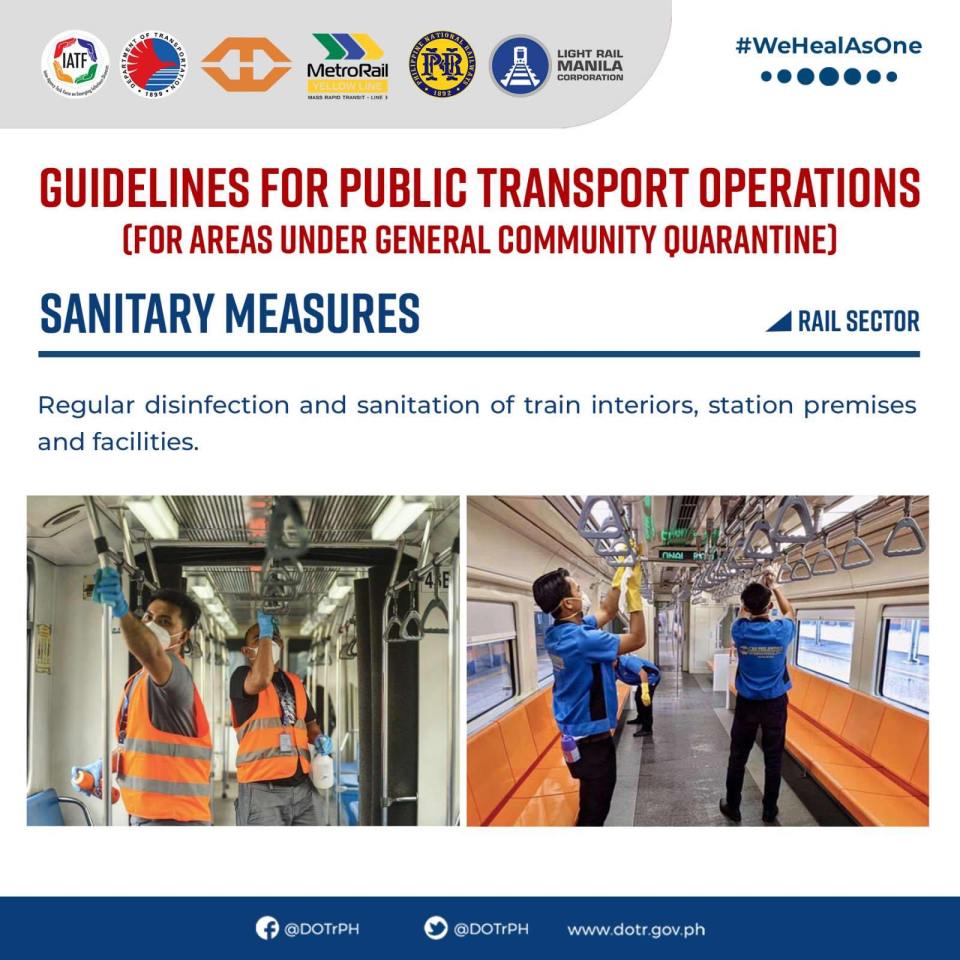

While I said that I will refrain from commenting or critiquing these guidelines starting from the previous post on road public transport, I could not help but say a few things about the case for rail. In particular, I am most concerned about the reduced capacity of trains based on the infographics above. The particular infographic states that passenger capacities for Line 1, Line 2, Line 3 and PNR would be 12, 10, 13 and 20 percent, respectively. These are very low numbers that are not even comparable to the 30 to 50% passenger capacities that road public transportation may be able to achieve. Would it be worth it (and I’m talking about financial terms here) to operate at these capacities? Or are there solutions that could increase train passenger capacities while ensuring physical separation. I use the term “physical separation” here instead of “physical distancing” because it may be possible to design not just a layout but barriers that would also be effective in minimizing if not eliminating the possibility of infection of the virus should any passenger turn out to be infected. People, after all, will be required to wear masks and even gloves. Others may opt to wear face shields. And there are also measures vs infection at the stations or terminals as well as the workplaces. What do you think?
–
On car-shaming and reducing car use
Here is another article I am sharing (re-sharing?). I have seen or read a lot of posts on social media about how we should not go back to the car-centric traffic before the Enhanced Community Quarantine (ECQ) and its variations. I do agree with this point. However, I take reservation about how some people seem to be resorting to car-shaming rather than be more proactive and progressive about coming up with strategies and/or plans that I hope would be evidence-based or supported by valid data. As the article states, “it takes more than car-shaming to change car use”:
Jaffe, E. (2020) “It takes more than car-shaming to change car use”, Medium, https://medium.com/sidewalk-talk/it-takes-more-than-car-shaming-to-change-car-use-107e28ccb2cf [Last accessed: 4/29/2020]
A key message from the article: “People are most open to changing their travel habits during major life events, such as a move. But even a well-timed message isn’t enough.” Perhaps the opportunity is here now to reform our transportation system. But that will take a lot of will or effort from all sectors most especially the national agencies (e.g., DOTr, DPWH) and local governments who have the authority and responsibility to implement changes. These changes include the assignment of exclusive lanes for bicycles, public transport and logistics while restricting car use. There are also other elements that need to be in place as we transition into the so-called “new normal” and so there will be a lot going on among the sectors or parties collaborating or interacting for transportation. Hopefully, there are context-sensitive strategies that will be adopted and implemented in order for everyone to transition more efficiently and effectively. And as they say…life goes on.
–
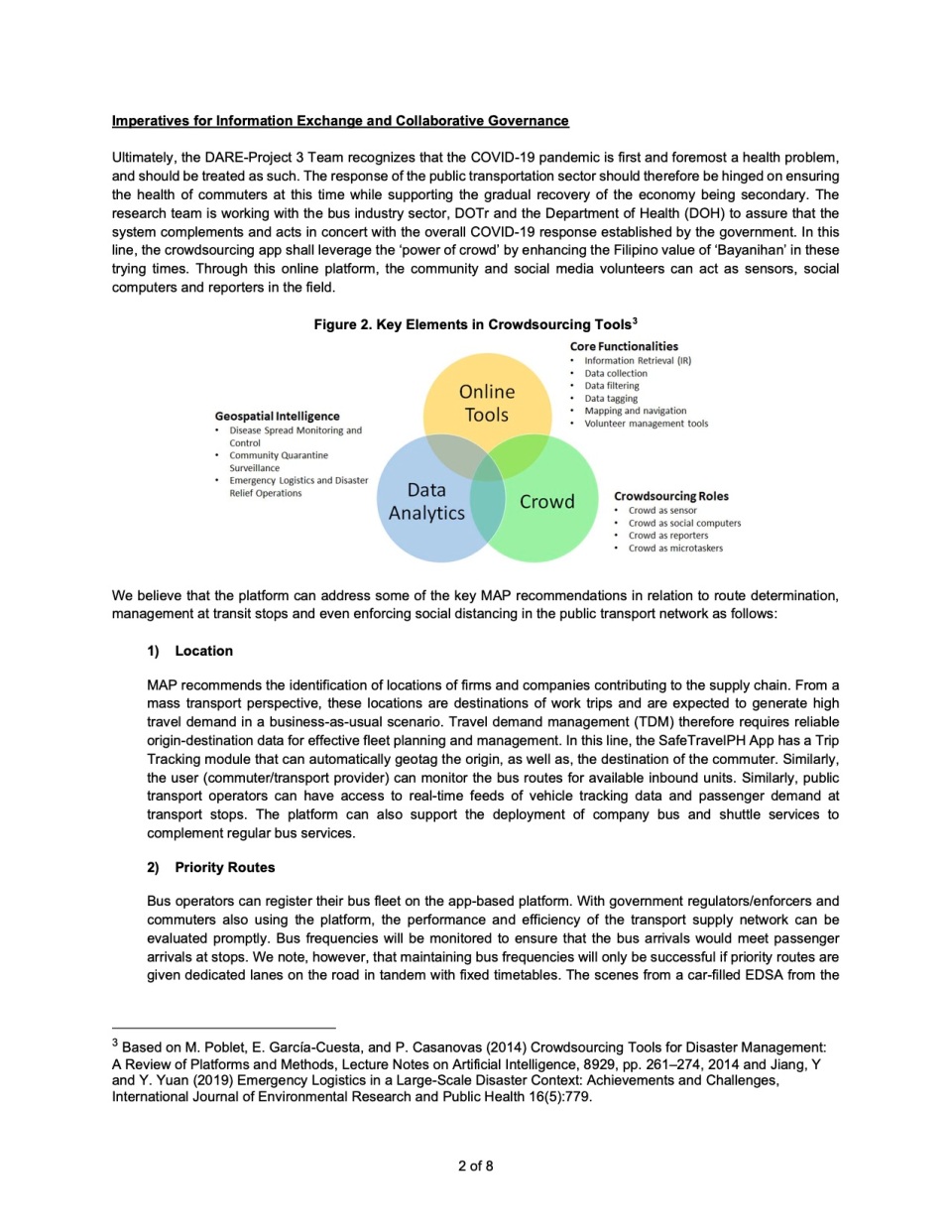
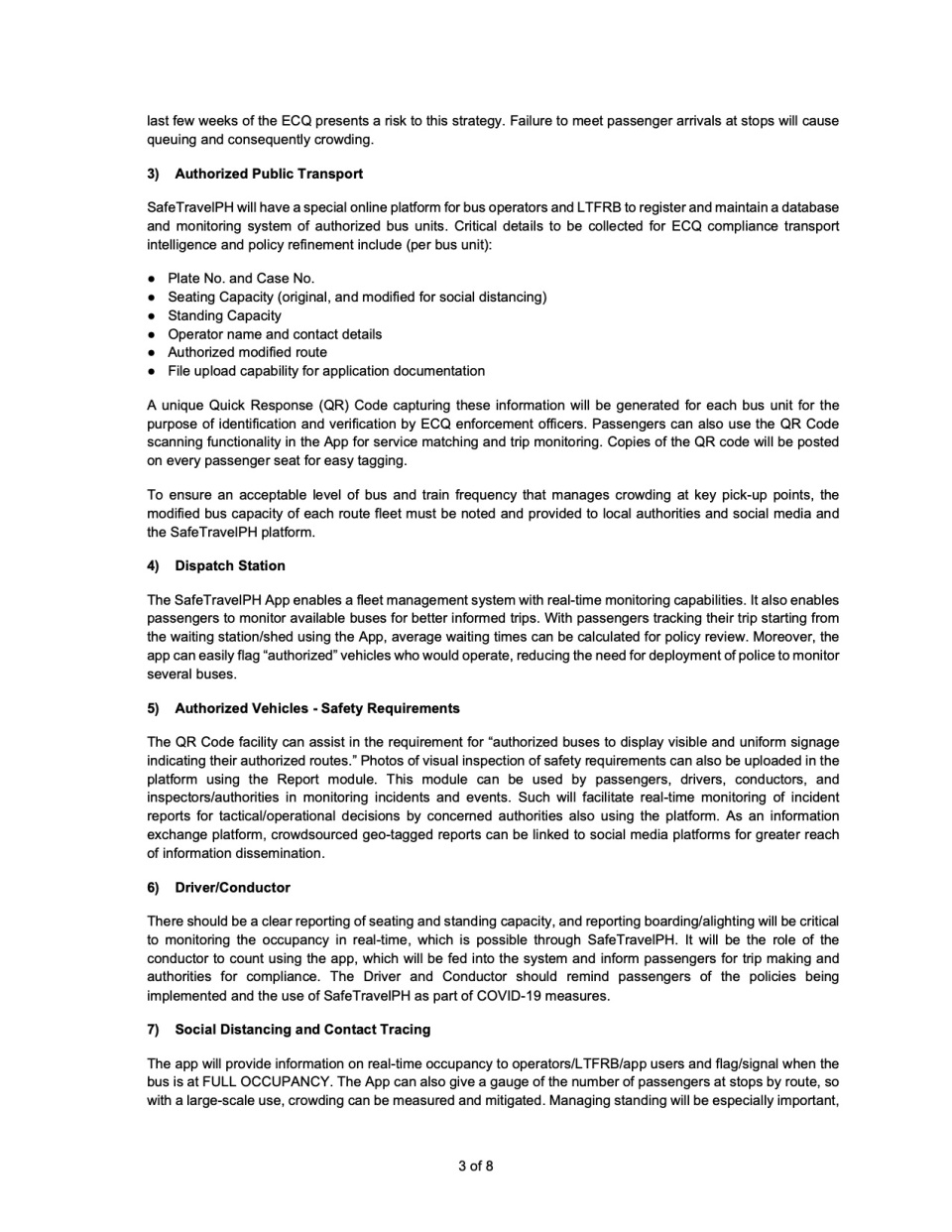
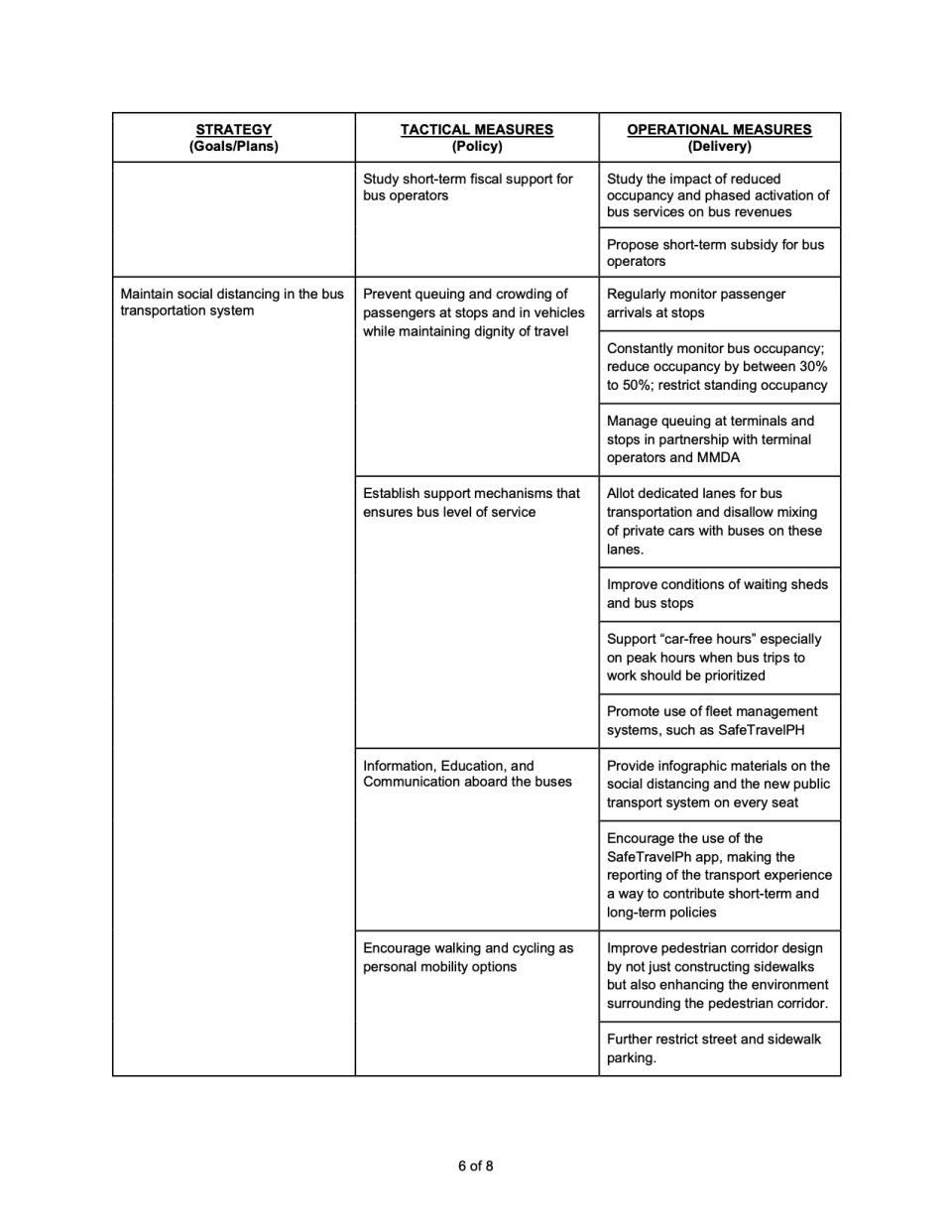
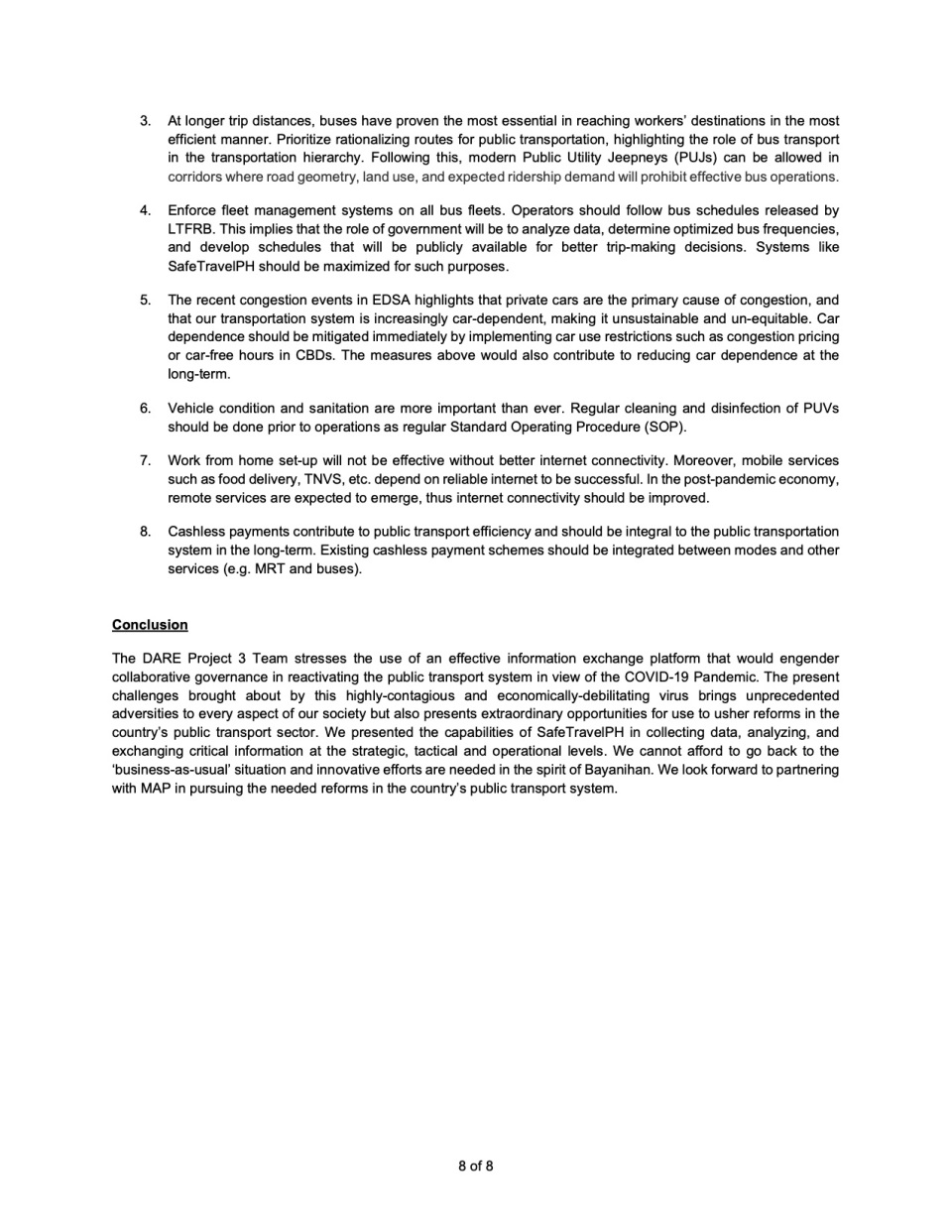
Public Transport Recommendations of the UP COVID-19 Pandemic Response Team
Here are the recommendations of UP COVID-19 Pandemic Response Team: “Effective Reactivation of Public Transport Operations for the New Normal through an Information Exchange Platform for Collaborative Governance”




–
On public transport services during the pandemic
I’ve read a lot of discussions and recommendations pertaining to public transportation services (mainly its lack thereof) during the Enhanced Community Quarantine aka lockdown in most parts of the Philippines. Problem is, a lot of people had their mobility curtailed as most people did not have their own private vehicles (cars or motorcycles) to do essential trips (i.e., for groceries, market, drugstores, hospitals, etc.). These include so-called frontline workers, most especially those working in hospitals or clinics. Even the use of tricycles on a limited basis while adhering to physical distancing guideline was not allowed in many cities and municipalities. What do we really need to do now and in transition to address the lack of public transport services?
Here is a concise yet very informative article on transit:
Walker, J. (2020) “Cutting Transit Service During the Pandemic: Why? How? And What’s Next?”, Human Transit, https://humantransit.org/2020/04/cutting-transit-service-during-the-pandemic-why-how-and-whats-next.html [Last accessed: 4/23/2020]
Most of the points discussed and recommendations presented are applicable to our case in the Philippines. We should also accept the fact that we cannot go back to the situation prior to the ECQ, and that the new normal calls for a reduction in car use. Meanwhile, we still have to address the pressing issues and come up with a plan or maybe strategies for public transport that involved not just buses and trains but other modes as well like the jeepneys, vans and tricycles.
–
On walking, running and cycling for exercise during the Covid-19 pandemic
We had been walking in the early mornings prior to the so-called “total lockdown” implemented by our Barangay. There were others like us in our community who walked, jogged or cycled during the same time we took our walks. However, we all practiced physical distancing and used masks while outdoors. We could afford to do this because the village where we resided in had relatively wide streets and there were few houses and residents compared to other residential areas. In our case, we usually walked in areas where there were even fewer houses and people. It is highly unlikely we could get Covid-19 during our morning walks. Afternoons were different as we observed more people going around including those who appear to be joyriding with their motorcycles.
Is there actual evidence that walking, jogging, running or cycling actual aid the spread of Covid-19? So far, there isn’t and what we have are mostly simulations. Yes, simulations like those that appear in articles that are going around the internet; often shared in social media. Here is a more informative and objective article about this topic that articulates more the importance of physical activity (i.e., in the form of walking, jogging, running or cycling) in combatting the virus while also emphasizing the need for social or physical distance and the use of masks:
Niiler, E. (2020) “Are Running or Cycling Actually Risks for Spreading Covid-19?”, Wired, https://www.wired.com/story/are-running-or-cycling-actually-risks-for-spreading-covid-19/?bxid=5bd6761b3f92a41245dde413&cndid=37243643&esrc=AUTO_OTHER&source=EDT_WIR_NEWSLETTER_0_DAILY_ZZ&utm_brand=wired&utm_campaign=aud-dev&utm_mailing=WIR_Daily_041420&utm_medium=email&utm_source=nl&utm_term=list1_p4 [Last accessed 4/15/2020]
I appreciate the efforts of those in our Barangay to make sure no one gets infected (there are zero incidents so far). However, sometimes the overeagerness seem to trump the need to practice common sense in these times. I believe there is a need to make an even bigger effort to ensure people are able to maintain physical and mental wellness through exercise or activity. I believe we are in a community where people are educated, aware and responsible enough to make this work.
–
On Davao’s Executive Order No. 23 allowing tricycles as a transport mode during the ECQ
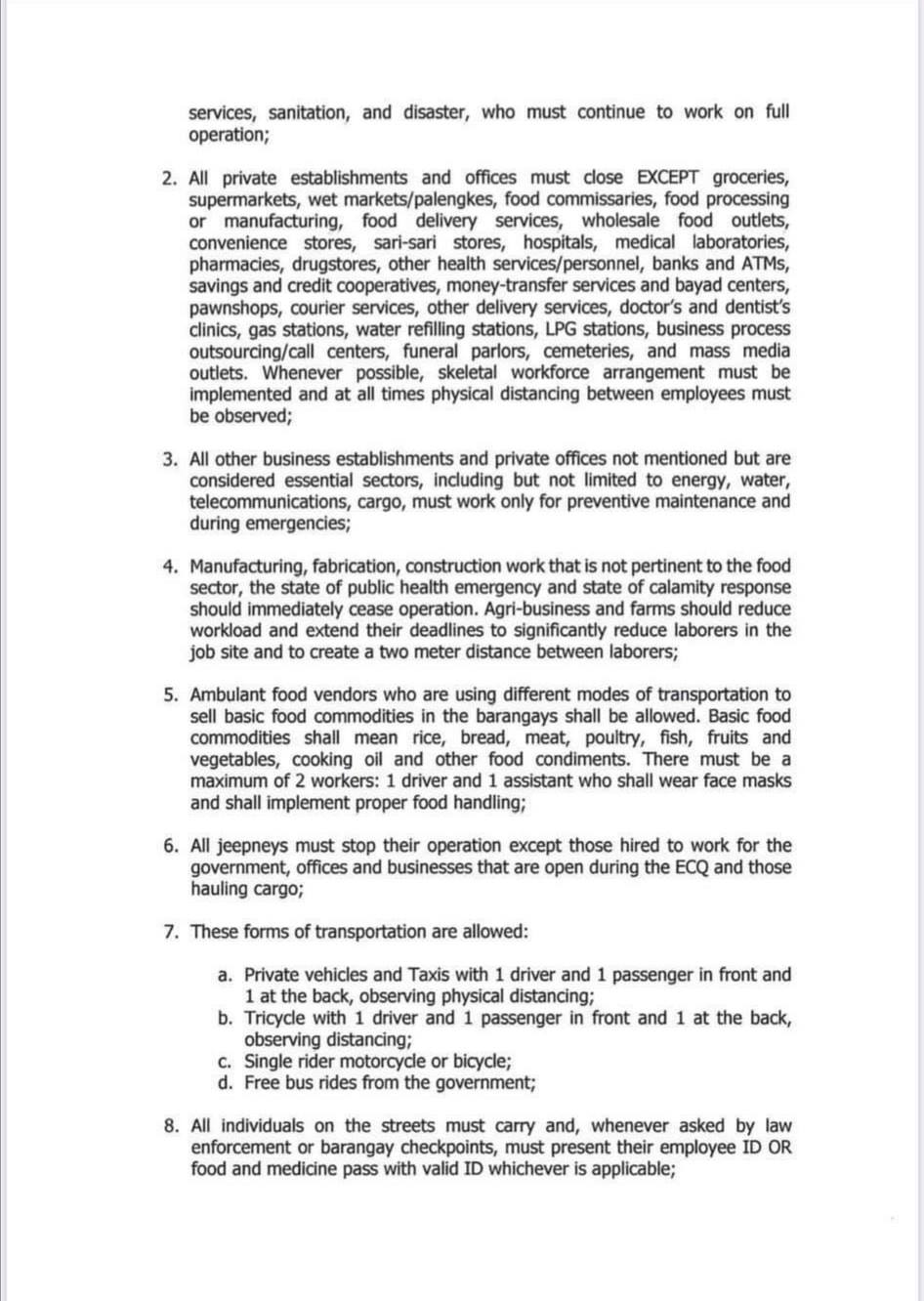
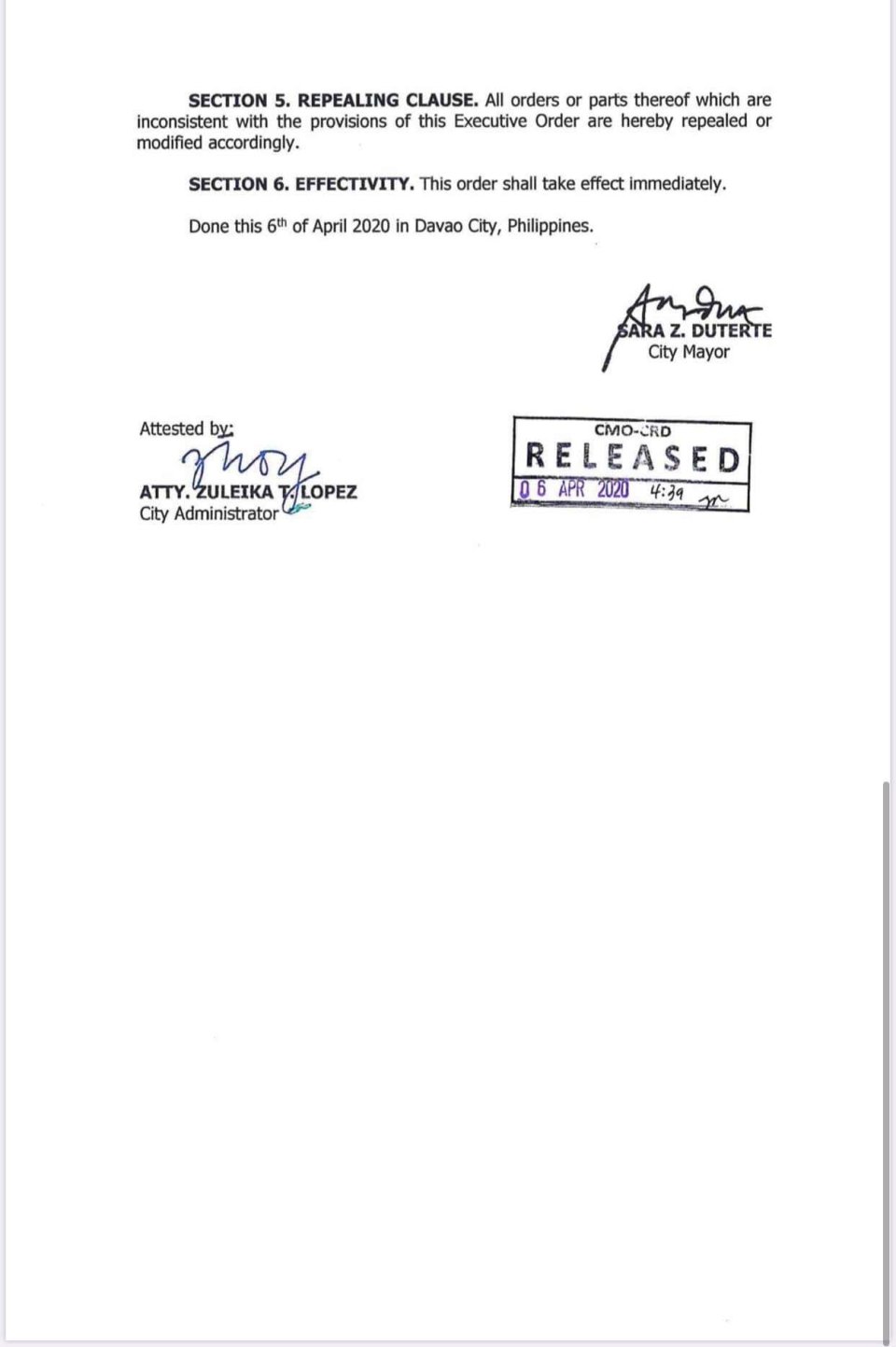
The other day, I posted about the Pasig City Ordinance promoting cycling or the use of bicycles for transport during the Enhanced Community Quarantine (ECQ) or lockdown period. Here is the Executive Order issued by the Davao City mayor where tricycles are allowed by the city (i.e., one driver and one passenger only) as a form of transport. The justification by the City Mayor in subsequent statements and interviews is so simple and common sense that you wonder why such cannot be allowed in other cities like Pasig, which at first allowed tricycles (also with the one driver, one passenger set-up) but was rebuked by national government for their alleged violation of rules set out by the task force in-charge of the nationwide ECQ. While the Davao Executive Order is in itself a formal document and statement, it is interesting to note that after issuing the EO, the Davao City Mayor, who happens to be the daughter of the Philippines’ President, also issued a statement that basically says she will answer all queries and criticisms of this EO; short of threatening those who will oppose it. Surprisingly or not surprisingly, depending on which side of the fence one is, national government was mum about the EO and let Davao be. Thus, it now presents a precedent for other LGUs to follow or invoke. Otherwise, there will be a double standard and it will seem as if Davao will always be a special case.


–
 Caught (up) in traffic