
Home » Policy (Page 26)
Category Archives: Policy
NCR checkpoint map
I just wanted to share the checkpoint map developed by a good friend from UP. Here is the text and link provided by UP Resilience Institute head Mahar Lagmay on his FB page:
Metro Manila quarrantine checkpoint map now available. It is already linked with the Google Traffic Map. Sana makatulong. You can check the traffic status if you zoom in on the interactive map.
Many thanks to Prof. Noriel Christopher Tiglao of UP NCPAG. He is a civil engineer by profession and has conducted research on transportation management and policy with the National Center for Transportation Studies (NCTS).
Copy paste to your web browser this URL http://35.185.190.69/
and continue to accept. Walang pong virus iyan.
I hope this is good info to many!
–
Politics: Questions on Succession
Here is another political post so click on another if this is not your thing. In a previous post, I wrote about politics in general and cited the example of Rizal politics. I write more about this topic based on my observations and assessment.
A big problem with patronage and clan politics is succession. Ipinamamana na lang ba ang posisyon sa gobyerno? (Are positions in government supposed to be like things that are handed down like inheritance?] Many cities and municipalities are like that and there are many so-called prominent families who hold top positions with some occupying Mayor, Vice Mayor and several Councilor positions. The more powerful ones also hold Governor, Representative and even Senator (which is a national post).
Rizal has very much similar circumstances with the congressional districts of the province and the capital city of Antipolo practically being dominated by certain families. The first district of Rizal has not had anyone except a Duavit while the second was for a while been held by a Rodriguez until a defeat in the last election by what seemed to be an upstart. He is actually from a political family from the southern Philippines whose been a good staff of the Ynares clan. Antipolo’s two districts are controlled by the Punos and the Acops. With both already juggling the post among their immediate families, there seems to be no one to end their dynasties. Even well-performing politicians like Cainta’s Nieto will be hard-pressed to run for Governor or Congressman.
It would take much more like perhaps a crisis or something disastrous for these well-entrenched politicians to be defeated. Nieto did it just when his predecessor was attempting to build a dynasty on the heels of subsequent disastrous floods in Cainta. But perhaps the case of Vico Sotto’s campaign and resulting upset of another dynasty in Pasig offers as a more interesting study of engaging and transformative politics? Let’s wait some more and see how things develop. Will they remain and sustain their momentum without losing (part of) their souls? Or will they end up being succumbing to the temptations of the ‘system’?
On the financial viability requirement for public transport operators
I came upon the news that the P2P Bus service between SM City North EDSA and SM Megamall suspended operations The Land Transportation Franchising and Regulatory Board (LTFRB) released a statement to clarify the circumstances surrounding the suspension, which apparently was the initiative of the operator rather than the agency. Apparently, too, some people were quick to attribute (blame seems to be the more appropriate adjective to describe how some netizens reacted) the suspension to LTFRB. Here is the statement posted on their social media page:
Land Transportation Franchising and Regulatory Board – LTFRB
February 23 at 7:52 PM ·LTFRB PRESS STATEMENT ON P2P OPERATIONS OF FROEHLICH TOURS, INC.
23 February 2020The Land Transportation Franchising and Regulatory Board (LTFRB) would like to clarify that it did not order the cessation of the P2P operations of Froehlich Tours, Inc. (FTI) which plied the SM North EDSA-SM Megamall and Trinoma-Park Square routes.
FTI was one of the first to be awarded with P2P routes in 2016. In November 2019, MAN Automotive Concessionaires Corporation (MAN) submitted a letter requesting the Board to look into the financial capability of FTI to maintain its operations, fund expenses that may arise from accidents, and continue to provide public service.
According to MAN, an exclusive truck and bus importer, assembler, and distributor, FTI initially acquired 17 bus units amounting to a total of P185.7 million from them. FTI was only able to pay P39.2 million which resulted in MAN having to repossess 12 bus units. To this day, P19.75 million is still left unpaid by FTI.
While these allegations are still under investigation by the Board, an inspection of the FTI bus units revealed that the company’s Provisional Authority, which allowed them to run and function as a public service provider, has already expired and no renewal was filed.
As of now, an order has been sent out to Froehlich Tours Inc. to submit its 2019 Financial Statement within a period of five (5) days from receipt of a copy. The hearing is reset, upon the agreement of both parties, on 3 March 2020 at the LTFRB Central Office.
Pending the outcome of the hearing, the Board shall adopt measure in the coming weeks to ensure that the riding public will be provided with the needed transport service on the routes affected.
–
There are two major points in the statement. One is on the financial viability of the operator and another is on the provisional authority granted by the LTFRB, which is a regulatory agency. The latter pertains to something more temporary and authoritative than a franchise, which is basically a license to provide transport services. These provisional authorities are often granted by the agency for so-called “missionary routes” as well as for supplementing the supply of vehicles during peak seasons like Christmas, Holy Week and Undas.
Financial viability is a requirement for all public transport operators. It is part of the formula for determining the viable number of units (i.e., vehicles) considering the fare that is to be charged to passengers taking into consideration the operating costs of operators. If this requirement was implemented strictly, a lot of operators would not be operating PUVs in the first place. The LTFRB, however, as well as its mother agency, the DOTr, have been lax about this requirement for so long a time that it is difficult to recall the last case where this was cited as a reason for suspending operations.
–
On the safety of e-scooters
There’s recent news about the Department of Science and Technology (DOST) launching a smart scooter system in Cauayan City, Isabela. This should be considered a positive thing in light of the scooter’s sudden popularity as a mode of transport. There are, however, much to be determined in terms of this vehicle being a safe mode of transport. Singapore, for example, has released guidelines for its use in its streets while there have been mixed reactions among American cities on how these vehicles should share spaces with other modes including walking and cycling. Here is a nice article about scooter safety that should point the way towards how we should go about in assessing safety:
Chang, A.Y.J. (2020) Demistifying e-scooter safety one step at a time, https://medium.com/@annieyjchang/demystifying-e-scooter-safety-one-step-at-a-time-956afcf12d75 [Last accessed: February 3, 2020]
As a parting shot in other cases, I have always asked: Would this have been an issue or a popular mode if we had good public transportation as well as decent pedestrian and cycling infrastructure? The answer could be a simple ‘no’ for our case in the Philippines where much is to be desired in terms of PT, pedestrian and cycling infra. But e-scooters seem to have attractive quite a few in developed cities including those with good PT, pedestrian and cycling infra. The jury is still out there if this was just a fad or perhaps, as some claim, part of the evolution for improved mobility.
–
Motorcycle taxis in Cebu
The recent controversies, and issues raised vs. motorcycle taxis (habal-habal) have captured the attention of a lot of people including those who don’t use this mode of transport. I will be writing about this and more of my opinion on motorcycle taxis in another article. For now, I am sharing these photos of habal-habal in Cebu.
 Off-street motorcycle taxi terminal at SM City Consolacion
 The terminal is located on the sidewalk at the corner of the SM lot. I assume it is tolerated by SM though it blocks the pedestrian way to the mall.
 Another herbal-habal terminal near SM Consolacion but serving a different set of barangays from the previous terminal of habal-habal I mentioned.
 Fair matrix? Habal-habal minimum fares to specific destinations
Motorcycle taxis are a popular mode of transport in many Philippine cities and are generally tolerated by local government units. I guess the treatment they get from LGUs show the role they play as a mode of public transport. It is unfortunate and disappointing that the TWG that’s supposedly evaluating motorcycle taxis in Metro Manila cannot give a favorable assessment when it is clear that these habal-habal provide people with another choice for their commutes.
–
Statement of the Philippine Competition Commission on Motorcycles as Public Transport
Here is the link to the press statement of the Philippine Competition Commission on Motorcycles as Public Transport:
I will just leave this here as it stands on its own with the details and discussions provided by the PCC. I will comment on this in another post but in essence I agree with the statement, which I think is a better document in terms of provisions and clarity compared to what the TWG has released so far.
–
National Transport Policy is out!
The National Transport Policy is out and there’s a lot of buzz about the wording of the policy. NEDA released the following infographics on their official Facebook page:
 Definition of what the policy is about
 Hierarchy of transport modes (note the emphasis on walking and cycling)
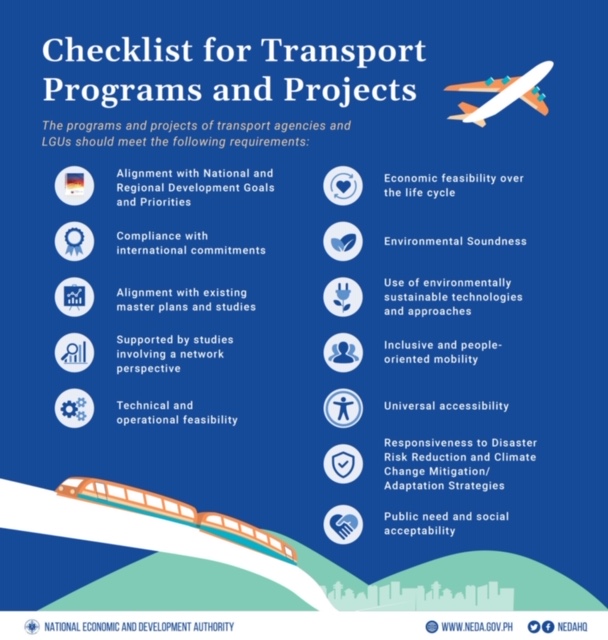 Checklist for programs and projects: I am already anticipating what proponents will be writing to justify projects according to this checklist.
I will reserve my commentaries for future blogs. There is really a lot to discuss about this policy and how it will implemented (properly or improperly), There are lots of different ideas, advocacies, interests and agendas on transportation that come into play here. And we can only hope that the policy and its implementing rules and regulations will be clear enough (not vague as to have so many loopholes) for this policy to effect transformation and inclusive and sustainable development.
–
Comments on current transport issues – Part 2: On motorcycle taxis
I continue with my comments on current and persistent transport issues. This time, I focus on one of two hot topics – motorcycle taxis or “habal-habal”.
1) On motorcycle taxis:
I am not a member of the Technical Working Group (TWG) that’s supposed to be evaluating the trial operations. I know one or two of the key members of the TWG and am surprised that they have not referred to the academe for studies that may have already been done about this mode of transport. I know there have been studies about it in UP and DLSU. Perhaps there are more from other universities in the country. Motorcycle taxis or “habal-habal”, after all, are practically everywhere and would be hard to ignore. Surely, researchers and particularly students would be at least curious about their operations? Such is the case elsewhere and many studies on motorcycle taxis have been made in the region particularly in Vietnam, Thailand and Indonesia, where these modes also proliferate.
The terms “trial”, “experimental” or “pilot” are actually misleading because motorcycle taxis have been operating across the country for so many years now. They are supposed to be illegal and yet they serve a purpose in the areas where they are popular. What is often referred to as an informal transport mode is ‘formal’ to many people who are not being served by so-called formal modes including the tricycle. Of course, one can argue that these terms (i.e., trial, experimental and pilot) refer to the app that are supposed to enhance the existing habal-habal operations.
I would strongly endorse motorcycle taxis but companies need to be held accountable should there be fatal crashes involving their riders. They are supposed to have trained and accredited them. The companies should also have insurance coverage for riders and passengers. LGUs tolerant of these should be watchful and do their part in enforcing traffic rules and regulations pertaining to motorcycle operations in favor of safe riding. This is to reduce if not minimize the incidence of road crashes involving motorcycle taxis.
I think one of the problems with motorcycle taxis is not really their being a mode of choice but the behavior of their drivers. While companies like Angkas and Joyride conduct training sessions with their riders, many revert to reckless on-road behavior including executing risky maneuvers in order to overtake other vehicles on the road. This is actually a given with many ‘informal’ motorcycle taxis (i.e., those not affiliated with the recognized app companies). But then this is also an enforcement issue because we do have traffic rules and regulations that are poorly enforced by authorities. Thus, there is practically no deterrent to reckless riding except perhaps the prospect of being involved in a crash.
I will refrain to include the politics involved in the issue of motorcycle taxis. I will just write about this in another article.
Coming up soon: hot topic #2 – Obstacles to the PNR operations
Comments on current transport issues – Part 1
I end the year with commentaries on transport issues. I recently responded to a request for an interview. This time, it was not possible to do it in person so we corresponded through email. Here are my responses to the questions sent, which are mainly about the public utility vehicle modernization program of the government.
· Will old-school jeepneys finally disappear on Philippine roads before the term of President Rodrigo Duterte ends, barely three years from now? What is a more realistic timeline of jeepney modernization?
Old school jeepneys won’t disappear from Philippine roads. For one, the modernization program has slowed down a bit and even the DOTr and LTFRB have stated and admitted that it is not possible to have 100% modernization before the end of term of the current administration. It’s really difficult to put a timeline on this because of so many factors that are in play including social, political, institutional and economic ones. The technical aspects are not issues here as there are many models to choose from and suitable for replacing jeepneys in terms of capacity.
· What are the bumps on road to jeepney modernization?
As mentioned earlier, there are many factors in play here. Economic/financial-related bumps pertain mainly to vehicle prices. The new models are quite pricey but it should be understood that this is also because the new ones are compliant with certain standards including technical and environmental ones that most ‘formally’ manufactured vehicles must pass unlike so-called customized local road vehicles (CLRV) like the conventional jeepneys. The financial package is not affordable to typical jeepney operators/drivers. The cost of a modern jitney (the technical term for these vehicle types) is close to an SUV and revenues may not be able to cover the combination of down payment, monthly payments, and operations & maintenance costs of the vehicle.
· Should local government units dictate the pace of jeepney modernization, not national agencies such as the Department of Transportation and the Land Transportation Franchising and Regulatory Board? Why?
I think the word “dictate” may be too strong a term to use. Instead, I prefer the word “manage”. After all, LGUs are supposed to capacitate themselves to be able to rationalize and manage public transport operations. That is why the DOTr and the LTFRB are requiring them to formulate and submit for evaluation and approval Local Public Transport Route Plans (LPTRP). Though the deadline was supposed to be 2020, the agencies have relaxed this deadline after few submissions from LGUs. Few because there were only a few who were capable or could afford consultants to prepare the plans for the LGUs. These plans should be comprehensive covering all modes of public transport including tricycles and pedicabs that are already under the LGUs. Buses, jeepneys, vans and taxis are still under the LTFRB. Plans may also contain future transport systems that are being aspired for by LGUs such as rail-based mass transit systems and other such as monorail or AGT.
· Transport groups like PISTON are against drivers and operators merging into cooperatives. Is consolidation into cooperatives unworkable? Why?
I think consolidation into cooperatives is workable and should be given a chance. Unfortunately, there are still few examples of successful transport cooperatives. And the success also depends on the routes served by their vehicles. And that is why there is also a need to rationalize transport routes in order to ensure that these are indeed viable (i.e., profitable) for drivers and operators.
Another angle here is more political in nature. Note that while PISTON and other like-minded transport groups oppose cooperativism, there are others that have embraced it and even went corporate to some extent. Perhaps there is a fear of a loss in power that the leaders of these opposition transport groups have wielded for a long time? Perhaps there’s a fear that success of cooperatives means the drivers and operators will turn to cooperativism and leave those transport groups? Surely there are pros and cons to this and groups should not stop being critical of initiatives, government-led or not, that will affect them. This should be constructive rather than the rant variety but government should also learn to accept these rather than dismiss them or be offended by them as is often the case.
–
More comments in the next year!
–
Unraveling ridesharing/ridesourcing
I have been writing about ridesharing/ridesourcing/ridehailing for some time now. I have also researched on its characteristics particularly in my country where it was initially hailed (no pun intended) as a solution to transport woes in highly urbanized areas. We’ve done our research with or without the cooperation of these companies. It does not surprise me that their operations have unraveled and many are exposed to be abusive. So much for being the ‘disruptive’ initiative that was praised by many before…
Emerson, S. (2019) “Uber Drivers Protest ‘Corporate Greed’ as Billionaires Cash In”, https://onezero.medium.com/uber-drivers-protest-corporate-greed-as-billionaires-cash-in-df65a7e470a7 [Last accessed: 11/18/2019]
–
 Caught (up) in traffic