
Home » Policy (Page 28)
Category Archives: Policy
Sabit
A common sight along Philippine roads are overloaded public utility vehicles. It may be indicative of how difficult it is to get a ride because such is usually the case when there is a lack of public transport vehicles during peak periods (i.e., when transport demand is greater than the supply of vehicles). That lack maybe due to simply not enough vehicles to address the demand or that there is enough on paper and operating but they are not able to make the return trips fast enough. The first case means demand has grown but the number and capacity of vehicles have not kept pace with the demand. The second means that technically there are enough vehicles (franchises) but the traffic conditions along the route have worsened and has resulted in vehicles not being able to travel fast enough to cover the demand.
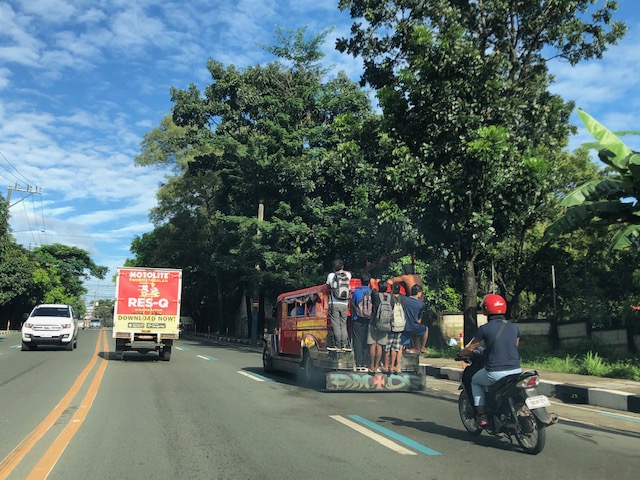 Jeepney with 6 passengers hanging by the back. All look like they are laborers or workers (construction?) but it is not uncommon to see students in their school uniform similarly dangling from jeepneys especially during the peak hours when its difficulty to get a ride.
Sabit is actually illegal and, if enforcers are strict, will incur apprehension and a ticket. Many local enforcers including those of the MMDA though are lax about this especially during peak periods. Jeepney drivers are more cautious when they know that Land Transportation Office (LTO) enforcement units are on watch as these are usually strict about passengers dangling from the vehicles. Newer jeepney/jitney models basically eliminated sabit as the doors are now on the right side of the jeepney instead of the back and there are no spaces or features to hold and step on to in the new models. It is for good as this is an unsafe situation for the passengers and there are reckless jeepney drivers who tend to exacerbate the situation by deliberately maneuvering the jeepney as if he wants passengers to fall off the vehicle. To those looking for a thrill (or death wish as a friend calls it), it is an exhilarating experience. But in most cases, it is a disaster waiting to happen.
–
On the issuance of provisional units for ‘modernised’ jeepneys
There seems to be a proliferation of various models of the so-called “modernized jeepneys”. They have been deployed along what the DOTr and LTFRB have tagged as “missionary routes”. The latter term though is confusing because this used to refer to areas that are not yet being served by public transportation, hence the “missionary” aspect of the route. The routes stated on the jeepneys are certainly new but they overlap with existing ones. Thus, the new vehicles are actually additional to the traffic already running along the roads used by the existing (old?) routes. The number of units are said to be “provisional” meaning these are trial numbers of these new vehicles and implying the route and service to be somewhat “experimental”. There can be two reasons here that are actually strongly related to each other: 1) the actual demand for the route is not known, and 2) the corresponding number of vehicles to serve the demand is also unknown. Unknown here likely means there has been little or no effort to determine the demand and number of vehicles to serve that demand. The DOTr and LTFRB arguably is unable to do these estimations or determinations because it simply does not have the capacity and capability to do so; relying on consultants to figure this out. That work though should be in a larger context of rationalizing public transport services. “Provisional” here may just mean “arbitrary” because of the number (say 20 or 30 units?) of units they approve for these new routes.
 A ‘modernised’ jeepney with a capacity of 23 passengers. The vehicle is definitely larger than the conventional jeepneys and yet can only carry 23 seated passengers. That’s basically the number of seats for most “patok” jeepneys that are “sampuan” or 10 passengers on each bench plus 2 passengers and the driver in the front seats.
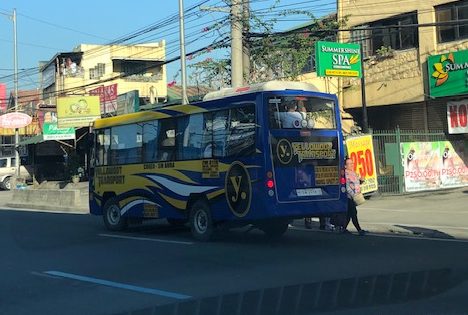 Modernized jeepney unloading passengers along the roadside
Rationalization should require not only the replacement of old jeepney units that seems to be the objective of the government’s modernization program. Rationalization also entails the determination and deployment of vehicles of suitable passenger capacities for the routes they are to serve. I have stated before that certain routes already require buses instead of jeepneys and that jeepneys should be serving feeder routes instead. Meanwhile, routes (even areas) currently having tricycles as the primary mode of transport would have to be served by jeepneys. Tricycles, after all, are more like taxis than regular public transportation. Such will also mean a reduction in the volumes of these vehicles and, if implemented and monitored strictly, may lead to an improvement in the quality of service of road public transport.
[Note: May I add that although I also use ‘jeepney’ in my articles, these vehicles should be called by their true names – ‘jitneys’. The term jeepney is actually a combination of the words Jeep (US military origins) and jitney (a public utility vehicle usually informal or paratransit offering low fares).]
Mixed messages for commuters?
I had spotted buses (or perhaps its just the same bus?) for a P2P service between Antipolo and Ortigas Center bearing what appears to be a statement for improving the quality of life of commuters. Many have been suffering and continue to suffer on their daily commutes starting from difficulties getting a ride to very long travel times. The term “dignity of travel” comes to mind, which a colleague coined many years ago to describe
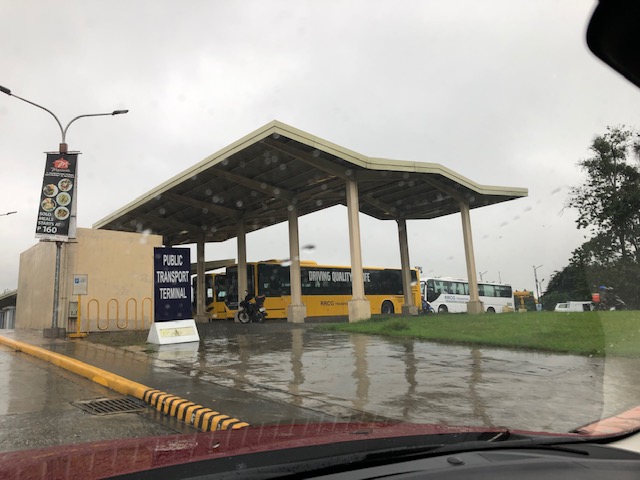 P2P buses at the public transport terminal at Robinsons Place Antipolo
 Whoever thought of this probably meant well; thinking about improving quality of life. The choice of words though may convey a different message as “driving” is in all caps and usually associated with a different, less appealing activity to sustainable transport advocates. I think they should have chosen “improving” instead of “driving” here.
This is somewhat similar to a much earlier post of mine showing SMRT buses in Singapore with ads promoting Uber and how it was supposed to complement public transport. That, of course, was a bit of a stretch in the city-state, which already has excellent public transport compared to elsewhere, and already complemented by very good taxi services.
Yesterday, there was a nationwide transport strike and depending on which side you are on, the reality is that we are still far from having more efficient public transport. But that’s another story and hopefully, I get to write about it in the next few days.
–
Quick share: “The ‘War on Cars’ is a Bad Joke
Here is another quick share. This time it is an article that I think attempts to diffuse what some many people regard as a war on cars being waged by those who advocate for public and active transport.
Litman, T. (2019) The ‘War on Cars’ is a Bad Joke, Planetizen, https://www.planetizen.com/blogs/105877-war-cars-bad-joke?fbclid=IwAR2_SZHQeYEUGiU2G8RUw0Za6GrkR-2peD3eSjshpNUOg9-G5SpDWm6OnFI [Last accessed: 8/25/2019]
The author makes very strong arguments supported by evidence and data to place this topic in the right context. That is, there is no need to “wage war” or use arguments that are more on the hateful side and therefore not constructive to both sides. I think there should be a mutual understanding of the benefits (and costs) of having many options for transport or commuting. That said, infrastructure or facilities should not heavily favour one mode (car-centric?) for transport to be sustainable and healthy.
Sadly, many so-called progressives (yes, I am referring to the younger generations who are still in the idealistic stage of their lives) appear to be blind to understanding but instead opt for the hardline stance vs. cars and those who use them. Instead of winning people over and convincing those who really don’t need to drive to take other modes, they end up with more people becoming more apathetic or unwilling to take a stand vs. the status quo. This is the very same status quo that is definitely degrading quality of life and is described as an assault to human dignity.
–
Quick share: “The changing role of transport strategy”
Here is a nice article briefly discussing the evolution of transport strategy planning that have led to local transport plans:
Gleave, J. (2019) The changing role of transport strategy, Transport Futures, https://transportfutures.co/the-changing-role-of-transport-strategy-598fce17e9e9 [Last accessed: 8/24/2019].
More importantly, there is a very good discussion here of the recent developments and the need to change approaches in order to become more effective at the local level. The article explains that there should be an appreciation of the availability of resources including tools that allow people to be more engaged or able to participate in the planning process for their cities, municipalities or communities.
–
Politics: Fresh Faces at the Local Level?
A major factor in shaping our cities and municipalities is the leadership in the form of local politicians, most especially the Mayors, who are the decision-makers for many aspects of their constituencies. Mayors have a hand in most if not all policies pertaining to land use (e.g., zoning, planning, etc.) and transportation (e.g., schemes, policies, franchises, etc.).
The likes of Vico Sotto, Isko Moreno and Francis Zamora are currently being praised for what seems to be their fresh and aggressive approach to addressing problems and issues in their respective constituencies. The three’s ascendance to mayor of their respective cities have also exposed the alleged graft and corruption of their predecessors. The dominance of the latter in the form of dynasties have all but assured that whatever anomalies passed on from one term to another are internalised and made unknown to their constituencies who are to remain blind to these abnormalities. Instead, the people are made to believe that progress is achieved with some worthwhile projects here and there to show that taxpayers’ money are spent well.
Prior to these personalities, there were others who sort of broke the dynasties in their respective towns. I can name at least two cases that I am very familiar with; both with the Municipality of Cainta – Mon Ilagan and Kit Nieto. Both ended long reigns with Ilagan making Cainta history by finally upending the Felix dynasty there. Previous to him, the only one who almost upset the then reigning dynasty was a woman – Eunice Fermindoza. Ironically, Ilagan’s attempt at a dynasty by making his wife run after his 3 terms was up was nipped by Nieto, an erstwhile ally who has come to represent not just the emergence but the establishment of people who have settled in suburban town in the various subdivisions developed over the course of the last 50 years. These are the middle class comprised of professional and office workers and their families who decided to reside in Cainta because of the town’s proximity to Metro Manila and homes their being relatively affordable.
Even before Sotto, Moreno and Zamora have embarked on their own programs, Nieto has shown that the efficient use of resources coupled with transparency and a genuine feel for the requirements of his constituents will get one re-elected and gain attention. Cainta has transformed and blossomed under this current mayor. For one, he has been able to complete many infrastructure projects and strengthened social and medical programs in the municipality. It is a wonder how Cainta is not yet a city considering its income and continued growth. One only wishes this growth is not sustained by poorly planned land use development where the town basically relies on developers (i.e., Megaworld and Filinvest) for the plans instead of being involved in order to avoid exacerbating the enduring traffic and flooding issues that are still the bane of this town. Unfortunately, Nieto is on his last term and it is unclear for now who might be competent and progressive enough to replace him. Among the current councilors in the current administration is a Felix and an Ilagan, scions of the two previous families that lorded it over Cainta. Will one of them rise again to reclaim what they probably regard as their right place? Hopefully not…Kawawa naman ang Cainta.
–
Safety guides for pedestrians and cyclists
Here are a couple of references/resources for pedestrian and cycling safety. These are guidelines and countermeasure selection systems that were developed under the Federal Highway Administration of the US Department of Transportation:
- Pedestrian Safety Guide and Countermeasure Selection System
- Bicycle Safety Guide and Countermeasure Selection System
These guides are designed to be practical and should be helpful to practitioners/professionals, policymakers as well as researchers. These would be people looking for references to use in designing or revising (correcting?) existing conditions or situations in order to enhance safety for pedestrians and cyclists who are among the most vulnerable of road users.
–
More irrational public transport?
I spotted a new vehicle serving a new route between Cogeo in Antipolo and SM Aura in Taguig. I see these vehicles along Marcos Highway from Masinag to Santolan. Friends have spotted the same along C-5 at Eastwood and at Tiendesitas; confirming the route this mash-up between the jeepney and bus is running along. The route overlaps with existing public transport lines along Marcos Highway (mostly jeepneys connecting the eastern cities and towns with Cubao) including the elevated Line 2.
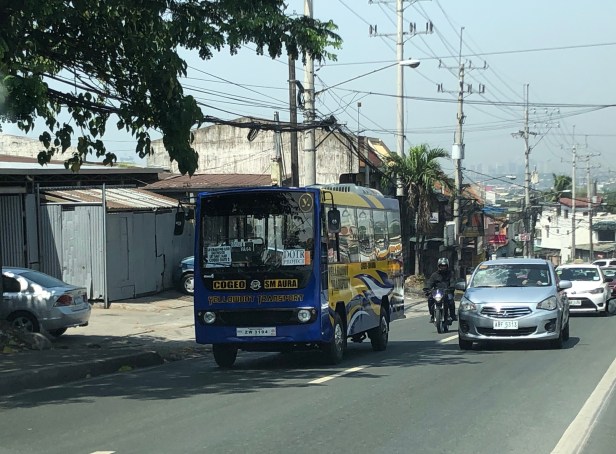 Jitney running along Marcos Highway in Antipolo (section between Masinag and Cogeo)
The jeepney has a sign stating it is a DOTr project. So is this an experimental run to determine the viability of the route in place of the traditional approach using what was termed as RMC (Route Measured Capacity)? I am not aware of any other ways by which the DOTr or the LTFRB are able to estimate the number and type of public utility vehicles to serve certain routes. There are, however, initiatives to open what they call “missionary routes” but this term used to refer to really new and unserved (referring to formal public transport) corridors or areas rather than those that are already being served by several modes of public transport. The results of this interpretation of “missionary routes” are more overlapping routes that further complicate and undermine efforts for rationalising or simplifying public transport services in the Metro Manila and other cities as well.
I will soon post here three maps showing the public transport route coverage for Metro Manila more than half a decade ago. These show the coverage of buses, jeepneys, and UV express services at the time. I now wonder how these would look like with the new routes overlayed unto the maps.
Article on sustainable transport’s role in “saving the world”
Here is another quick post on another article I am sharing showing the importance of sustainable transport:
Milner, D. (2019) How sustainable transport can save the world, medium.com, https://medium.com/@djjmilner/how-sustainable-transport-can-save-the-world-f2f64517dc52 [Last accessed: 4/9/2019]
It goes without saying that sustainable transport has a lot of potential for helping mitigate climate change and other issues but much is expected of our leaders for policies and program & project development & implementation towards achieving sustainable transport in our cities and municipalities.
–
How many TNVS vehicles are enough?
There’s this old article I chanced upon on social media:
Badger, E. (2018) “What’s the right number of taxis (or Uber or Lyft cars) in a city?”, The Upshot, The New York Times, https://www.nytimes.com/2018/08/10/upshot/uber-lyft-taxi-ideal-number-per-city.html [Last access: 3/26/2019]
This article is still very much relevant since the government is still apparently unable to determine the number of TNVS vehicles needed to serve the demand in cities. The latter refers to those cities that TNCs have identified for operations and where they are already operating. Obviously, the question applies to taxis as well. But then taxis and TNVS have practically the same operational characteristics. I am not referring to business models but to the way these modes operate as parts of a cities transport system. What is really the demand for driven for-hire vehicles? Will this demand be significantly reduced once mass transit lines like MRT-7 and the MM subway are operational?
This also extends to motorcycle taxis as well. While there is already a proliferation of informal motorcycles taxis around the country including major cities and the capital, the formal services represented by Angkas shows just how many riders want in on this service. And it’s basically attractive due to the potential income they can derive from this. And so this begs the question: How many habal-habal units are enough?
–

