
Home » Policy (Page 36)
Category Archives: Policy
Updates and resolution on the common railway station in North-EDSA
The big news today is the agreement among the government and the big corporations involved in the issue of the common station at North Avenue-EDSA where three rail transit lines (Line 1, Line 3 and the future Line 7) will be converging. The key features of the agreement are reproduced here:
“KEY FEATURES OF AGREEMENT
- The Common Station has three components: (a) Area A, where the platform and concourse for LRT-1 and MRT-3 are located; (b) Area B, which consists of two Common Concourses connecting Area A and Area C; and (c) Area C, where the platform and concourse for MRT-7 is located.
- Area A will be financed and built by DOTr. Area B will be financed and built by Ayala and its partners (NTDCC) (this is Ayala’s contribution to the Common Station project). And Area C will be financed and built by San Miguel.
- The portion of Area A for LRT-1 will be operated, maintained, and developed by LRMC. The portion of Area A for MRT-3 will be operated, maintained, and developed by DOTr. Area B will be operated, maintained, and developed by Ayala. And Area C will be operated, maintained, and developed by San Miguel.
- The MOU contains the design parameters for the Common Station, which will be the basis of the Detailed Engineering Designs to be developed after signing of the MOU. The Detailed Engineering Designs will be completed within 240 calendar days from signing date.
- The designs shall ensure that a defined level of service is maintained at all times by all components of the Common Station.
- The designs shall ensure that all components of the Common Station are interconnected, and that SM City North EDSA and Trinoma are interconnected to the Common Station.
- The Common Station is targeted to be completed by 2 April 2019, subject to extension as may be justified under the MRT-7 Agreement with respect to Area C.
- SM’s TRO will be lifted soon after the Detailed Engineering Designs are completed.
- DPWH will build an underpass along EDSA at the area where the Common Station will be constructed. This will be financed and built by DPWH.”
That was a direct copy and paste from the DOTr’s Facebook page.
There is another piece of information that’s gained a popular following and that is the design for the common station that was shared to the public:
Proposed design of the common station
I think the design is basically okay in terms of location. The layout would need to be refined in order to address concerns pertaining to optimum and efficient transfer of passengers between lines. I assume from the drawings that all three lines will be at the same level but with a plaza separating Lines 1 &3 from Line 7. There are also issues pertaining to proposed road grade separation in the area but that seems to have been addressed already by item #9 in the preceding list. We can only hope that the current government and private sector partnership can expedite this project.
–
Commuting and stress
Here is another quick post but on a topic that’s related to health and therefore is something that I think many should be interested in and perhaps take important note of.
Commuting: “The Stress that Doesn’t Pay”
There are many links to various medical articles within the article. At the last part, there is also a list of references that the reader may want to look at. I’m also posting this for future reference. This would contribute to the formulation of topics for research especially the inter-disciplinary or collaborative kind.
–
Motorcycles as goods transport
Our study on motorcycle taxis revealed most if not all of these “habal-habal” and “Skylab” being used to transport goods as well. These include agricultural products, food, construction materials, fuel, poultry, and others you would not see your typical courier service motorcycles will carry.
[All photos courtesy of Mr. Sherman Avendano of the National Center for Transportation Studies]
 A motorcycle bearing what appears as goods for or from the market treading a muddy and puddle-full road.
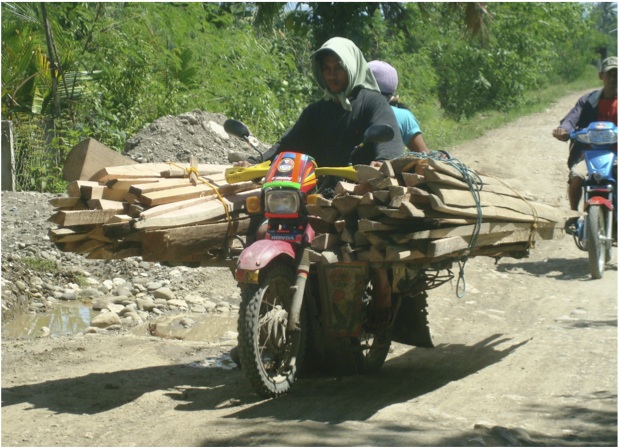 Motorcycle transporting what looks more like lumber than firewood.
 Skylab carrying what looks like 4 sacks of rice.
I was gifted by my wife with a coffee table book she got from one of her trips to Vietnam. The book contains photos of motorcycles in Vietnam being used to transport various goods including furniture, water bottles, crafts and even items like tractor tires, water tanks and roofing. I guess one can also compile a similar set of photos to come up with a Philippine version of that book.
–
Do people understand what Uber and Grab really are?
Over the holidays, I’ve read a lot of posts about Uber and Grab. Mostly, these were complaints about the surge pricing scheme of Uber. A lot of people cited the exorbitant rates Uber charged for trips even short ones like Ortigas to Center to Greenhills and Trinoma to Katipunan. Though the complaints are legitimate ones, I also try to see the other side of the coin considering Uber and Grab do tell potential passengers how much it will cost them for such commutes during peak periods (i.e., when roads are congested). Potential riders do have a choice whether they should take the rider (and therefore agree with the fare stated by the app) or take another transport mode instead. The issue here should not be entirely Uber’s or Grab’s fault. Our public transport system, particularly in Metro Manila, sucks. And that includes the conventional taxis that could have provided better services if regulations were strictly implemented or if the operators managed their drivers and maintained their vehicles well. Based on my experience, taxis in Cebu, Iloilo and Davao, for example, are better managed and regulated, and provide better service quality than those in Metro Manila.
Then there were the joint LTFRB and DOTr advisory for Uber and Grab units and the LTFRB order on surge pricing and fare rates.

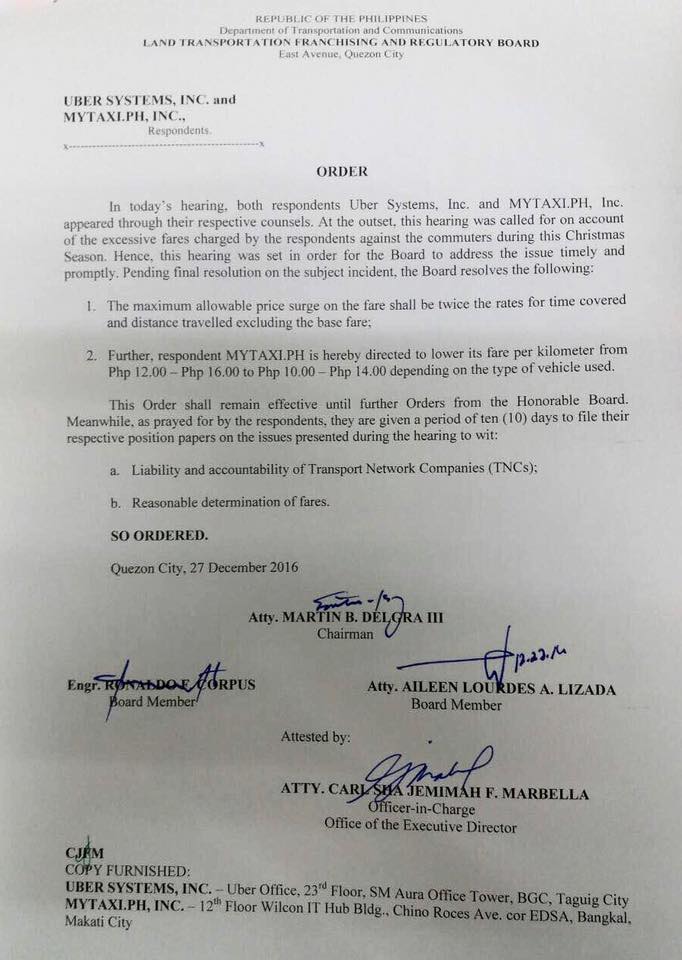
From both cases, it is clear that car-sharing or ridesharing services like Uber and Grab are treated as taxis rather than as premium services that likely entail higher fares but are subject to prospective passengers’ willingness to pay for such services.
Such opens the door for more questions than answers: Is this a misunderstanding or perhaps a deliberate action on the part of Philippine regulators (LTFRB and DOTr)? Why can’t they impose the same standards for vehicles, operators and drivers of conventional taxis? Wouldn’t it be in the best interest of the general riding public for LTFRB to clamp down on conventional taxis in order to reduce dilapidated vehicles as well as unqualified drivers? Surely, conventional taxis will become more attractive if they provide better services including significant reductions in the incidence of typical complaints against taxis like negotiating fares and refusing passengers because of their destinations.
Here are some more questions that need clear and objective answers for one to have a fair assessment of these services:
- Do these show how much we (both commuters and regulators) understand how these car-sharing modes are supposed to operate?
- Do officials at DOTr and LTFRB, who are supposed to be regulators of public transport services know how Uber and Grab are supposed to operate?
- How do they really fit in considering all the other modes of transport available to commuters?
–
Uber as a Ponzi scheme?
I came upon this article posted by an acquaintance on his social media account. The article appears to be click-bait given its title but reading through it, the author leads you to other articles of what seems to be a series about Uber’s operations. I won’t give any assessment here as we are also doing research on ridesharing (although for now its mostly about the passengers perspective and characteristics). I will let my readers digest the content and context of the following article:
Excellent, deep series on Uber’s Ponzi-scheme economics
–
Habal-habal in Metro Manila
I posted about our ongoing research on motorcycle taxis. One of our subject areas are Pasig and Taguig in Metro Manila. These would likely represent the urban motorcycle taxi operations that we wanted to document and assess. One terminal I specifically asked our staff to visit as part of the recon/pre-survey activities is located at Pinagbuhatan, Pasig City near where the Pasig River connects with the Laguna de Bay. It is along Circumferential Road 6 and, based on my observation, has transferred locations several times since C-6 was being widened and paved.
 This is the terminal at Pinagbuhatan, Pasig City along C-6 and near the Napindan Ferry Terminal.
 The current terminal stands along what used to be the older C-6 lane. The newer paved section of the widened C-6 is shown in use. It used to be closer to the bridge that crossed the Pasig River and near the Napindan Ferry Terminal.
 The habal-habal riders and operators have an organization and are generally tolerated by the local government. Unlike their provincial “relatives”, they usually only take one passenger seated at the back of the rider. Two passengers are not unusual or irregular especially if one is a child.
I will post about the characteristics of habal-habal operations soon. However, I don’t want to preempt the research we are doing so I would also prefer that we submit our report first and maybe even submit a paper or two for publication before I post them here. Among the things we have obtained so far are video recordings of what its like to ride these motorcycles. We used an action camera mounted on the rider’s helmet for this purpose. Our staff also did a quick interview of the service providers and will be doing a full survey soon to get substantial information for our research.
–
Some relief due to the number coding adjustments?
A friend asked me about my commute after the Metropolitan Manila Development Authority (MMDA) had implemented a tweak in the number coding scheme. To those not familiar with the recent adjustments to the Unified Vehicular Volume Reduction Program (UVVRP) or more popularly known as the number coding scheme, the MMDA has recently eliminated the window that was applied to many roads. The 10:00 AM to 3:00 PM window is no more and the MMDA also extended the coding period to 8:00 PM from the old 7:00 PM lifting.
My observation from my personal experience commuting in the mornings between Antipolo and Quezon City is that my travel times have somewhat improved. After Undas, I have enjoyed travel times of 45 minutes to 1 hour during the same morning periods when I choose to travel. This has improved significantly from the 1.5 hours I had spent prior to the adjustment. My usual route was mainly through Marcos Highway so perhaps its not just the coding aspect but also the fact that much of the construction work for the LRT Line 2 Extension have been completed and there have been less obstructions due to this project between Masinag and Santolan. My homebound trips seem to have improved too for the same reasons although not as significant as my morning commute. Another friend has similar observations and is very happy about the big improvements he says he now enjoys considering he has even longer commutes between Antipolo and Manila (Intramuros) or Makati (Gil Puyat).
But generally speaking, is it possible that there are significant positive impacts of the tweak in the number coding scheme? My assessment is that it is very possible and very likely especially if we see it from the perspective of vehicle trip reduction due to the adjustments made in the restraint policy. The number coding scheme is a travel demand management (TDM) measure designed to reduce vehicle traffic through vehicle use restraint. By introducing the coding window many years ago, the restrictions to vehicle travel were in effect relaxed and that encourage more people to use their cars.
The elimination of the coding window means people could not move their times of commute to later than 7:00 AM or earlier than 3:00 PM. It meant people whose vehicles were “coding” had to leave (forced?) early and go home late. Extending the coding period to 8:00 PM probably was probably a back-breaker to many people. And then the difference now compared to the 1990s and decade after that is the availability of the more reliable Uber and Grab vehicles that many car-owners had no option to use before. I’m not a psychologist but perhaps such factors have led to an improvement in traffic conditions. How long this would last shouldn’t be so difficult to tell given the experiences in the past and the fact that population and vehicle ownership continues to rise. Perhaps a year or two if no significant improvements in transport (e.g., mass transit projects) happen.
–
Starting November 14, the MMDA is also supposed to be clamping down (read: stricter implementation) on the motorcycle lane policy along EDSA, C5, Commonwealth and Macapagal Blvd. I’m not so sure how they will be doing this as enforcement along the stretches will require a lot of manpower.
–
Mobilizing sustainable transport for development
The United Nations (UN) has recently published a new report on “Mobilizing sustainable transport for development” authored by a High Level Advisory Group on Sustainable Transport formed by the UN. The report and other resources may be found at the following website:
Secretary General’s High Level Advisory Group on Sustainable Transport
This is under the UN’s Sustainable Development Knowledge Platform. You can check out the other materials at the website. The UN has many initiatives on sustainable transport and has been very active in promoting or advocating for sustainable transport for a long time now. It is through the UN Centre for Regional Development (UNCRD), for example, that the Philippines and other ASEAN countries were able to formulate their national EST strategies. The new report continues on the UN’s commitment to promote sustainable transport to improve people’s lives around the world.
–
Tutubi bike share at BGC
I had been curious about the ADB-supported bike share initiative they called Tutubi since it was launched at the University of Sto. Tomas (UST) in Manila and at Bonifacio Global City (BGC) in Taguig. These have sophisticated portals where one can rent a bicycle by simply swiping or tapping your card unto the terminal. I finally noticed the bike station at Bonifacio High Street in BGC. I don’t know how I missed it since we are there weekly but then there are usually events in that area and the bike share station may have been obscured. Following are a few photos I was able to take as I watched our toddler walking about curiously and excited of the fountains and others she found interesting at High Street.
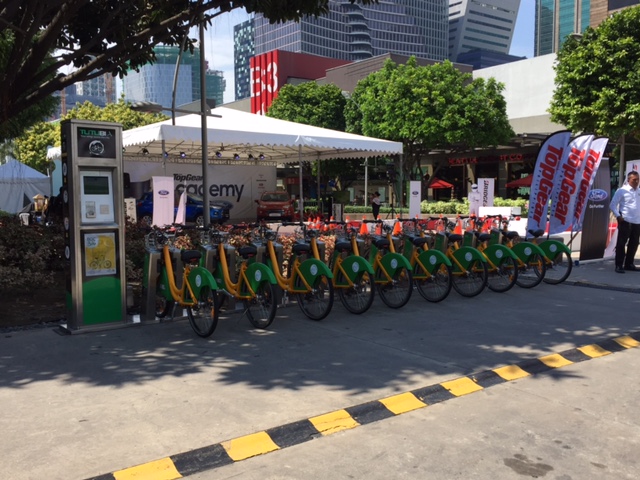 All the bikes seem to be here as not a slot was vacant.
 It seemed ironic to see not one bike in use against the backdrop banners of a popular motoring magazine.
 A closer look at the portal shows what looks like a new (unused?) facility.
It seems to me that there are few users of the Tutubi at least at Bonifacio High Street. I wonder if the bikes at UST are utilized more than the ones at BGC. I also wonder if UST is monitoring or studying bicycle use in its campus. Its use being limited within the premises of the campus sort of restricts users and diminishes utility. UST has a walkable campus and while its area is big (20+ ha) compared to other universities and colleges in the University Belt district, it is smaller beside Katipunan neighbors Ateneo De Manila University (80+ ha) and the University of the Philippines (493 ha). The latter two are also “walkable” with UP having more park-like features and open to the public.
UP Diliman has its own Bike Share program run by students and (I might come as biased) these seem to be popular on campus as I see many of the bikes used by students to go around from one building to another. UP Bike Share currently employs a more conventional system including subscriptions for frequent users. There is, however, a Department of Science and Technology (DOST)-funded project through the Electrical and Electronics Engineering Institute of UP Diliman that hopes to develop a more sophisticated system for managing and monitoring the bikes. That project has just started so we might wait 1 to 2 years to see its fruits.
–
Oversupply of vehicles for ridesharing/carsharing – Part 2
This is a follow-up on the recent post on ridesharing/car sharing where I talked about my observation that there seems to be an oversupply of vehicles being used for what is claimed as ride-sharing or car-sharing. In that post, I mentioned an observation by me and my colleagues that popular ride-sharing/car-sharing companies like Uber and Grab have led to more vehicles on the roads. I add to that the findings of our students that:
- Those shifting to Grab and Uber are mostly those already using taxis (regular users) and those using UV Express, which is a higher capacity vehicle using either vans or AUVs (average passenger capacities between 10 and 18 passengers).
- GrabCar and Uber function more as premium taxis rather than ride-share or car-share modes.
A friend who’s among the first Uber drivers in the country (He was already an Uber driver before the explosion in the service’s popularity.) shared that Uber earlier had been a real car-share/ride-share. My friend’s full time job was as a musician and he thought of becoming an Uber driver only to have some additional income for when he wasn’t busy with his work or didn’t have gigs. He was not roving around Metro Manila to get fares much like what is now being done by many Uber and GrabCar units.
Later, when Uber and Grab began more aggressive marketing; promoting their services as potentially generating much more income than conventional taxis and perhaps even a person’s full-time job, people started purchasing cars not for their use but to use in business in the form of Uber and Grab cars. I can probably understand those who bought cars and drove the cars themselves. To me, these would still qualify as ride-sharing/car-sharing but on the upper limit of what we can really consider “sharing” since they are supposed to be driving during their free times. Arguably, unemployed people have the entire day as free time compared with employed people or those who run businesses other than being Grab or Uber drivers. These include housewives and even “househusbands” who may have a vehicle at home that they can use for Uber or Grab. Employed people can only share their rides during the time they go to their offices or when they travel home later in the day. Others may have more free time as business people would likely have more flexible schedules.
Following is a series of screenshots I took en route to a meeting. It is, I believe, more systematic in terms of trying to determine the availability of vehicles – in this case GrabCars. Again, correct me if I’m wrong about my assumption that the vehicles displayed represent available cars. If they do not then it means the app is misleading people into thinking there are available cars for them to hire.

Grab Cars in the vicinity of UP Diliman
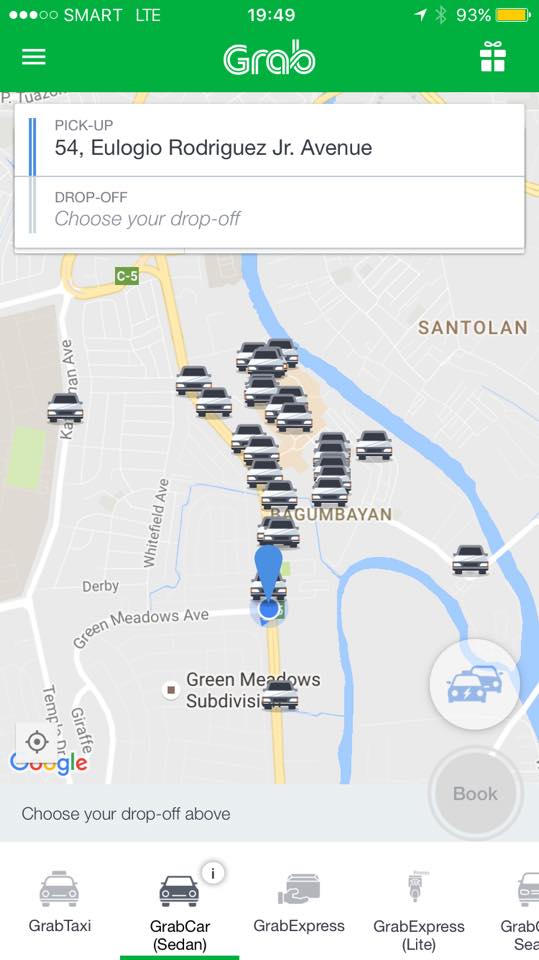 Grab Cars in the vicinity of Eastwood
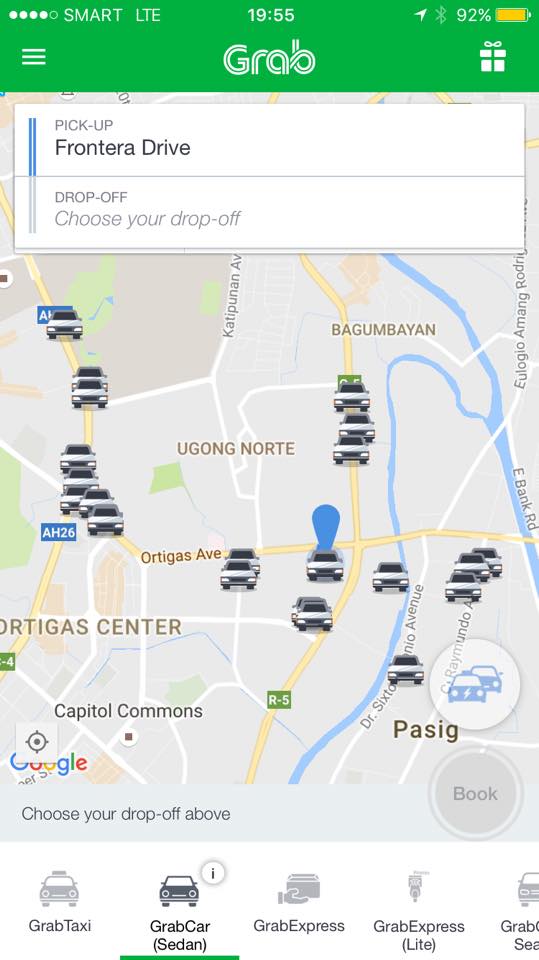 Grab Cars in the vicinity of Tiendesitas
 Grab Cars in the vicinity of Cainta Junction
–

