
Home » Policy (Page 4)
Category Archives: Policy
Let’s act on road safety crisis!
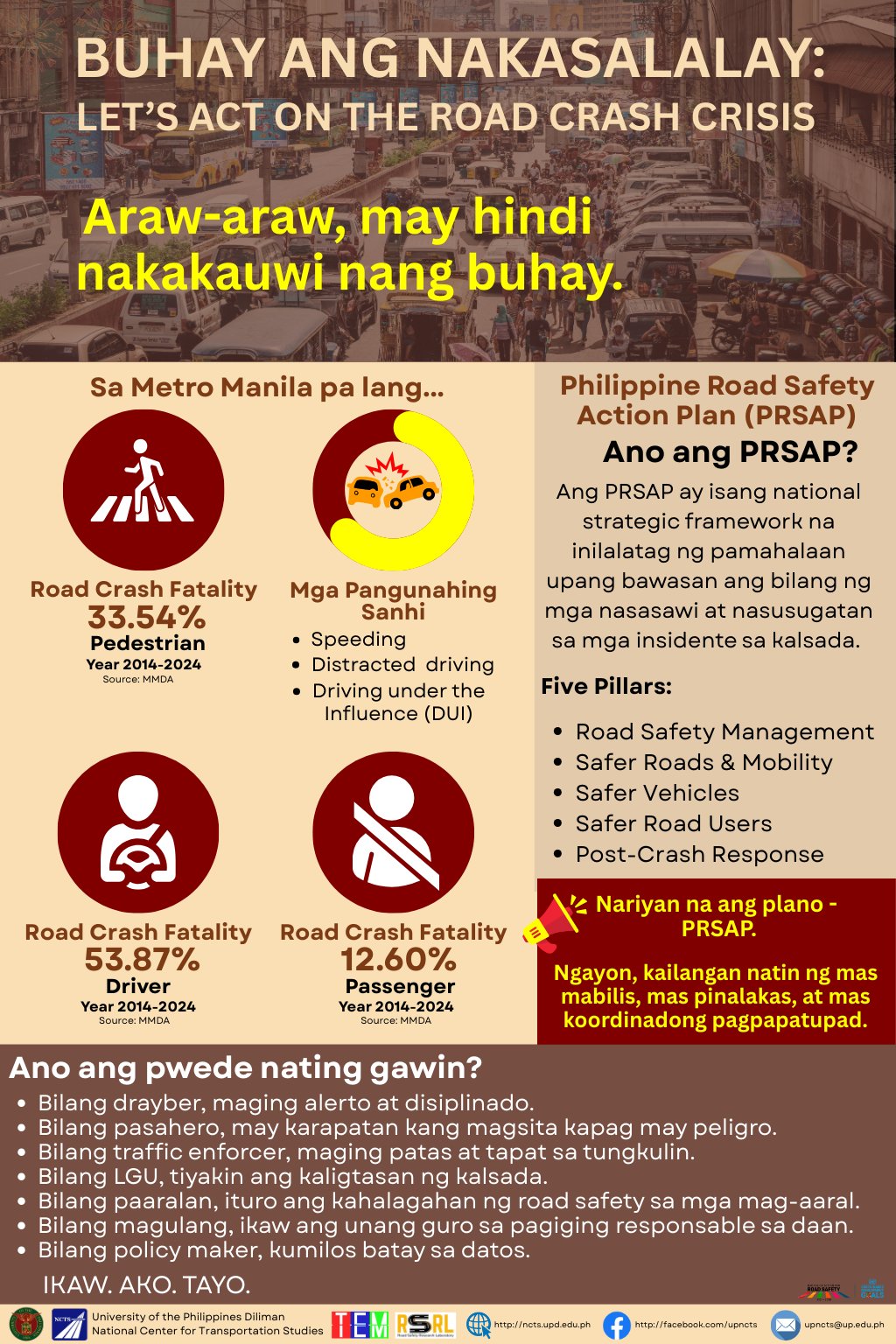
May is Road Safety Month. It’s quite ironic that we started the month with some of the most gruesome crashes including one at SCTEX and another at NAIA. There is indeed a crisis on road safety but many are in denial or perhaps insensitive to the impacts of these crashes. We need to act and only together can we be most effective in reducing the risks for all road users.
So what can one do? How can one contribute to making roads safer? Sharing this poster from the Road Safety Research Laboratory (RSRL) of the National Center for Transportation Studies (NCTS) of the University of the Philippines:
–
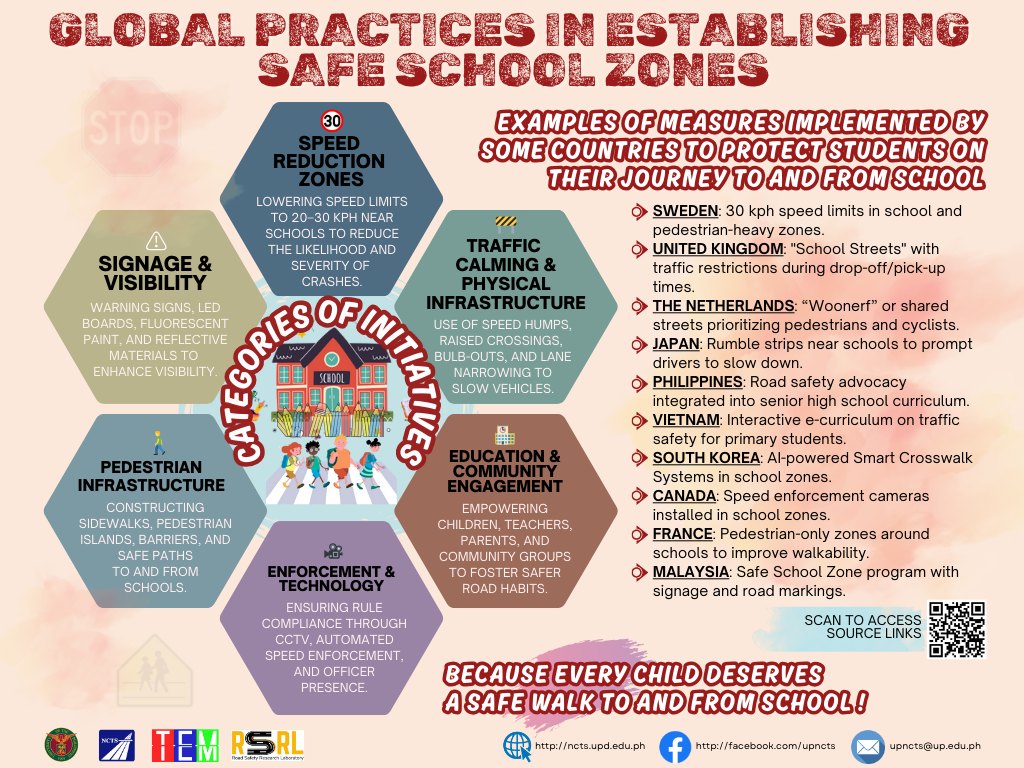
On safe school zones
We’ve been working for safer roads since I started practicing as a transportation engineer/planner. Most recently, we were working on a program supported by UNICEF on Child Road Traffic Injury Prevention (CRTIP). The work towards safer roads especially for those who are most vulnerable is always challenging but it is something that is definitely worthwhile. As we approach May, which is Road Safety Month in the Philippines, I will try to write more about road safety.
Here is an infographic shared by the Road Safety Research Laboratory of the National Center for Transportation Studies of the University of the Philippines:
–
On understanding road diets
I’ve written and shared articles on road diets and complete streets before. Here is another article share on road diets
Johnson, R. (April 21, 2025) “Explainer: What is a Road Diet – And Why Should Cities Embrace It?,” Momentum Magazine, https://momentummag.com/explainer-what-is-a-road-diet-and-why-should-cities-embrace-it/ [Last accessed: 22/04/2025]
To quote from the article:
“The road diet isn’t about punishing drivers. It’s about creating streets that work better for everyone—from the parent pushing a stroller to the teenager biking to school, the delivery driver navigating a tight urban corridor, or the senior walking to the store.
As our cities continue to evolve, road diets offer a cost-effective, data-backed, and scalable way to make them safer, cleaner, and more livable. It’s not just about losing a lane—it’s about gaining a better future for urban mobility.”
Indeed, the first thing that usually comes to mind of motorists whenever road diets and complete streets are mentioned is that the road space (and consequently capacity) will be reduced. This reduction of capacity is actually from the perspective of the motor vehicle rather than the number of people traveling along a road as well as improving road safety for all. The article is spot on in its discussion on the resistance to road diets (and complete streets). Of course, context is very important here and it is important to identify which roads can be transformed for the transformation to be most effective.
–
More garbage along our streets
Election Day approaches in the Philippines and despite certain rules that are supposed to be in place and followed by candidates and their supporters. Enforcement from the COMELEC is really bad (and that’s the truth everywhere around the country). Otherwise, we’d have a lot of disqualifications every election and perhaps many incumbent politicians won’t be able to run for office. Here are a few examples in my home city of Antipolo in Rizal where a dynasty “rules” and also has connections with another family in Cavite.
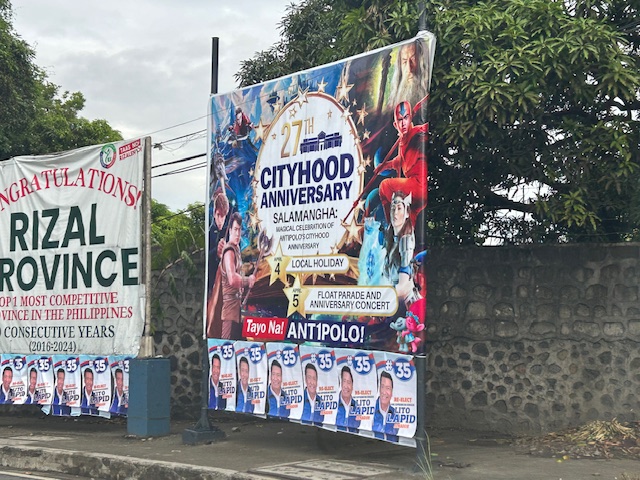 Antipolo’s city hood anniversary tarp features a Cavite politician who is closely related to the current leaders of the city and the Province of Rizal. Below the tarp are posters of a Pampanga politician who is also a movie actor like the other guy.
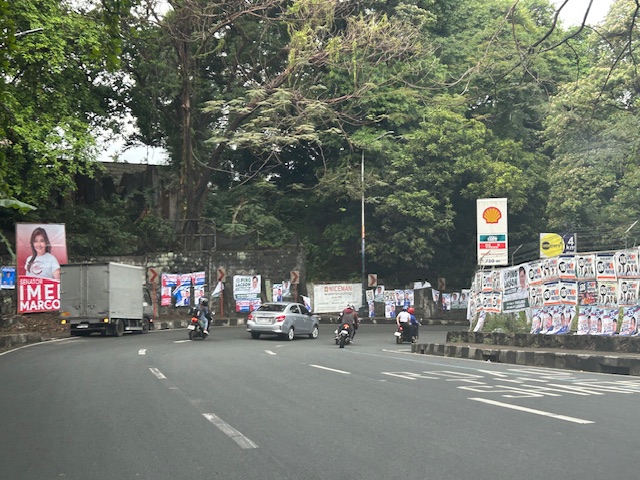 Antipolo roads are full of these campaign materials. Supporters have not spared private property of the garbage.
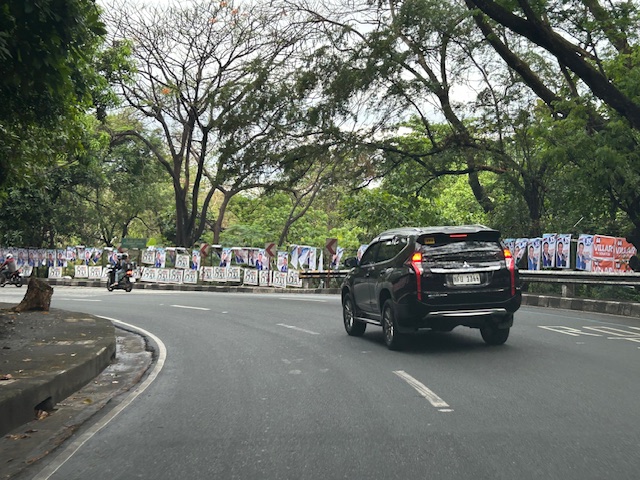 Perhaps those who will do the Alay Lakad to Antipolo this coming Maundy Thursday should each remove a poster, tarp or more as they journey to the Shrine of Our Lady of Peace and Good Voyage. This could be part of their penance and serve also as cleansing of minds in preparation for elections.
Try to explain again how these politicians are not overspending (and probably charging the costs to taxpayers). The math is pretty easy. You can check how much a politician’s monthly income is based on the salary grade of the position he/she is running for. Compare that to the amount spent for his/her campaign. You can’t recover the amount spent in one term. Are they billionaires willing to part with their money to get elected to positions that demand a lot in terms of the competence and dedication to good governance. Rather, the suspicion is that politicians will likely be corrupt and get his/her money back in a variety of ways to recover millions or even billions spent. It’s really a vicious cycle that doesn’t end well for the Filipino people in terms of the infrastructure and services we could have if only politicians moderated their greed.
–
On the pushback vs. bike lanes
I saw this short article at Planetizen that linked to another article that was the original one about cities dismantling or removing bike lanes. This is a very concerning trend in the US but something that’s also happening here. The Department of Public Works and Highways (DPWH) has always been lukewarm to bike lanes (parang napipilitan lang), the Metro Manila Development Authority (MMDA) seemed never to understand it (even during BF’s time as Chair), and many local government units that jumped on the bike lane bandwagon during the COVID-19 pandemic have reneged on their declared commitments. Currently, it seems that only cities like Quezon City and Iloilo City have sustained bike lanes development. Others have removed protected bike lanes or have not enforced vs. motor vehicles encroaching on the bike lanes.
Johnson, R. (February 18, 2025) “Cities Start to Backpedal on Bike Lanes: A Growing Crisis for Cyclists,” Momentum Mag, https://momentummag.com/cities-start-to-backpedal-on-bike-lanes-a-growing-crisis-for-cyclists/ [Last accessed: 3/2/2025]
To quote from the article:
“Bike lanes have become a culture war where those in favor are seen as “woke” or some other terrible conservative slur. But, most who use bike lanes are just regular people who want to save some money, and get the mental and health benefits to cycling to work.
Urban cyclists, bike commuters, and advocates for safer streets, have all noticed a troubling trend. What was once a symbol of progress toward sustainable transportation and safer roads for all is being reversed in multiple cities across North America.”
Will bike lanes and cyclists suffer similar setbacks here? Will the Department of Transportation (DOTr) continue to champion bike lanes? Will the agency be more aggressive and assertive of bike lanes development? Your guess is as good as mine!
–
Counterflow lanes in Bangkok, Thailand
I almost forgot again about this set of photos showing the implementation of a counterflow scheme along a long stretch of road in Bangkok. Heading out of Bangkok, I was able to take photos of the counterflow lanes and variable traffic signs used for this purpose. We were northbound meaning we were traveling outbound of the metropolis and opposed to the peak direction (southbound was inbound to Bangkok).
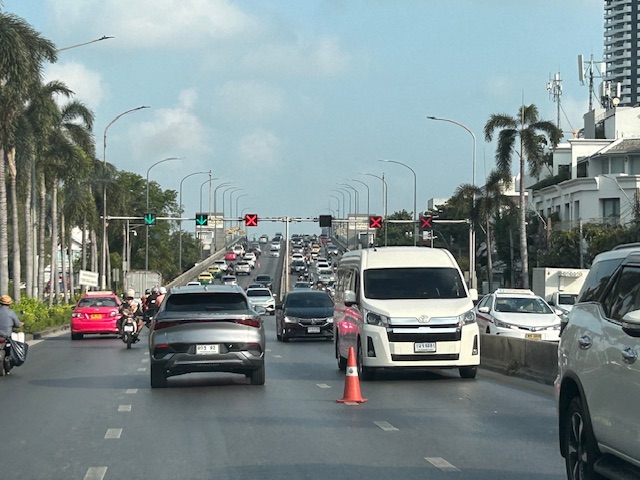 Approaching an overpass where variable traffic signs are installed overhead (i.e., on a gantry).
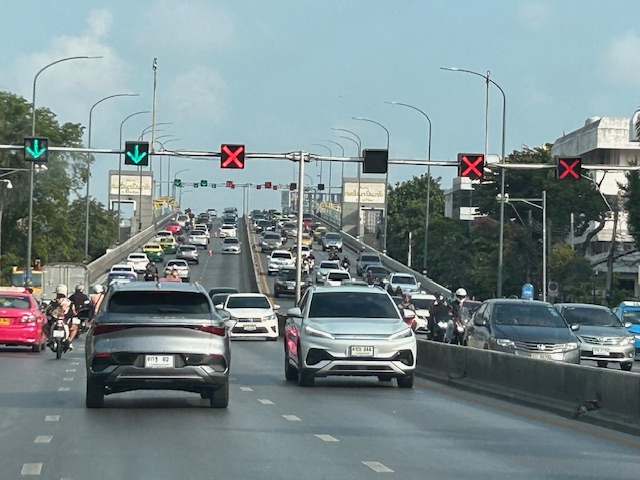 It is easy to see which lanes are assigned for our direction and which ones for the opposite flow.
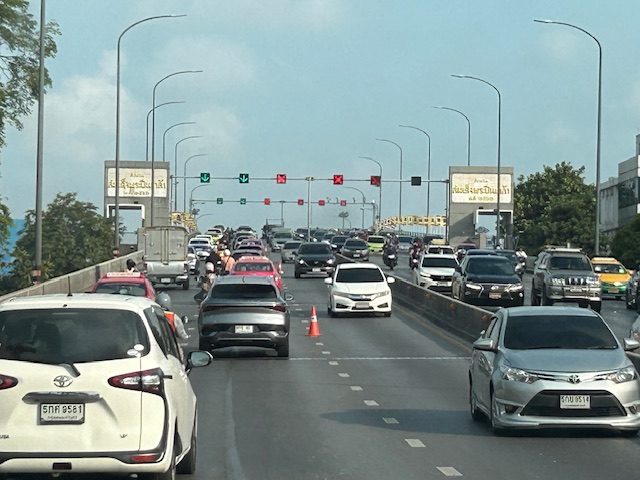 On the overpass, you can see that the variable signs are installed at regular intervals. There are a few cones that act as physical separators (not really barriers) between opposing flows.
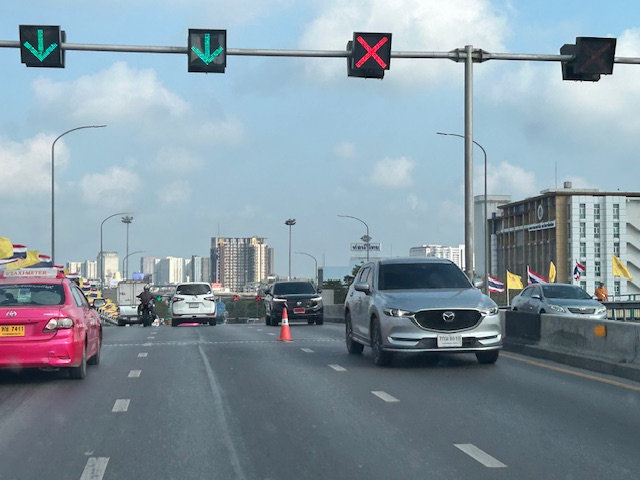 Sort of a close up of the variable signs and a cone. I assume the cones are placed there by traffic authorities. They might be transferred to the other side of the overpass if the counterflow was in favor of our direction.
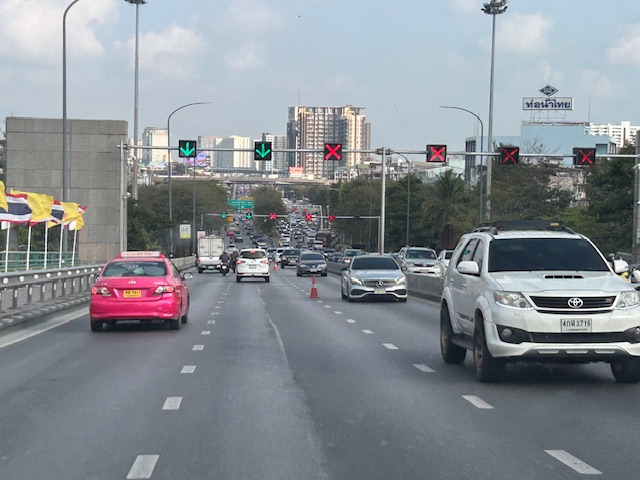 Another photo showing the installed variable signs towards the other end of the overpass.
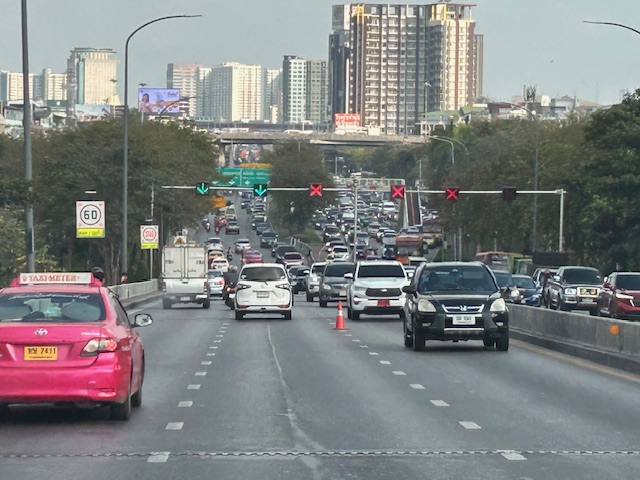 Four lanes are assigned to inbound traffic while only two are for outbound traffic.
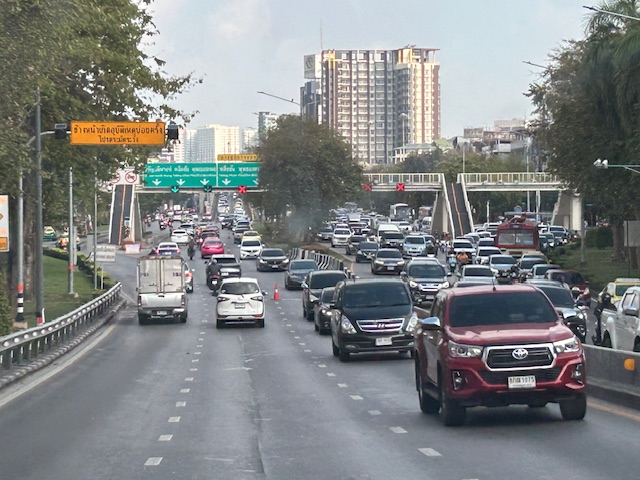 At the foot of the overpass is a pedestrian overpass. The stairs appear to be quite steep based on the photo. I’m not aware of criticisms of the pedestrian footbridges in Bangkok. I would have to ask my Thai friends about their designs.
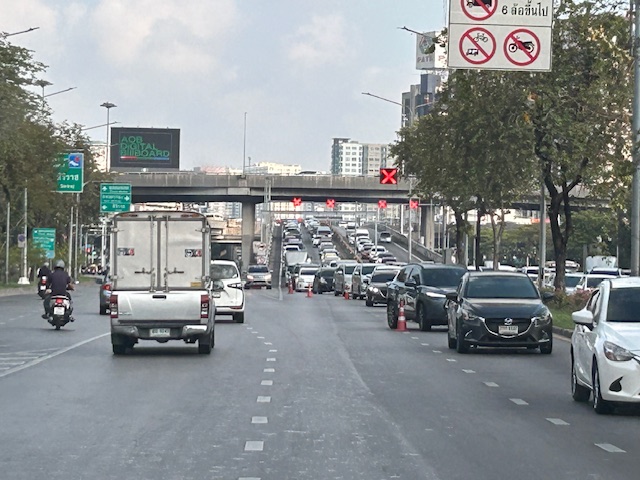 Another overpass where all lanes are assigned to the southbound direction
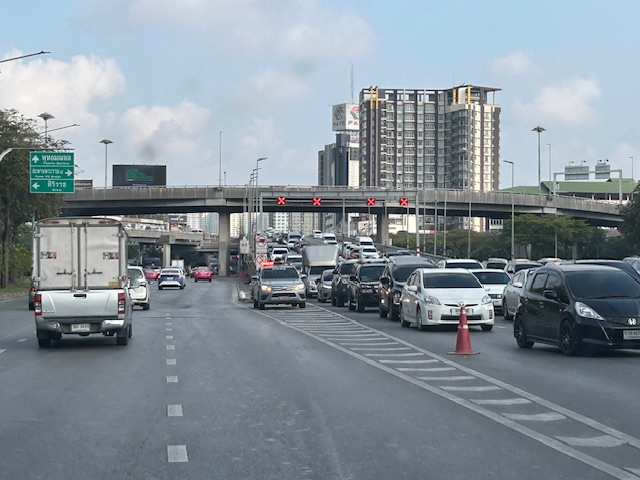 The parked vehicle on the chevron is with the traffic authority of Bangkok.
I actually started writing this in April last year. I will try to finish some drafts I started last year this month while also posting about my recent travel to Bicol.
–
“Coding exempt” vehicles and the demise of the coding scheme
I saw this car ahead of me during my commute. I knew this was an electric vehicle and these as well as hybrid ones were given an incentive in Metro Manila. They are “coding exempt” meaning these vehicles can be driven any day and ay hour during the weekdays.
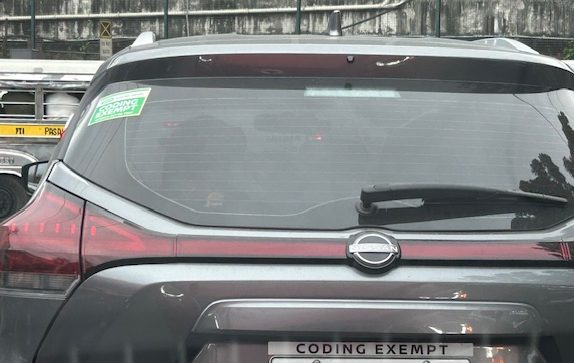 Are they selling these ‘coding exempt’ accessories or do these go free when you buy these cars?
People ask if the number coding scheme (UVVRP) in Metro Manila is still effective or relevant. Well, the answer is a ‘no’ and that is because over time, people have adjusted to it. Car owners have bought a second, even third vehicle that they call their ‘coding’ vehicle. Others opted to purchase motorcycles. And so that’s what we generally see along most roads in Metro Manila. It didn’t help that hybrid and electric vehicles are given exemption from the coding scheme. Those who can afford to buy yet another vehicle or perhaps replace their conventional ones are already buying these as evident from their increasing presence along our roads. While there is the perceived benefits with less emissions and air pollution, we still lose with congestion and its derivatives. Perhaps we should already have a congestion pricing scheme implemented for Metro Manila like the one in New York City. And proceeds should go to the improvement of public transportation to help arrest the erosion of its mode share in favor of private vehicles.
–
To B(RT) or not to B(RT)?
I kind of expected questions or comments from my ‘students’ after my lecture last Wednesday about “Traffic Congestion.” Among my slides were those featuring solutions to transport and traffic problems. I presented both soft and hard approaches including travel demand management schemes and infrastructure that we should have built decades ago. The uniformed officers who were there had a very simple take on congestion – it’s basically because of a lack of discipline. While theirs may also be valid observations based on their experiences, ‘discipline’ is not the most critical problem that we have especially considering the ever increasing demand for travel. One government official present was very direct in his question about what I thought about the MMDA’s pronouncement that they plan to remove the EDSA Bus Carousel. I thought my reply and the following explanation was clear – it was a wrong move.
The EDSA Bus Carousel is simple. Bus lang sa bus lane (Only buses along the bus lane). Pag may private or pa-VIP, bawal at huli dapat (If there are private vehicles or those who regard themselves as VIPs using the lane, then they should be apprehended. An HOV (high occupancy vehicle) lane is more difficult to implement. Mas pahirapan ang pag monitor and enforce (It is very difficult to monitor and enforce). So this proposal to phase out the EDSA bus lanes don’t make sense from this perspective. In fact, I don’t agree with a couple of more senior transport experts who say that the MRT Line 3 is sufficient and that it hadn’t reached capacity yet. It has but in the time that the carousel has been operational, the carousel had absorbed much of the demand along the corridor. There is also the fact that it will take much time before Line 3 is upgraded. Are the new train sets here? Are the stations designed for these trains and more passengers? If the answers are no, then MRT3 will not have its capacity increased in such a short time. That also means the carousel is very much relevant not just to supplement MRT3 capacity but as a needed alternative mode for commuters.
–
Article on the evaluation of congestion pricing
I want to share this article on the congestion pricing zone in London. This is called the Ultra Low Emission Zone (ULEZ), which also met resistance when it was first implemented.
Selby, O. (January 16, 2025) “ULEZ expansion hasn’t hurt high street spending,” Centre for Cities, https://www.centreforcities.org/blog/ulez-expansion-hasnt-hurt-high-street-spending/ [Last accessed: 2/1/2025]
Quoting from the article:
“The benefits ULEZ has provided to public health have been studied extensively. The data is clear: London has the worst air quality of any UK city and the capital’s emission zone is helping to change this.
So far, card transaction data does not suggest that ULEZ is harming high street spend. This should reassure policy makers in London, who committed to the emission zone a while ago, and strengthen the convictions of policy makers in New York who are now following suit.”
The article is a nice reference not just for evaluation of similar congestion pricing schemes but can also be used for carless streets or zones. I wonder if there are similar work being done for Baguio’s congestion pricing scheme as well as the carless programs in Ortigas Center. Quezon City should also do this for the newly implemented program along Tomas Morato.
–
Shared lanes in Baguio City – Loakan Road
I have several drafts of articles about our recent travel to Baguio City. Those include write-ups about roads to/from and in Baguio City. Before I post about Kennon Road and Marcos Highway, I want to share some examples of shared lanes I was able to take photos of while going around the city. The following photos were taken along Loakan Road near Camp John Hay. It is the same road that takes you Baguio’s airport.
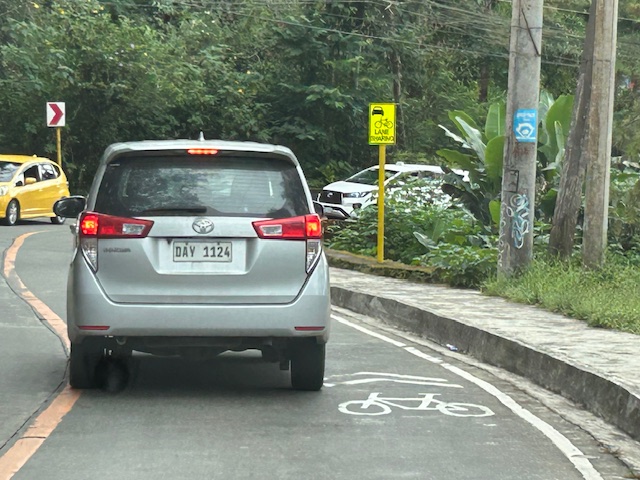 Note the use of the international standard for bicycle pavement marking. This is different from the rather odd bicycle marking in the DPWH guidelines that looks like a person on a treadmill (among other interpretations).
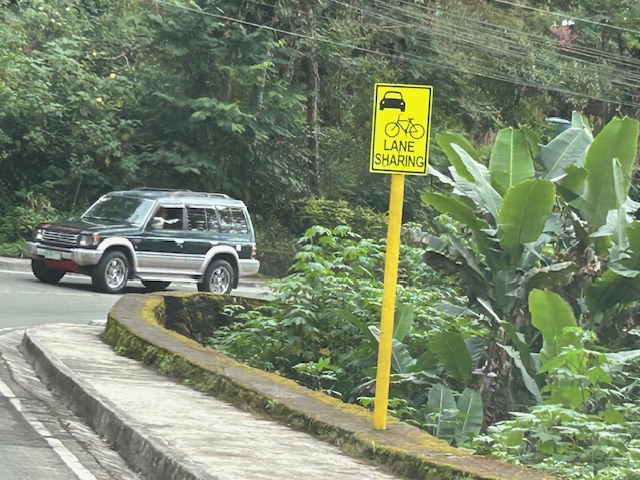 The signs are also not standard and somewhat small as you can probably see in the photos.
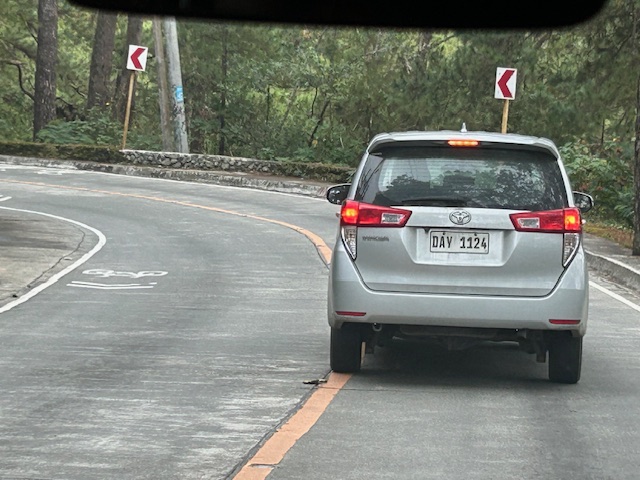 Chevron signs for the curve
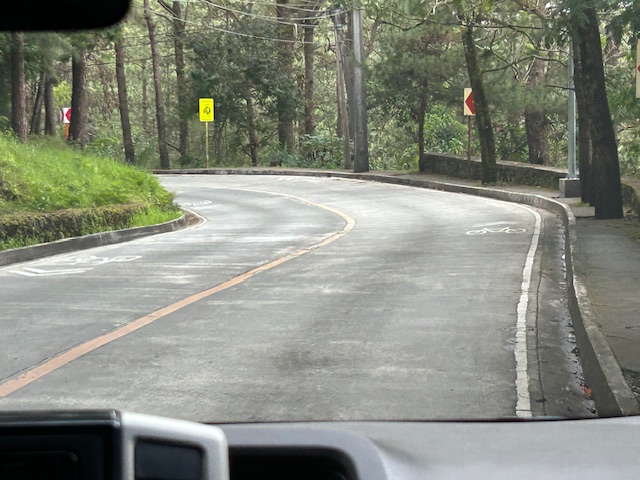 Another example of a curve section
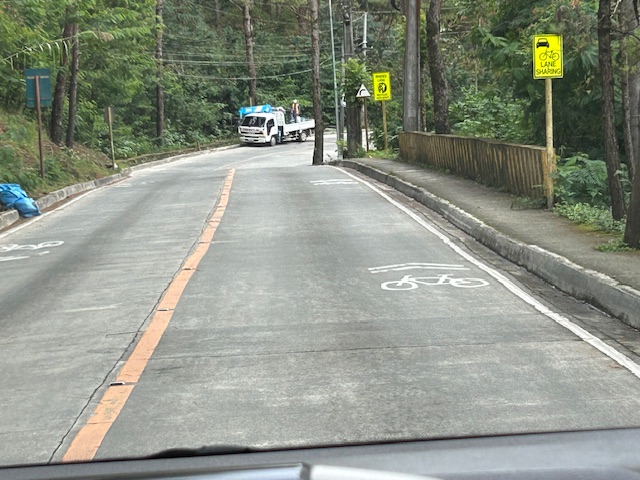 There are actually two types of signs installed along the road – both state lane sharing but with the other directing bicycles to keep right.
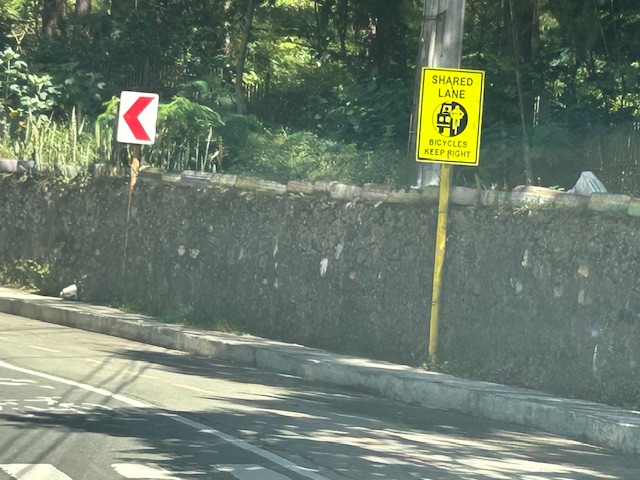 Two signs alternated along Loakan road. This one directs bicycles to keep right.
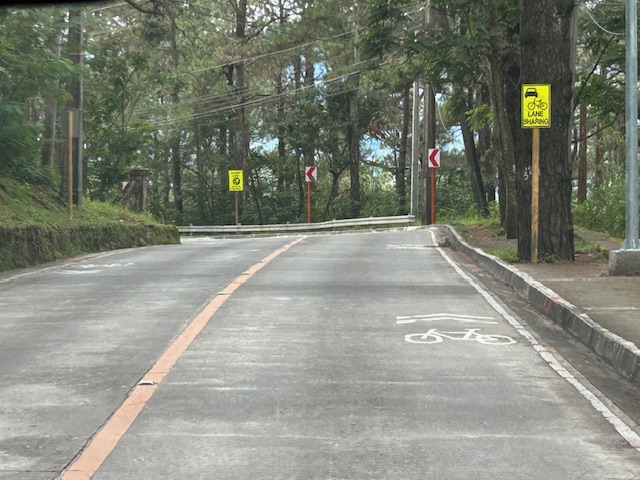 Signs and pavement markings are closely spaced. Perhaps the intervals are less than 5 meters for the pavement markings?
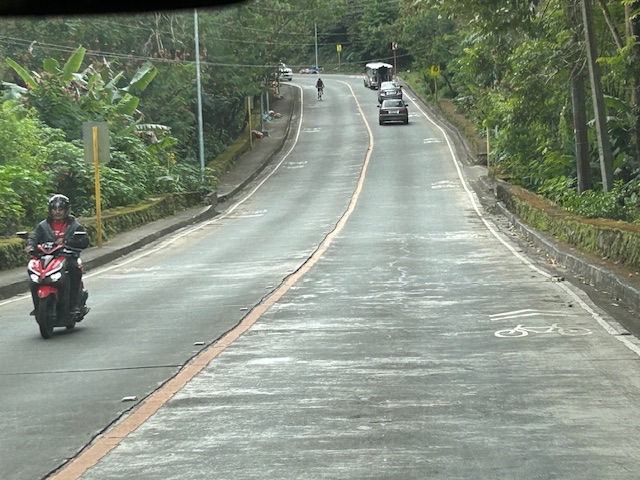 Section showing pavement markings for shared lanes
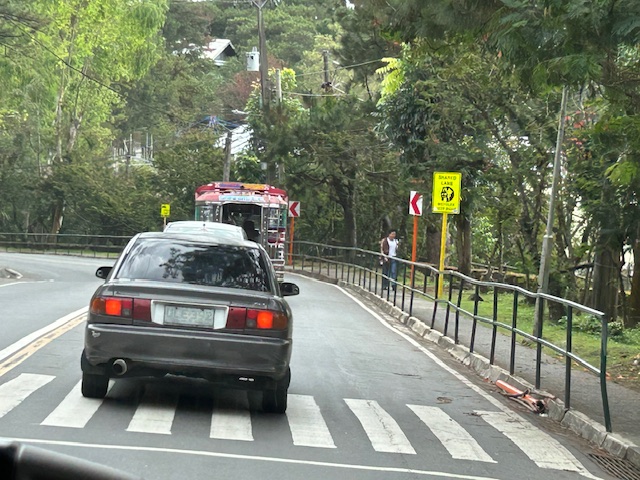 Pedestrian crossing and fenced sidewalks
While shared rights of way (sharrows) or shared lanes is not preferred where there is space for bikes, these can be implemented for 2-lane roads with adequate lane widths such as Loakan Road. It is clear from the photos that there is ample if not generous space for cyclists and motorists to share a single lane. The premise for safety here is that motorists will not be hogging the road space, being mindful of cyclists, and will move at safe speeds.
–

