
Home » Policy (Page 41)
Category Archives: Policy
Good intentions and knee jerk reactions
Social media is again abuzz with stories about Uber and how Philippine government agencies like the Department of Transportation and Communications (DOTC) and the Land Transportation Franchising and Regulatory Board (LTFRB) are hassling Uber, Grab and similar companies into complying with government regulations covering their services. Is it really a hassle and are these “Transport Network Companies” or TNCs the real deal in terms of solving part of Metro Manila’s transport woes?
I believe Uber and other services like it have good intentions towards providing high quality, on-demand transport services. However, based on what I’ve read about the service in other countries (particularly in the US and Europe), the intention (original?) was to take advantage of surplus or excess capacity of vehicles being driven by “owner-drivers” between origins and destinations such as their homes and offices. That means an improvement of sorts for traffic as, instead of having one vehicle per person, two or more can share a single car. The main differences with conventional carpools is that the driver and his passengers practically do not know each other, and the passengers pay the driver a fee that is agreed upon at the start of the transaction. This works well in car-oriented cities as well as those with less than satisfactory public transport services especially when it comes to taxis.
The last sentence seems to be the right description for Metro Manila and other rapidly growing Philippine cities. And so, Uber, Grab Car and other shared service attracted many users who can afford them and providers willing to share their rides with total strangers. I stated “owner-drivers” in the previous paragraph as this was supposed to be an essential part of the set-up where Uber and others didn’t add to the cars already on the roads. Problem is, apparently and allegedly, some enterprising people who had the resources thought it would be a good idea to deploy all their vehicles (and even purchase additional ones) by hiring drivers they could register with Uber or Grab Car. That way, they thought they could bypass the typically bureaucratic process of getting a franchise for taxi or rental car franchises that also include all those business permits and, of course, taxes. The result of this would not be the utilization of excess capacity but the addition of more cars on the roads and therefore contribute to worsening congestion.
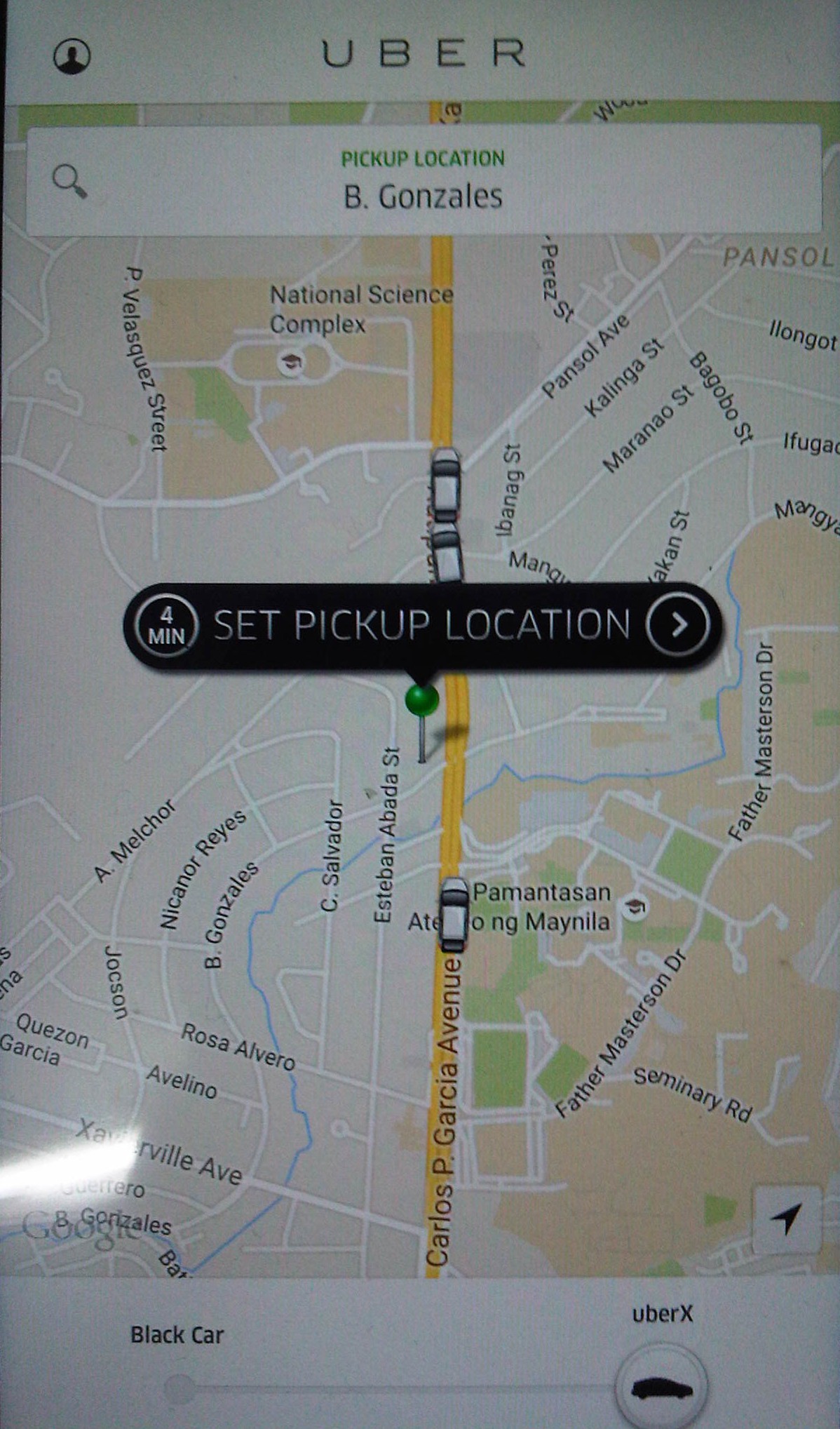
As far as the LTFRB is concerned, like it or not, they are just doing what they are mandated to do and are supposed to do with any transport service provider that is not purely private (i.e., services with a fee). It just so happens that the DOTC and LTFRB have been on the receiving end of a lot of flak from the public and especially in social media for what is perceived as the agencies’ ineptitude in dealing with major issues in public transportation. These include the continuing saga that is EDSA-MRT 3 and the perceived low quality services provided by buses and jeepneys in general that leave people at the mercy of taxis and UV express if they opt not or cannot afford to purchase their own vehicles.
The main issue is not whether DOTC and LTFRB should pay attention to Uber and others like it. The agencies should as per their mandates. However, there are a lot of other more serious and more urgent issues/problems including the much delayed mass transit projects and the low quality of service being provided by buses, jeepneys, UV express and conventional taxis that the DOTC and its attached agencies need to act on and now. I know it is a generalization (There are many good bus, jeepney, UV express and taxi drivers and operators out there who are also working their butts off to earn a living.) but then when you combine unsafe driving, with high fuel consumption and a lot of harmful emissions then you get a cocktail that’s definitely bad for all travelers.
How many people use Uber or Grab Car or taxis? Do they outnumber those taking the LRT/MRTs, buses, jeepneys and UV express? They don’t and therefore only represent a small percentage of the trips being taken everyday in Metro Manila and adjacent areas. And so the more pressing issues are really those pertaining to mass transit and the dire need to construct these systems once and for all in order to achieve a more sustainable and inclusive transport system for this still growing megalopolis.
–
Some thoughts on the EDSA MRT 3 problem
A lot of people reacted when the current Philippine President practically absolved the Department of Transportation and Communications (DOTC) from any fault regarding the issues on the EDSA MRT Line 3 during his recent State of the Nation Address (SONA). The main message in some articles appearing on mainstream and social media is that the President should blame DOTC for the mess. I have the opinion that both DOTC and the private entities involved (MRT Corporation, MRT Holdings) are responsible for the problem and its being continuously unresolved.
A week ago, I got the following question in my email:
Who is it that we could blame for the current state of the rail system? What do you suggest that the government or the private partner do in order for them to improve the line?
Quite frankly, I thought the first question was too direct and blunt as to ask who we can blame for the MRT3 mess. It is also very awkward to answer the second question because it assumes that I am an expert on the legal issues on this matter. I am NOT a legal expert nor would I want to pretend to be one. Here was my reply:
That’s actually a very tricky question. We can’t really blame a specific person or persons but perhaps entire organizations that are supposed to be responsible for the mess that is MRT3. The main or root issue seems to be legal and not at all technical. The technical problems experienced are manifestations of a contract that is a textbook case for how NOT to do a PPP. I am not privy to the details of the discussions between the government and the people involved and behind MRTC so it is awkward to make comments specific to this matter of the contract and all its complexities. Perhaps the DOTC wants to follow “Daang Matuwid” by not budging to the terms laid out by MRTC? Perhaps MRTC is aware of the stakes (plight of the riding public) and is using this to force DOTC into a deal that is not favorable to government? We can only speculate on this without firsthand knowledge of their discussions.
However, from the perspective of transport as a service and as a public good, I would say that MRTC indeed is aware of the public’s clamor for improvement. This is all over the news and social media in the form of commentaries, images and even videos of the undesirable experiences of those taking the MRT3. In the end, DOTC must decide whether it is all worth it to maintain the stalemate with MRTC considering that the public interest is at stake here and things will just become worse with inaction. Perhaps the government should move towards the best compromise they can live with considering the urgency of addressing the problem at hand.
I would like to think that my reply was quite cautious. There have been many allegations and claims from both sides of the table regarding how to resolve the impasse and the conflicts that seem to be interwoven with the contract on the MRT3. Perhaps such cases test the limits of “Daang Matuwid”? Much was and is expected from DOTC considering its battery of lawyers including top officials of the department. Aren’t they supposed to have been involved in discussions and negotiations aside from strategic planning for our transportation in this country? I guess the general public especially those who take the MRT3 for their commutes already know who to blame for their plight…
–
State of the nation’s transport – 2015
The National Center for Transportation Studies (NCTS) of the University of the Philippines Diliman received a few letters from media the past week or so asking for resource persons on transport for today’s State of the Nation Address (SONA) by the Philippines President. It is something like a routine for media to come up with commentaries or reports assessing the performance of the government. This year is a bit special because today’s is the final SONA to be delivered by the current administration. The presidential elections will be in May next year and the next SONA will be delivered by whoever wins in that election. There is already a long list of aspirants, declared or expressing interest, for the top government post in the country, and this includes many who are perceived to be critical if not hostile to the current administration.
I was invited to give an assessment by a major media network back in 2010 and I remember giving that previous administration a grade (using the UP grading system) of 2.0. I explained that I could not give a very high grade because a lot of transport infrastructure remained unimplemented. These included airports, ports, highways and bridges, and, most notably, mass transit systems. I had knowledge though that many of the infrastructure projects were at the end of the project development or already have their feasibility studies and were ready for implementation by the succeeding administration. These were the so-called “low hanging fruits” that were “ripe for the picking” the following years. Sadly, many of the notable low-hanging fruits remain unimplemented. These include the LRT 2 Extension to Masinag in Antipolo City, the expansion of Clark Airport, the rehabilitation of the PNR, and the BRT in Cebu City.
 Traffic congestion along Commonwealth Avenue – whatever happened to the proposed MRT 7? [Photo courtesy of Rodel Velasco]
I recall a short exchange in social media with a government official whose favourite tagline was something like “We can do it!” He is fond of applying the tagline to a lot of things but especially with certain advocacies and politicians that he wanted to promote. When I asked him about transport and traffic at a CBD his office was involved in developing, the tagline immediately vanished in mention. He was quick to express what seemed to be his resignation that transport and traffic could not be improved in that rapidly developing CBD. This may be partly because they could not influence certain government agencies to expedite the implementation of urgent transport projects that would benefit the CBD. Clearly, to me, the tagline had a limit in terms of its applicability.
It seems the more appropriate tagline should be “Just do it!” as the Nike commercial goes and as adopted by a great senator who recently passed away (one who could have been a good president). It took the current administration a long time to evaluate projects and much of the delay appears to be related to the government’s fascination for PPP (Public Private Partnerships) to the point that their mention of projects being planned for implementation became another type of PPP – PowerPoint Presentation. It has been a frustrating last 5 years for transport infrastructure development especially public transportation and it is partly due t the insistence of the government to almost exclusively depend on the private sector for mass transport infrastructure. One opinion by a colleague that I also share in is for government to put its money (actually the people’s money) where its mouth is (in a manner of speaking) and invest in the construction of mass transit systems for major cities and then look to the private sector to operate/manage these systems. The government doesn’t have a good track record for managing transit systems (e.g., Metro Manila Transit Corporation, Pasig River Ferry Ferry, LRT Lines 1 and 2, etc.) but it has shown that it can build these (again LRT 1 and 2) and others (SCTEX, Iloilo and Bacolod Airports, etc.) if it wanted to. Perhaps we should again reflect on the real state of the nation’s transport come 2016 but do this very quickly so that we could finally alleviate the daily suffering experienced by most commuters.
Promoting road safety to our youth
Road crashes has been regarded as one of the top killer disease worldwide. Many people have perished or have been seriously injured in road crashes. As such, road safety is and should be a top concern among national and local agencies. We are all vulnerable road users whether we are pedestrians, motorists or riders regardless of our age, gender, ability or health, income and other attributes. And so it is in our best interest to be aware of and participants to initiatives advocating road safety.
The Philippines is part of the Global Road Safety Partnership (GRSP) with its own PGRSP acting as an umbrella organization consolidating and coordinating road safety initiatives among government and private organisations. Among these initiatives are programs promoting road safety among our youth and particularly to our children. Kids are very receptive to ideas. Their minds are like sponges in terms of their absorption of knowledge and information about everything around them and what’s provided to them. If they are taught about road safety at an early age, they would hopefully be able to appreciate this and even influence their parents, siblings and relatives to be practitioners and advocates of road safety.
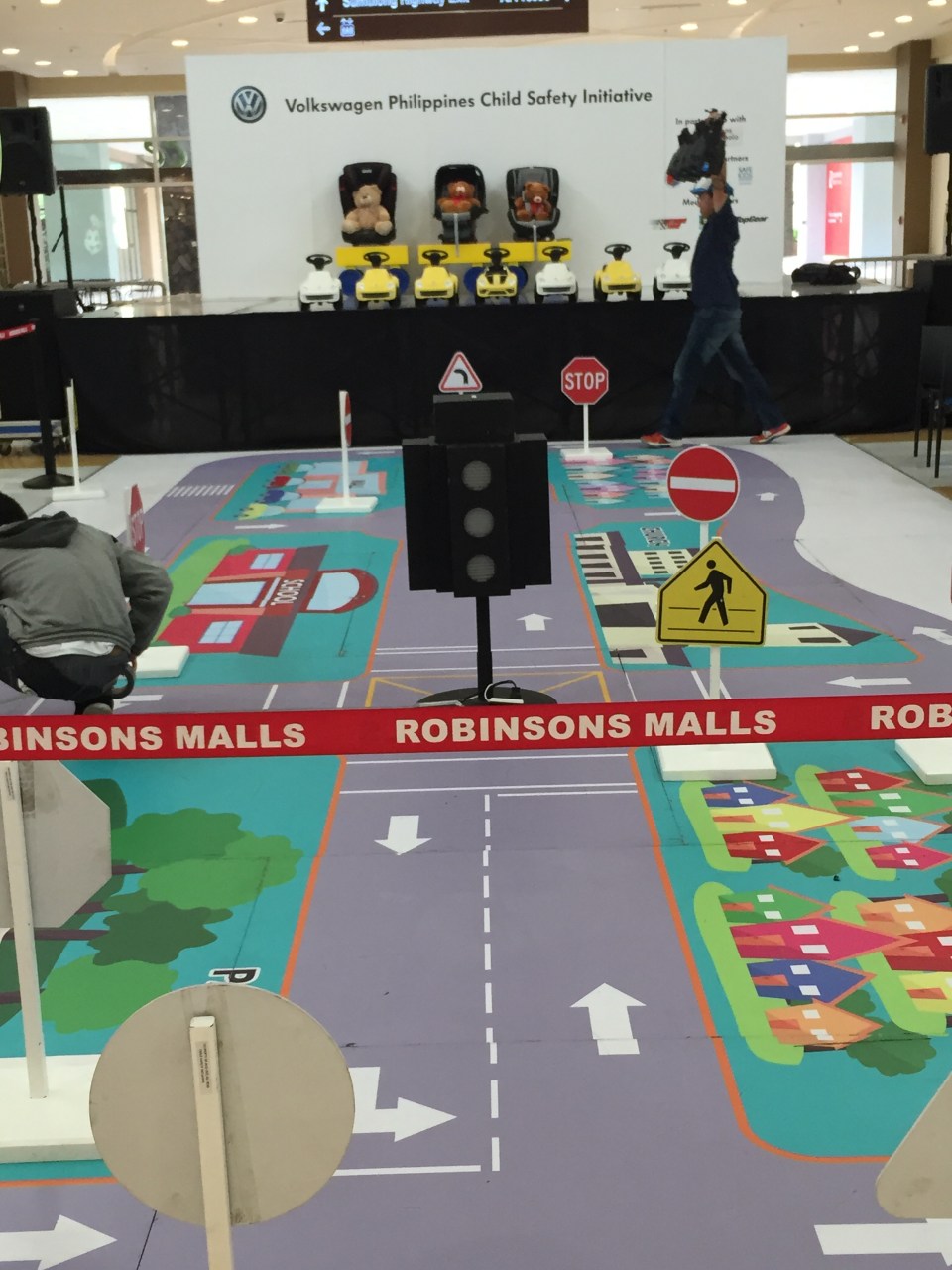 Road safety promotion initiatives like this is a collaboration of several government and non-government entities like the DOTC, PGRSP and Safe Kids Philippines with support from various partners in the private sector including Automobile Association Philippines (AAP), Top Gear, and of course, Volkswagen Philippines, which has a very active child safety program.
 Layout of the ‘portable road safety park’ that can be easily set-up in road safety promotion roadshows like those being held at malls around Metro Manila and its adjacent towns.
 Another view of the ‘park’, stage and orientation area for the road safety initiative at a major mall in Antipolo City, which is to the east of Metro Manila.
 Children and their parents/guardians flock around a resource person for the road safety initiative and park.
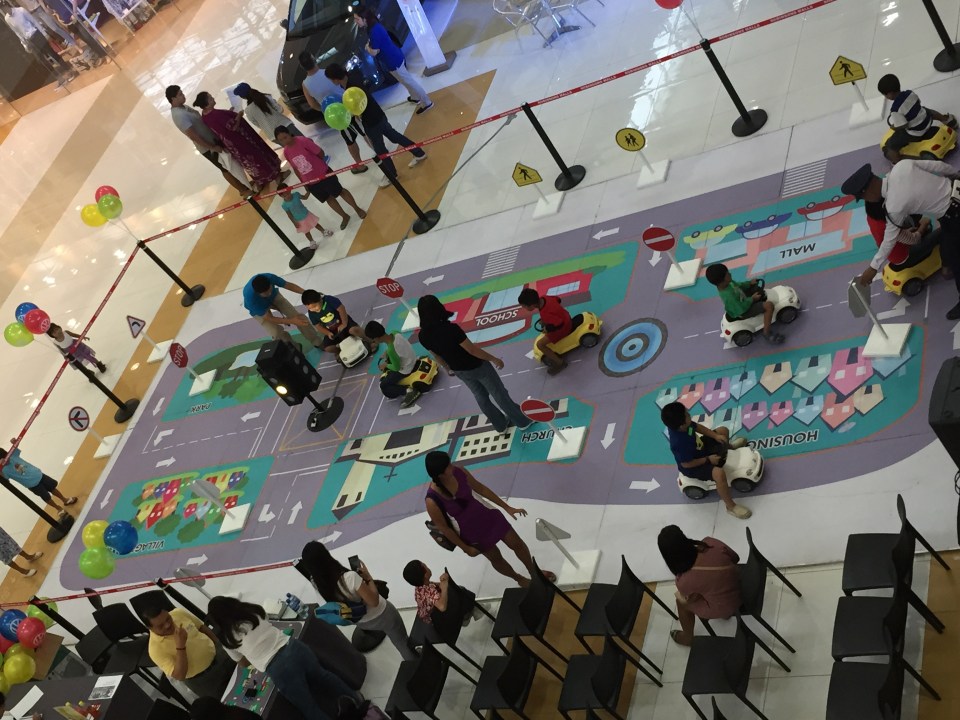 Kids try out the portable road safety park, simulating traffic using toy cars and familiarising themselves with basic traffic rules and road signs.
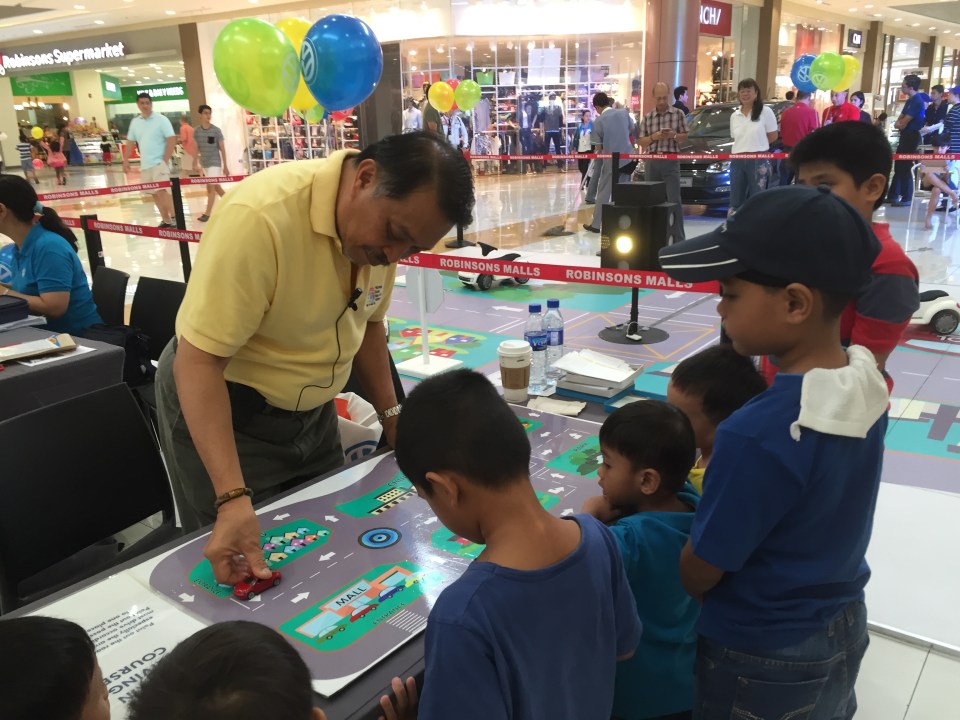 Former LTO chief and current Secretary General of the Philippines Global Road Safety Partnership (PGRSP – the local affiliate of the international group) Albert Suansing orienting children about the road safety activity
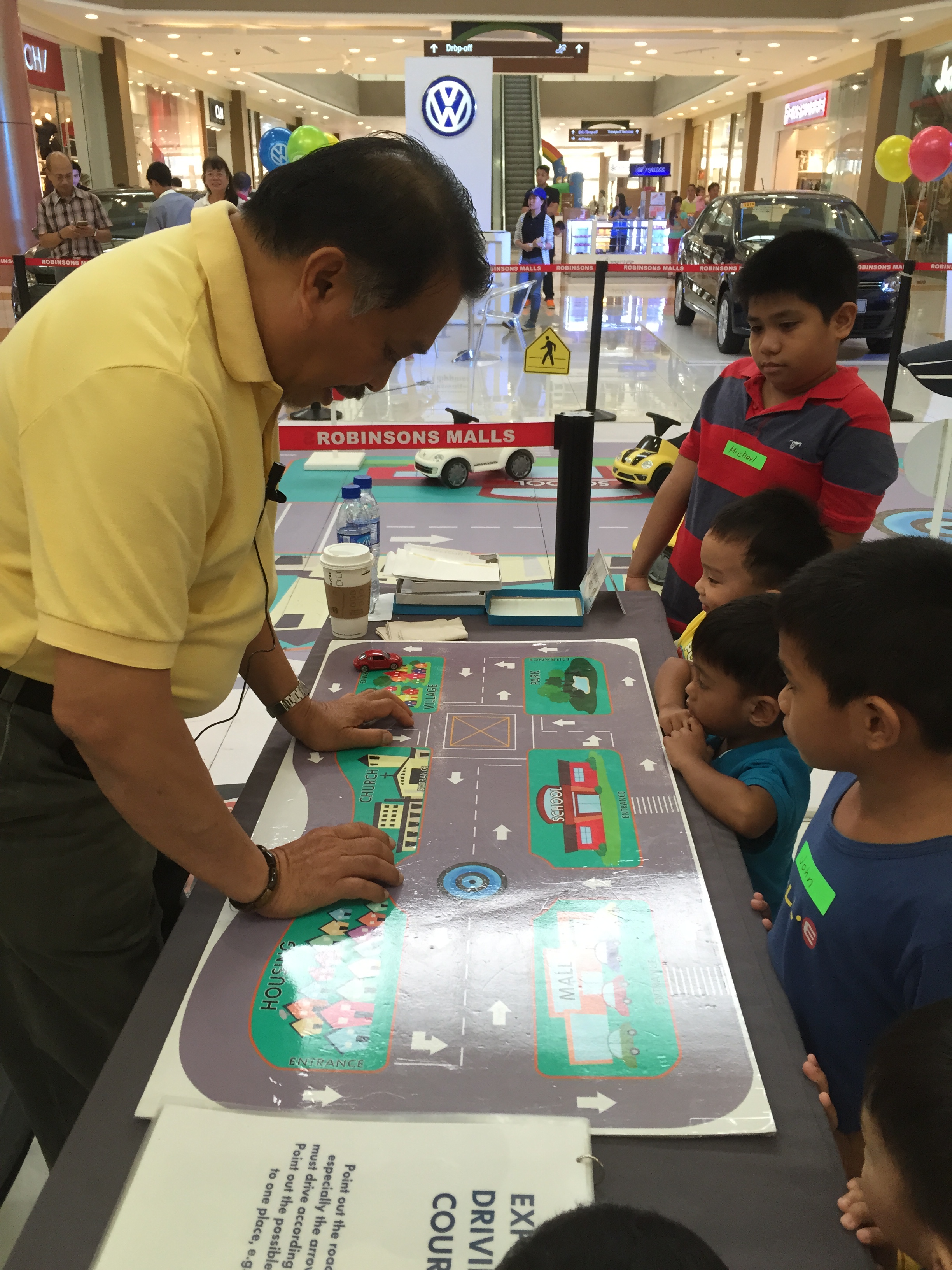 People should be taught about road safety at an early age. Children are very receptive and their minds are like sponges in terms of absorbing the information provided to them (e.g., road safety practices, correct behaviour for pedestrians and motorists, etc.).
We hope that there will be more initiatives like the one we featured here. I believe there are many who support road safety and those who are interested in promoting it among various stakeholders. Hopefully too, these will be extended and held in other cities around the country in order to increase road safety awareness and support that will ultimately lead to safer road environments for all.
–
Some setbacks for sustainable transport
There have been a few setbacks for sustainable transport in the news recently and not so recently. One is the burning of an electric vehicle, a COMET to be precise, that saw one unit burn to the ground near the UP Town Center along Katipunan Avenue. I am not aware of any official or formal findings being released as to what really happened to the vehicle but that is basically a big PR problem now as detractors of e-vehicles will point to the incident as proof that e-vehicles still have a long way to becoming a viable and safe option as public utility vehicles. E-vehicles have a lot to prove especially as an option for public transport and such setbacks only strengthen the argument against them and leaves us with the current conventional options.
Another is the discontinuance of service inside the Bonifacio Global City (BGC) of hybrid buses operated by Green Frog Transport. This one is due to what Green Frog described as exorbitant fees being charged by Bonifacio Estates Services Corp (BESC) for their buses to enter BGC. This is making the rounds of social media but there seems to be no response from BESC nor from the Bases Conversion and Development Authority (BCDA), which is supposed to also have a say with policies in BGC. Perhaps BESC thought it best to just give Green Frog the silent treatment for what appears as a trial by publicity approach by Green Frog. One commuter commented that maybe BGC authorities should push for their Fort Buses to be hybrid and phase out the jeepneys in favour of higher capacity transit inside BGC.
There have also been issue on road safety including many incidents of pedestrians getting run over by vehicles. Many of these have been captured on video particularly by the Metropolitan Manila Development Authority (MMDA), which has set-up a network of cameras in many intersections along major roads. Many show vehicles Given that many cases feature jaywalking, it is still the responsibility of any motorist to exercise caution when manoeuvring, especially when turning at intersections. Drivers will always have blind sides or weak sides when they manoeuvre so they should be very careful when in doubt and not immediately proceed when it is not clear that they have a clear path. At BGC (again) one will notice that many motorists do not give way to pedestrians even when the latter are crossing at the right locations and according to the sign clearing them to cross the street. In one case involving two speeding SUVs, one lost control and hit a pregnant woman crossing the street. While a significant number of vehicles in BGC are through traffic, it is still the responsibility of BGC’s traffic enforcers to ensure motorists follow traffic rules and regulations including prioritising safety over haste. Simply attributing such safety issues to through traffic is no excuse for traffic enforcement being as lax as or par with the rest of Metro Manila, especially for a CBD that packages itself as better than the rest of Metro Manila.
On the new transport categories by the DOTC
An article came out recently about the four new transport categories introduced by the Department of Transportation and Communications (DOTC).
These are:
- Transportation Network Vehicle Service (TNVS),
- Premium Taxi,
- Airport Bus, and
- Bus Rapid Transit
To quote from the article from Rappler, TNVS are:
“Vehicles of application-based, ride-sharing service providers, like Uber, GrabTaxi, Tripda, and EasyTaxi, will now fall under the category TNVS.
TNVS will cover vehicles that provide pre-arranged transportation services for compensation, using an online-enabled application or platform technology to connect passengers with drivers using their personal vehicles, Abaya said.
These new rules will also allow ride-sharing service providers to accept regular passengers heading to any point of destination in the country, Abaya added.
Operators of TNVS, called Transportation Network Companies, are also required to screen and accredit drivers and register them with the Land Transportation Franchising and Regulatory Board (LTFRB).
All TNVS vehicles will also be required to install and use global positioning system (GPS) tracking and navigation devices. Only sedans, Asian Utility Vehicles, Sports Utility Vehicles, vans, or similar vehicles will be allowed, and these should not be older than 7 years.
The new framework makes the Philippines the first country to have nationwide rules on ride-sharing, according to both the Philippine transport department and Uber. Previously, only local and city governments have regulated the services…”
Premium Taxis are described as:
“…vehicles with a 7-year age limit under this new category will be equipped with GPS, online and smartphone booking capability, and cashless transactions through credit or debit card payments.
Like TNVS, premium taxis will be allowed to accept regular passengers heading to any point of destination in the country…”
And Airport Buses are:
“…should have fixed schedules and off-street stops, low-floor height and adequate luggage space, CCTV cameras, GPS device, free WiFi, and must run on Euro V or clean alternative fuel.”
Abaya pointed out that Green Frog has expressed interest in the airport bus service that would ply three areas including Makati City, Mall of Asia (MOA) as well as Bonifacio Global City (BGC) or Ortigas business centre…”
I won’t mention the BRT anymore. It deserves its own feature (as if the previous ones on it are not enough to describe the system), and is the only mass transit among the 4 categories “introduced” by the DOTC.
These new transport categories are obviously a step in the right direction. These are not new ideas and the institution of these categories by the DOTC is long overdue considering that the agency had to go through this process in order to address legal issues pertaining to such services. In the case of TNVS and Uber, for example, much has been mentioned about franchise issues and how Uber was illegal under the prevailing set-up. It is good to have another option to the regular taxis but then weren’t GrabTaxi and EasyTaxi were supposed to have enhanced services?
As for airport buses, such limousine services have been in operation in many other countries. Unfortunately, in Metro Manila’s case, these buses would have to contend with worsening traffic conditions along most major roads connecting the airport terminals to the various points of interest mentioned in the article (e.g., Makati CBD, BGC, Ortigas CBD, etc.). It is good though that Green Frog was mentioned in the article as the new category provides an opportunity for cleaner and more efficient technologies to be applied to transport services. Still, if these services will be operated by reckless drivers then they won’t be much better than what we already have at present.
–
Still on license plates
I can’t seem to get over this pet peeve of mine that is the earlier move of the Land Transportation Office (LTO) for all new vehicles to adopt the same license plate design. It was an illogical move even as the LTO claimed the new plates had security features that allowed easy verification of vehicle registration. Common sense tells us that the easiest verification of whether a vehicle is for private or public utility is by simple vision. You don’t need high tech equipment to tell you that a van sporting a private plate and picking up passengers for fares is operating illegally. You didn’t need to exert a lot of effort to read the very small lettering on the new license plate for where the vehicles is registered because the first letter of the old license plates already indicated the region (i.e., the first letter corresponds to a region – ‘B’ for Region 2, ‘F’ for Region 6, and so on).
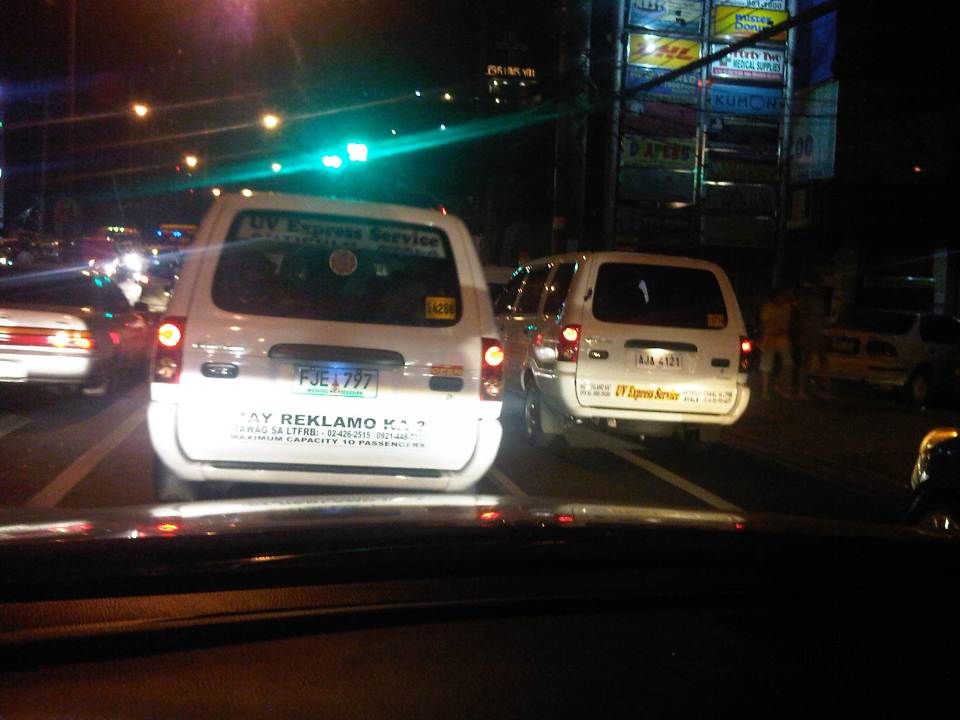 Two UV Express vehicles bearing plates that are supposed to be for private vehicles. The one on the left didn’t even make the cut for the new plates, being issued the older green plates.
I really hope that this is corrected ASAP considering that the LTO has rescinded the earlier policy and is supposed to issue yellow plates again for public utility vehicles.
–
Resistance is futile? The case against electric jeepneys
There is a strong sentiment against electric jeepneys along the route where the COMET is currently operating. This opposition has always been there even before the COMET came about. I would like to think that this is partly due to the perception among many operators and drivers that conventional jeepneys would be phased out and replaced by e-jeepneys. But then isn’t this replacement supposed to be an upgrade in terms of having a more energy efficient and therefore economical vehicle that had a significant bonus of being low emission as well.
I finally got a photo of the sign Katipunan jeepney operators and drivers put up at the terminal below the Aurora Blvd. flyover.
 Protest against electric jeepneys written on Manila paper and posted on overpass column at the Katipunan jeepney terminal
Given the recent innovations and the rapid advances in electric and other fuel vehicles, it should come as no surprise that more reliable and more efficient models of these vehicles will be available in the market. In the case of the Philippines where the thrust for e-vehicles is focused on public transport, there will eventually be a model that will comprehensively beat conventional jeepneys in every aspect. That is, if there is not yet a model that good. Arguably, the COMET and the latest e-jeepney model (BEEP) are already better than conventional jeepneys. However, their acceptability is pending with operators and drivers who seem uninterested with the case against conventional jeepneys. Perhaps these people are being fed false information by another party? Hopefully, they will open their eyes and mind to the reality that will eventually catch up with them if they do not embrace change.
–
Another example of mismatched plates
My most recent post was on the inappropriateness of the new license plates issued by the LTO to public utility vehicles. New taxis, UV express and jeepneys suddenly had the back and white license that’s supposed to be issued only to private vehicles. This meant that it would be difficult to distinguish the legitimate PUVs from colorum or illegally operating ones. In the last post, I was able to show an example each for these license plates on a taxi and a UV Express van. Yesterday, I was able to get a photo of a jeepney bearing this “anomalous” plate as I was caught in an unexpected traffic jam along an otherwise free-flowing road in Rizal.
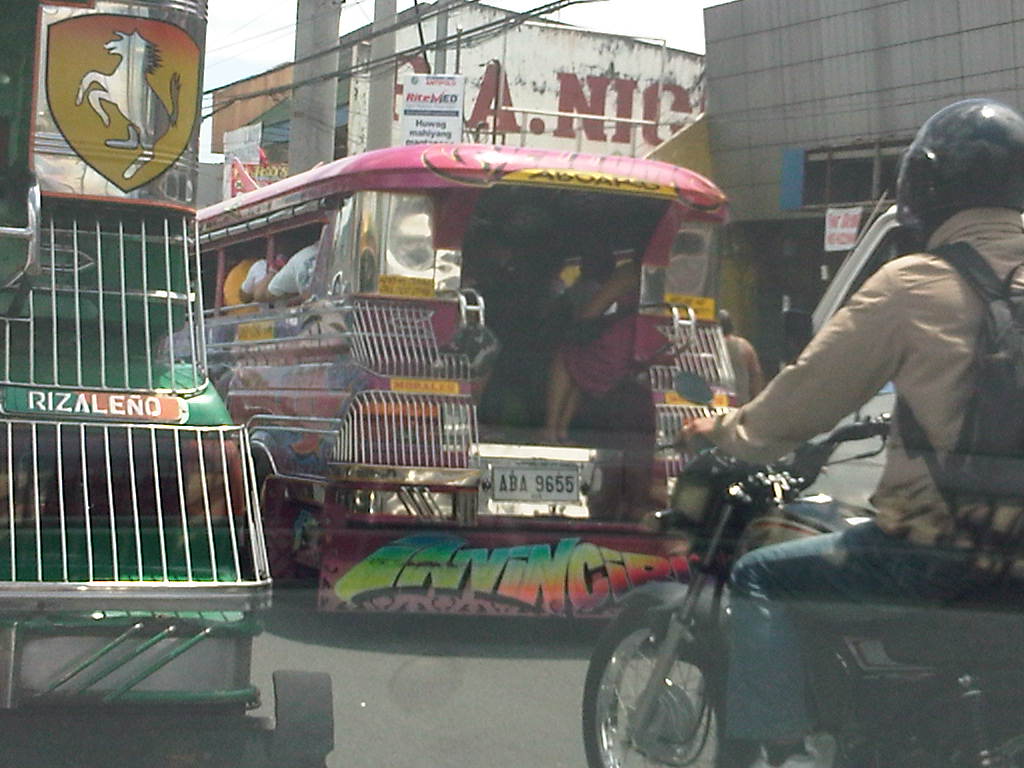 Jeepney bearing the black and white license plate issued to private vehicles
–
On the uncommon sense on license plates
The issuance of new license plates has been a very “painful” process and experience to a lot of people and it is not without serious issues. For one, there is still a backlog in license plates as evident from Strictly speaking, these vehicles shouldn’t be operating or not allowed to be driven even considering they are technically registered with the Land Transportation Office (LTO). The proliferation of vehicles without license plates allows for the abuse of such by owners of relatively new vehicles who can remove their plates in order to be able to take their cars on their coding days. It is also possible to be involved in a road crash or incident where the driver of a vehicle without a license plate can make an escape (the details on the conduction sticker are not easy to spot and memorize) or evade apprehension.
Among the most problematic is the issuance of plates of the same design as that used by private vehicles to public utility vehicles like UV Express and taxis. This creates a lot of opportunities for abuse especially private vehicles masquerading as PUVs. These are without the proper franchises and are illegal (i.e., colorum). What the LTO claims as security features on the plate are meaningless as the uniform color of the plates defy the simple logic behind the old policy of having a specific color to quickly distinguish among vehicles bearing different color plates. This makes it easier for traffic officers including the Philippine National Police (PNP) to spot vehicles with mismatched or inappropriate license plates.
 Taxi cab bearing plate with the same design as that used by private vehicles.
 UV Express van bearing license plate for private vehicles
The purpose of having plates with different colors is for quick identification and distinction of vehicles. A plate with yellow background has always been associated with public utility vehicles. Those with blue lettering or background are those for diplomatic plates. Those with red lettering or background are for government plates. Fortunately, the LTO has reverted to the original policy pertaining to the license plate colors and new plates to be issued to PUVs will once again be a distinctive yellow. Perhaps corrections are due for those legitimate PUVs that were issued inappropriate design (i.e., color) plates.
–
 Caught (up) in traffic