
Home » Policy (Page 43)
Category Archives: Policy
The Philippines Anti-Drunk Driving Law
It’s a Friday and another weekend is here. It’s also payday weekend and so it’s expected that restaurants, cafes and bars will be full tonight and the weekends with people dining, lunching, having coffee, and likely for many – drinking. For many years, the latter has resulted in too many road crashes, a significant number of which have had fatal outcomes – usually cars or motorcycles crashing into one another or by themselves. It’s even more dangerous (and highly likely to be fatal) for motorcycle riders who need to balance themselves on two wheels after getting inebriated. Meanwhile, a lot of driving under the influence (DUI) that in many other countries including the US and Japan don’t get apprehended primarily due to the absence of laws and guidelines for their capture and evaluation. There was no way to test their blood alcohol content (BAC) in the field and traffic personnel couldn’t force people to go to hospitals to be tested.
There’s good new, however, especially for road safety advocates. The Philippines is finally implementing Republic Act No. 10586 – An Act Penalizing Persons Driving Under the Influence of Alcohol, Dangerous Drugs, and Similar Substances, and for other Purposes, which was signed into law in May 27, 2013. Under the law, private vehicle drivers can be arrested and penalized for BAC of more than 0.05% while truck and public transport drivers and motorcycle riders can be apprehended for a BAC of more than 0.0%. For comparison, Japan requires a BAC of 0.0% for ALL motorists.
The Implementing Rules and Regulations for the law may be found here: PH Anti Drunk Driving Law2013 Rules. The Land Transportation Office (LTO) and the Metro Manila Development Authority (MMDA) have already acquired equipment to help them evaluate apprehended persons. These include breath analyzers and staffs of both agencies have already undergone training to be able to implement the law. Unfortunately, traffic enforcers cannot randomly test people on the road but would have to apprehend them first for violating other traffic rules and regulations. But I am sure our traffic law enforcers can be quite creative in how to catch these people who pose dangers to all other road users by their being irresponsible for driving or riding under the influence of alcohol or dangerous drugs. And with the national elections coming up next year, there will be a lot of checkpoints sprouting up along major roads that will also open opportunities for testing and apprehensions.
–
If you build it, will they come?
There seems to be a belief among the more zealous advocates of sustainable transport that if “you build it, they will come.” It seems cliche but this saying is not necessarily applicable to many things especially when referring to transport infrastructure. There are examples of roads, terminals and other transport facilities that have been built but sadly are underutilized mainly due to the demand just not being there and taking much time to attain. The last is usually due to the fact that certain conditions or prerequisites have not been satisfied. One such example of this is the case of the Subic-Clark-Tarlac Expressway (SCTEX), whose payment for the loan that covered the construction costs was premised on a very high traffic demand forecast. It took some time for more people to use the expressway as the traffic from the major developments (Clark, Subic, Tarlac and Bataan industrial and commercial developments) just didn’t happen as immediately as assumed in the forecast. Still, there is a strategic value to such major infrastructure considering it as an investment and something that will cost a lot more in the future if not built today.
In Metro Manila, the MMDA has allocated or designated lanes for cycling along several major roads. These included the lanes they created out of painting existing pedestrian sidewalks and marking these as bikeways. One section is between Magallanes and Ayala while another is from Ortigas to White Plains. These are poorly designed, “pwede na yan” types of bikeways that people on bicycles would find very difficult to use because the course is full of obstacles. And how about the plight of pedestrians who would have to share these narrow paths with cyclists? Such mixed signals on providing for the needs of pedestrians and cyclists are not necessary unless of course the main objective of this exercise is just to get the attention of a wider audience that is the general public, which I would strongly agree is needed to advocate for sustainable transport. Focus on the ultimate goal, however, should not be lost for what appears as small victories. Perhaps an even stronger initiative should be towards having the DPWH revise road design guidelines to incorporate walking and cycling requirement especially for national roads.
 Bicycle lane along Julia Vargas Ave. in Pasig City
Cebu City enacted an ordinance essentially promoting cycling through the planning and implementation of bikeways, bike lanes or shared lanes. However, initial efforts seem to be following the MMDA’s “pwede na yan” approach. I think Cebu could do better and come up with a better plan for integrating and mainstreaming bikeways into the transport network. But of course, a lot still needs to be done for pedestrian facilities.
In conclusion, building transport infrastructure is not an assurance that it will generate its intended benefits at once. However, some infrastructure are more strategic than others as perhaps they form part of a network. Expressways in Luzon are among these strategic investments. High standard highways in Mindanao are also essential. Rail rehab and building in Luzon is strategic. The same in Mindanao perhaps is not. Mass transit systems in highly urbanized cities are required but perhaps many should start with buses rather than rail. Bridges across islands are not urgent. International-standard airports in major cities are necessary but not all provinces require such airports. Its not a simple task to determine what will work and what wouldn’t. While it is easy to attribute so many benefits in order to justify a project, such practice would usually result in white elephants that few people benefit from.
–
“No” to additional jeepneys?
I finally got a photo of a banner that I’ve seen on many jeepneys plying the Katipunan route. This appeared on jeepneys a couple of weeks ago and the message on it is clear: “No to more jeeps, to more traffic in Katipunan.” I became curious about this as I noticed that list of transport groups that had their names printed at the bottom of the tarpaulin. Noticeable is the absence of one group, Pasang Masda, among the list that includes, among others, LTOP, ALTODAP and the party list group 1-Utak, which used to have a seat in the Philippines House of Representatives.
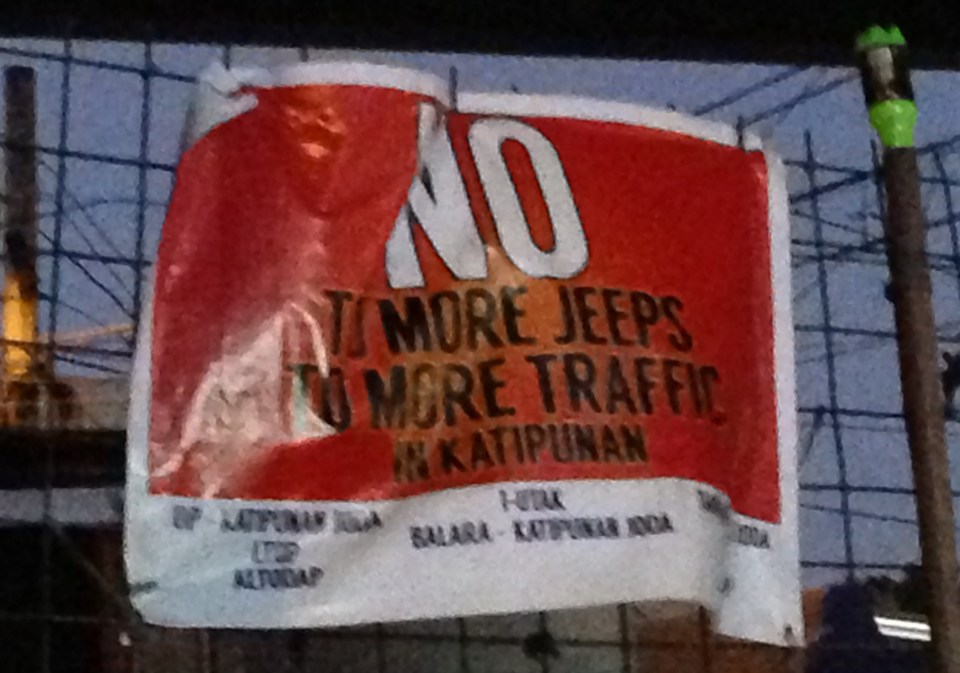 Tarpaulin sign hanging at a wire fence at the Katipunan jeepney terminal under the Aurora Blvd. flyover.
Pasang Masda is supporting the Comet jitneys currently plying the North EDSA-Aurora Boulevard route (via Mindanao Ave., Congressional Ave., Luzon Ave. and Katipunan Ave.). In fact, the head of the group is reported to have bought a few units, likely convinced of it as a good investment. Is it? Only time will tell considering its route is not necessarily the best for it, overlapping with several jeepney routes including the UP-Katipunan route. Is the Comet a game changer? So far, it isn’t and that’s mainly because of its single roue that’s not exactly favorable for a demonstration of the vehicle’s capability and claimed advantage over the conventional jeepneys. A colleague even says that it seems the route approved for it doomed its operation in the first place. But that’s an entirely different story from the opposition to it that’s stated in the tarps at the Katipunan jeepney terminal and some of the jeepneys plying the route.
So, is it a “no” to more jeepneys because their numbers are really already excessive OR is it a “no” because the additional jeepneys are from other groups or those not affiliated or in league with the undersigned? It seems that the latter case applies here and this should be taken as an example of what to expect along the way as initiatives to phaseout or replace conventional jeepneys get going. It is a bit complicated due to mainly to the social aspects of a phaseout or replacement but it gets more complex with the personalities involved including and especially the leaderships of various transport groups.
–
On jaywalking, overpasses and informal terminals
I had some errands last December and decided to take public transport instead of taking our car and wasting time parking the vehicle. There was significantly less traffic at that time of the year because schools already on Christmas break and everyone else seemed to be on the slow side of the holiday mode (read: not in shopping mode). I needed to cross the wide road that is Quezon Avenue and there was a sign where I usually crossed that it was now prohibited to cross there. I had to take the overpass to get to the other side and to the jeepney stop to board one to get back to the university.
The overpass at the Quezon Ave.-Araneta Ave. intersection is under-utilized. I base this on the several times I’ve used the overpass. Most people prefer to cross at road level, taking advantage of the traffic signal cycle that allows for gaps in the traffic for pedestrians to cross safely. Of course, there are those who cross any time and seem to tempt fate by their behaviour. They seem to tempt also the MMDA traffic enforcers assigned in the area but from what I have observed, enforcement of the “no jaywalking” policy is usually lax or non-existent. People regularly cross at ground level in plain view of traffic enforcers.
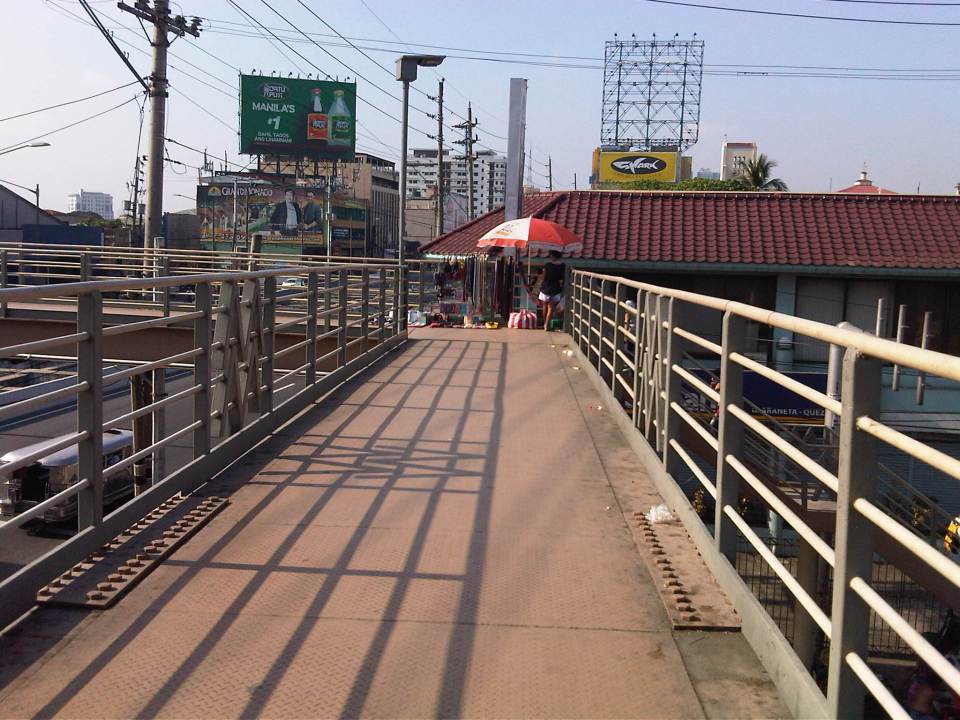 A vendor set-up at the corner of the pedestrian overpass at the Quezon Ave.-Araneta Ave. intersection. Obviously, there are few pedestrians using this overpass as most prefer to cross at ground level.
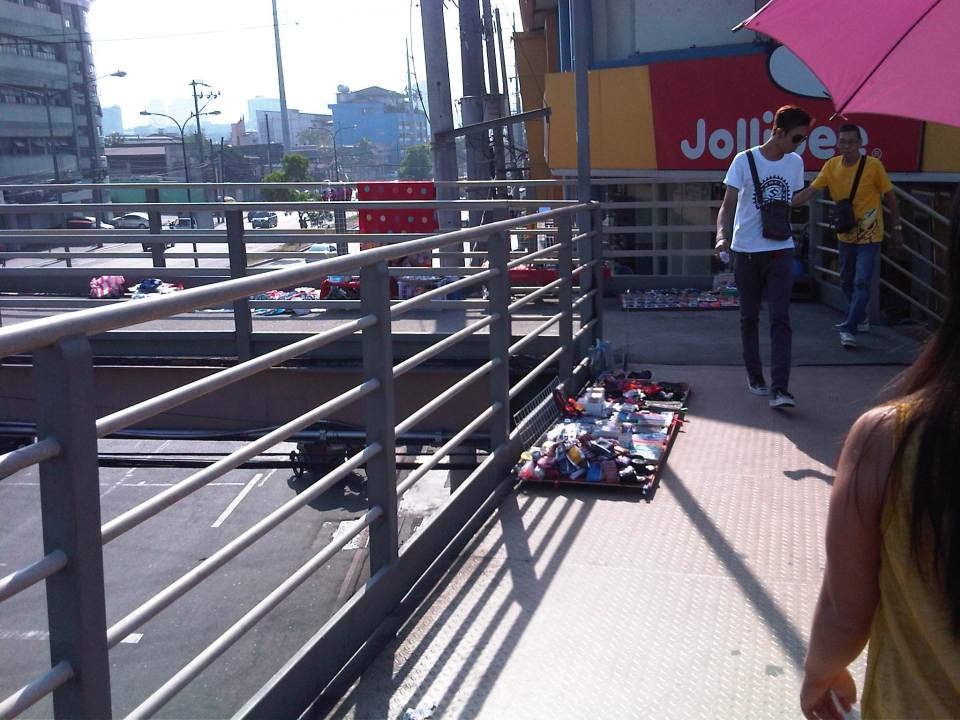 More vendors on the overpass – fortunately, there were few pedestrians using the overpass at the time. Its not the same for other overpasses that are crowded due in part to vendors occupying much of the facility.
 The stairs for many overpasses around Metro Manila are a bit on the steep side. That’s generally not okay with senior citizens, children or persons with disabilities.
There is an informal, on-street jeepney terminal right at the foot of the overpass. If you are in a hurry, its best to try to board a jeepney on the second lane as they are more likely to proceed when the approach is given a green light. From my experience, it takes about 2-3 cycles before the “queued” jeepneys finally cross the intersection. It takes that time to at least have several passengers for the jeepneys before it proceeds to cross the intersection. Most passengers here are transferring from jeepneys plying routes along Araneta Ave. There shouldn’t be an informal terminal here and jeepneys occupy 1-2 lanes of the road at a critical point – the intersection approach. This means intersection capacity is significantly affected and many vehicles could not proceed as they are blocked by the jeepneys. Special mention is made of vehicles wanting to make a right turn but have to go through this “gauntlet” of public utility vehicles. Again, there are MMDA enforcers in the area but it seems the jeepneys and the barkers hold sway and likely with the blessing of enforcers. Such situations are commonplace in Metro Manila and many other cities, and contribute to traffic congestion and other problems commuters regularly encounter.
–
Legit or kabit?
Traveling one morning from Antipolo, I spotted a bus with a familiar company name – EMBC. The last time I saw these buses operating as public transport was when I was in college, and I thought that the company folded up after losing money. However, I have seen some of their buses being used as shuttle services. It seems that the company has been revived but how is a bit unclear. EMBC stands for Eastern Metropolitan Bus Corporation, which was an old company that served the towns of Rizal along with the Antipolo Bus Co., G-Liner and CERT buses during the 1970’s and 1980’s. EMBC buses competed with the Antipolo Buses with their routes overlapping between Tikling Junction in Taytay, Rizal and Divisoria via Ortigas Avenue, E. Rodriguez Ave. (C-5), Pasig Blvd., Shaw Blvd., and Aurora Blvd. These two had overlapping routes with G-Liner and CERT, which plied the Taytay/Cainta to Quiapo route via the same Ortigas Ave. Extension.
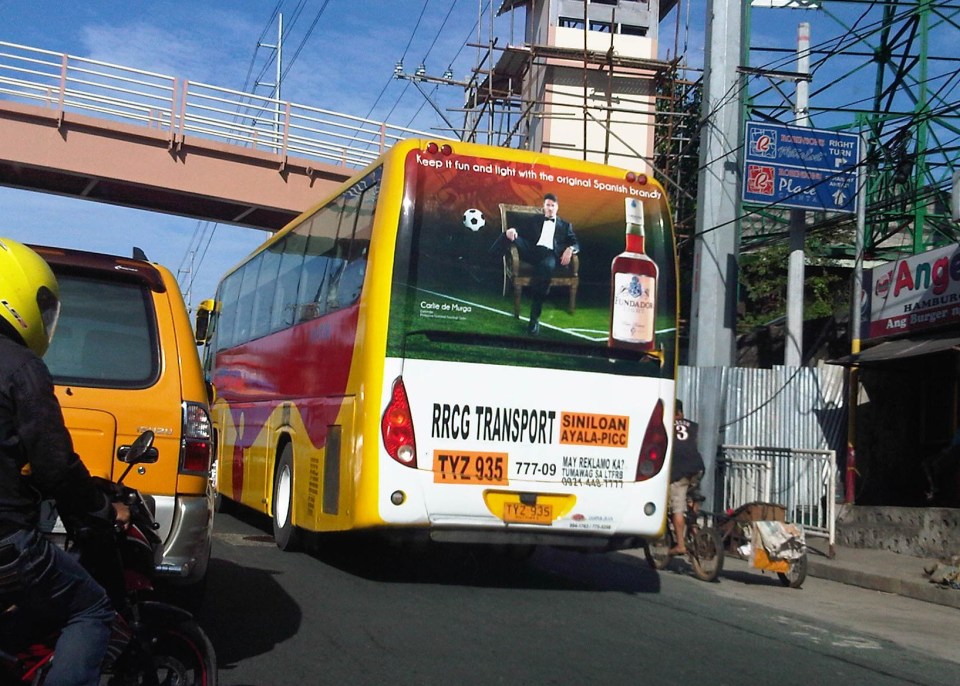 The back of the EMBC bus states that it is run by RRCG Transport with a route connecting Siniloan, Laguna and Ayala Avenue-PICC (it probably turns around at the PICC, where Gil Puyat/Buendia Ave. terminates).
 Closer inspection reveals that the bus is operated by Jasper Jean, another bus company that is better known for its Fairview-Alabang services.
EMBC is an old company and one that has been dormant if not extinct for quite some time. Was its franchise resurrected like what allegedly happened to another old bus company, BLTBCo. a few years ago? In this latter case, certain LTFRB officials were supposed to have been axed as they were allegedly behind the revival or “resurrection” of the franchise. I think it is not a “resurrection” case as I have also seen what looked like legitimate EMBC buses with information on the bus body showing EMBC as the operator of the bus unit. Unfortunately, I haven’t had the opportunity to take a photo of such examples. Thus, it is likely that the bus in the photo above is a case of “kabit.”
The concept of “kabit” (literally “connect” in English) in public transportation is not a new one. It has been used (and abused) in many cases) where the existing franchise holder(s) along a specific route could not deploy the number of vehicles necessary to address the demand for transport. In such cases, the franchisee (an operator) enlists other entities to provide the vehicles. And so there is an agreement among the formal franchise holder/operator and the “kabit” entities outside the contract between the government and the franchisee.
This is one reason why it is not necessarily the main company (franchise holder) that can be the guilty party in an incident involving one bus. However, the penalties (e.g., suspension and fines) are imposed on the franchisee and not necessarily to the “kabit” operators. The latter’s vehicles in turn continue to operate despite the suspension being technically applicable to ALL vehicles bearing the company’s name. Such are among the many issues concerning “kabit” and perhaps also among the strongest arguments to put a stop to this practice that is detrimental to the interests of people taking these buses.
–
Comet – rare sightings
A colleague was saying that he has not seen the Comet, a jitney-type vehicle currently plying the SM North – Katipunan route via Mindanao Avenue and Commonwealth Avenue, for quite some time. I shared the same observation and this is based on my regular commute that includes travel along Katipunan Avenue. The Comet is becoming, if it is not yet, a rare sighting even considering its relatively long and apparently convenient route. The route passes through residential and commercial areas and would be a direct, single ride for students in particular of three major schools in the Katipunan area – UP, Ateneo and Miriam. It also connects to 2 large malls, SM North and Trinoma, and 2 rail stations, LRT 2 Katipunan Sta. and MRT 3 North EDSA Sta. Despite these traffic generators along its route, it seems that the Comet still has less than the desired ridership. I say ‘seems’ because I currently don’t have the hard statistics on ridership but only observations from those who have seen the vehicle along its route.
 I saw this one on my way home last December in heavy traffic as our jeepney approached the Katipunan – C.P. Garcia intersection. It had few passengers considering its long route from SM North EDSA to Aurora Boulevard via Katipunan Ave.
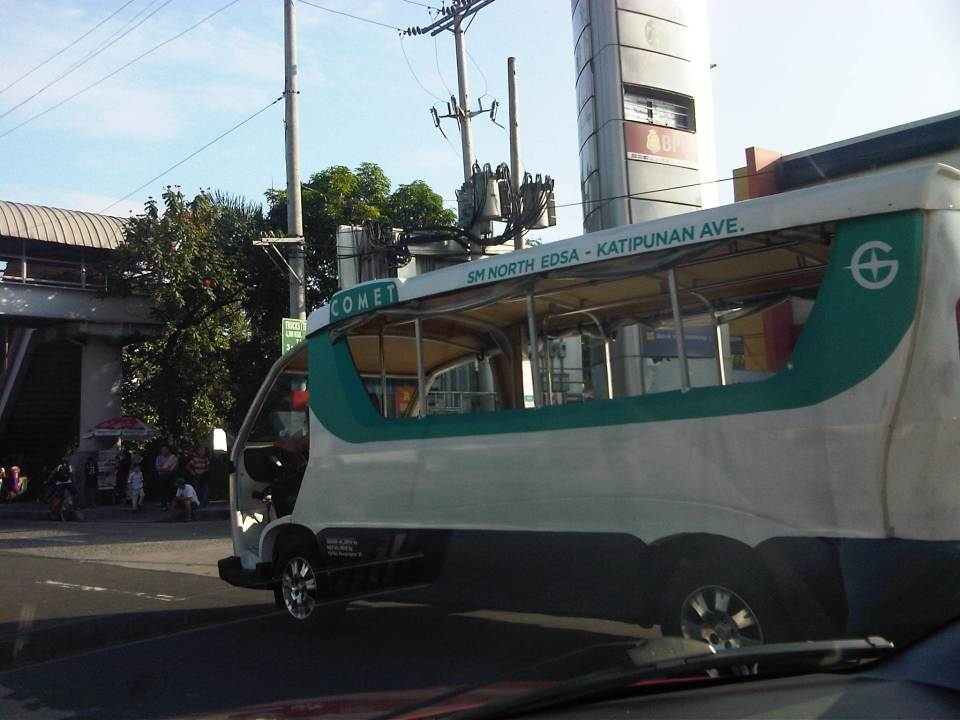 An almost empty Comet spotted one morning this January along Katipunan
What is the future for the Comet? It is unclear so far despite the hype and claims that this is supposed to be the vehicle to replace the conventional jeepney. (To be fair, this is what was also said of the e-jeepney that precluded the Comet.) The DOTC does not have a clear and firm policy or commitment to making this work. Its pronouncements have so far been towards deploying the Comet along new routes instead of replacing existing jeepneys on existing routes with this low emission vehicle. I believe that the only way for the Comet to work is for it to be mainstreamed as a replacement for the jeepney and along suitable routes, of course. The DOTC could and should review jeepney franchises to determine how the Comet and other similar low emission vehicles can be phased in over a realistic period in order to modernize public transportation currently being supplied by conventional jeepneys.
I recently noticed that there are jeepneys along Katipunan bearing tarps on their sides stating “No to additional jeepneys.” Underneath are the names of three jeepney groups supporting this call but with the exception of a major jeepney group that’s supposed to be supportive (even owning several units) of the Comet. Are the signs a form of resistance to change? Do the groups know or understand what they are saying and what they stand for? Or are these indicative of disagreements among jeepney groups, operators and drivers regarding the future of their operations using conventional jeepneys?
There will surely be resistance from these sectors if there are changes to be made that will affect their sources of income. It is a very daunting and sensitive task to decouple transport and livelihood in the Philippines. However, the issues coming out of such changes to improve public transport services should be met head on rather than skirt them, particularly in the case of the agencies responsible for these services – the DOTC and the LTFRB. Only then can we have the transformation we need for road-based public transport in this country.
–
On the new vehicle plates in the Philippines
A lot has been written about the new license plates being issued by the Land Transportation Office (LTO) for vehicles. I have read and heard many opinions or explanations from officials, experts and pundits about how the current license plates were better than the old ones due to its security features. As well, I have heard the opposite – criticisms by similar officials, experts and pundits usually focusing on the flaws of the new plates compared to the previous ones. They do agree on one thing, that the 4 numbers now appearing on the new vehicle plates issued to vehicles registered from January 2014 (5 numbers for the new motorcycles) are a necessity due in part to the rapidly increasing number of registered vehicles in the Philippines. Of course, the delays in the actual issuance of the plates themselves for new vehicles is another story.
Green plates are for private vehicles (not for hire). Red plates are for government vehicles. Blue plates (with only numbers and no letters) are diplomatic plates. Orange plates are the newest type of plates and were issued to electric vehicles. These solid orange plates and not of similar design to those bearing the Rizal Monument. Yellow plates are for “for hire” vehicles including public utility vehicles like buses, jeepneys, taxis and vans-for-hire. Recently, there were actually two types of yellow plates. One type used the design with the Rizal monument in the middle and these were issued to limousines such as those operated by hotels and tour companies. The other is the solid yellow plates (no Rizal Monument) that were issued to PUVs.
 UV Express vehicle with the solid yellow plate.
The new plates issued by the LTO are black and white – basically black lettering on white plates. Recently, friends have been telling me about their seeing the new black and white plates on taxis. I had thought that this shouldn’t be the case since PUVs like taxis are supposed to have distinctive color (yellow) plates in order for illegally (so-called colorum) operating vehicles to be spotted easily by authorities. It turned out that the LTO under the previous head of the agency did away with the yellow plates in favor of what they claimed to be more sophisticated new plates. My reaction was that this was absurd and visual identification (i.e., seeing the color of the vehicle’s plate) is still the easiest was to spot colorum vehicles. I had wondered, too, how the LTO came up with that obviously flawed decision and if they consulted among law enforcement agencies like the PNP who would be tasked to apprehend illegally operating road transport.
 Such incidence of green plates on public utility vehicles were a no-no (illegal) in previous administrations. I assume that this one is “temporary” in the absence of what were phased out yellow plates.
Fortunately, the LTO led by its current chief has decided to bring back the yellow plates. These will probably follow the new plate design but with yellow instead of a white background. Hopefully, all legitimate PUVs will have these yellow plates instead of the “temporary” private plates many have been issued. These will aid in the enforcement of regulations pertaining to PUVs and will help weed out colorum vehicles.
–
A tale of two consultants
I attended a seminar last November where there were two foreign consultants who gave talks about public transport and the reforms required for Metro Manila. One consultant had extensive experience in public transport, having worked in Hong Kong and Singapore, and is currently a consultant in Jakarta. The other appeared to have the more limited experience but claimed credit (I think partial at best) for public transport reforms in a major Asian city. I was impressed by the first in part because he was very honest with his statements especially as he explained a list of prerequisites for fixing public transport in Metro Manila (and other large cities). The bottomline from his presentation was that it was not possible to have a quick fix and there are no easy paths towards solving public transport problems in Metro Manila and elsewhere in the Philippines.
The second consultant was more on the patronizing side – promising a lot and a little too optimistic to be realistic or practical in his presentation on how to solve Metro Manila’s public transport woes. His material was hodge-podge at best with lots of visuals but not really getting to the point in terms of concrete solutions. It only betrayed his very limited if not unfamiliarity with transport and traffic in the metropolis despite his being a consultant with the office of the highest official of the transport department. There is a saying that if something seems to good to be true, it probably is. I think the same applies to what the second consultant presented to us that morning.
We need more of the first type of consultants who will tell us how it really is with regards to the “challenges” we face in solving transport and traffic problems in this country. The second type just lets us into a false sense of confidence or a feeling that the problems are not so big or complicated and that we are not in a big, deep hole that we need to climb out of. Its one thing to throw caution to the wind and another to have oneself firmly grounded in terms of the understanding of the problem at hand. Understanding the problem is the first step in the formulation of suitable alternatives and allows for the elimination or at least the minimisation of non-practical and non-realistic options.
–
Some questions on a gloomy Saturday morning
On gloomy Saturdays like today, I often tend to sort of contemplate on some questions coming from events and articles the past few days. I don’t really want to answer these questions right now and immediately but would rather let these and the follow-ups play around in my mind. I would rather not do some shout outs on social media about these questions as some friends tend to be sensitive and I don’t really want to make a lot of effort carefully framing posts on FB just so they won’t appear to be offending certain persons who might be over-zealous about their advocacies or who would be so defensive of their organizations. Here are some questions running around in my brain right now:
1. Does DENR have the mandate to require sidewalks and bikeways along all roads? Design and implementation-wise, isn’t this supposed to be under the DPWH (for national roads) and the LGUs (for local roads)? Is this more a policy statement? But then shouldn’t this come from DOTC?
2. Is going out of your way really the way to get noticed and be awarded? Are there no points for people doing a great job at what they are supposed to be doing?
3. Shouldn’t an agency first check if they are doing what they are supposed to do and the outcomes reflect their objectives? Are emissions testings and monitoring successful or do we still have a lot of smoke-belchers on our roads? If they already have their hands full with their tasks according to their mandate, shouldn’t they first mind their business before even encroaching into another agency’s tasks?
4. Does media have to give so much airtime to a driver of a luxury vehicle who assaulted a traffic enforcer?
5. Why does it seem to be so much fuzz about Uber? Is it just on social media? Do most other commuters give a damn about it when they really can’t afford availing such services?
6. Are government engineers bereft of an appreciation for the arts, culture and heritage? Are they too mechanical or dumb to understand what planning and design really is all about?
–
“Unsung heroes” for sustainable transport in the Philippines
A “Bayanihan sa Daan” is being held today at Malacanan. It is supposed to be a recognition of sorts for organisations, local governments and individuals who have contributed or advocated for people-friendly (i.e., pedestrians and bicyclists) roads and cities in the Philippines. I am glad to see some cities that we have assisted or advised being recognised as well as organisations that we have collaborated with who are present at the event. Unlike them, we were not invited to the event nor have we been recognised by the current administration for our efforts in promoting sustainable transport. Perhaps it is because it is a given in our center’s mandate and the recognition is really for those who went out of their way to initiate, promote or implement programs and projects for people-friendly transport.
There are names I could mention in our organization who have done a lot for sustainable transport in general, whose works in more than a decade have helped increase awareness on environmentally sustainable transport (EST) among national agencies and local governments and have spawned. They have conducted so many workshops, seminars and consultations with agencies like the DOTC, DPWH, DENR and MMDA, and LGUs including all Metro Manila cities and municipalities, Cebu City, Davao City, Cagayan de Oro City, Baguio City, Iloilo City and others. These were done at a time when these entities had little knowledge of sustainable transport and international agencies were uncertain about whether they should engage and who they should engage for EST and related initiatives.
I defer from naming these responsible and progressive people as I know they would prefer to remain rather anonymous but working effectively to realize sustainable transport in the Philippines. I do know they are selfless and tireless in their advocacies for sustainable transport unlike others who seem to be on-board because of the bandwagon or because it is fashionable to do so. There are those, too, who seem to be in it for the past many years but are actually only hangers-on and interested more in the funding and not in coming up with sustainable transport systems. I hope that these sustainable transport initiatives can themselves be sustained. It’s one thing to be loud about your advocacies and appear as a hardcore proponent without actually having any results to show, and another to be a silent worker whose works actually formed the foundation for current initiatives and continue to work behind the scenes to implement EST in the Philippine setting.
–

