
Home » Policy (Page 46)
Category Archives: Policy
Sunday smog
We were staying at a hotel over the weekend and our room afforded us a good view of the cityscape to the left and seascape to the right. We weren’t able to get a good view of the sunset as we were practically facing south-east and the orientation of the window prevented any, even slight view of what is always a nice Manila Bay sunset. We did expect to see the sunrise the following morning.
As the sun came up, we took this photo of the cityscape. Closer to us were buildings in Pasay City while those farther away were buildings in Bonifacio Global City. I remembered reading somewhere that what makes our sunsets so colourful or spectacular are the elements in our atmosphere. Air pollution tends to bring the most dramatic colors for sunsets and I believe that’s in a way also applicable to sunrises. I took a snapshot of the cityscape from our hotel window expecting the worst for what could be the equivalent of an exposed negative in the old days. Instead, I got the pretty decent photo below showing the sunlight reflecting off the haze around Metro Manila and giving the cityscape that eerie look on a Sunday morning.

There’s a joke that is often recycled concerning air pollution and air quality. According to this joke, the Philippines doesn’t need to worry about air pollution since every year it is visited by many typhoons. These typhoons passing through the country sweep away the pollution thereby making the air around us cleaner. This is actually true and one need only to get outdoors after a typhoon to smell the fresh air. Of course, it doesn’t take long before the smog returns and therein lies the punchline to the real joke. At the rate we are going in terms of vehicle emissions alone, we would probably need at least a typhoon every week for the entire year if we wanted clean air to breathe. The dry seasons would probably be the worst in terms of poor air quality. And so we must see that the joke is on us and air quality will only continue to deteriorate if we do not act now and do not pitch in for the fight for clean air.
–
The Philippines’ National EST Strategy – Final Report
Friends and some acquaintances have been asking about whether there is a master plan for sustainable transport in Philippines. There is none, but there is a national strategy that should serve as the basis for the development and implementation of a master plan, whether at the national or local level. This strategy was formulated with assistance of the United Nations Council for Regional Development (UNCRD) through the Philippines’ Department of Transportation and Communication (DOTC) and Department of Environment and Natural Resources (DENR), which served as the focal agencies for this endeavour. The formulation was conducted by the National Center for Transportation Studies (NCTS) of the University of the Philippines Diliman. For reference, you can go to the NCTS website for an electronic copy of the National Environmentally Sustainable Transport Strategy Final Report.
 Cover page for the National EST Strategy Final Report
–
We deserve better transport!
In the news lately are various problems pertaining to transport and the solutions authorities have come up with that they think are stop-gap solutions to alleviate the problems. The EDSA MRT Corp, for example, tried to experiment with a bus service to supplement the supply of transport for the tremendous demand for the MRT 3 trains. For some reason, the MRTC did not coordinate with the MMDA as well as the LTFRB for the experiment and this resulted in their buses being halted by the MMDA for being “colorum” or illegally operating public transport services. That quickly fizzled out even as they tried to convince queued passengers at stations to take the express bus instead.
More recently, this May, the MRT 3 experimented with what they called express trains. This was actually a “skip” train service where certain trains will not be stopping (i.e., skipping) certain stations. This was supposed to address congestion as well as improve travel times. It didn’t on both ends. Such services would have a chance if the MRT had the trains (rolling stock) for this kind of operation to be sustainable. Also, there’s the issue of the MRT tracks not being designed for trains to bypass stations with stopped trains (i.e., express trains bypassing local trains). That alone means there’s a limit to the number of trains you can deploy because there’s no way one can bypass the one ahead of it.
The MMDA recently re-introduced ferry services along the Pasig River. These are basically school buses loaded up on boats. While I’m sure the people behind this are well meaning, I couldn’t help but cringe with the idea that this seems to be the best we can do with the resources we have and agencies like the MMDA and the DOTC (especially the DOTC) seem content with their ideas for a solution to the transport/traffic mess we are in. Is it safe? So far, there have been no incidents yet so there are
The bottomline is that we do not deserve this low quality of transport services. The inefficiencies have directly or indirectly cost us a lot in terms of actual money or time that could have gone into more productive ventures. And the problem seems to be that many people have become manhid of their conditions and have taken transport matters in their own hands. Such comes in different forms like getting a motorcycle so they won’t have to take public transport or get caught in traffic jams. Another way is to get a second (even third or fourth) car so that the number coding scheme will not affect one’s trips. These examples, however, are more exceptions compared with the majority who cannot do anything about their plights except perhaps wake up earlier or stay at the office or school later so they don’t have to deal with traffic jams or difficulties of getting a ride.
I think we should voice out our displeasure with the current conditions and there are many ways to do this without going out in the streets to protest. That includes using social media to get the attention of those responsible for transport and traffic in your city or town. You just have to watch out for the trolls as there are many out there including those who seem to be working with the very same people responsible for transport and traffic. In such cases, you have to be careful how you react if someone heckles your posts. Actually, you shouldn’t mind them because otherwise, you would easily become frustrated or offended, which is what they want you to be. So you got to keep your cool and be patient with this social media approach. There are many advocacies out there that you can probably participate in and these include initiatives by competent NGOs who push for sustainable transport, inclusive mobility and clean air, among others. I like the term a friend coined from various experiences they had with their work on the Bus Rapid Transit (BRT) in Cebu and Manila – dignity of travel. We have to get back this dignity that has steadily deteriorated or degraded by the poor quality of our transportation systems.
–
On walkability
There is an increased awareness for walking and cycling these days thanks to the increasing number of advocates and the aggressive and persistent campaigns for people to take up these modes of transport instead of the motorised forms. In the Philippines, the joke has been for people to have the propensity to ride a jeepney or tricycle even for short distance trips that elsewhere would be considered walkable. Why is it like this? Are Filipinos really lazy? Or is it a matter of not having the facilities for people to be able to walk safely and comfortably? I believe it is the latter case that discourages people from walking. There is the fear that you can get sideswiped by errant vehicles driven by reckless drivers or riders. There is also the impression that you can get injured from uneven paths or incur unwanted exposure to the elements (e.g., heavy rains, floods, punishing heat, etc.).
An important thing for this advocacy for walking would be to promote good, sound design and not just making walking an afterthought for streets. I have seen and heard a lot about sharing the road but for the wrong reasonings and without understanding the pre- or co-requisites for successful programs for walking and cycling. I would like to think that atop the list of pre- or co-requisites would be a good public transport system. We currently don’t have that in Metro Manila and it is difficult to cite exceptions around the metropolis given the poorly planned transit stations where transfers between modes are inefficient and definitely not seamless. However, standalone examples of walkable places and facilities can be seen around Metro Manila. I feature some of them below:
 30th Street in Bonifacio Global City is a good example of how roads in urban areas should be developed. Note the wide spaces provided for walking and cycling and the limited space (4 lanes) for motorised traffic. I just hope that the wide pedestrian spaces are not intended for future widening of roads for motorised traffic. During early mornings and evenings you will find many joggers along this road and around Bonifacio High Street – proof that the environment is conducive enough for such activities.
 On the ground, 30th Street looks every way walkable with the trees providing the shade (and oxygen) to make walking an attractive option anytime of the day.
 Pedestrian crossings should be clearly marked and in the case of BGC, even those at signalised intersections are painted as zebra crossings (more appropriate for unsignalised crossings) instead of the standard parallel line markings. Unfortunately, whatever may be the case for these cross walks, most motorists seem to be unaware of the rule that once a pedestrian steps on the cross walk, then motorists should give way to the pedestrian. Motorists should also slow down upon approaching a cross walk – something not commonly seen in the Philippines.
 Atop a typical pedestrian overpass – I took this photo at an overpass along C-5, which is an example of the more recent overpasses constructed in Metro Manila. Previously, there were a number of issues regarding overpasses constructed during the time when Fernando was MMDA Chair including slippery steel floorings, low railings and steep stairways (i.e., not friendly to senior citizens and persons with disabilities). This overpass has a more sturdy design and the railings provide users with a sense of safety. Stairs are also less steep than those of previous ones.
More on walkability in future posts!
–
Bottlenecks and other traffic issues in Antipolo
Commuting between our home in Antipolo and my work place in Quezon City, I have noted a lot of issues on transport and traffic that needs to be attended to by the local government in coordination with other entities like the DPWH and Meralco. Here are some photos with my notes and comments.
 Much of Sumulong Highway have been widened to 4 lanes but many electric posts remain in the middle of the additional lanes and pose hazards to motorists and cyclists. These posts seem to have been here for quite some time now and the paint on them gives the message that they will be here for the foreseeable future. Paint or no paint, they are road hazards and have the potential to kill people on vehicles crashing into the poles. I think this is supposed to be the responsibility of the power company (Meralco) but there needs to be a firm request and coordination coming from Antipolo City Government to finally relocate these poles.
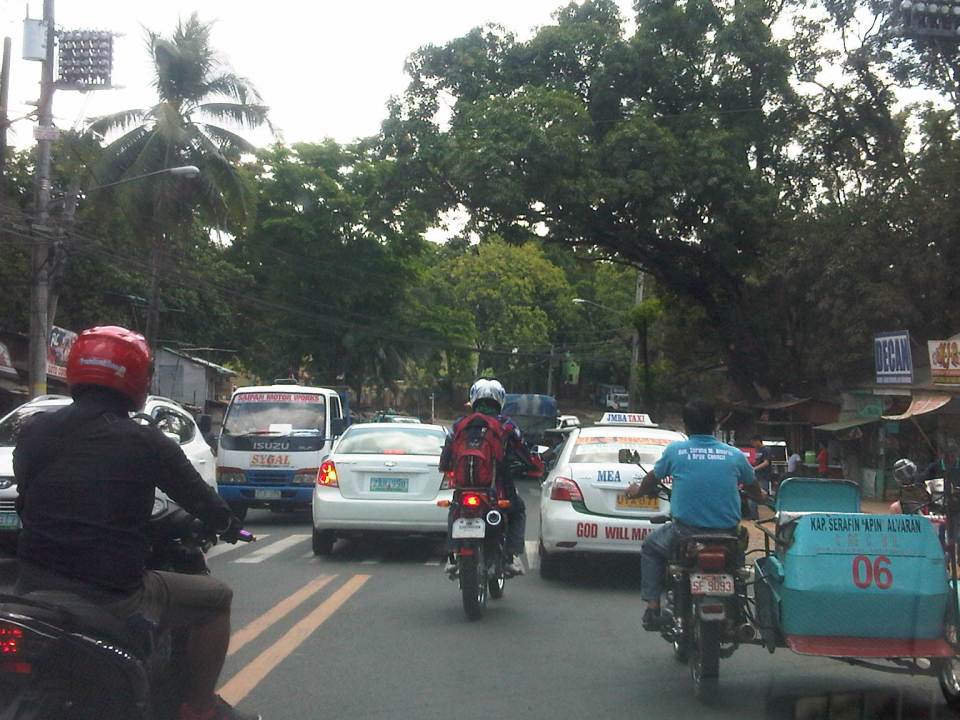 Congestion is often caused by counter-flowing vehicles forcing their way back into the right lane (like the car in the middle of the photo) upon encountering opposing traffic. It doesn’t help that there are motorcycles splitting the lanes to make for a very crowded road.
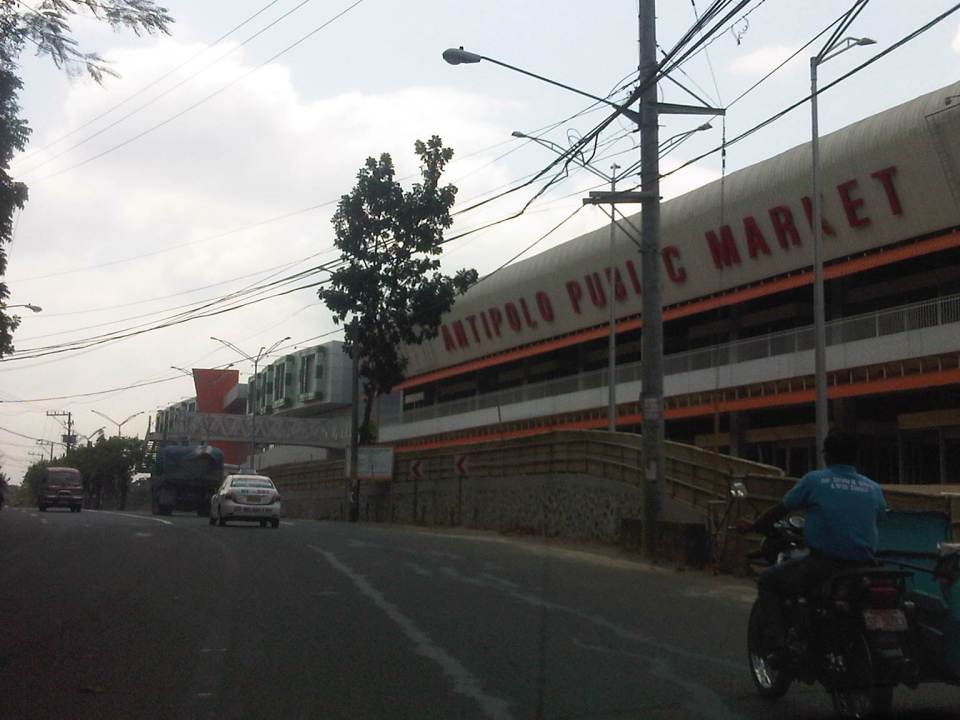 The new but still closed Antipolo Public Market along Sumulong Highway and near the intersection with Daang Bakal (the old railroad line that’s now a road). I wonder about the trip generation potential of this complex as it is not yet operational. Meanwhile, a huge Robinsons mall (looks larger than their Magnolia property) is currently under construction just across from it and will definitely be a major traffic generator in that area. The combined traffic to be attributed to these commercial complexes will surely have a tremendous impact on Sumulong Highway and other roads in the vicinity.
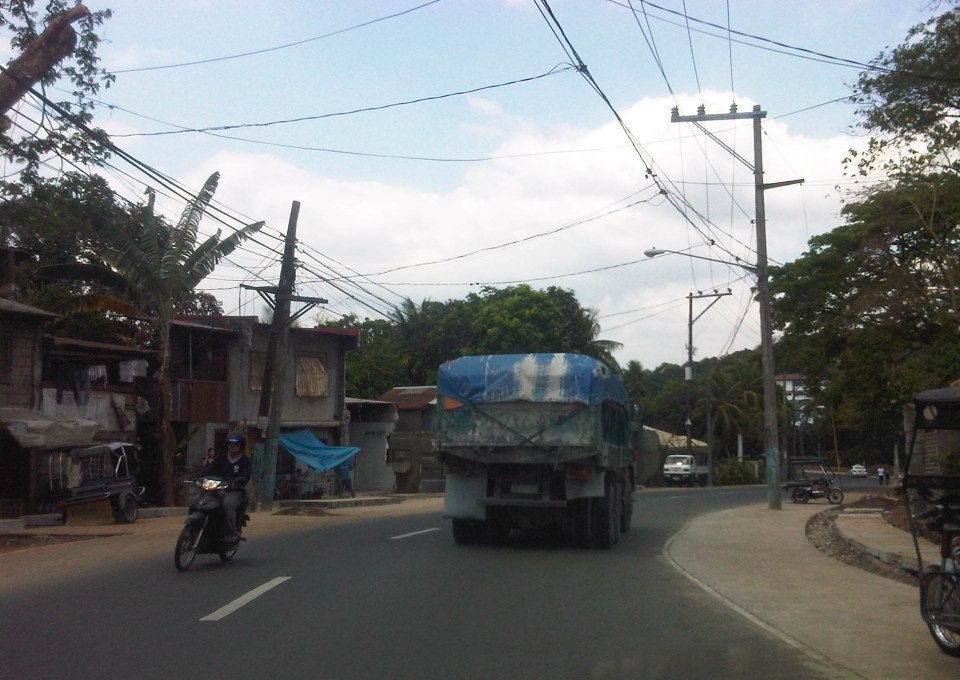 Both Sumulong Highway and Ortigas Avenue Extension carry significant truck traffic. These often cause congestion as they are slow going up to Antipolo and can block the entire road as Sumulong Highway and Ortigas Extension have some narrow sections where the shoulders could not provide enough space for other vehicles to pass the slower moving ones. In certain cases like the one in the photo above, there are electric posts in the middle of the shoulder lane.
 Tricycles occupy the outer lane of Ortigas Ave. Ext./Olivares Street. Such informal and on-street terminals are illegal along national roads and yet the city tolerates them. One explanation for this is that there are informal communities along the highway on shanties built along what is supposed to be a ledge along the mountainside (shown at right in the photo). These are where tricycle drivers and their families reside.
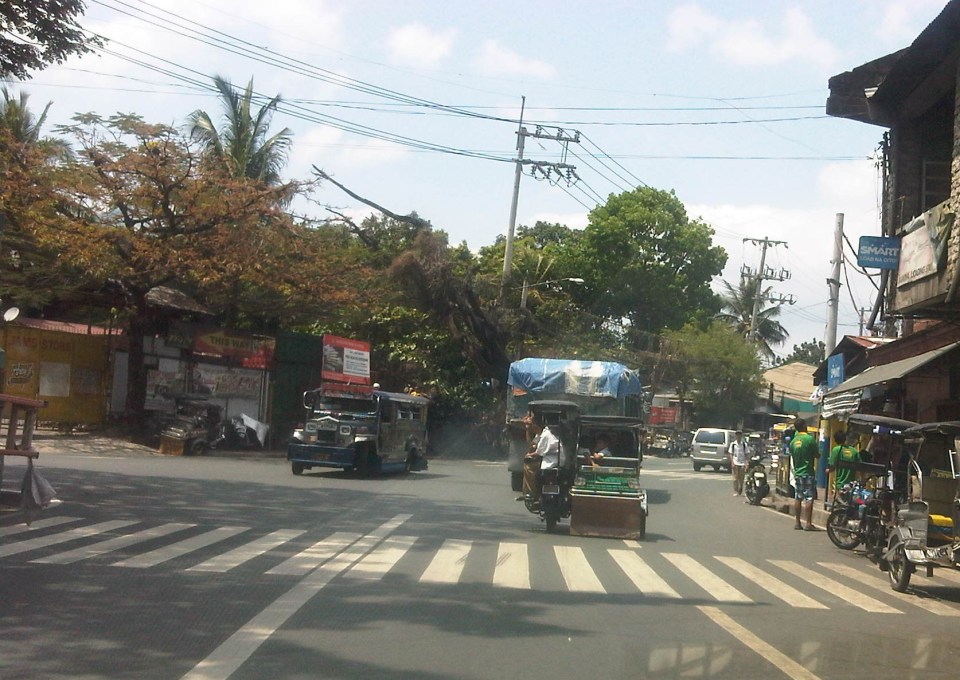 Tricycles from different tricycle operators and drivers associations (TODAs) seem to roam the entire city. This is contrary to the common practice in other cities and municipalities where tricycles are limited within a certain area or district that in many cases just overlap with others (e.g., UP Teachers Village-Philcoa-Krus na Ligas).
 Many tricycles serve as school service. However, the observation is that most tricycles tend to be overloaded with passengers. These are usually small children so the driver probably figured that they could cram more passengers than what is legally allowed.
 Sharing the road? Antipolo is very popular with cyclists and weekends bring a lot of them to the city as they come from all over via the main routes along Sumulong Highway and Ortigas Avenue (there should also be those coming from the east via the Antipolo-Teresa Road and Antipolo-Tanay Road). Most motorists are aware of these cyclists and give way to them. Most experienced cyclists are also aware of the ROW of other vehicles and so keep to the inner lanes. This mutual awareness and respect are vital to make roads safe for all. I think the only thing needed is to provide space for pedestrians as there are significant numbers of people walking, hiking or jogging along these roads.
–
“Pwede na yan” bikeways?
The recent clamor for bicycle facilities have led to several initiatives in Metro Manila and other Philippines cities (most notable recently is Iloilo) to support the demand for cycling facilities. While Marikina City already has a network of off-street bikeways segregated from motorised traffic, there are few other examples of such facilities elsewhere. The more recent initiatives in Metro Manila involved the Metropolitan Manila Development Authority (MMDA) establishing bikeways in several areas along major roads in the metropolis. I say establish because the MMDA did not construct new bikeways like the ones in Marikina or Iloilo. What the agency did was to designate sidewalks and other existing paths for cycling by painting these over. Unfortunately, these so-called bikeways did not take into consideration the needs of pedestrians with whom cyclists must share this limited space. And so few people use them despite a high profile launch that brought together government officials and NGOs including cycling and mobility advocates and enthusiasts. I guess the big test was really not whether advocates and enthusiasts would really use the bikeways (Don’t count on the officials to use them. They have chauffeur-driven vehicles.). Would the regular commuter use them instead of the roads, despite the risk or dangers posed by motor vehicles?
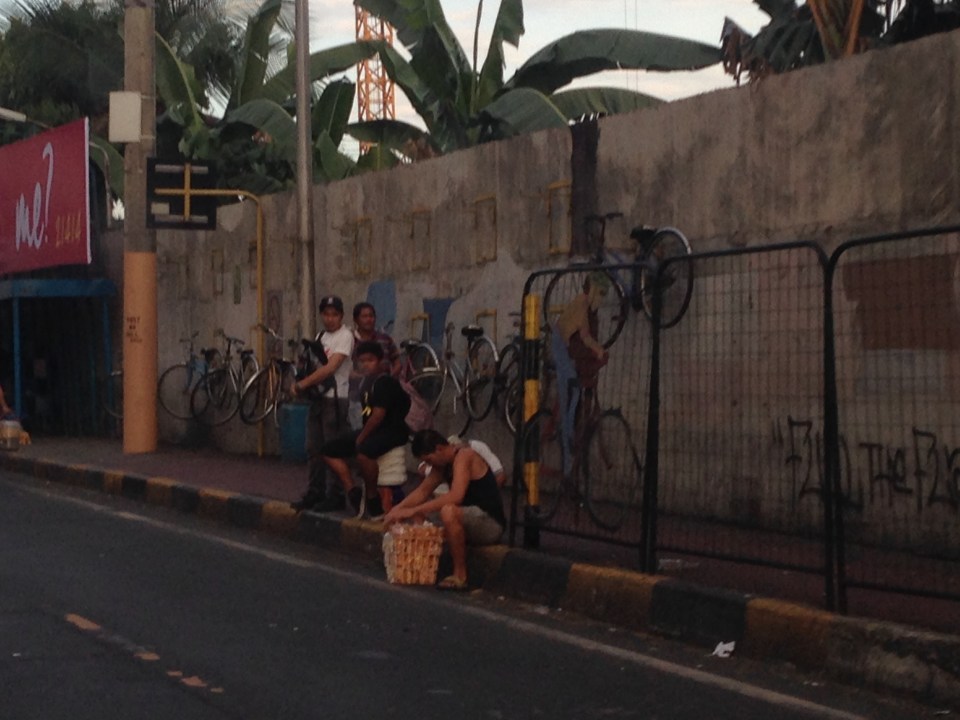 Commuters waiting for a bus ride along EDSA with suspended bicycle racks behind them. The sidewalks along EDSA have been painted red, designating them for bicycle use. The big question now is how cyclists will interact with pedestrians given the very limited space they should be sharing.
 Bicycles hanging on racks attached to the perimeter wall of an exclusive subdivision along EDSA.
 Cyclist using the curb side lane of EDSA – these people run the risk of being sideswiped by buses operating along the yellow (bus) lanes of this busy thoroughfare. It is quite obvious in the photo that there is no space on the sidewalks to accommodate cyclists and even pedestrians. Column for the MRT-3 stations are right on the sidewalks and makes one wonder how this flawed design was approved in the first place. MMDA enforcers usually appear as if they are only bystanders and seem to be generally helpless when it comes to managing traffic.
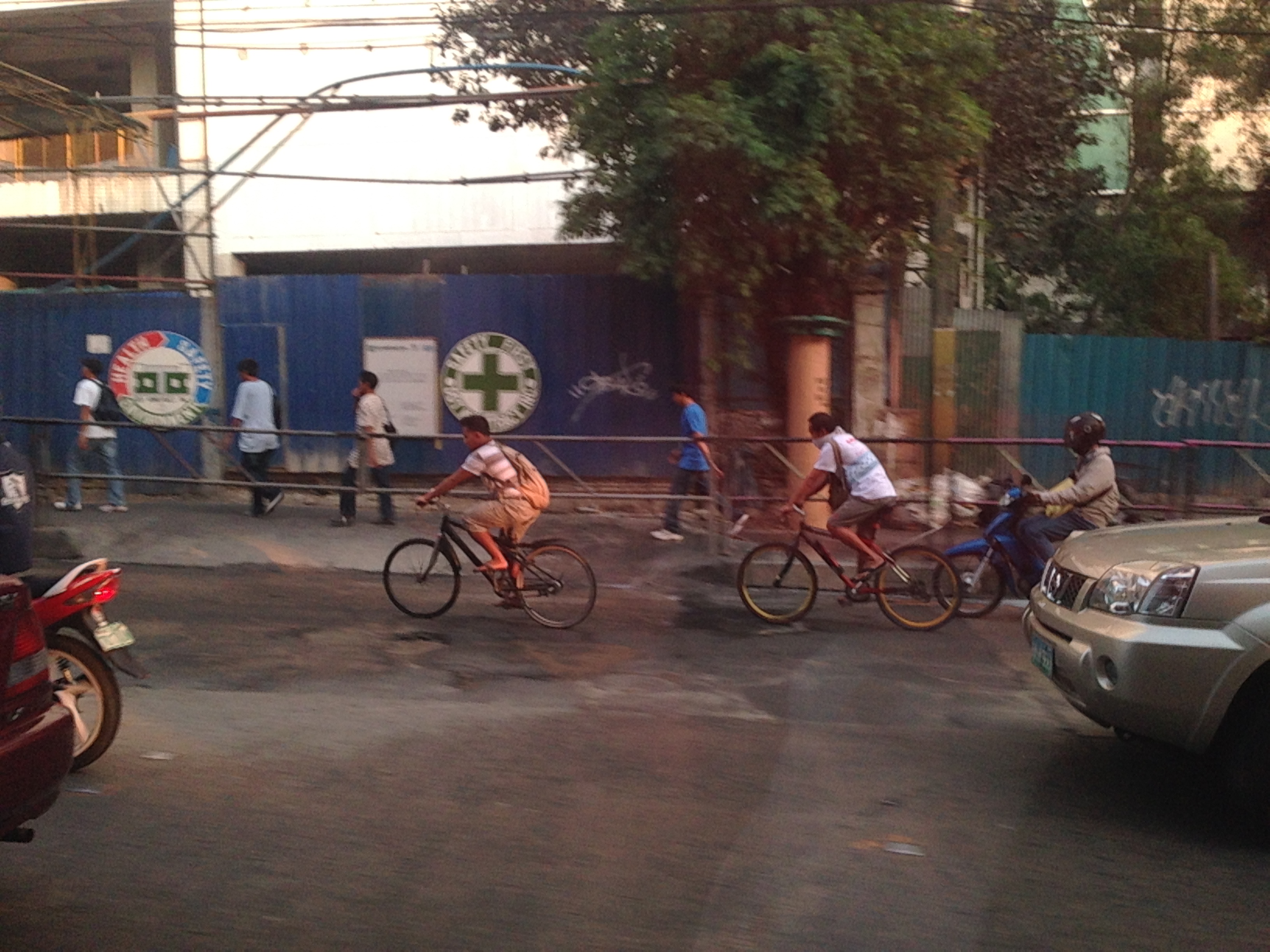 Workers cycling back to their homes after a day’s work. Many people have opted to take bicycles for their daily commutes even if they have to travel long distances in order to save money that would otherwise be paid as fares for buses, jeepneys, UV Express or tricycles. Note that the cyclists use the outermost lane of the road as the sidewalks pose many obstacles including pedestrians as shown in the photo. Some cyclists though want more than a share of the sidewalk or a lane of the road for their use regarding pedestrians and motor vehicles as nuisance for them. Surely, some pedestrians also regard cyclists as nuisance to walking and would prefer to have the sidewalks for themselves.
Cycling is in a way an emancipation from motorized transport commutes, and savings translate to money they could allocate for other needs of their families. While there are raw data for family expenditures from census surveys, there are few studies and publications focused on transport. It would be interesting to see how much a typical Filipino family spends for transport in absolute terms as well as a percentage of their total incomes. Such information would be essential for understanding the needs of travelers, especially for daily commutes for work and school (other trips include those for purposes of shopping, recreational, social and others). Long commutes are associated with higher expenses (e.g., in terms of fares or fuel costs) and reducing such costs through shorter commutes should free up money for necessities like food, housing and clothing. Ultimately, this would help solve issues relating to poverty and health, which can easily be related to commuting behavior and characteristics.
It is in that context that transport systems should be planned and implemented carefully along with the housing developments. This underlines the essence of the relationship between transport and land use that has been the topic of discussions for quite some time now that apparently, a lot of people in this country, especially officials and the private sector have chosen to ignore or apply selectively (i.e., according to their own advantage and not really for the general welfare of the public). A transport system is not cycling alone, or roads or railways alone. It is, by definition, a network, a set of interacting, integrated elements and each of these components of the system are essential for it to function well. It is the interaction and integration that are the key elements that we often forget as we advocate one transport mode over others as if they are independent from each other. They are not and we should complement rather than compete in our advocacies for transport so we can finally achieve an efficient, effective system for everyone.
–
Quiapo traffic
Fridays in Manila are associated with Quiapo and the devotion to the Black Nazarene. People flock to Quiapo Church to hear Mass or pray at the Basilica, which is arguably among the most popular for Roman Catholics. Fridays are regarded as feast days dedicated to the Black Nazarene and since many people go to Quiapo Church throughout the day, there is almost always traffic congestion in the area. These days, however, any weekday is a congested day in that area what with more vehicles and more people coming to this area or just passing through.
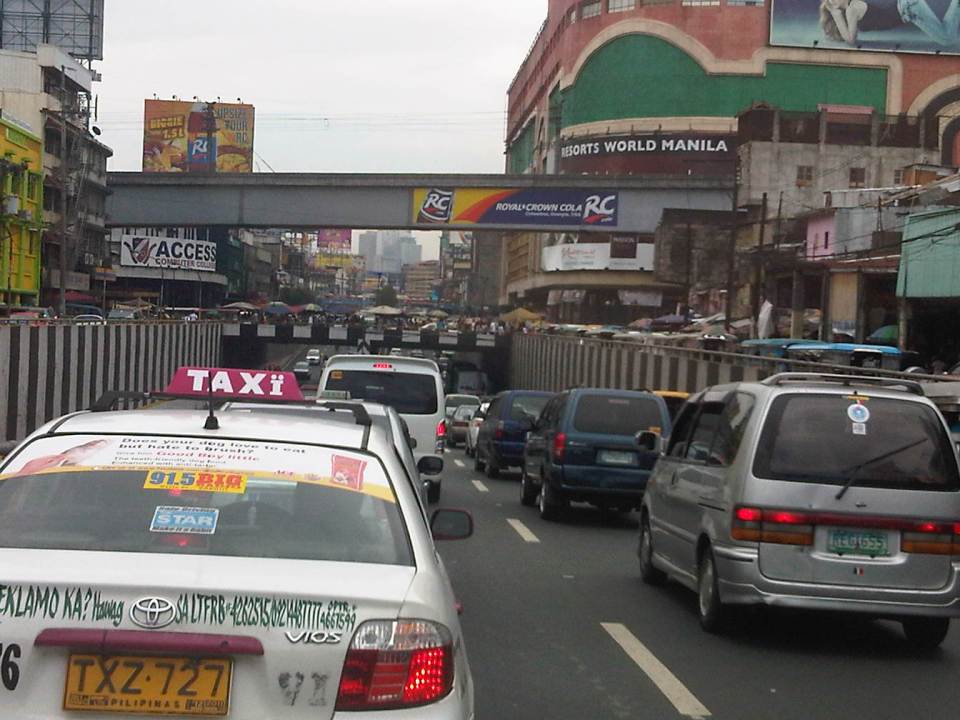 Espana Avenue ends at its junction with Quezon Boulevard and turning left leads the traveler to the Quiapo District. The photo shows heavy traffic along the underpass and the elevated LRT Line 2.
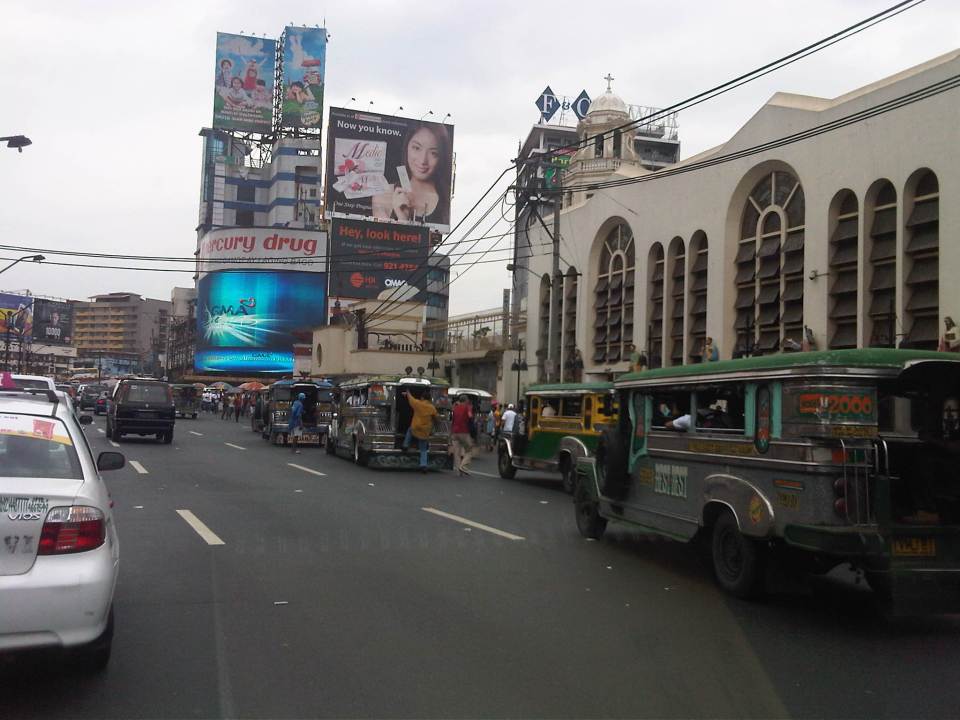 Quiapo Church is just beside Quezon Boulevard and jeepneys loading and unloading passengers occupy up to 3 lanes nearest to the church.
 There is a door at the side of the church along Quezon Boulevard and people seem to be everywhere even the middle of the road as they walk or wait to ride a jeepney.
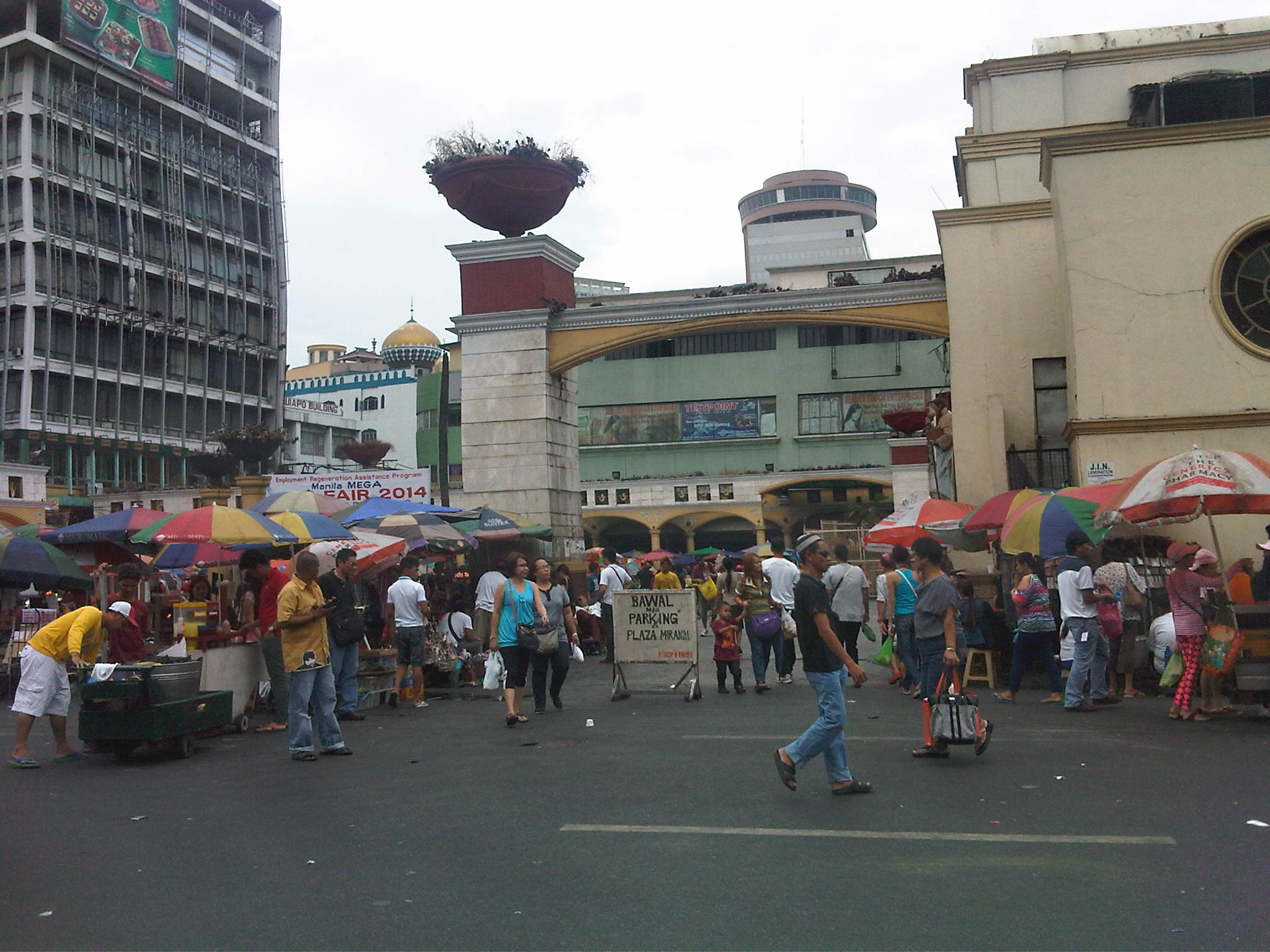 Historic Plaza Miranda in front of the church is witness not only to a lot of the frenzied processions during the feast day of the Black Nazarene every January. Plaza Miranda has also been a venue for many political rallies including the infamous one in the early 1970s that was among the triggers for Martial Law. On “normal” days, the plaza is home to vendors, fortune tellers and other denizens of this area.
There are other popular churches around Metro Manila that attract a lot of people throughout the year and not just during feast days. Among these are Baclaran in Pasay City (Our Lady of Perpetual Help), St. Jude in Manila, Sto. Domingo in Quezon City, San Agustin and the Manila Cathedral in Intramuros, Manila. Nearby in Antipolo is the Shrine to Our Lady of Peace and Good Voyage. These churches are among the busiest especially on certain days of the week (e.g., Wednesdays are for Baclaran, etc.) and with the coming Holy Week, a lot of people are again expected to flock to these churches for the Visita Iglesia tradition. Hopefully, these devotions are really a manifestation of faith rather than the pretentious kind where the road trip is more touristy than religious or prayerful.
–
Driver’s personal insurance?
A friend of my father-in-law approached me to ask if there have been studies on requiring Philippine drivers to get personal insurance before being issued a driver’s license. I replied that I am unaware of any study or studies on this topic. I told him, though, that there have been discussions to require bus and trucks drivers to get certification from the Technical Education and Skills Development Authority (TESDA) to drive these large vehicles. The certification is the same required in other countries for foreign drivers seeking working in those countries. And so, prospective OFW drivers would have to take up the certification course at TESDA in order to qualify as drivers in other countries. These discussions were made at DOTC together with the LTO and the TESDA prior to 2010. Since then, I have no knowledge if such discussions were continued or if someone or some group pursued this. Based on what we see now on our roads where buses and trucks have been involved in many road crashes, I can only conclude that the certification initiative was not pursued for one reason or another.
The reason I was asked whether there were studies on the topic of driver insurance is that the person is part of a group (he didn’t reveal it to me and I didn’t ask him about the name) seeking for a bill to be filed for this insurance to be required prior to being given a license to drive. He told me that this is based on the system in the US, where prospective drivers are required to get insurance as a prerequisite to being issued a license to drive. The premium for the insurance is dependent on the record of the driver and increases significantly with the person’s involvement in a road crash where he or she is proven as the guilty party. The premium also increases when drivers are found to have violated traffic rules and regulations, and the data based on citations or tickets issued by apprehending officers are transmitted to the Department of Motor Vehicles (DMV), which is the equivalent of our Land Transportation Office (LTO). The idea is for drivers involved in crashes or frequently violated traffic rules and regulations to be charged a higher premium until a point when there will be no legitimate companies willing to insure the driver because of his record. Alternatively, the driver might be forced to give up on driving because he or she could no longer afford the steep premium resulting from his/her own actions on the road.
This is actually a good idea and one that probably is worth looking into in more detail by our LTO if it is to use this as a way to reduce errant drivers on the road. I would propose that higher premiums should be required of public transport drivers who would be responsible for a lot of lives. Truck drivers can have their premiums dependent on what kind of trucks they drive. Perhaps higher premiums are for those driving tankers or lorries carrying sensitive or high value freight. The bottom line, of course, is how such a system can be operationalised or implemented. There is also that thing about enforcement and the sharing of information between apprehending entities (e.g., PNP, local police or local government staff) and the LTO for the data required to assess a driver’s record whenever he or she renews his or her license. There will always be loopholes and/or fixers somewhere but these should not deter the authorities from seeking a better system than what we have now where drivers can “get away with murder” sometimes quite literally.
–
DPWH and DOTC merger
I had posted on one of my social media accounts about the idea of a merger of the Department of Public Works and Highways (DPWH), Department of Transportation and Communication (DOTC) and Housing and Land Use Regulatory Board (HLURB) to become the Department of Land Use, Public Works, Transportation and Communication or DLUPWTC (that’s definintely a mouthful). While it was April Fool’s, I got a lot of comments agreeing with the idea. One friend even gave a short history review noting that DOTC used to be DPWTC and what is now DPWH used to be DPH.
The idea of a merger of agencies is not a new idea nor is it a novel one if you look at the potential more closely. In fact, the Japanese already did such mergers many years ago when they created “super ministries” in the Ministry of Economy, Trade and Industry (METI) and the Ministry of Land, Infrastructure, Transport and Tourism (MLIT) and the Ministry of Education, Culture, Sports, Science and Technology. These would be like merging the NEDA, DTI into one agency, the DPWH, DOTC, HUDCC, HLURB into another agency, the DepEd, CHED and DOST into a single entity. Such was undertaken in order to promote efficiency in government services in Japan by streamlining the bureaucracy among agencies that are supposed to have strong linkages if not overlapping responsibilities.
This idea makes sense for the DPWH and DOTC, and more so now that there seems to be a dearth in leadership over at the transport department while the public works and highways department is enjoying a resurgence, revitalized by a strong secretary. While these two agencies have cooperated for the longest time, much is still desired for a seamless collaboration where DOTC might serve as The Planning Agency while DPWH might be The Implementing Agency. They would probably work best under the guidance of a single strong leadership who would have a vision for a much improved future transport for the country and a knack for how to realize this vision.
Think about it and suddenly its not a joke worthy of April Fool’s Day.
–
“Sharing the road” – bandwagons and fads? Let’s hope not!
There seems to be a lot of talk about “sharing the road” and the initiatives to have more bikeways. I hope I am proven wrong but it seems to me as if these current programs and projects are more of a fad. A lot of people (and local governments) join the bandwagon with little understanding of what needs to be done. It’s usually because of the good PR they get out of these that they agree to coming up with the token carless street or the haphazardly implemented bicycle lanes. More than PR, some cities are aware of the opportunities that come with such initiatives as international agencies and groups are willing to spend money to support such programs and projects. The question really is on sustainability and doing the right thing not only on initiating things or coming up with programs but on the substance itself. And by substance I mean that programs should also go into the details of designs. Too often, the “pwede na yan” approach is taken and this just won’t do.
 The MMDA painted the sidewalks in White Plains and designated them as bikeways, in a way alienating pedestrians.
A vision for what people want to have is there but it is ultimately how the achieve the vision that needs a lot of work. For example, bills are being filed in congress to force the creation of bicycle lanes along major highways. (And mind you there are a lot of similar bills filed in congress that upon closer inspection actually have little substance.) The premise here seems to be that if you build them then people will start cycling. That was not the experience in Marikina, which boasts of the country’s only bikeways network that includes many off-street sections. These bikeways were built at a time when the perception and analysis pointed to a critical mass of cyclists in that city that was thought to be surely the tipping point in terms of non-motorised transport. Nowadays, the same bikeways are used by motorcycles and tricycles and most cyclists we see are not commuters (e.g., cycling between home and work/school) but recreational cyclists. It would take Marikina some effort to promote commuting by bicycles and much effort in enforcement to correct the misuse of the bikeways. The “new” bikeways in Quezon City appear to be poorly conceptualised as the MMDA decided to paint the sidewalks along EDSA northbound without addressing the obstacles like electric posts. Still, it is an effort to put NMT in the consciousness or awareness of the general public (thanks in part to media’s making these news worthy items).
Cities like Pasig and Taguig like to show-off Ortigas Center and Bonifacio Global City, respectively, as their faces when in fact the cities have not done much in their original cores. The running joke is that the real Taguig is not the areas to the west of C-5 but the old Taguig, which is to the east. This Taguig is the one plagued by narrow streets and the proliferation of tricycles. It was not so long ago that a former mayor imposed e-tricycles on BGC (where they were not suitable) while not doing much to lift a finger in the mayhem of tricycles in old Taguig (e.g., along Gen. Luna). As for Pasig, you just have go along the Pasig River and the Manggahan Floodway to see what it has accomplished so far in those areas.
There are no quick fixes to the transport and traffic problems our cities are facing. In the case of Metro Manila, much is at stake for the long-delayed mass transit projects. And the DOTC’s announcements of projects being formulated or proposed are no longer taken seriously as they have not delivered on any of these despite 4 years of this current administration. For other cities, it is important to learn the hard lessons from the experience of Metro Manila. There is also a need for a drastic change in transport and traffic policies in our cities. Iloilo, for example, has built an expensive bike lane along Ninoy Aquino Avenue (Diversion Road) and has marketed its Esplanade as a haven for pedestrians and cyclists. Yet the city has not acted on the clamour to revisit the overpasses along Gen. Luna (Infante and Jalandoni flyovers). The latest information I got from the city is that there are issues in the design of the bikeway along the Diversion Road as the surface (they used pavers) is not suitable for cycling. It seems, also, that the city and cyclists were not consulted by the DPWH when the bikeway was designed and constructed resulting in many cyclists using the Diversion Road itself for traveling. This last example is a lesson for our local governments and national agencies that they need to cooperate with each other and turfing has no place in transport and traffic if we are really serious about bringing solutions to problems we encounter everyday.
–

