
Home » Policy (Page 7)
Category Archives: Policy
Article share: on subsidies to public transportation
Here’s a nice article that presents arguments for subsidies to support transit or public transportation:
Wilson, K. (February 5, 2024) “Study: Subsidizing Transit Actually Makes It More Efficient,” Streets Blog USA, https://usa.streetsblog.org/2024/02/05/study-subsidizing-transit-actually-makes-it-more-efficient [Last accessed: 2/18/2024]
Subsidies to public transportation can be quite tricky and may require quite a balancing act. There seems to be few options outside of the straightforward subsidies national and local governments in the Philippines provide. Rail transit, for example, is heavily subsidized but these are rare for road-based public transportation. The concept of service contracting has been considered but it also has a few variations. While there seems to have been a proof of concept tested during the pandemic, it required so much funds that government apparently lost interest (i.e., the funds were also needed by other sectors). Local governments meanwhile, or at least those that had resources, decided to operate their own public transport (e.g., Quezon City bus).
To quote from the article:
“Newmark’s study doesn’t definitively determine why, exactly, high subsidies seem to correlate with better efficiency and transit agencies collecting more fares, but he has some theories. Some systems, he says, use subsidies to increase service frequency or install dedicated lanes to speed routes up along heavily-utilized corridors — and riders are responding, predictably, by showing up in droves. (Route expansion can help, too, he said, but only if agencies expand service to places “where there’s actual demand.”) Others use subsidies to keep ticket prices low, but not to eliminate fares outright, which Newmark argues is a smart move.
“People value stuff they pay for, and they pay for stuff they value,” Newmark added. “An underlying point in this paper is that transit offers something [valuable], and it’s worth trying to capture that value, whether through fares or in other ways.”
If transit networks and the taxpayers who support them can get that recipe right, it could create a virtuous cycle.
“If people see the benefits [of subsidies], that may make them more willing to invest [their taxpayer dollars],” he adds. “Good transit leads to a real social movement for more subsidies.” “
What do you think about subsidies to public transport in the Philippine setting? Of course, we are referring to ‘formal’ public transportation here. There are many ‘informal’ or paratransit modes like tricycles and non-motorized pedicabs. There are also motorcycle taxis providing services or filling in the gaps in transport services.
–
On the Pasig River esplanade project
My news feed was full of articles on the Pasig River esplanade, or at least the recently completed section at the Manila Central Post Office building. This is a proof of concept type of project that hopes to be expanded or extended to cover both sides of the river much like the Iloilo River Esplanade project. If you are wondering what the section looked like before the project, here are two posts I wrote in 2012 that features a lot of photos of the Muelle del Rio:
These were way before the fire that damaged the Post Office building. However, even at that time, there were already calls for the renovation, even repurposing of the Post Office building. Such projects or proposal draw inspiration from Singapore where old buildings have been preserved and many repurposed (e.g., how about the Post Office building transformed into a hotel?). Perhaps such will breathe life and lead to a revival of this part of Manila?
–
Westbound bike lane along Ortigas Avenue Extension, Cainta, Rizal
I was not able to post these photos of the westbound bike lane along Ortigas Avenue Extension immediately after I shared photos of the eastbound bike lane. The bike lanes, as can be seen from the photos, are painted green.
 Bike lane past Valley Golf and STI
 Bike lane approaching Brookside (Sunset Drive) with the CK Square as a landmark
 Still a big issue for bike lanes is the presence of electric and communication poles/posts that have not been relocated after so many years since Ortigas Avenue had been widened.
 Bike lane across from Tapsi ni Vivian
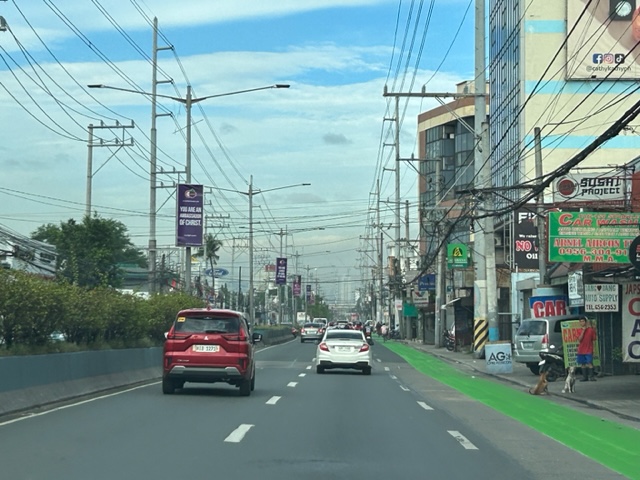 These photos were taken before the solar studs were installed to delineate the bike lanes and make them more visible at night or when its dark.
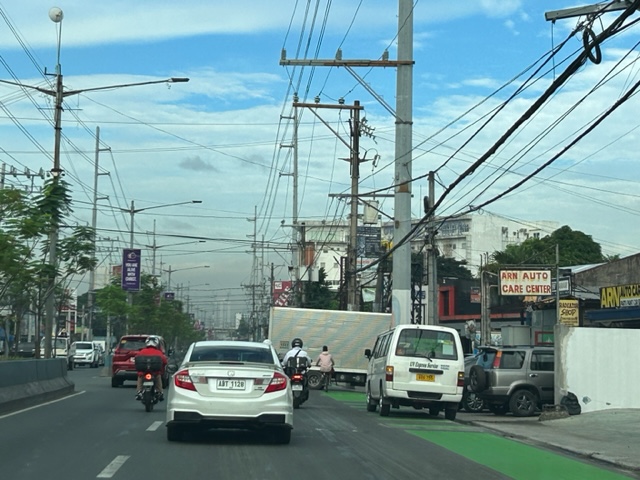 Also, challenges and concerns for cyclists are parked vehicles and those maneuvering from the various establishments along the road. This photo pretty much captures those two concerns – a parked UV Express van and a truck maneuvering out of a store occupying the bike lane.
 Cyclist pedaling along the bike lane approaching the Shell Gas Station (where there is also a McDonald’s)
 Bike lane in front of the Ortigas Hospital just outside the Brookside Gate 1 and near Cainta Junction
More photos of the bike lanes soon!
–
Speeding, road crashes and nuts behind the wheel
A recent road crash involving a car slamming into a truck along Marcos Highway in Antipolo City highlights one of the main concerns affecting road safety in the Philippines – speeding. Video from a CCTV camera installed at an establishment near the crash site showed a truck making a U-turn and doing it correctly (i.e., the maneuver) and safely. What followed was a car that was obviously speeding but seemingly not out of control. The car slammed the back of the truck in what was a fatal and tragic crash.
Are the roads to blame? While roads and bridges are static, design elements are the main culprits for why these facilities can be unsafe to users. Straight, level and wide sections of roads invite speeding among drivers and riders alike. The so-called ‘ideal’ sections of roads encourage drivers and riders to speed up, regardless of the speed limits. Thus, roads like Commonwealth Avenue in Quezon City and Marcos Highway in Antipolo, Cainta, Marikina and Pasig have many speeding vehicles. The design speeds for these roads are definitely above the speed limits. I still maintain though that it takes two to tango. That is, even with the above conditions, disciplined, experienced drivers and riders should not have been speeding or doing any other risky maneuver. That could have reduced the likelihood of such crashes. I think that’s pretty plain and common sense.
–
Want Less Traffic and More Parking? Start Charging for It!
Here’s a quick share of an article on parking:
Source: Want Less Traffic and More Parking? Start Charging for It!
From the article:
“like most urban issues, parking is not an isolated problem. If smart parking programs are implemented but road design and policies still encourage motor vehicle use, the efficiency of parking programs will be limited by the intrinsic political and physical nature of each location. Nevertheless, free parking is a nuisance and a massive cost to the public, especially lower-income individuals, causing congestion and ultimately reducing mobility. Research shows that charging for parking makes the most out of parking spaces in a given area, and makes the process of maintaining parking fairer by charging its users instead of everyone indiscriminately.”
–
29th Annual Conference of the TSSP
The Transportation Science Society of the Philippines (TSSP) held its 29th Annual Conference today, December 7, 2023. Following is the program for the conference, which featured a panel discussion in the morning and technical sessions in the afternoon.
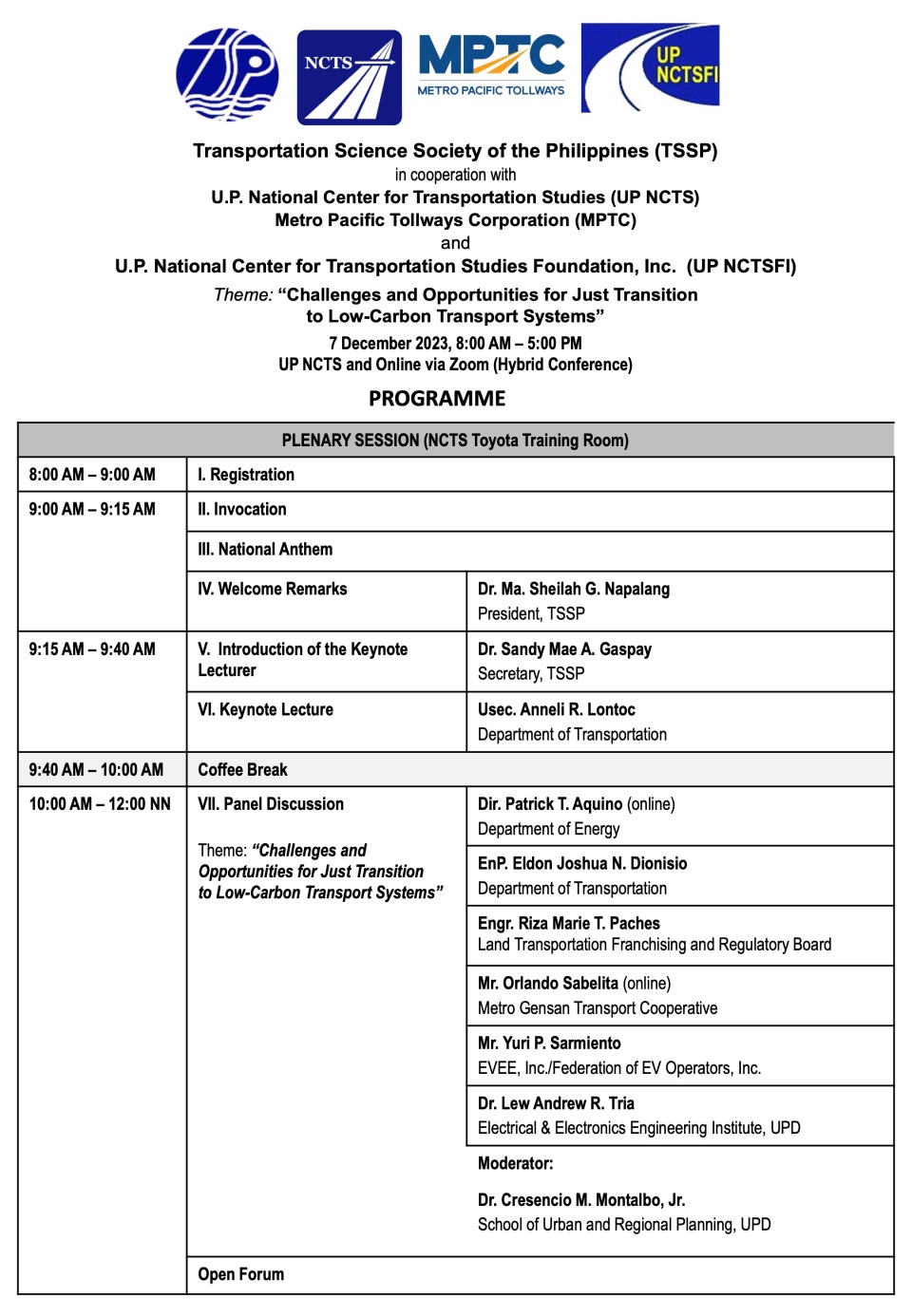
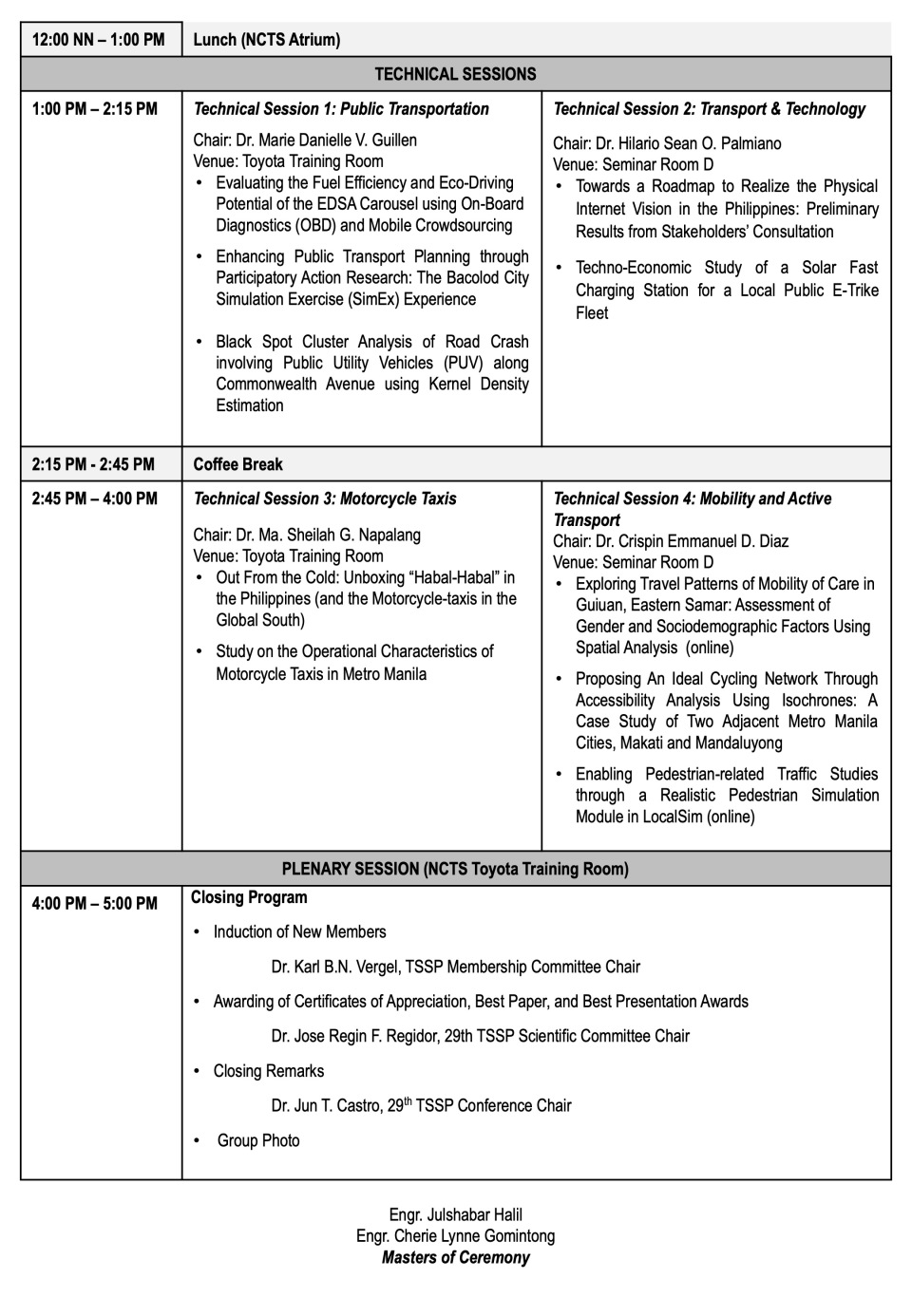
This was the first mainly face-to-face or in-person conference for the society since 2019. Previously, the conferences were online. As reported in the concluding part of the program, there were 84 participants who showed up at the venue while there were 30+ participants who were online via Zoom.
There were a couple of awards at the conference. These were the Best Paper Award and the Best Presentation Award. The Best Paper Award, based on the scores garnered from the blind review of the papers went to:
Maria Belen Vasquez and Jun T. Castro of UP Diliman for their paper entitled “Exploring Travel Patterns of Mobility of Care in Guiuan, Eastern Samar: Assessment of Gender and Sociodemographic Factors Using Spatial Analysis”
There was a tie for the Best Presentation Award. The two were Ms. Vasquez for the presentation of the paper on the Mobility of Care in Eastern Samar, and Mr. Erris Sancianco for the presentation of a paper he co-authored with Noriel Christopher Tiglao, Niki Jon Tolentino, Gillian Kate Hidalgo, Mary Joy Leanda, and Lester Jay Ollero entitled “Evaluating the Fuel Efficiency and Eco-Driving Potential of the EDSA Carousel using On-Board Diagnostics (OBD) and Mobile Crowdsourcing“. These papers will likely find their way to the Philippine Transportation Journal’s next issue.
Though it was not announced, a likely venue for the next conference will be Vigan, Ilocos Sur in the Northern Philippines. The likely host will be the University of Northern Philippines, the premier state university in that province. Previously and most recently, the conference was held in Cebu City (hosted by the University of San Jose-Recoletos) in 2019 and before that in Cagayan De Oro City (hosted by Xavier University) in 2018. TSSP was already organizing the 2020 conference when the pandemic struck and the country went on a lockdown. That conference was supposed to have been held in Baguio City in Benguet, and to be hosted by St. Louis University.
More information on the conference may soon be found at the TSSP’s official website: https://ncts.upd.edu.ph/tssp/
–
On making intersections safe by ‘daylighting’
I came across this interesting article that introduced a somewhat new term to me – daylighting.
Abramson, B. (November 24, 2023) “How to Daylight Your City’s Intersections (and Why It Matters),” Strong Towns, https://www.strongtowns.org/journal/2023/11/24/how-to-daylight-your-citys-intersections-and-why-it-matters [Last accessed: 12/3/2023]
From the article:
“Daylighting is the technical term for a common-sense solution to traffic safety: By removing visual obstructions in approaching intersections, users can better see and more safely cross each other’s paths. “
There are certainly many intersections and even mid-block crossings in our cities and municipalities that could use ‘daylighting’ to improve safety. Many of these intersections and crossings are used by the most vulnerable road users like children, senior citizens and persons with disabilities. Interventions need not be expensive and may also involve the community. Examples are shown in the article, and these can easily be implemented formally or informally with the cooperation of stakeholders including the local government units and national agencies (i.e., DPWH) under whose jurisdiction many roads are.
–
On reimagining our streets
We start the last month of the year by sharing this article on complete streets:
Robertson, D. (November 15, 2023) “Safe streets are global—and it’s time for the U.S. to catch up,” Smart Growth America, https://smartgrowthamerica.org/safe-streets-are-global-and-its-time-for-the-u-s-to-catch-up/?eType=EmailBlastContent&eId=03b04320-4eeb-4bf5-9b12-71ec2a960421 [Last accessed: 12/1/2023]
To quote from the article:
“The examples mentioned here are exemplary cases, but demonstrate that the future of mobility need not follow the same dangerous status quo. They prove that with a combination of public and political will to the commitment of the prioritization of people over cars, we can produce the results we care all about.”
While the article is on complete streets, there is a very quotable section that referred to the situation in Japan:
“Anyone who wants to register a car in Japan today must prove that they have a private place to park it. This shifts the economic burden of providing parking from the public to drivers, and also ensures that supply of parking will not grossly outpace demand.”
There are many opportunities for the complete streets concept to be applied in the Philippines. A few have already been implemented but there should be more especially in light of the gains from the development of bike lanes networks in many LGUs that started during the COVID-19 pandemic. As for parking, perhaps the Japanese example should be adopted and implemented to curb car-dependence.
–
The wrong message for electric and hybrid vehicles
There are two billboards along Katipunan Avenue, each displayed to face either the northbound or southbound traffic along the busy thoroughfare. The ad by a major Japanese automaker is a sales pitch for one of its electric vehicle models. The ad states one of the incentives or come-ons for electric and hybrid vehicles granted by government (in this case the Metro Manila Development Authority) to encourage people to buy electric or hybrid vehicles; ideally to replace their fossil fuel-powered vehicles.
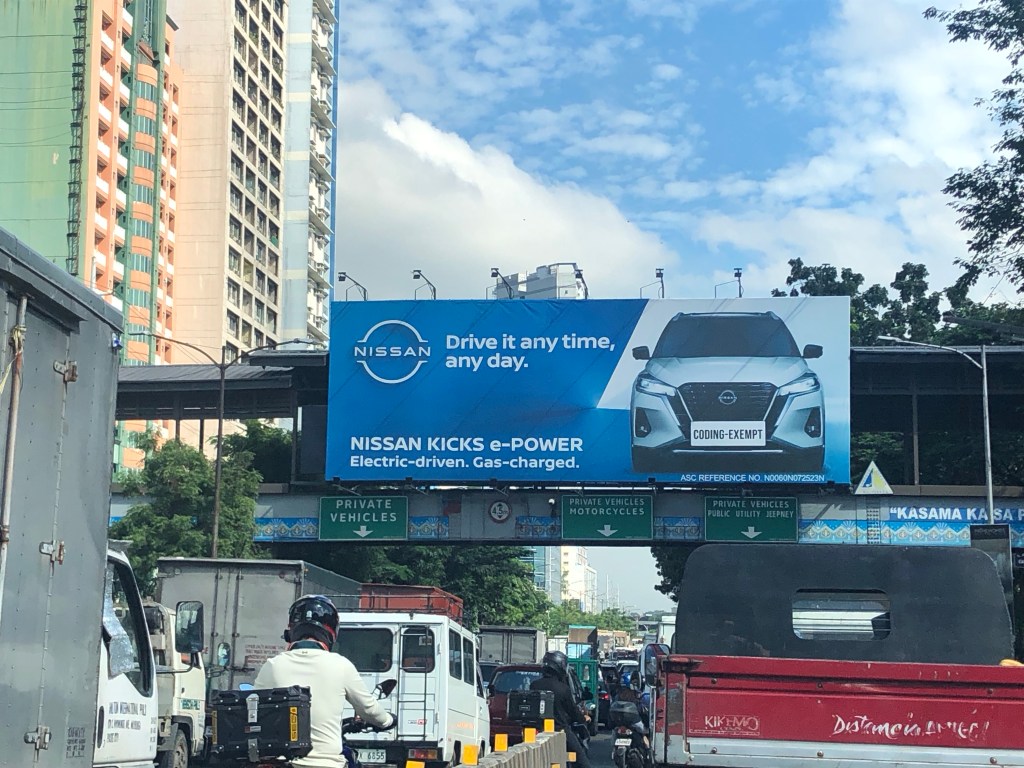 Electric and hybrid vehicles in Metro Manila are exempt from the MMDA’s number coding scheme. The ad is clear about that especially as a selling point for the vehicle featured.
At this point, more electric and hybrid vehicles would probably translate to more traffic congestion. They will just be replacing the conventional vehicles if not adding to them. The incentive will actually backfire vs. the MMDA since the number coding scheme will eventually be rendered ineffective (di pa ba?) with the addition of these coding-exempt vehicles.
–
Still on the Katipunan zipper lane
I’ve occasionally arrived at Katipunan with the experimental zipper lane still in use. I usually take Major Dizon from Marcos Highway in order to have a chance of using the zipper lane. That is, I take the left-most lane of C5 so I am in a good position in case the lane was available when I get to the Ateneo area. Perhaps it is already assumed that the right most lanes are already dedicated to vehicles bound for Ateneo or Miriam (mostly Ateneo I suppose).
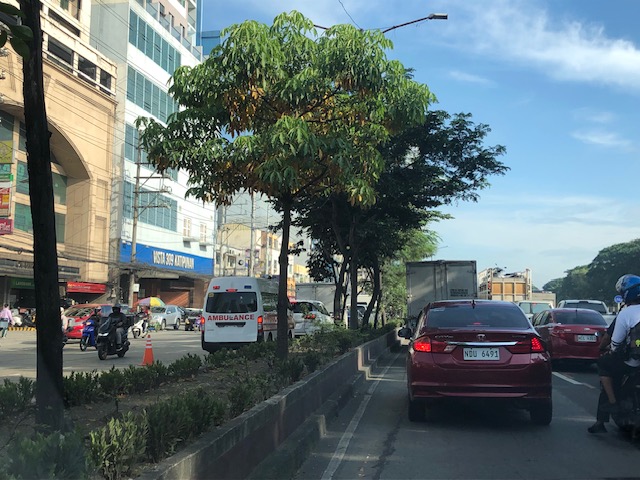
So far, I’ve been able to use the zipper lane only once. On the other times, I stay on the left-most lane (beside the island) of Katipunan/C5. The zipper is relatively short as vehicles return to the correct side of the road at Ateneo Gate 3. The merging there means slower movement of both the zipper lane and the median lane traffic. So is the zipper lane a success? I would say the experiment is just above “marginal success” (or pasang awa) given its limited application. It doesn’t hurt to implement the scheme as traffic along the southbound side of Katipunan is generally light anyway.
–
 Caught (up) in traffic