
Home » Policy (Page 9)
Category Archives: Policy
Tricycle policies in Zamboanga City
I forgot about these photos I took at the driveway of a shopping mall in Zamboanga City. The tarps state the penalties for erring tricycle drivers in the city under a couple of City Ordinances (185 and 485, series or year not stated in the tarp) and the fare matrix based on City Ordinance 416 (series or year also not stated).
 Penalties for erring tricycle drivers in Zamboanga City. As stated in the tarp, the typical offenses include: overcharging, refusal to convey passengers, insolent, discourteous or arrogance, undue preferences or unjust discrimination, and operation of motorized tricycle for hire in prohibited areas. It is also clear that the penalties are not just for drivers but the owners/operators of the trikes with erring drivers.
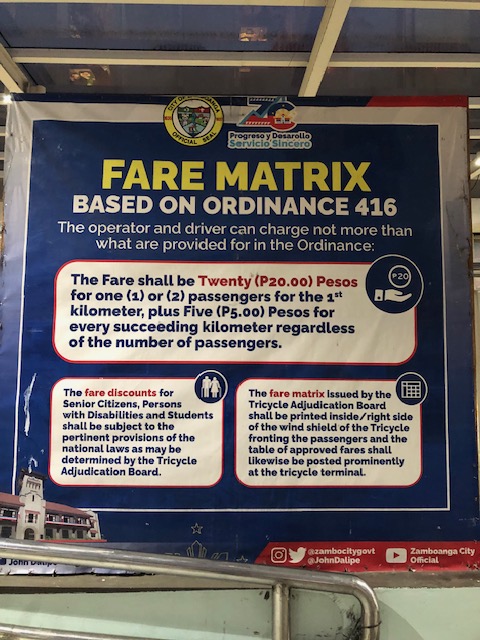 Simple fare calculation stated on the tarp. I assumed there were specific matrices posted in each tricycle but there was none since operations are free-for-all regardless of TODA in the city. That is, trikes in the city practically have no zones of operation where they are restricted or confined similar to what they have in other cities like Olongapo or Quezon City. In the latter, they can issue specific matrices or tables for the passengers’ reference much like what you have in jeepneys that have fixed routes. This can be confusing to passengers and creates situations that may lead to drivers taking advantage and overcharging passengers.
In a city like Zamboanga where there are many one-way streets, tricycle drivers can easily lengthen or appear to lengthen trips leading to overcharging of fares. Where tricycles do not have zones or areas of operations per TODA, this becomes the weakness or flaw even with ordinances in place for erring drivers and a simple fare matrix for passengers’ reference. Of course, regular commuters should be familiar with the usual fares they pay so perhaps that’s among the basis for knowing if you’re being overcharged. Visitors though will likely pay more if the driver consciously takes advantage of the situation. Again, this is a matter for enforcement of the ordinances passed by the city and an example of how such ordinances will be implemented.
–
Article share: What’s Incomplete About Complete Streets?
The concept of road diets circulated in Metro Manila more than a decade ago. I recall the Metro Manila Development Authority (MMDA) picked up the concept and attempted to apply it in some parts of Metro Manila. Since there are no evidence of that endeavor surviving now, then we can assume that it was a failure. There is no wonder there as I also recall the effort to be half-hearted and more to get media mileage (cheap talk or lip service) out of it. Road diets eventually evolved into the complete streets (though the literature now will state road diets as part of complete streets). That experience and similar initiatives of varying success (or failure) rates are not unique to the Metro Manila but is actually happening elsewhere including cities in countries where the complete streets have been applied more comprehensively and yet somehow found to be lacking or not as effective a solution as expected. I am sharing an article here that discusses what seems to be lacking or ‘incomplete’ as it is referred to.
Source: What’s Incomplete About Complete Streets?
Quoting from the article:
“What’s missing? First of all, even the best Complete Streets policy can’t solve the problem of fiscal scarcity. Even in a city committed to Complete Streets, street redesign must fight for public dollars with other worthy goals such as education and public safety. As a result, Indianapolis’s improvements are a drop in the bucket. The city maintains 3,400 miles of streets and roads, so its 100 miles of bike lanes affect only 3 percent of the city. Similarly, 2,000 miles of the city’s roads still lack sidewalks.
Second, the quantitative benchmarks seem to focus on sidewalks and bike lanes (Sec. 431-806), and the policy doesn’t mention traffic calming or similar policies. So if the city had a six-lane road with traffic going 60 miles per hour, the Complete Streets policy would not affect that road except to the extent necessary to build a sidewalk or a bike lane.** Thus, even the best Complete Streets policies don’t really address some of the most dangerous features of American street design.”
—
Article on “Fair Share Transportation Planning”
I am sharing this new article from Todd Litman on fair share transportation planning. The content is relevant and very timely in the Philippines considering many people including and especially transport officials are struggling with the thought of allocating resources to provide or improve facilities geared towards more equitable transport systems (e.g., more facilities for active transport).
Here’s the summary as quoted from the article:
“To be efficient and equitable, a transportation system must serve diverse demands. A diverse transportation system allows travelers to use the most efficient option for each trip—safe walking and bicycling for local errands, efficient public transit when traveling on busy travel corridors, and automobiles when they are truly the most cost-effective mode considering all impact—and it ensures that people who cannot, should not, or prefer not to drive receive their fair share of public investments.
Current transportation planning practices are biased in various ways that overinvest in automobile infrastructure and underinvest in more affordable, inclusive, and efficient modes. It is time for planners to reconsider our analysis methods and funding practices to ensure that non-auto modes, and therefore non-drivers, receive their fair share of transportation resources.
This is not anti-car. Motorists have good reasons to support more investments in non-auto modes that reduce their traffic and parking congestion, reduce their chauffeuring burdens and crash risk, and provide better options when their vehicles are unavailable. Everybody wins from a more diverse and efficient transportation system.”
On one’s exposure to noise
Here is another article on noise, relating about how it affects our health (e.g., “noise can damage your heart as well as your hearing”). The article also includes reference to an app developed by the US National Institute for Occupational Safety and Health (NIOSH) – a sound level meter iOS app that utilizes sound energy, and has its accuracy verified in an acoustics lab.
To quote from the article something related to transport and traffic:
“As a general rule of thumb, the World Health Organization considers average road traffic noise levels above 53 decibels and average aircraft noise levels above 45 dB to be associated with adverse health outcomes, though their metrics are weighted slightly differently than the average on your screen.
Nighttime noise is considered particularly harmful because it can fragment your sleep and prompt a stress response, even if you don’t remember waking up. The W.H.O. has long recommended less than 30 dB of nighttime noise inside your bedroom for high-quality sleep.”
We tend to dismiss or take for granted the noise from transport and traffic. While it seems that it does not have an effect on our health and well-being, it will eventually catch up with us and cost us health-wise. I have downloaded and installed the NIOSH app on my phone and occasionally monitor the noise around me whether I am at home or at the office. It can get pretty loud during my commutes and I drive so am curious how loud it can be for those taking public transportation. I have experienced riding in jeepneys blaring loud music. A daily dose of that for long periods each way of the commute will surely affect one’s hearing and overall health. Exposure, after all, isn’t just about the intensity of the noise but how long you experience or endure it.
–
On noise and how it affects your health
I am sharing this article on noise that was recently published in The New York Times:
Baumgaertner, E., et al (June 9, 2023) “Noise Could Take Years Off Your Life. Here’s How,” The New York Times, https://www.nytimes.com/interactive/2023/06/09/health/noise-exposure-health-impacts.html?smid=url-share [Last accessed: 6/13/2023]
To quote from the article:
“European countries have far outpaced the rest of the world in regulating noise. The European Union requires member nations to monitor and assess sound levels across regions and to produce new action plans every five years to address communities at greatest risk. The E.U. now mandates quiet brake locks on rail freight fleets and noise labels on outdoor power equipment; it also requires noise reduction in car manufacturing and mitigation efforts at airports.
Individual cities and countries have taken additional measures. Paris has installed noise cameras that measure the sound level of vehicles and fine drivers who exceed them. Berlin has used new bike lanes to reduce the flow of engine-powered vehicles and move the source of the noise to the center of the road, away from houses. Switzerland has introduced national “quiet hours” — overnight, one midday hour on weekdays, and all day on Sundays.
While scientists say it’s too soon to make a prediction about the effects of these policies on cardiovascular health, several European countries have reported tens of thousands fewer residents exposed to major sources of noise.
Like many health issues, protection against noise would be economically advantageous. Economists who analyzed health care spending and productivity loss because of heart disease and hypertension have argued that a 5 dB reduction in U.S. noise could result in an annual benefit of $3.9 billion.”
Not everyone is aware of how noise may affect our health. Most of us are exposed to noise of different levels and lengths of time (i.e., duration). We probably take for granted, for example, the noises we hear during our commutes or perhaps the noises in our workplaces. These actually take a toll not just on our hearing (e.g., long time factory workers likely have hearing problems after they retire) but other aspects of our health as well. Long commutes inside jeepneys blaring music can do damage to your health. Noise from busy streets will cause damage to the health of those residing along these streets. Are we doing anything to mitigate such noise in the Philippines?
–
On sleepy drivers
I am sharing this article on sleep-deprived driving as there appears to be low awareness of the dangers of this behavior as opposed to the typical drunk driving or driving under the influence (DUI) cases that we often hear or read about in the news (mainstream or social media).
Britt, R.B. (April 18, 2023) “Sleep-Deprived Drivers Might as Well be Drunk,” Medium.com, https://robertroybritt.medium.com/sleep-deprived-drivers-might-as-well-be-drunk-887aab48c1c [Last accessed: 4/21/2023]
To quote from the article:
“A 2016 study by AAA linked lack of sleep in the past 24 hours to dramatically higher crash risk, in hour-by-hour increments:
6–7 hours sleep: 1.3 times the risk
5–6 hours: 1.9 times the risk
4–5 hours: 4.3 times the risk
<4 hours: 11.5 times the risk
The risk of a crash drops to zero if you simply stay off the road, of course. Otherwise, the bottom line is pretty clear:
“You cannot miss sleep and still expect to be able to safely function behind the wheel,” said David Yang, executive director for the AAA Foundation for Traffic Safety.”
So make sure you get your sleep because it is really important for you to function not just as a driver or rider. It also applies to other activities or tasks as well whether you’re working, studying or playing.
–
Back to ‘old’ normal for air travel in the Philippines
Before we embark on another trip this week, I just wanted to share that it seems all is back to the old normal in as far as air travel is concerned in the Philippines. There are few, if any, exceptions based on what I and colleagues have experienced while traveling domestically. The only difference now from pre-COVID-19 air travel is that people are required to wear face masks inside the aircraft. Inside the airports, masks appear to be optional though most people wear them.
 The March-April 2023 issue of Cebu Pacific’s Smile Magazine features places to go while in Tokyo, Japan, a popular destination these days as foreign travel restrictions have eased.
Cebu Pacific provides passengers with their Smile magazine on-board their aircraft. Philippine Airlines domestic flights don’t have magazines (unless they do on Business or First Class) for Economy passengers. I noticed also that PAL did not have duty free items on-board their aircraft (at least for the MNL-SIN-MNL trips we had recently). I know that other airlines have resumed duty free sales on-board so perhaps this is just a cost-cutting thing for PAL. Meanwhile, Cebu Pacific’s inflight shop is open and selling souvenir items on their domestic flights.
–
A Serious Critique of Congestion Costs and Induced Vehicle Travel Impacts
Here is a quick share for today. This is an article by Todd Litman critiquing congestion costs and induced vehicle travel impacts:
Quoting from the article:
It is time for planners to rethink the way we evaluate congestion problems and solutions. Vehicle travel is not an end in itself; our ultimate goal is to improve accessibility. Traffic congestion is one constraint on accessibility, but others are more important. For example, the study, “Does Accessibility Require Density or Speed?” found that a given increase in urban density, and therefore proximity, has a far greater impact on overall accessibility than an increase in travel speed, and therefore congestion reductions. This is particularly true of disadvantaged groups who cannot drive or are financially burdened by vehicle expenses.
It is irresponsible for transportation agencies to expand highways in ways that contradict other community goals. If they do nothing, at worst, traffic congestion will maintain equilibrium; people will manage within its constraints. Even better, transportation agencies can invest in resource-efficient alternatives—better walking, bicycling, public transit, and telework opportunities—that improve accessibility, increasing transportation system efficiency.
If we truly want to truly optimize our transportation systems, we need a more comprehensive analysis of impacts and options, including the full costs of urban highway expansions and the full benefits of non-auto mode improvements and TDM incentives. Highway expansion should be a solution of last resort, only implemented when all other solutions have failed and users are willing to pay the full costs through tolls.
It’s time to stop obsessing about congestion and instead strive for efficient accessibility that serves everybody in the community.
Source: A Serious Critique of Congestion Costs and Induced Vehicle Travel Impacts
A brief history of transport strikes – Part 4: impacts and implications
What was supposed to be a week-long transport strike by jeepney drivers and operators was called off yesterday. Frontpage news showed a photo of representatives of protestors with government officials. Government official statements also declare that the government will be talking with the transport sector to sort out issues and to try to address these in relation to the PUV Modernization Program (PUVMP). One day earlier, government was quick to state that the strike had no impact on transport. Were there really no impacts?
I think the fact that schools went back to online mode and offices allowed employees to work from home show the impacts of the transport strike. If you haven’t noticed, the government has been using the tactic of cancellation of classes for quite some time now. To reduce the impacts of transport strikes on commuters, classes on all levels were canceled, thereby reducing transport demand. The only difference now is that there is capacity for online classes due to adjustments made during the height of the pandemic. So instead of cancelling classes altogether, schools reverted to online mode. Meanwhile, for those who needed to go to their workplaces and did not have their own vehicles, there were various free rides (libreng sakay) services provided by national and local government agencies. Cities like Quezon City already operated their own bus services so people could take these instead of their usual PUV modes for commuting.
What are the implications of the shortened strike? The shortened strike has various implications. One is that it showed the protesters did not have enough resources to sustain the strike. It also showed that transport leaders appear to just want some attention from government. A colleague commented about this being something like a show or the strike being part of a game of “bad cop, good cop” among government officials and agencies. If you haven’t noticed, this has been going on for some time now. Government already knows how to reduce the potential impacts of protests like this. Suspending classes in schools significantly reduces the travel demand on a typical weekday. Offices giving their employees the option to work from home during the strike also adds to the reduction in travel demand. And libreng sakay vehicles are easier to deploy as agencies and LGUs have vehicles for this purpose. Meanwhile, the continuing rise in motorcycle ownership also contributed to people being able to still commute (i.e., having the motorcycle taxi option). At least for Metro Manila, once the railway projects are completed, there will be a railway option for commutes. Barring a simultaneous strike with buses and vans, protests from the jeepney sector will surely be diminished.
–
A brief history of transport strikes – Part 3: advocacy and bandwagon
You see a lot of posts on social media stating people supporting the current transport strike. There are cartoons and memes that dramatize if not romanticize the plight of drivers. One cartoon I saw has a girl asking her driver-father if he will join the strike. The father replies he is unsure as they won’t have any income to cover their needs. One panel shows the driver’s cash box with graduation photos of what appear to be his other children. Of course, this suggests that the jeepney driver was able to support his children in their education while also suggesting about the uncertainties for the other child (who is in the comic). The comic obviously appeals to the emotions of the reader. It is a fallacy but one that is very close to and appeals to the psyche of the Filipino.
Another cartoon appears to be comparing modernization with replacing office computers. It states that the government’s modernization program is like an office requiring its employees to replace their old notebooks with high end ones. Only, the office is not paying for the new units and will have these charged to the employees’ salaries. I thought that was an oversimplification. Jeepneys are public utility vehicles and not private. There are rules and regulations governing PUV acquisition, franchising and operations, unlike your typical office computer.
I think we should draw the line between advocacy and simply jumping onto the bandwagon that is supporting a transport strike without knowing and understanding the details about it. Otherwise, we end up giving unconditional support to what others will refer to as a backward public transportation system. There are always two sides to a coin and while there are good stories about the jeepney and how it has supported many families, there are also bad ones that have allowed them to remain practically unchanged over so many decades. The same applies to the opposition – those who call for a phase-out or outright modernization without understanding the terms given to drivers and operators and the overall context and situation regarding the modernization program. It is easy to take sides. The question is if you are aware and understand the details about the issues here.
–
 Caught (up) in traffic