
Home » Ports (Page 2)
Category Archives: Ports
On logistics in the Philippines
I am not a logistics expert and will not pretend to be one. I have, however, been involved in several projects that included logistics as a major study component. These include a nationwide study on inter-regional passenger and freight flow and another for freight forwarders affected by vehicle restraint policies in Metro Manila. A more recent engagement has allowed me to take a look at logistics in the country from other perspectives including that of national agencies seeking to improve goods movement in the country and development agencies that have committed to help the country to do just that. There are local issues and there are regional ones. The regional ones often involve the need for infrastructure such as maritime ports and airports, highways and bridges, and other facilities such as those for storage and refrigeration.
For an archipelago like the Philippines, logistics is a bit more challenging than in countries whose territories are not separated by bodies of water. There is no lack for good practices though as there are other archipelagos that could provide good examples for connecting the islands such as Japan and the United Kingdom. Nearby, we share similar challenges with Indonesia and to a certain extent Malaysia. Of course, availability of resources is always an issue and particularly for the prioritization of infrastructure to be constructed aside from those that need to be maintained. The DOTC along with its attached agencies like the Philippine Ports Authority (PPA) and the Civil Aviation Authority of the Philippines (CAAP) are in the frontline when it comes to airports and ports planning, development, and maintenance are concerned. However, the DPWH plays a vital role for highways and bridges and the connections for these ports and airports including what is termed as “last-mile” connectivity that is often passed on as a responsibility of local governments. This is likely due to local roads often providing the connection between national roads (under the DPWH) and ports and airports. It is a good thing that the current DPWH has committed to a convergence program regarding national and local roads that has benefited a lot of sectors and industries like tourism and agriculture.
Rail transport is not mentioned here because there is practically none even for what remains of the once relatively extensive PNR main lines. The local issues are not simpler and can be a bit more complicated than the regional ones. The complications are usually due to more petty circumstances that may involve politics and local power plays. The basic ingredients though are related to traffic congestion and the damage to roads and bridges attributed to trucks.
Many cities and municipalities have implemented truck bans along their major roads. These are usually one or two routes in the smaller cities and towns, usually passing through the “bayan,” “poblacion” or central business district (CBD). These roads are usually national roads (e.g., McArthur Highway and the Pan Philippine Highway pass through many towns). As such, there are cases where bypass roads are constructed to alleviate congestion along these roads as well as to try to preserve the pavements in the town proper. Such traffic schemes targeting heavy vehicles are not new and are also a way to address the issue on overloading that is common in trucking in the Philippines. The bypass roads, however, generally invite development and unplanned development have often made these alternate routes more congested than the original ones.
Manila did a “power play” recently by implementing a more aggressive truck ban. This led to more severe congestion around the Port of Manila and a lot of delays that have cost a lot of money in part due to the limited alternative routes in the city and most roads are already constricted. The costs have repercussions on the economy in general as the movement of goods are affected by the impasse in Manila. Whether this was for more political or practical reasons is difficult to say because the mayor and vice mayor have invoked the very common issues of traffic congestion, road safety and pavement maintenance that got the attention, sentiment and agreement of a lot of people. Many of these people though do not understand the impacts of inefficient goods movement and likely are concerned only about passenger transportation.
More recently, a lot of containers were shipped from the Port of Manila to Subic. These are supposedly “overstaying” shipments or those that have not been claimed for a long time or have some issues regarding their release. This should ease congestion somehow but there remain the problems of shipping or logistics companies regarding freight transport in general that needs to be addressed. Both Subic and Batangas ports have been mentioned in many formal studies over the past few years including a more recent one supported by JICA. Still, there is a lot of hesitation if not confusion or uncertainty on how to go about with shifting goods movement to these ports, which are regarded to be underutilized. There are good roads connecting these ports with cities and towns but these might not be enough in the long run.
Perhaps there is a need to reconsider regional rail transport again especially for the islands of Luzon and Mindanao where long distance rail may have a tremendous impact for transporting goods over long distances. Of course, there are also issues pertaining to other ports and airports in the country including those in Mindanao (e.g., Davao, Cagayan de Oro, Phividec, Gen. Santos, etc.) and Visayas (e.g., Cebu, Iloilo, Tacloban, etc.). The RORO ports are among those that need attention as they are directly involve road transport aside from the ferries that carry them over the waters. These nautical highways are vital for goods movement around the country and require both national agencies and local governments cooperating for these facilities and services to function efficiently.
–
Manila’s truck ban experiment
The City of Manila has announced that it will implement a truck ban from February 10, Monday. Trucks of at least 8-wheels and 4,500kg gross weight will not be allowed to travel in Manila’s roads from 5AM to 9PM. Manila’s City Ordinance No. 8336 calls for the daytime truck ban in the city in order to reduce traffic congestion that is perceived to be brought about by trucks. 8-wheelers are likely 3-axle trucks with a 4-wheel, 2-axle prime mover pulling a 1-axle, 4-wheel (double-tired) trailer. I am not aware of the technical basis for the ordinance. Perhaps the city has engaged consultants to help them determine the pros and cons of this daytime truck ban. I hope it is not all qualitative analysis that was applied here as logistics is quite a complicated topic. And such schemes in favor of passenger transport (and against goods movement) actually creates a big problem for commerce due to the challenges of scheduling that they have to deal with. To cope with this ordinance, companies would have to utilize smaller vehicles to transport goods during the daytime. This actually might lead to more vehicles on the streets as companies try to compensate for the capacity of the large trucks that will be banned from traveling during the restricted period by fielding smaller trucks.
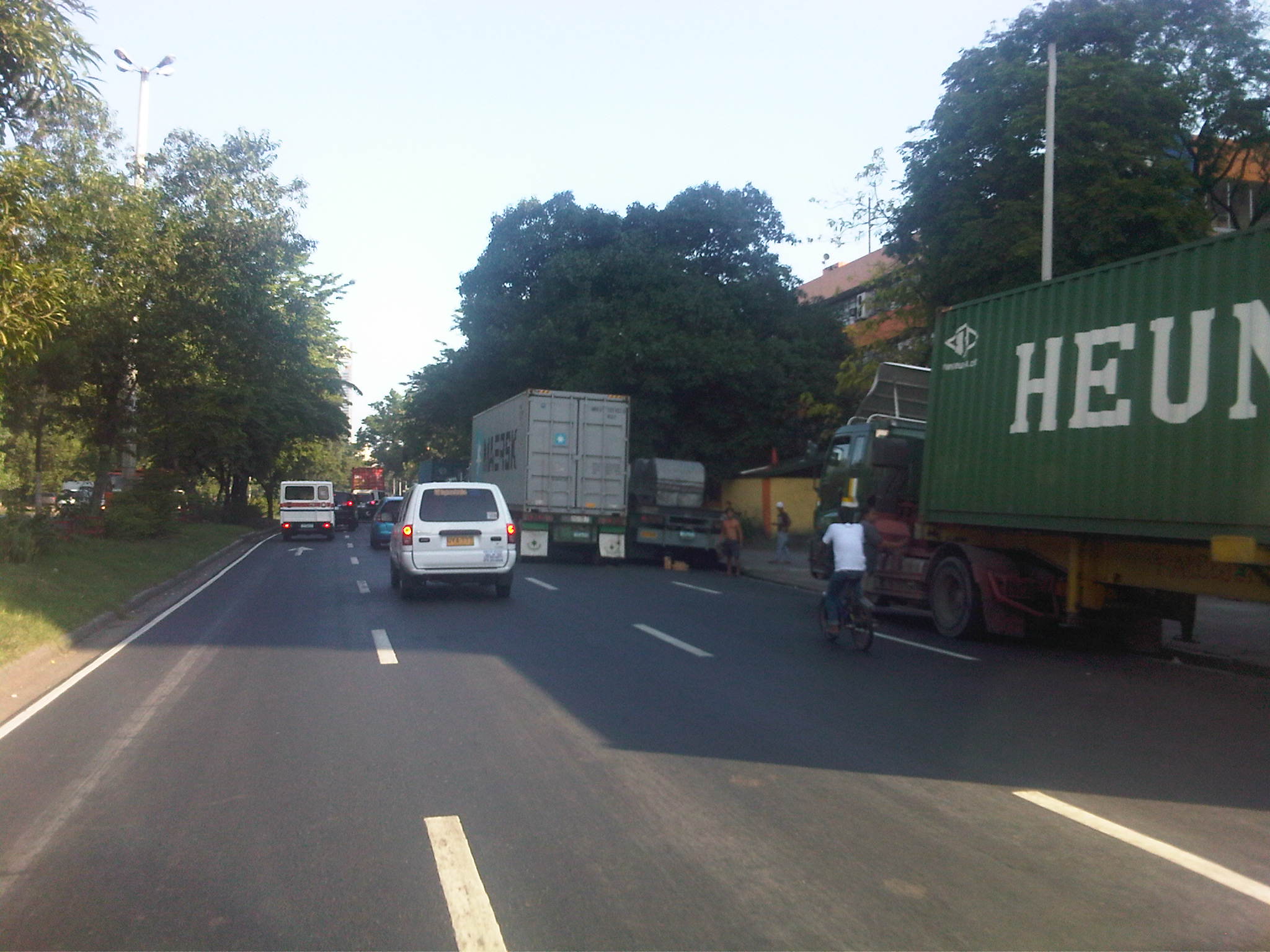 Trucks parked along Bonifacio Drive near the DPWH Central Office in Manila’s Port Area.
The latest word is that Manila has postponed implementation of the ordinance to February 24. This was apparently due to the reaction they got from various sectors, especially truckers and logistics companies who would be most affected by the restrictions. It was only natural for them to show their opposition to the scheme. Reactions from the general public, however, indicated that private car users and those taking public transport welcomed the truck ban as they generally stated that they thought trucks were to blame for traffic congestion in Manila. The truck ban will definitely have impacts beyond Manila’s boundaries as freight/goods transport schedules will be affected for the rest of Metro Manila and beyond. The Port of Manila, after all, is critical to logistics for the National Capital Region, and its influence extends to adjacent provinces where industries are located. Such issues on congestion and travel demand management measures focused on trucks bring back talks about easing freight flow to and from the Port of Manila to major ports in Subic and Batangas. There have been studies conducted to assess the decongestion of the Port of Manila as Batangas and Subic are already very accessible with high standard highways connecting to these ports including the SLEX and STAR tollways to Batangas and the NLEX and SCTEX to Subic. Perhaps it would be good to revisit the recommendations of these studies while also balancing the treatment of logistics with efforts necessary to improve public transport. After all, trucks are not all to blame for Manila’s and other cities’ traffic woes as buses are repeatedly being blamed for congestion along EDSA. In truth, there are more cars than the numbers of buses, trucks, jeepneys and UV Express combined. And the only way to reduce private car traffic is to come up with an efficient and safe public transport system. –
SuperCat trip from Calapan to Batangas
We were glad that we were able to get on either the SuperCat or FastCat for our return trip to Batangas after a meeting in Calapan. For one, this meant that our travel will only be an hour, 1.5 hours less than a trip on a regular RORO ferry. The RORO ferry schedule also didn’t favor an early arrival in Batangas considering we also had to travel back to Metro Manila. The SuperCat staff earlier didn’t sell us tickets because they were not sure there would be SuperCat trip in the afternoon given the conditions at sea.
 SuperCat staff had to assist passengers as they boarded the vessel due to the rough waters that frequently lifted the vessel and make one lose his/her balance.
 Another photo showing staff assisting boarding passengers. Each passenger had to go one at a time and at intervals due to the movements of the docked vessel.
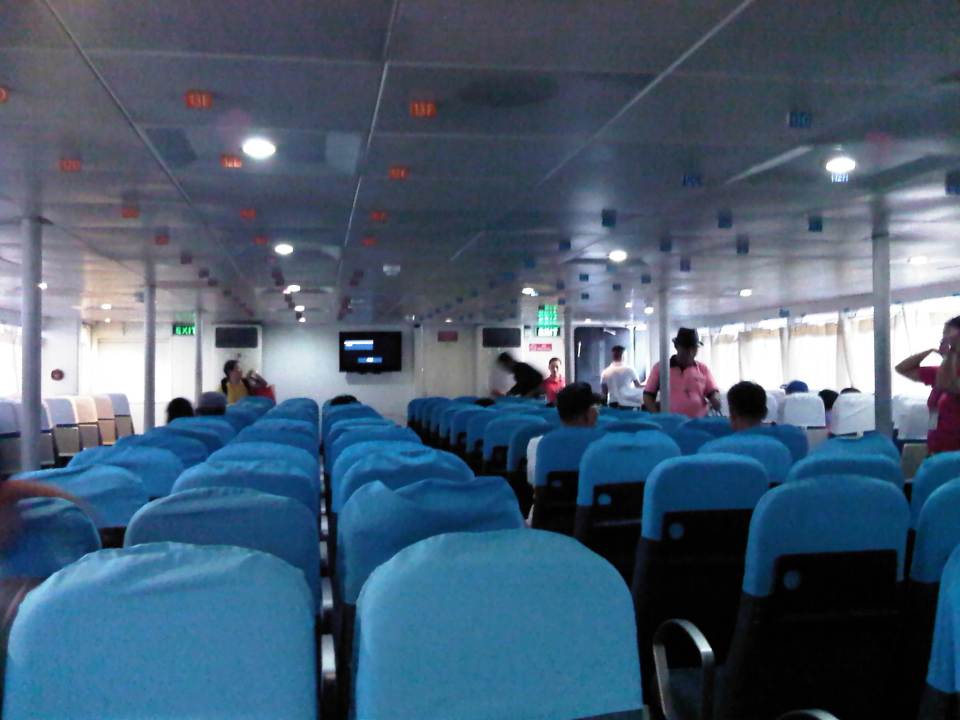 Inside the craft, it was obvious that this was a much better vessel than the regular RORO ferries plying the same Calapan-Batangas route. The seats were more comfy and the interior was clean and obviously well-maintained, and that includes the toilets on the vessel. There was airconditioning and staff were more professional and attentive to passengers (probably taking after airline flight attendants). There were few passengers so some people had entire rows to themselves.
 Passengers may place their bags or things under their seats or in front of them as there were no overhead compartments or space for stowing luggage and other items. Passengers with no one beside them put their bags on the empty seats instead.
 The crew served us some simple snack comprising of peanuts, a cupcake and a fruit drink. There were items like sandwiches, junk food and other drinks available at the bar inside the SuperCat but choices were limited and I learned their stocks were already depleted as this was the last trip for the day for the SuperCat. There were no night time fast craft trips.
 I tried to get photo of what was showing on the television screen but the choppy waters combined with the dim lighting didn’t favor my BlackBerry’s camera. There was only one screen and it’s size is obviously not suitable for passengers seated farther from the front. It didn’t really matter because it was only a 1-hour trip between Calapan and Batangas when using the SuperCat.
 Dim lights as passengers disembark from the fast craft. Outside, crewmen assisted passengers who might lose their balance due to the instability of the vessel due to the rough waters.
It was already drizzling when we got out of the terminal and rain was pouring as we drove out of Batangas and unto the STAR tollway.
–
RORO Ferry trip from Batangas to Calapan
[This post has generated a lot of inquiries about fares and schedules for RORO services between Batangas and Mindoro. I would like to clarify that what I wrote about is on one experience we had on a trip about 2 years ago. I am not connected with any of the ferry companies nor am I connected with the port authorities. For more info/details, here as some useful links:
SuperCat: http://www.supercat.com.ph/Fares/fares.asp
Montenegro Lines: http://www.montenegrolines.com.ph/index.php?nav=4
Port of Batangas: http://www.ppa.com.ph/batangas/about.html
Port of Calapan: http://www.ppa.com.ph/Calapan/cal_about.htm
Safe trips!]
—
Following is the original post:
Due to rough seas, there were no SuperCat trips between Batangas and Mindoro when we arrived at Batangas Port one Thursday morning. It seemed that there was only one fast ferry under the banner of SuperCat that plies the Batangas-Calapan route and it was on hold in Calapan due to rough waters. Later in the day though I would theorize that there might not have been enough passengers that morning between the cities and a decision had to be made not to make the trip, with the convenient and irrefutable reason of rough seas.
 RORO Ferry ticket (left) and passenger terminal fee ticket
 A view of two RORO ferries docked at the Batangas Port. One was operated by Montenegro Lines’ Marina Ferries and the other by Starlight Ferries.
 Passengers boarding the ferry Reina Hosanna. Some vehicles, mostly trucks were already loaded on the ferry. Others would have to wait until passengers have boarded the vessel.
 A view inside the ferry where vehicle and freight are positioned and secured for the voyage. People form a line before the narrow stairway to the passenger level.
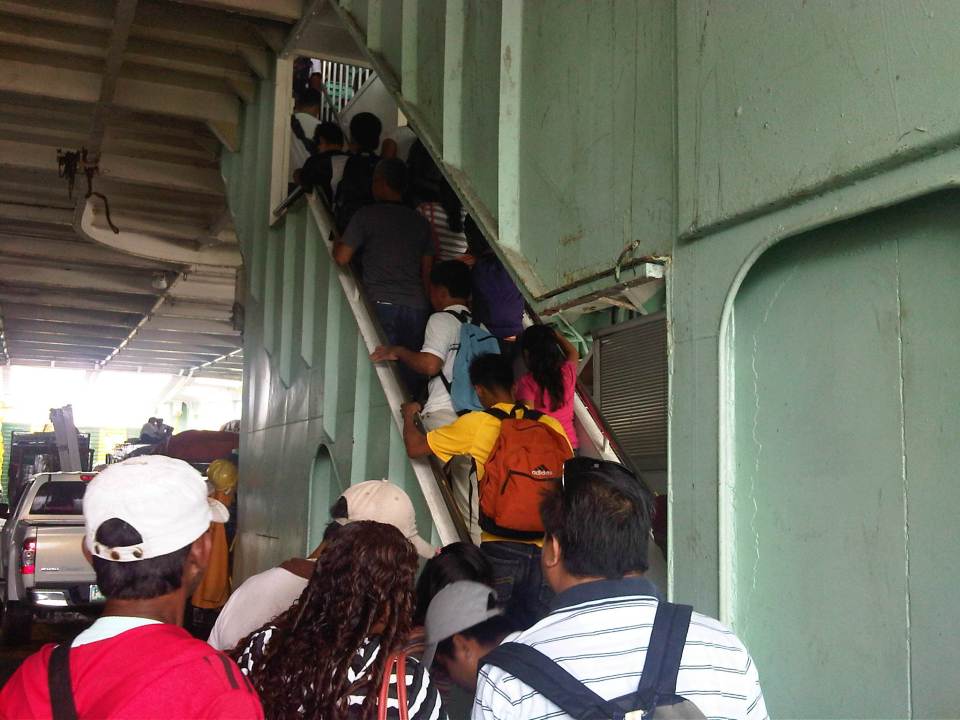 Passengers climbing the narrow stairway to the passenger deck of the Reina Hosanna.
 A view of the Batangas Port from the upper (view) deck of the ferry right above the passenger deck. Trucks can be seen boarding (rolling on) the ferry. The orange things are lifeboats lined along the rear of the passenger deck.
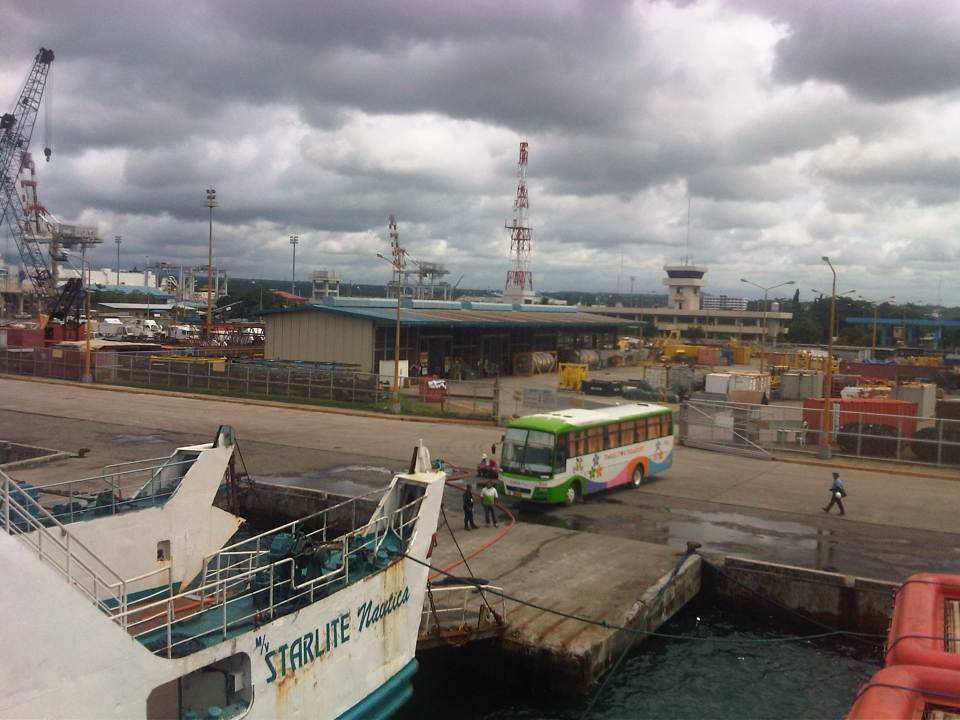 A provincial bus arrives to board another RORO ferry, the Starlight Nautica, which was scheduled to leave an hour after our scheduled departure. There are many bus companies plying the western nautical highway route , which can take the traveler to Caticlan, the jump off point for Boracay Island.
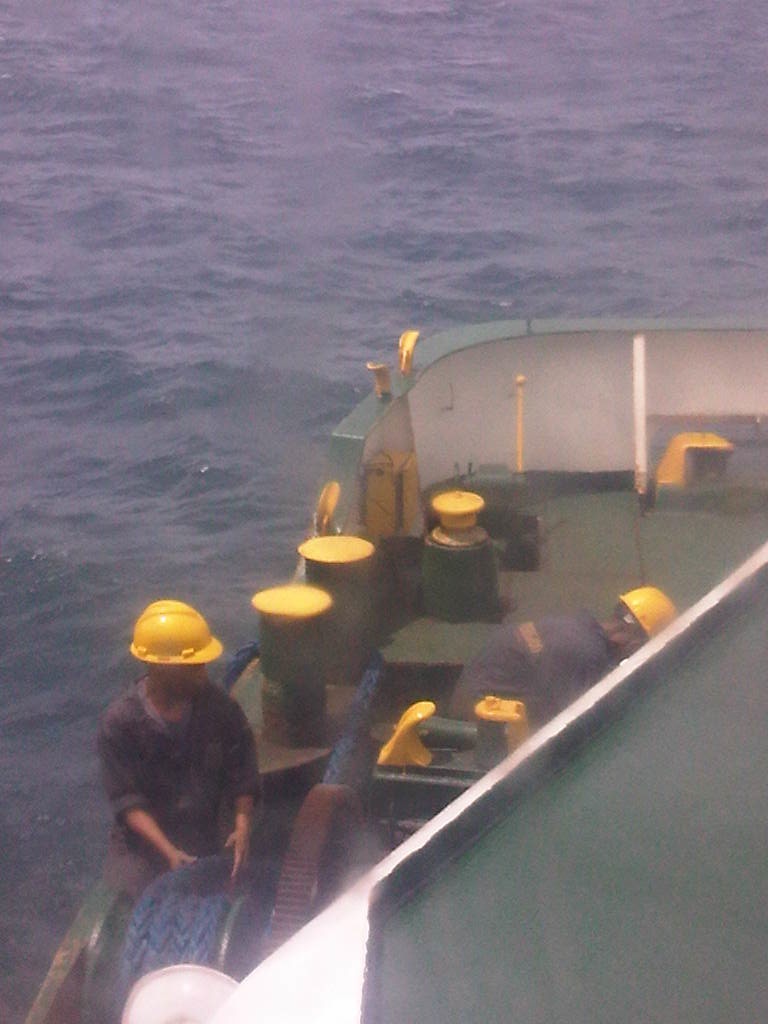 Reina Hosanna crewmen raise anchor.
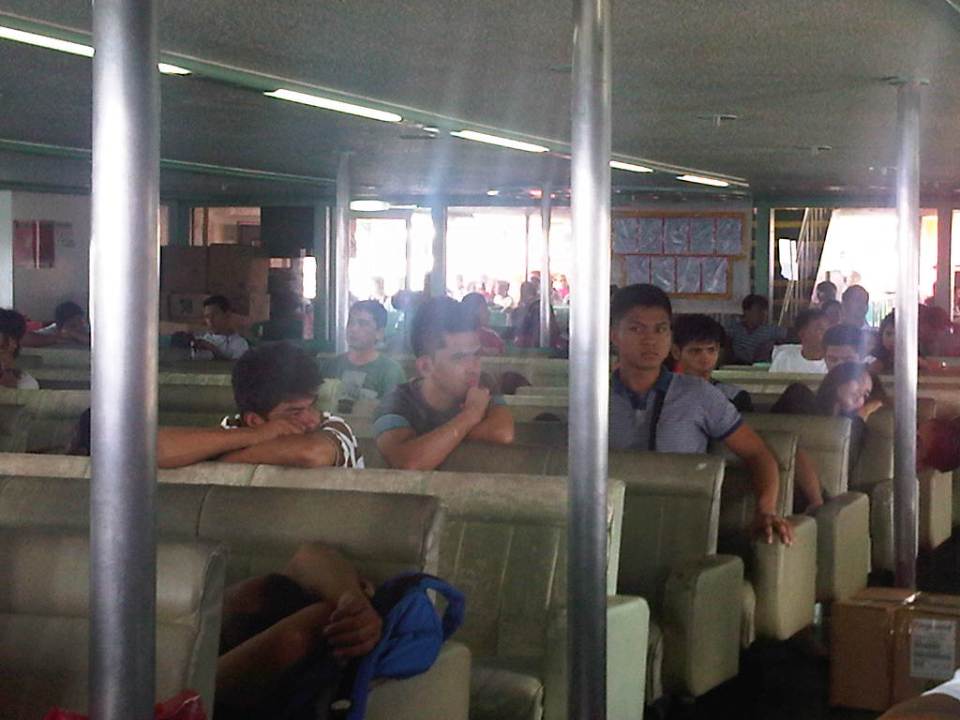 A view inside the passenger deck – seats were cushioned but mostly dilapidated and obviously requiring re-upholstery. The cabin seemed to be originally air-conditioned and we were lucky that the weather was fine and not so hot that day. Some passengers went to the upper deck to get some air.
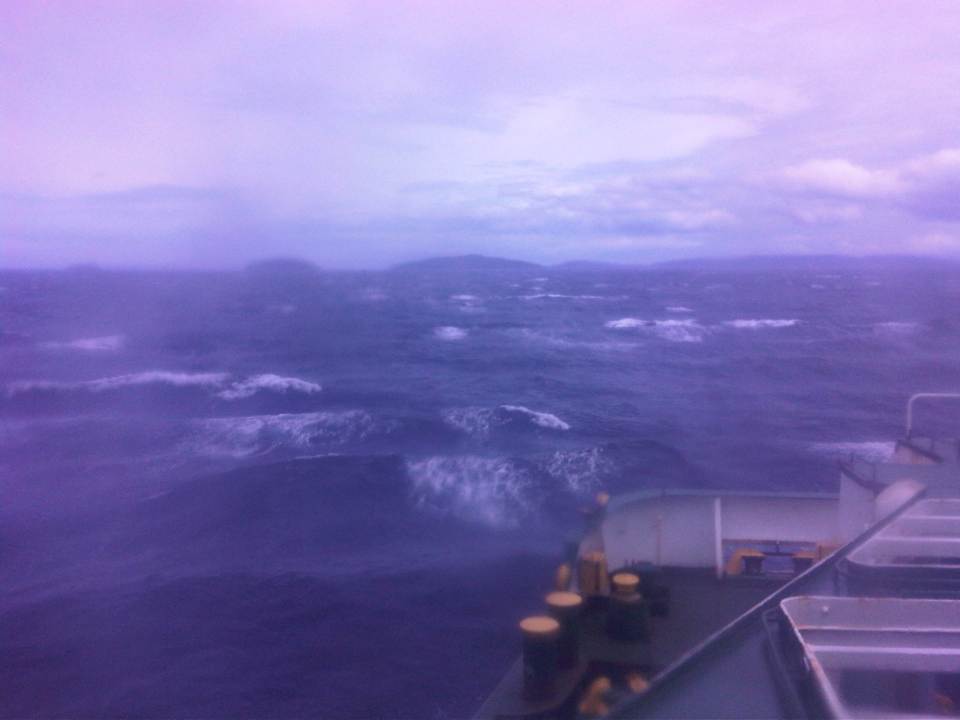 Rough seas along the Verde Island passage to Calapan. We actually saw two fast craft going the opposite direction during our almost 3-hour voyage to Mindoro. One was a SuperCat and another was a FastCat, and they were traveling despite the same rough waters shown in the photo!
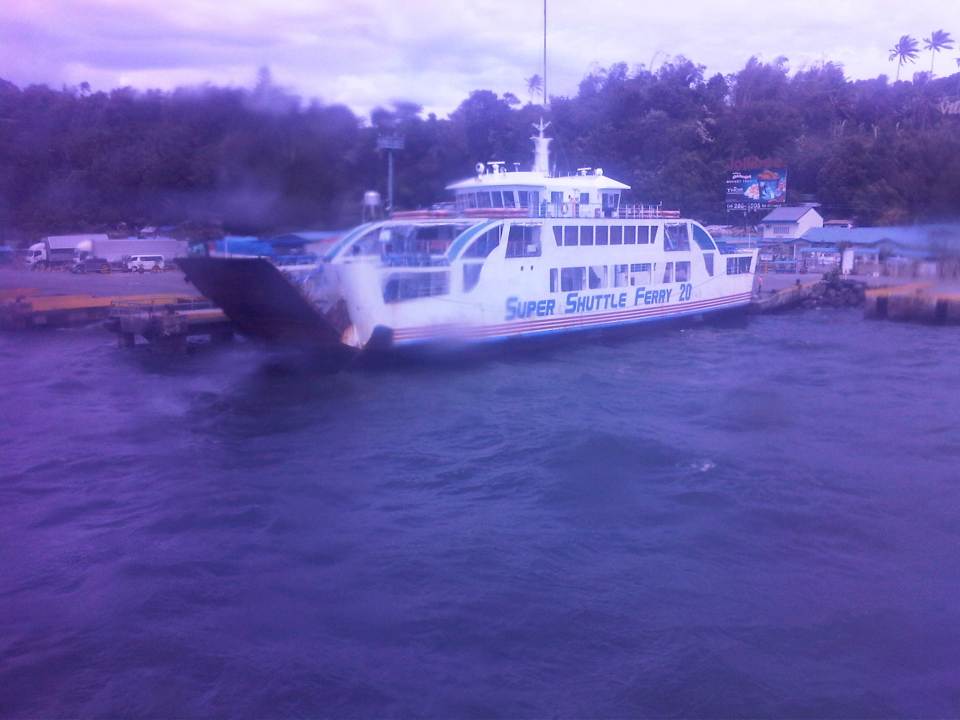 Another ferry preparing to leave Calapan Port.
 Crew throwing a line to the port as our ferry docked at Calapan.
 Passengers disembarking from the ferry.
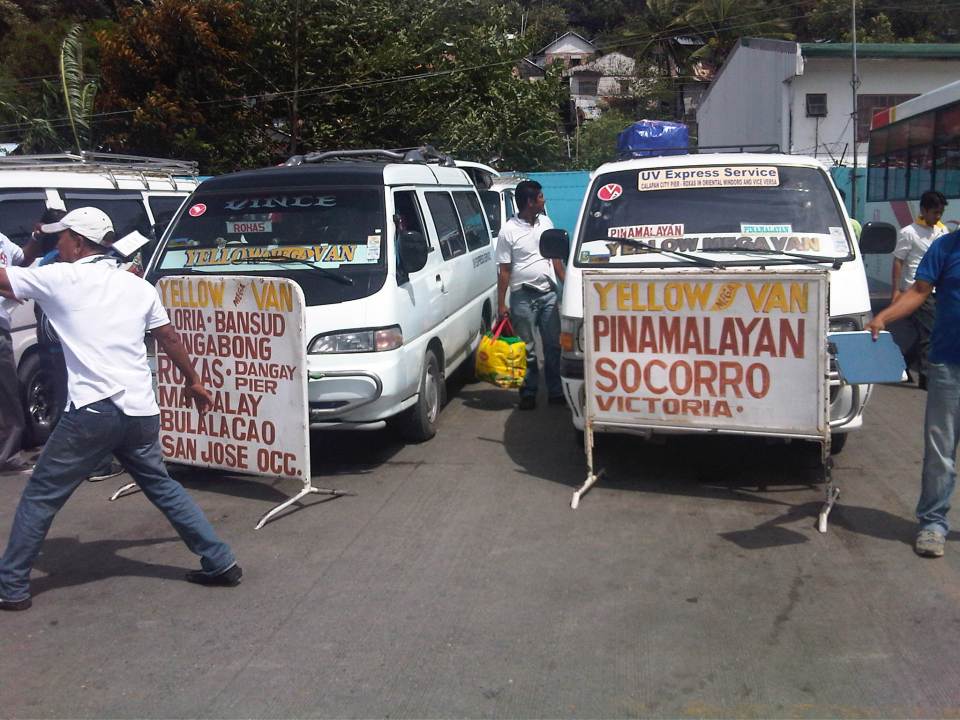 Vans waiting for passengers bound for various destinations in Mindoro including those in Mindoro Occidental on the other side of the island.
It was my first ferry ride in a long time. The last one was a fast ferry trip using the SuperCat service from Cebu to Tagbilaran, Bohol. That was in the afternoon and was quite a rough ride, too. I think shipping lines should not balk on the safety and comfort of passengers. People would be willing to pay a higher fare if the vessels are in better condition and facilities such as seats are well-maintained. I can only imagine the traveling conditions during the peak periods when a lot of people would take these RORO ferries as they are usually the cheaper and practical option between islands. –
Ferry to Marinduque
A friend, Dr. Jonathan Salvacion, posted some photos of a trip he made to Marinduque. I noticed a couple of photos showing the ferry their group took between the Port of Lucena and Marinduque Island. After getting his permission to use the photos, I am post both here to show the typical ferry used in inter-island, roll-on roll-off (RORO) transport in the Philippines. Being an archipelago, providing safe and efficient inter-island transport is a continuing challenge for the country. A lot of progress, though, has been made regarding infrastructure and services. The improvements include the nautical highway system comprised of highways and seaports where the past and present administrations have invested heavily during the past decade.
 Passengers boarding the ferry to Marinduque – the port is designed with a ramp for vehicles to easily “roll-on/roll-off” the vessel [Photo credit: Jonathan Salvacion]
 Inside the ferry, vehicles are parked while passengers are seated above on deck. [Photo credit: Jonathan Salvacion]
–
 Caught (up) in traffic