
Home » Public Transport (Page 14)
Category Archives: Public Transport
On preserving railways – an example in Bulgaria
Here’s a quick share of an article about saving Bulgaria’s last narrow gauge railroad:
The article is relevant as it discusses the plight of railways amidst shrinking ridership and escalating costs of operations and maintenance. The railways in the article is not a isolated case. It is quite common for many railway systems. The difference of this example from another similar service like those in Japan is that Japan Railways or private companies can probably absorb the costs and maintain the line not just as a service but to show their commitment. Historically, there are many railway lines, branches if you prefer, of the Manila Rail Road Company (later the Philippine National Railways) that had to be discontinued due in part to a combination of diminished ridership and escalating O&M costs. The Main Line South, for example, had several branches including an extension from Albay to Sorsogon that had to be discontinued. Nowadays though, the topic should also be considered as the railways in the country is being expanded again. There is still the issue of ridership and this will always be in competition with road-based transport as well as aviation.
–
On the key transformations needed to achieve sustainable, low carbon transport
Also related to COP26, I am sharing material from the Sustainable Low Carbon Transport (SLOCAT) partnership, of which our center is part of. SLOCAT recently released the 11 key transformations for sustainable low carbon land transport urgently needed to meet the climate targets. Here’s a link to their site:
SLOCAT also has the following Wheel of Transport and the Sustainable Development Goals (SDG’s) on the same site. The Wheel illustrates the four cross-cutting themes: equitable, healthy, resilient and green.
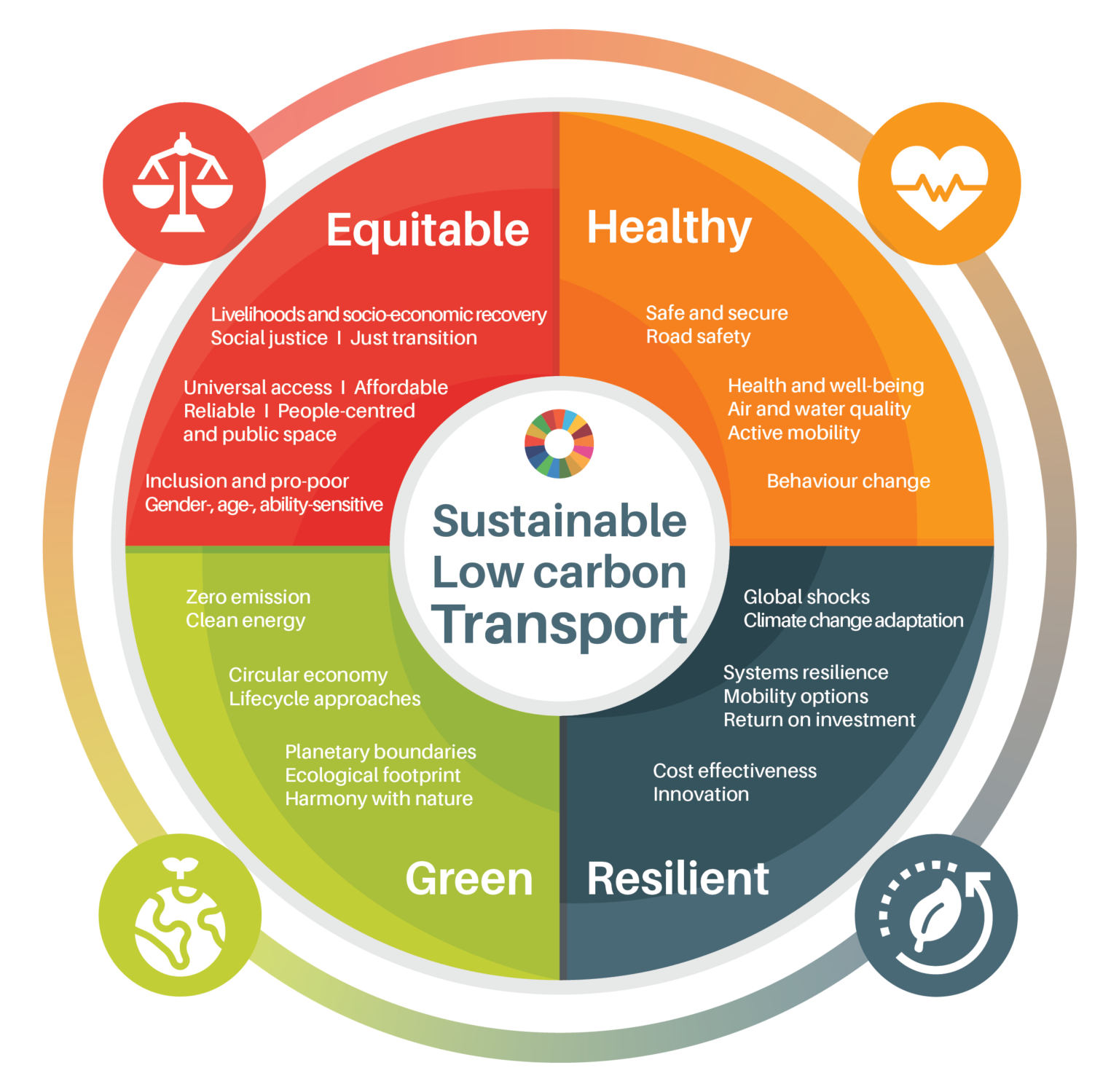
In the SLOCAT site, they list the following to support the transformations:
Overarching approaches to apply across transport modes and sub-sectors overtime
- Put people first, not vehicles and technology
- Co-create and communicate a compelling vision and targets
- Guide short- and medium-term action with clear, coherent political messages
- Combine push and pull measures: Regulate and incentivise
- Link policies within and beyond transport for synergies
- Prioritise resources by social and sustainable value for money
- Engage, empower and coordinate stakeholders across government levels and sectors
- Build capacity and improve data
- Implement pilots to learn and share, then roll out at scale
–
On housing and transportation
I’ve written about how we should not be trying to isolate transportation as if it is singly at fault for the transport and traffic mess many of us are in at present. There are many factors affecting travel behavior including mode choice. Travel distances, travel times and mode choices are not a consequence of transportation system (including infrastructure) alone. Land development and pricing especially those pertaining to housing are critical in how people decide where to live. These are intertwined with transportation and can be quite complex without the proper data or information to help us understand the relationship. That understanding, we are to assume, should lead us to the formulation of policies intended to correct unwanted trends and perhaps encourage more compact developments that are closer to desirable concepts such as the 15-minute city.
Here is an interesting article to enrich the discussion on this topic:
Dion, R. (October 28, 2021) “Coupling Housing and Mobility: A Radical Rethink for Freeways,” Planetizen.com, https://www.planetizen.com/features/115126-coupling-housing-and-mobility-radical-rethink-freeways?utm_source=newswire&utm_medium=email&utm_campaign=news-11012021&mc_cid=85ec2b565f&mc_eid=9ccfe464b1%5BLast accessed: 11/3/2021]
The first thing that came to my mind are residents of northern and southern Metro Manila and the surrounding provinces. Many chose to buy houses there and beyond (i.e., Bulacan, Laguna and Cavite) and yet work or study in Metro Manila CBDs like Makati, Ortigas and BGC. And they do use the tollways (e.g., NLEX, SLEX, CaviTEX, Skyway) to get to their workplaces and schools.
This is also a relevant and timely topic in the Philippines as many cities are already headed for sprawls that will inevitably put more pressure on transportation infrastructure development that usually leans towards car-oriented projects (e.g., road widening, new roads, flyovers, etc.) rather than people-oriented ones (e.g., modern public transportation systems, bikeways, pedestrian infrastructure). Note that only Tokyo has developed an extensive enough railway system to cover the sprawl that is the Tokyo Metropolitan Area, which if interpreted loosely also includes Yokohama, Kawasaki and Chiba in the sprawl. No, we cannot build as fast to have as dense a railway network as Tokyo’s or other cities with similar rail systems. And so we have to figure out another way to address this problem.
–
Safe streets for children
We have been working with UNICEF and several partner organizations on a project on Child Road Traffic Injury Prevention (CRTIP). The Final Reports for the two pilot cities, Valenzuela City and Zamboanga City, have been submitted and represents over 2 years work including during the lockdowns due to the Covid-19 pandemic. The latter part of project implementation indeed became a challenge as we couldn’t travel and engage face-to-face or conduct field surveys like how we did in the first part of the project. Still, I believe we were able to accomplish much and most of what we initially set out to do. Here are the covers of the Final Reports we submitted to UNICEF and we understand will be officially or formally transmitted to the two cities.


The reports narrate the surveys conducted for 25 schools in Zamboanga and 41 schools in Valenzuela. Each initially had selected 25 schools but Valenzuela pushed for an additional 16 schools midway into the project. The SR4S tool developed by iRAP was used for the assessments of critical areas around the schools. The initial assessments were used to identify interventions to improve safety in these areas and recommendations were submitted for consideration of the cities as well as the DPWH where applicable (i.e., the DPWH has jurisdiction over national roads and improvements proposed along these). While some interventions were implemented, others and many were delayed mainly due to Covid-19.
We also conducted a survey to determine the commuting characteristics of schoolchildren in both cities. Since most schools were public schools, it was no surprise that most children lived near the schools or within the school district (which is basically the catchment area for these schools). Thus, it also came as no surprise that most schoolchildren came by foot (walking), motorcycles (riding with a parent) or motor tricycle. There’s a lot of information and takeaways from the data but unfortunately, we could get the bigger, more complete picture of Valenzuela City because they selected only elementary schools covering students from Grades 1 to 6. Zamboanga had a more robust data set with both elementary and high schools, covering Grades 1 to 12. The information derived from these surveys were also analyzed and related to the SR4S assessments. The commuting survey results and SR4S assessment are subject of two technical papers presented in the recent EASTS 2021 conference hosted by Hiroshima University.
What’s next? We are now drafting a proposal for a Phase 2 of the project. We hope to continue and reinforce and follow-up on the recommended interventions from Phase 1. We also hope to be able to work on the CRTIP data hub that was only partly completed due to the many constraints faced by that part of the project. I will post here from time to time about some of the outcomes from the surveys and assessments.
–
On rethinking transit for our cities
There’s a nice article recently published on The New York Times. It’s about how cities have been rethinking and developing their transit systems in light of climate change and the pandemic. Here is the article:
An interesting part of the article is on the call for the return of trams or street-level trains. These are very similar to the tranvia that used to be the preferred mode of public transport before World War 2. Would that be possible to build now in Metro Manila? Perhaps it would be a bit more challenging given the development but there are definitely corridors or areas where you can have trams…if the government wanted to. Among those would be along the Pasig River if the development will be similar to the esplanade and enough ROW can be acquired and allocated for these street-level transport. There is also the Botocan ROW, which we actually studied many years ago for Meralco, for the feasibility of a street-level transit system stretching from Katipunan to Quezon Institute. It could have been the revival of Meralco’s rail division of old.
What do you think?
–
Why not rationalize other routes now?
There is an enduring discussion in various forums and platforms about the lack of supply of public transportation. I can’t help but notice though that many discussions consciously or unconsciously leave out the part of public transport rationalisation that calls for phasing out lower capacity vehicles in favour of higher capacity ones. I have written about this and explained the necessity particularly along corridors with high transport demand. Delaying what is required (not necessarily what is inevitable) means we fall short of transforming public transport services in this context.
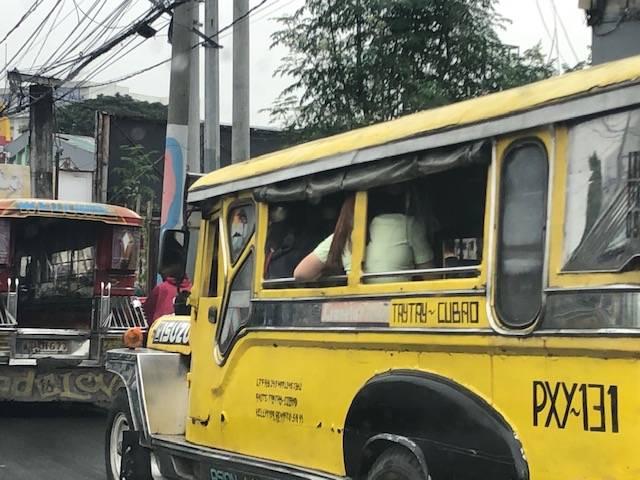
There are definitely missed opportunities here but the current discussions and proposed resources for 2021 including funds for service contracting seems to suggest a status quo in terms of vehicles with the exception of the modernisation part. Perhaps this is because we are still in pandemic mode and survival is still the name of the game? Nevertheless, there should be initiatives and continued dialogue about ‘graduating’ from lower capacity vehicles to higher capacity ones. Of course, this discussion is more urgent for highly urbanised cities than smaller ones.
–
On Transit, Urban Equity and Sustainability
Here is another quick share of an article about public transport, urban equity and sustainability:
Descant, S. (September 2021) “How Can Transit Deliver Urban Equity and Sustainability?”, Government Technology, https://www.govtech.com/transportation/how-can-transit-deliver-urban-equity-and-sustainability [Last accessed: 9/21/2021]
The article discusses how the Covid-19 pandemic clearly shows the role of public transportation in the lives of a lot of people. There is that opportunity to significantly if not radically improve public transportation now more than ever. Surely governments and their transit or regulating agencies have thought about this. While the pandemic led to situations that are not necessarily clean slates for many, there are definitely opportunities here and there to implement change that will increase benefits for transit users while attracting non-users to shift from their preferred modes (i.e., private vehicles). Here’s a takeaway from the article:
“We know that public transportation is the solution. So there needs to be a commitment at the federal level, not just in terms of funding, but also integrating public transportation deeper into the fabric of society, through land use policy and through other transportation access policies — the sidewalk and bike lane piece — with the data and payment apps as well…”
What improvements do you think should and can be done now given the pandemic situation? Are these still timely or have we figuratively “missed the bus”, so to speak?
On preserving old transit systems
Many old cities have either retained or phased out their old road-level transit systems. I am referring mainly to rail-based streetcars rather than road-based ones such as buses. Even the indigenous types of road-based public transport may be phased out and usually in the name of modernization. Some though, like Singapore’s rickshaws and Manila’s calesas are still existent but you will find them either during odd hours or in tourist areas.
A good example of a city that has retained and preserved its transit system that is San Francisco in the US. The city still has a running cable car system, and its street cars maintained and operated by the San Francisco Municipal Railway (Muni). These are practically operational, traveling museums. The streetcars, for example, are of different models – a collection of streetcars from various cities around the world that have phased out this transit systems a long time ago. So it should not be surprising to see a different street car every time. And one could try to ride each one in operation while staying in city.
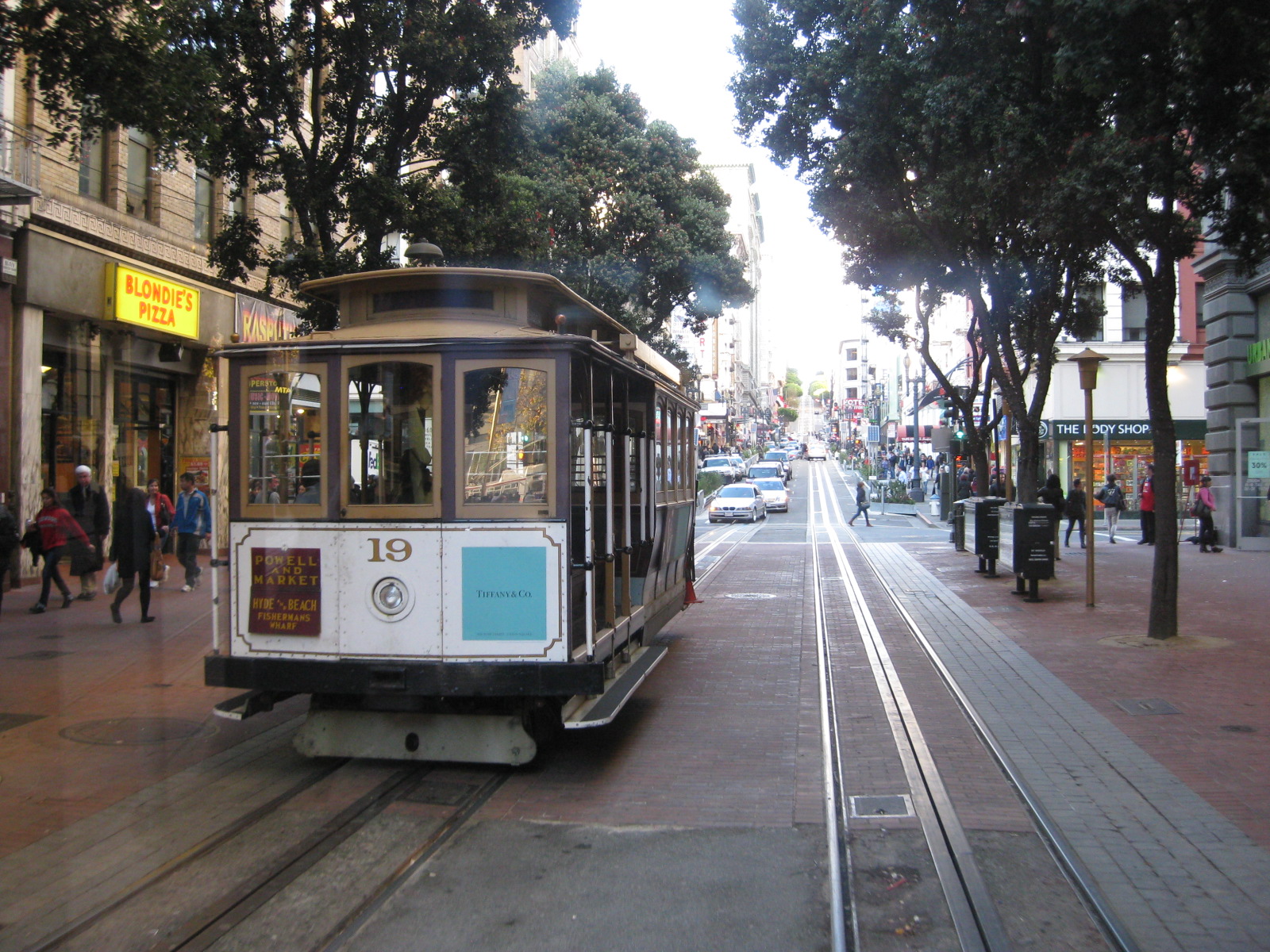
Here is an article about Kolkata’s (Calcutta’s) trams:
Schmall, E. (September 2, 2021) “Kolkata’s ‘Fairy Tale’ Trams, Once Essential, Are Now a Neglected Relic,” The New York Times, https://www.nytimes.com/2021/09/02/world/asia/kolkata-india-trams-calcutta.html?smid=url-share [Last accessed: ]
What are your thoughts about preserving or phasing out these transit systems?
–
On current health protocols applied to public transport
The current surge of infections attributed to the Delta variant of Covid-19 has been alarming. The recent quarantine issuances by national government have not been effective as there was basically lax enforcement or implementation. Granted, there were just a lot of loopholes designed to allow so-called “economic frontliners” to go to work and under conditions that made their commutes risky in the context of the pandemic. The same laxity and loopholes apply too, to people who have no business roaming around and yet travel with their motor vehicles (especially motorcycles) and bicycles across cities, towns and provinces in the guise of exercise or essential travel.
Meanwhile, the practice and enforcement of public health protocols in the country has been lax and misguided (e.g., do we really need to wear face shields?). In public utility vehicles, people are now crowding inside with usually only a sheet of plastic separating one from another. This is not exactly reassuring in as far as spreading the virus is concerned. And we shouldn’t pretend that we are not aware that there are asymptomatic people going around and infecting others whether knowingly or not. It’s no wonder, really, why people who have the private vehicle or active transport option use these instead of public transport.


Much has been said about government failing to address the Covid-19 pandemic from the start. And it continues to bumble through this health crisis (if you don’t want to call it one then either you don’t understand the gravity of the problem or just refuse to do so – the latter is worse). Tagging workers as ‘economic frontliners’ is probably at least as bad as calling BPO workers ‘Bagong bayani’, adding them to the Overseas Foreign Workers (OFWs) who had been branded as so in the past. This becomes a convenient excuse to ease health-related restrictions for people to travel/commute to work. It is a form of gaslighting the very same workers to believe they need to go out and work. Meanwhile, precious funds are being diverted elsewhere including the dolomite beach at Manila Bay and money spirited away in preparation for next year’s elections.
I got it from recent surveys that people give a higher priority to employment and earning income over Covid-19. Perhaps most have not had direct experiences with the frightening cases of Covid-19 (i.e., they’re asymptomatic or have encountered only asymptomatic cases with friends and families). I hate to say it but it seems like the same thinking pertaining to extra judicial killings (EJK). I can already imagine hearing the usual comments: “Malayo sa bituka.” “Wala akong pakialam diyan.” “Okay lang yan. Hindi naman kami apektado niyan.” These comments reflect an absence of empathy. Empathy I think is very much needed today in order for people to understand what’s going about. And that’s not just about us but businesses as well that definitely, likely lost a lot during this pandemic but still need to empathize if not call out those who are really responsible about the mess we are in. Do your employees really need to go to the office? Or can they continue working from home? The answer to these questions affect commuting in the time of Covid-19 and relates strongly to the protocols applied to public transport.
–
On the future of Uber and other ridesharing/ridehailing companies
A few years ago, Uber was the darling of transportation. It and others like it were considered disruptors. They were but then eventually unraveled as their business model and practices were challenged and exposed. Here’s an article that does not mince words in describing what and how Uber is:
Doctorow, C. (August 11, 2021) “End of the line for Uber,” Medium, https://marker.medium.com/end-of-the-line-for-uber-901e3077bbbc [Last accessed: 8/21/2021]
There’s a wealth of references (links provided) in the article provided to support the arguments of the author. It is not anecdotal but an accumulation of facts from various experiences as well as a documentation of the company’s efforts to hide its flaws.
I co-authored several papers analyzing what was seen as a phenomenon. It was clear that people preferred Uber or Grab over regular taxis because of the higher quality of service they got. Similar results were obtained elsewhere and spelled the doom of many taxi drivers. Those that survived were the better serving ones like taxis in Japan and Singapore. However, the more recent of those papers have shown that what are called TNVS or transport network vehicle service have basically been deceiving and took advantage of their drivers (whom they do not want to refer to as employees). Did they help reduce congestion? They did not, and even added more cars to traffic.
–
 Caught (up) in traffic