
Home » Public Transport (Page 23)
Category Archives: Public Transport
Bus stops in Bangkok
My former professor – my second adviser – posted a few photos of bus stops in Bangkok. I am re-sharing these here to show one aspect of how buses operate in Bangkok including the route numbering and the schedules.
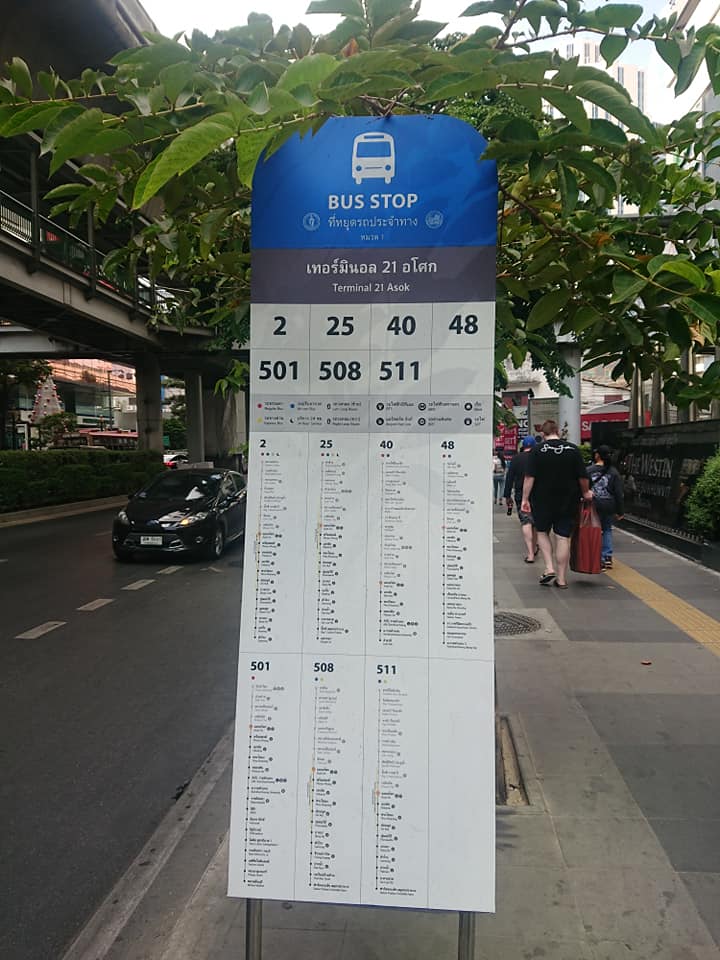 Bus route numbers and lists of designated stops for each [Photo credits: Fumihiko Nakamura]
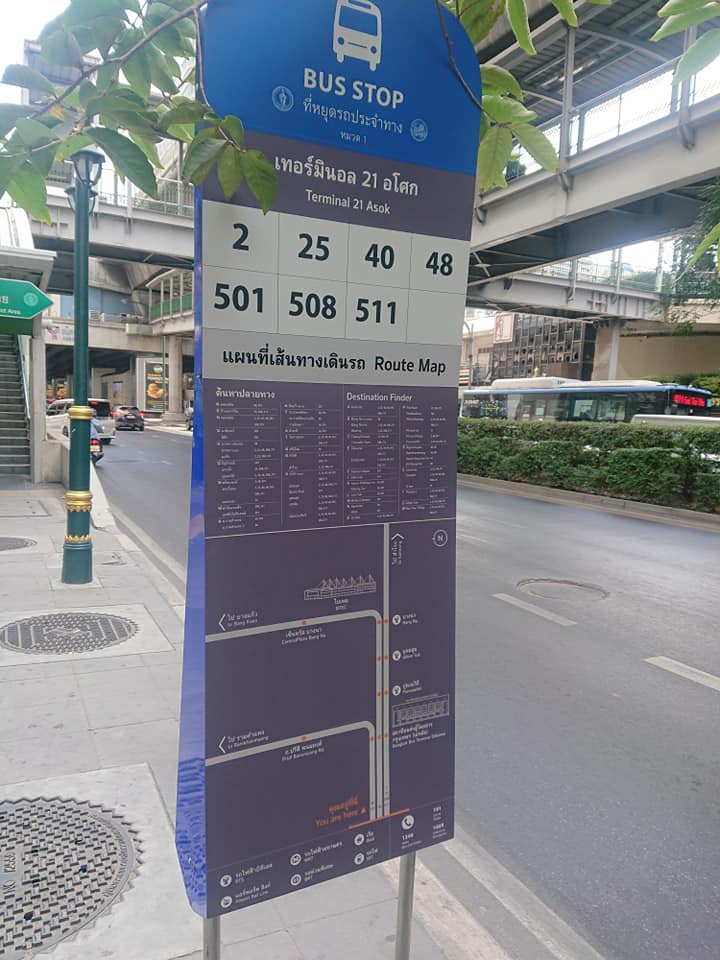 Route map on the other side of the panel [Photo credits: Fumihiko Nakamura]
There are no schedules here like the ones on bus stops in Japan or Singapore but the basic information is quite helpful for commuters and tourists who opt to take regular public transport instead of taxis or ride share. Are such devices being considered by the MMDA or other cities for their public transportation? If not, then maybe they can consider and include this in their New Year’s resolutions.
–
Transit station connections in Singapore
The connections between transit stations in Singapore show us examples of how to encourage people to walk long distances. The links, mostly underground, are interconnected with branches to common exits to hotels, office and residential buildings. These are basically transit malls lined with cafes, restaurants and shops. There are even gyms (e.g., UFC) and play venues along some connections.
 Underground transit mall between a City Hall Station (red line) and Esplanade Station (orange line)
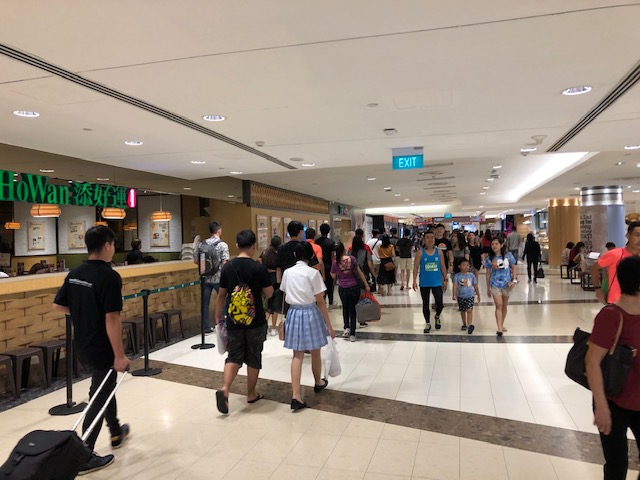 The connection is lined with restaurants, cafes and shops
Singapore’s underground connections reminded me of similar structures in Tokyo and Yokohama. You can just walk underground and come up near your destination. This is especially advantageous and comfortable during the summers when the hot weather becomes a detriment to walking outdoors. Underground transit malls or connections are usually air-conditioned or air is pumped into them for ventilation. As such, temperatures are significantly lower compared to the surface/ground. Will we have similar facilities/developments here in the Philippines and particularly in Metro Manila once the MM Subway is developed?
–
Some advantages of transit access – the case of a stadium and an arena
One of the advantages of having mass transit access to a major venue is that mass transit can carry more people than any other modes of transport to and from the venue. In the recent U2 concert held at the National Stadium in Singapore, we experienced first hand how a mass transit system is able to serve the surge in the demand to and from the Stadium Station of the SMRT’s Orange Line.
 People filing towards the station – most people calmly I say most because there were some who apparently were not so familiar with the ways in Singapore and tried to muscle their way into the crowd. Maybe its like that in their own countries?
 It was just like rush hour conditions at the station. Only, people weren’t going to work but home from the concert
Previous to this, I had similar experiences when I was residing in Japan. One time it was a surge in demand due to the popular fireworks display at Yamashita Park in Yokohama covered by three of JR Stations and the end station of the old Tokyu Toyoko Line. There was no Minato Mirai Line at the time that terminated at the park so people had only the JR Sakuragicho, JR Kannai and JR Ishikawacho Stations and the Tokyu Sakuragicho Station.
This is the weakness of the Philippine Arena, which can only be accessed via the NLEX and by road transport. The result for the larger capacity stadium’s hosting of a U2 concert resulted in horrendous traffic jams and hellish travel times for attendees. Friends stated that whatever high that they got from the concert was steadily depleted by their commutes to their homes. This will not improve even with Manila-Clark railway line because the line will be along the other side of the tollway. It won’t make sense for a branch to be constructed for the arena given the intermittent demand for the events it typically hosts in a year. But there can be a road transport connection to the nearest rail stations to at least alleviate the car traffic generated by the venue.
–
Commuting in Singapore
Another thing we miss about Singapore is the public transportation. It was easy to go around Singapore especially with its comprehensive, extensive rail transport network. This is complemented by even more extensive bus transit services. All these are offer convenient, comfortable and reliable public transportation. As such, there is practically no need to use your own private vehicle for transportation unless there really is a need arising for their use (e.g., emergencies).
 Passengers wait for the train to arrive at an SMRT platform
 Passengers line up before the platform gates at an underground station
The transport system in Singapore actually reminded me of how efficient and reliable it was to commute in Japan where I’ve lived in three area – Tokyo, Yokohama and Saitama – for various lengths of time. These transport systems are what Metro Manila and other rapidly urbanizing cities in the Philippines need in order to sustain growth while providing for the transport needs of its citizens.
–
Unraveling ridesharing/ridesourcing
I have been writing about ridesharing/ridesourcing/ridehailing for some time now. I have also researched on its characteristics particularly in my country where it was initially hailed (no pun intended) as a solution to transport woes in highly urbanized areas. We’ve done our research with or without the cooperation of these companies. It does not surprise me that their operations have unraveled and many are exposed to be abusive. So much for being the ‘disruptive’ initiative that was praised by many before…
Emerson, S. (2019) “Uber Drivers Protest ‘Corporate Greed’ as Billionaires Cash In”, https://onezero.medium.com/uber-drivers-protest-corporate-greed-as-billionaires-cash-in-df65a7e470a7 [Last accessed: 11/18/2019]
–
Sabit
A common sight along Philippine roads are overloaded public utility vehicles. It may be indicative of how difficult it is to get a ride because such is usually the case when there is a lack of public transport vehicles during peak periods (i.e., when transport demand is greater than the supply of vehicles). That lack maybe due to simply not enough vehicles to address the demand or that there is enough on paper and operating but they are not able to make the return trips fast enough. The first case means demand has grown but the number and capacity of vehicles have not kept pace with the demand. The second means that technically there are enough vehicles (franchises) but the traffic conditions along the route have worsened and has resulted in vehicles not being able to travel fast enough to cover the demand.
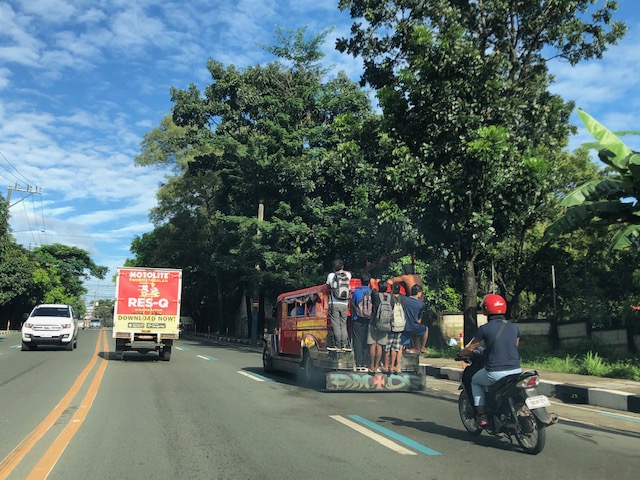 Jeepney with 6 passengers hanging by the back. All look like they are laborers or workers (construction?) but it is not uncommon to see students in their school uniform similarly dangling from jeepneys especially during the peak hours when its difficulty to get a ride.
Sabit is actually illegal and, if enforcers are strict, will incur apprehension and a ticket. Many local enforcers including those of the MMDA though are lax about this especially during peak periods. Jeepney drivers are more cautious when they know that Land Transportation Office (LTO) enforcement units are on watch as these are usually strict about passengers dangling from the vehicles. Newer jeepney/jitney models basically eliminated sabit as the doors are now on the right side of the jeepney instead of the back and there are no spaces or features to hold and step on to in the new models. It is for good as this is an unsafe situation for the passengers and there are reckless jeepney drivers who tend to exacerbate the situation by deliberately maneuvering the jeepney as if he wants passengers to fall off the vehicle. To those looking for a thrill (or death wish as a friend calls it), it is an exhilarating experience. But in most cases, it is a disaster waiting to happen.
–
Modified jeepneys?
I spotted this modified jeepney along my commute between Antipolo and Quezon City. The jeepney has been modified so its door is no longer at the back like most jeepneys but at the right side. Judging from the design and the license plate, this was not a “new” jeepney though its the first time I saw this along my regular commute.
 Modified jeepney plying the Antipolo-Cubao (via Sumulong Highway) route
The design is a safer one as passengers board and alight from the right side and to the sidewalk (assuming the jeepney driver positions the vehicle in the right manner for a stop). A back door meant passengers boarded and alighted in front of another vehicle or is exposed to traffic. This reminded me also about the designs for LPG jeepney models that were rolled out more than a decade ago but didn’t really take off. The electric jeepneys also have models with the side door that is now found in most models including non-electrics in the modernization program. Perhaps the government should require all jeepneys to be at least retrofitted this way?
–
Cooperative work among LGUs to address transport problems along Ortigas Avenue Extension?
I saw a recent post about a meeting hosted by Pasig City. The Mayor of Pasig City recently held a meeting where he invited the mayors or Antipolo, Cainta and Taytay to discuss, among other things perhaps, transportation along Ortigas Avenue. Ortigas Avenue is a corridor shared by several LGUs most notably the Rizal towns of Antipolo (which is the provincial capital and a highly urbanized city), Cainta and Taytay. The latter two are among the richest municipalities in the country; a fact I underline here since that also should translate to them having the resources or means to help come up with transport and traffic solutions.
 Morning rush traffic starts very early these days. This photo was taken around 6AM on a Thursday along the westbound direction just after the Manggahan Bridge. The pedestrian overpass at C. Raymundo junction is shown and the dark colored buildings are at Robinsons’ Bridgetown development. Note the commuters along the right waiting for a ride.
Photos paint a thousand words. The Taytay Mayor attended the meeting. He has been under fire for the horrendous traffic caused by the mismanagement of Tikling Junction as well as the Barkadahan Bridge area that was and is supposed to be a major alternative route for Rizalenos heading to their workplaces in Makati and BGC. More recently, there were posts about the traffic signals installed at Tikling Junction that basically invalidates the roundabout concept for the junction. The result last Thursday, the first day of operations for the signals, was hellish traffic that backed up a couple of kilometers along the Manila East Road and Ortigas Ave. Extension (some reports say until Cainta Junction). This, even as the signal settings were supposedly done with help from the MMDA.
Antipolo was represented by its former Mayor and husband to the current one. He also happens to be a former Governor of the Rizal Province and likely to run again as his mother, the current governor, is on her 3rd term. It seems to me that the province is not so interested in solutions for Ortigas Avenue despite most of its constituents traveling through the corridor to get to their workplaces and schools. Marcos Highway is not the main corridor for Rizal towns as it basically carries only Antipolo and maybe some of Tanay (via Sampaloc) traffic. Ortigas Avenue Extension branches into two major roads from Tikling – Ortigas Ave Extension, which ends at the capitol, and the Manila East Road, which connects to practically all of Rizal towns with San Mateo and Rodriguez (Montalban) being the exceptions. It is time for the province to pay attention to this commuting problem experienced daily by her constituents.
The Mayor of Cainta seems not as interested as the others, sending a representative who appears to be not one of the top officials (the traffic chief with a rank of SPO1=Master Sergeant is lower ranked than a councilor) of the Municipality to such an important meeting. In fact, he is currently now embroiled in a controversial faux pas involving himself by not wearing a helmet while riding a motorcycle. What’s more is his downplaying this and appearing to be even justifying the act. He eventually apologized but not before stating his moves. He is not new to publicity (stunts?) and knows how bad publicity still translates to good publicity especially in this days of fake news and trolls (he apparently has many on social media). He seems to forget that transport and traffic solutions for Ortigas Ave will likely benefit anyone seeking reelection or higher office in Rizal. He is on his last term as mayor and the break-up with some of his allies including his former Vice Mayor who ran against him in the last elections shows the limits of his political career. What was rumored as plans to run for Rizal governor might just be downgraded to perhaps Vice Mayor? In any case, he should show more interest and effort in finding solutions beyond traffic management and not by himself but in cooperation with others with whom his jurisdiction shares the problems with. Perhaps the initiative of the Pasig Mayor presents an opportunity for such cooperative work? Many people are very interested in this and will be watching – and hoping.
–
On the issuance of provisional units for ‘modernised’ jeepneys
There seems to be a proliferation of various models of the so-called “modernized jeepneys”. They have been deployed along what the DOTr and LTFRB have tagged as “missionary routes”. The latter term though is confusing because this used to refer to areas that are not yet being served by public transportation, hence the “missionary” aspect of the route. The routes stated on the jeepneys are certainly new but they overlap with existing ones. Thus, the new vehicles are actually additional to the traffic already running along the roads used by the existing (old?) routes. The number of units are said to be “provisional” meaning these are trial numbers of these new vehicles and implying the route and service to be somewhat “experimental”. There can be two reasons here that are actually strongly related to each other: 1) the actual demand for the route is not known, and 2) the corresponding number of vehicles to serve the demand is also unknown. Unknown here likely means there has been little or no effort to determine the demand and number of vehicles to serve that demand. The DOTr and LTFRB arguably is unable to do these estimations or determinations because it simply does not have the capacity and capability to do so; relying on consultants to figure this out. That work though should be in a larger context of rationalizing public transport services. “Provisional” here may just mean “arbitrary” because of the number (say 20 or 30 units?) of units they approve for these new routes.
 A ‘modernised’ jeepney with a capacity of 23 passengers. The vehicle is definitely larger than the conventional jeepneys and yet can only carry 23 seated passengers. That’s basically the number of seats for most “patok” jeepneys that are “sampuan” or 10 passengers on each bench plus 2 passengers and the driver in the front seats.
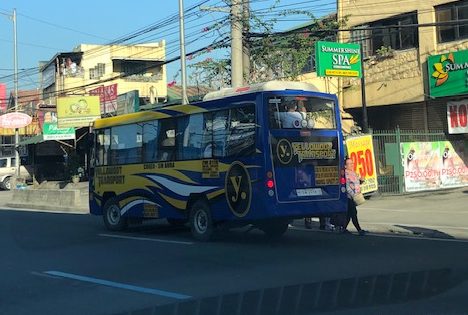 Modernized jeepney unloading passengers along the roadside
Rationalization should require not only the replacement of old jeepney units that seems to be the objective of the government’s modernization program. Rationalization also entails the determination and deployment of vehicles of suitable passenger capacities for the routes they are to serve. I have stated before that certain routes already require buses instead of jeepneys and that jeepneys should be serving feeder routes instead. Meanwhile, routes (even areas) currently having tricycles as the primary mode of transport would have to be served by jeepneys. Tricycles, after all, are more like taxis than regular public transportation. Such will also mean a reduction in the volumes of these vehicles and, if implemented and monitored strictly, may lead to an improvement in the quality of service of road public transport.
[Note: May I add that although I also use ‘jeepney’ in my articles, these vehicles should be called by their true names – ‘jitneys’. The term jeepney is actually a combination of the words Jeep (US military origins) and jitney (a public utility vehicle usually informal or paratransit offering low fares).]
Is there really a transport or traffic crisis in Metro Manila?
I was interviewed recently for a research project by students enrolled in a journalism class. I was asked by one in the group if we indeed have a transport crisis in Metro Manila. The other quickly added “hindi transport, traffic” (not transport but traffic). And so I replied that both terms are valid but refer to different aspects of the daily travel we call “commuting”. “Traffic” generally refers to the flow of vehicles (and people if we are to be inclusive) while “transport” refers to the modes of travel available to us.
“Commuting” is actually not limited to those taking public transportation. The term refers to all regular travel between two locations. The most common pairs are home – office and home – school. The person traveling may use one or a combination of transport modes for the commute. Walking counts including when it is the only mode used. So if your residence is a building just across from your office then your commute probably would be that short walk crossing the street. In the Philippines, however, like “coke” and “Xerox”, which are brands by the way, we have come to associate “commute” with those taking public transportation.
And so we go back to the question or questions- Do we have a transport and traffic crises? My response was we do have a crisis on both aspects of travel. All indicators state so and it is a wonder many including top government transport officials deny this. Consider the following realities for most commuters at present:
- Longer travel times – what used to be 30-60 minutes one-way commutes have become 60 – 120 (even 180) minute one-way commutes. Many if not most people now have double, even triple, their previous travel times.
- It is more difficult to get a public transport ride – people wait longer to get their rides whether they are in lines at terminals or along the roadside. The latter is worse as you need to compete with others like you wanting to get a ride ahead of others.
- People have to wake up and get out of their homes earlier – it used to be that you can wake up at 6:00AM and be able to get a ride or drive to the workplace or school at 7:00/7:30 AM and get there by 8:00 or 9:00AM. Nowadays, you see a lot of people on the road at 5:30AM (even 4:30AM based on what I’ve seen). That means they are waking up earlier than 6:00 AM and its probably worse for school children who either will be fetched by a service vehicle (e.g., school van or bus) or taken by their parents to their schools before going to the workplaces themselves.
- People get home later at night – just when you think the mornings are bad, afternoons, evening and nighttimes might even be worse. Again, it’s hard to get a ride and when you drive, traffic congestion might be at its worst especially since most people leave at about the same time after 5:00PM. Coding people and others not wanting to spend time on the road (instead working overtime – with or without additional pay) leave for their homes later and arrive even later.
- Less trips for public transport vehicles – traffic congestion leads to this. What used to be 6 roundtrips may now be 4. That affect the bottomline of income for road public transport providers. Given the increased demand and reduced rolling stocks of existing rail lines that includes rail transport.
To be continued…
—
 Caught (up) in traffic