
Home » Public Transport (Page 36)
Category Archives: Public Transport
Updates on the Line 2 Extension: What’s next?
Marcos Highway is part of my regular commuting route and so I have been able to observe the progress of the construction of the elevated tracks for the extension of Line 2. The contractor, DMCI, is nearing the completion of their part of the project. Unfortunately, the stations and the electrical/power systems for the extension have not been bidded out by the DOTr and so there are not a few doubts whether the extension will be operational by 3rd quarter of 2017, which is the original completion date for the whole project. The construction of the two stations alone are expected to take some time and also will have a big impact on transport and traffic despite the construction sites being more concentrated around the stations at Emerald and Masinag. Here are a couple of photos showing what it looks like along Marcos Highway.
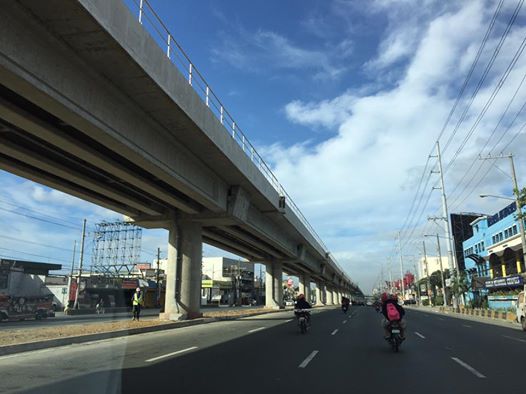 DMCI has almost completed clearing the stretch of Santolan to Masinag of their equipment. The barriers that delineated their work space are mostly gone, freeing up a lane each along either side of Marcos Highway. This has eased traffic along this major thoroughfare connecting Metro Manila to the east.
 The pedestrian overpass across Vermont Royale has been retrofitted so the center section passes under the Line 2’s structure.
Timing is of the essence for the two additional stations of Line 2. As I said, the projected completion and start of operations was 3rd quarter of 2017. Of course, the last quarter of this year would still be most welcome but further delays mean more losses on the part of commuters and, overall, the government. Perhaps it was a mistake for the previous administration to have not included the stations in the package that DMCI eventually got and now has almost completed? Maybe the current administration should expedite the remaining parts of the Line 2 extension. This should prove how serious the current government is with its promises for better public transport (i.e., mass transport).
–
Updates and resolution on the common railway station in North-EDSA
The big news today is the agreement among the government and the big corporations involved in the issue of the common station at North Avenue-EDSA where three rail transit lines (Line 1, Line 3 and the future Line 7) will be converging. The key features of the agreement are reproduced here:
“KEY FEATURES OF AGREEMENT
- The Common Station has three components: (a) Area A, where the platform and concourse for LRT-1 and MRT-3 are located; (b) Area B, which consists of two Common Concourses connecting Area A and Area C; and (c) Area C, where the platform and concourse for MRT-7 is located.
- Area A will be financed and built by DOTr. Area B will be financed and built by Ayala and its partners (NTDCC) (this is Ayala’s contribution to the Common Station project). And Area C will be financed and built by San Miguel.
- The portion of Area A for LRT-1 will be operated, maintained, and developed by LRMC. The portion of Area A for MRT-3 will be operated, maintained, and developed by DOTr. Area B will be operated, maintained, and developed by Ayala. And Area C will be operated, maintained, and developed by San Miguel.
- The MOU contains the design parameters for the Common Station, which will be the basis of the Detailed Engineering Designs to be developed after signing of the MOU. The Detailed Engineering Designs will be completed within 240 calendar days from signing date.
- The designs shall ensure that a defined level of service is maintained at all times by all components of the Common Station.
- The designs shall ensure that all components of the Common Station are interconnected, and that SM City North EDSA and Trinoma are interconnected to the Common Station.
- The Common Station is targeted to be completed by 2 April 2019, subject to extension as may be justified under the MRT-7 Agreement with respect to Area C.
- SM’s TRO will be lifted soon after the Detailed Engineering Designs are completed.
- DPWH will build an underpass along EDSA at the area where the Common Station will be constructed. This will be financed and built by DPWH.”
That was a direct copy and paste from the DOTr’s Facebook page.
There is another piece of information that’s gained a popular following and that is the design for the common station that was shared to the public:
Proposed design of the common station
I think the design is basically okay in terms of location. The layout would need to be refined in order to address concerns pertaining to optimum and efficient transfer of passengers between lines. I assume from the drawings that all three lines will be at the same level but with a plaza separating Lines 1 &3 from Line 7. There are also issues pertaining to proposed road grade separation in the area but that seems to have been addressed already by item #9 in the preceding list. We can only hope that the current government and private sector partnership can expedite this project.
–
Commuting and stress
Here is another quick post but on a topic that’s related to health and therefore is something that I think many should be interested in and perhaps take important note of.
Commuting: “The Stress that Doesn’t Pay”
There are many links to various medical articles within the article. At the last part, there is also a list of references that the reader may want to look at. I’m also posting this for future reference. This would contribute to the formulation of topics for research especially the inter-disciplinary or collaborative kind.
–
Do people understand what Uber and Grab really are?
Over the holidays, I’ve read a lot of posts about Uber and Grab. Mostly, these were complaints about the surge pricing scheme of Uber. A lot of people cited the exorbitant rates Uber charged for trips even short ones like Ortigas to Center to Greenhills and Trinoma to Katipunan. Though the complaints are legitimate ones, I also try to see the other side of the coin considering Uber and Grab do tell potential passengers how much it will cost them for such commutes during peak periods (i.e., when roads are congested). Potential riders do have a choice whether they should take the rider (and therefore agree with the fare stated by the app) or take another transport mode instead. The issue here should not be entirely Uber’s or Grab’s fault. Our public transport system, particularly in Metro Manila, sucks. And that includes the conventional taxis that could have provided better services if regulations were strictly implemented or if the operators managed their drivers and maintained their vehicles well. Based on my experience, taxis in Cebu, Iloilo and Davao, for example, are better managed and regulated, and provide better service quality than those in Metro Manila.
Then there were the joint LTFRB and DOTr advisory for Uber and Grab units and the LTFRB order on surge pricing and fare rates.

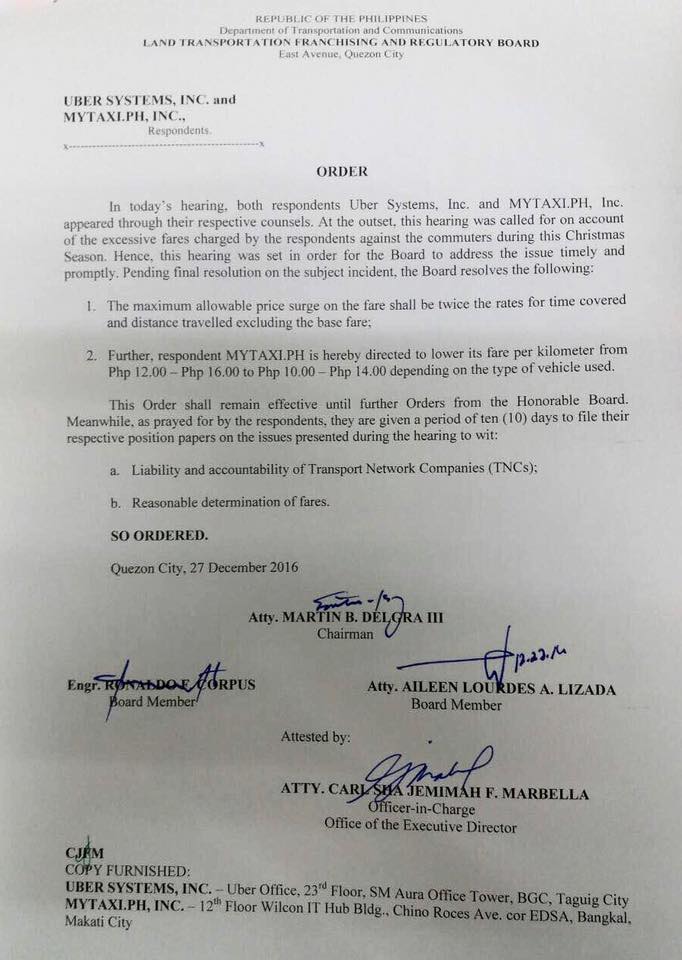
From both cases, it is clear that car-sharing or ridesharing services like Uber and Grab are treated as taxis rather than as premium services that likely entail higher fares but are subject to prospective passengers’ willingness to pay for such services.
Such opens the door for more questions than answers: Is this a misunderstanding or perhaps a deliberate action on the part of Philippine regulators (LTFRB and DOTr)? Why can’t they impose the same standards for vehicles, operators and drivers of conventional taxis? Wouldn’t it be in the best interest of the general riding public for LTFRB to clamp down on conventional taxis in order to reduce dilapidated vehicles as well as unqualified drivers? Surely, conventional taxis will become more attractive if they provide better services including significant reductions in the incidence of typical complaints against taxis like negotiating fares and refusing passengers because of their destinations.
Here are some more questions that need clear and objective answers for one to have a fair assessment of these services:
- Do these show how much we (both commuters and regulators) understand how these car-sharing modes are supposed to operate?
- Do officials at DOTr and LTFRB, who are supposed to be regulators of public transport services know how Uber and Grab are supposed to operate?
- How do they really fit in considering all the other modes of transport available to commuters?
–
Habal-habal in Agusan
The initial part of our research on motorcycle taxis has been completed last December 2016. We are currently drafting a paper for submission to an international conference to be held later this year. The paper contains the outcomes of the surveys undertaken in Surigao Del Sur, Agusan Del Norte and Metro Manila. These include a profile of motorcycle taxi drivers and vehicles that gives us a good idea of how much these people earn and the typical range and loads (passengers and goods) they carry.
Following are photos of motorcycle taxis in Agusan. I won’t post too much detail on the net income of drivers/operators but I guess they earn enough (some even more) given the typical cost of living in these areas where they operate. Motorcycle taxi drivers/operators actually are part of the so-called underground economy where, despite the work and income, people don’t pay their taxes like regular employees or professionals at various workplaces.
[All photos courtesy of Mr. Sherman Avendano of the National Center for Transportation Studies]
 Typical habal-habal with 3 passengers
 “Skylab” with roof – the planks or extensions on either side of the motorcycle are the main features of this motorcycle taxi.
 Typical rural roads in areas served by habal-habal are unpaved. These are muddy during the wet season and dusty during the dry season. As such, it can be a rough ride for those using motorcycles and perhaps even rougher by car.
 Habal-habal passing by a puddle on the road – the passengers are obviously children likely on their way to school based on their uniforms
More on motorcycle taxis soon!
–
Grab vs Uber: the ridesharing services battle for supremacy?
I have made it a custom to share articles here on my blog. One reason for me to do this is so I have an archive of sorts for articles that caught my attention that I have either read or not that I want to get back to. Here is another article on ridesharing, this time from a popular magazine:
Grab vs Uber: Who’s getting the riders and making money?
This is relevant material for ongoing studies we are doing about ridesharing. I am also writing a couple of papers on this topic that we intend to present and publish next year.
–
Uber as a Ponzi scheme?
I came upon this article posted by an acquaintance on his social media account. The article appears to be click-bait given its title but reading through it, the author leads you to other articles of what seems to be a series about Uber’s operations. I won’t give any assessment here as we are also doing research on ridesharing (although for now its mostly about the passengers perspective and characteristics). I will let my readers digest the content and context of the following article:
Excellent, deep series on Uber’s Ponzi-scheme economics
–
Habal-habal in Metro Manila
I posted about our ongoing research on motorcycle taxis. One of our subject areas are Pasig and Taguig in Metro Manila. These would likely represent the urban motorcycle taxi operations that we wanted to document and assess. One terminal I specifically asked our staff to visit as part of the recon/pre-survey activities is located at Pinagbuhatan, Pasig City near where the Pasig River connects with the Laguna de Bay. It is along Circumferential Road 6 and, based on my observation, has transferred locations several times since C-6 was being widened and paved.
 This is the terminal at Pinagbuhatan, Pasig City along C-6 and near the Napindan Ferry Terminal.
 The current terminal stands along what used to be the older C-6 lane. The newer paved section of the widened C-6 is shown in use. It used to be closer to the bridge that crossed the Pasig River and near the Napindan Ferry Terminal.
 The habal-habal riders and operators have an organization and are generally tolerated by the local government. Unlike their provincial “relatives”, they usually only take one passenger seated at the back of the rider. Two passengers are not unusual or irregular especially if one is a child.
I will post about the characteristics of habal-habal operations soon. However, I don’t want to preempt the research we are doing so I would also prefer that we submit our report first and maybe even submit a paper or two for publication before I post them here. Among the things we have obtained so far are video recordings of what its like to ride these motorcycles. We used an action camera mounted on the rider’s helmet for this purpose. Our staff also did a quick interview of the service providers and will be doing a full survey soon to get substantial information for our research.
–
Skylab – motorcycle taxi
We are currently doing research on motorcycles and a major part of the research is on motorcycle taxis. Motorcycle taxis are popular in many areas in the Philippines despite national and local government agencies have not sanctioned or legalized their operations. There are two popular versions of the motorcycle taxis – the habal-habal and the Skylab. Both are basically motorcycles with some add-ons to increase passenger capacity or to be able to carry more goods or cargo.
The habal-habal is carries all passengers or cargo on the motorcycle with some variants having a plank for extension to the back or a customized seat over the gas tank that is usually for children. The Skylab owes its name from the US satellite that fell to the earth in the 1970s. The shape of the satellite inspired innovative extensions along each side of the motorcycle. This enabled riders to take in triple the number of passengers they could with the habal-habal set-up. Both have variants with roofs.
The following video shows a Skylab in Surigao Del Sur care of a very good friend, Dr. Alex Ladaga of Surigao Del Sur State University, whom we are collaborating with in this research:
More on these motorcycle taxis soon!
–
Mobilizing sustainable transport for development
The United Nations (UN) has recently published a new report on “Mobilizing sustainable transport for development” authored by a High Level Advisory Group on Sustainable Transport formed by the UN. The report and other resources may be found at the following website:
Secretary General’s High Level Advisory Group on Sustainable Transport
This is under the UN’s Sustainable Development Knowledge Platform. You can check out the other materials at the website. The UN has many initiatives on sustainable transport and has been very active in promoting or advocating for sustainable transport for a long time now. It is through the UN Centre for Regional Development (UNCRD), for example, that the Philippines and other ASEAN countries were able to formulate their national EST strategies. The new report continues on the UN’s commitment to promote sustainable transport to improve people’s lives around the world.
–
 Caught (up) in traffic