
Home » Research
Category Archives: Research
On the dangers of drowsy driving
Here’s another quick share of an article on road safety. This one is about drowsy driving, which is said to be more dangerous than drunk driving. Drowsy here is equated to being sleepy – for whatever reasons may have led the driver to be drowsy. Perhaps lack of sleep, fatigue or being simply tired, or maybe due to food or medication he/she took before driving.
Here is the link to the article, which has a link to the report referred to in the article:
https://www.ghsa.org/news/drowsy-driving-new-data-analysis
From the article:
“…several strategies to combat this dangerous behavior:
-
Start with prevention: Promoting healthy sleep habits for everyone – especially for teens as they begin their driving journey – is essential. Drivers should practice good “sleep hygiene,” which includes sleeping in a quiet, cool, device-free environment and avoiding caffeine or alcohol before bed.
-
Vehicle technology that’s available now: Advanced Driver Assistance System (ADAS) features can monitor for telltale signs of drowsiness (like yawns or long blinks) and issue visual, auditory or haptic alerts to tell drivers to take a break. Notably, none of the current systems prevent a driver from ignoring them and continuing to drive, or from turning them off entirely.
-
Change the culture at work and school: Employers should implement responsible scheduling and travel policies to minimize fatigue. School districts can consider shifting high school start times later in the day to help teens get more rest. One study of high school student drivers found significantly lower crash rates with a later school start time.
-
Build more, smarter infrastructure: Infrastructure changes such as rest stops, rumble strips and cable median barriers can help prevent drowsy driving, wake drivers up or reduce the severity of a run-off-the-road crash.”
–
On at-grade crossings and footbridges
Here’s a quick share of an article on how at-grade crossings are generally better and preferred over footbridges:
When Footbridges Cost Lives and At-Grade Crossings Save Them
The article effectively articulates the case for at-grade crossings and presents the facts and references in support of these crossings. I will only add here that context is still important along with an appreciation or understanding of the volume of traffic and occupancy of vehicles along the roads. Commonwealth Avenue, for example, requires footbridges but there should be better designs for these footbridges than the current ones along this highway. I think we lack good designs that we can refer to and this leads to a summary dismissal of footbridges where they are actually most suitable.
–
Is there a future for the Philippine made AGT?
I am writing this after reading posts on social media about how they are hopeful about the Philippine-made Automated Guideway Transit (AGT) being finally operational. For one, both AGT models (60 passenger capacity train and 120-passenger capacity train) have not been technically certified. And then there are really no plans for lines to be constructed anywhere.
The closest to plans that we have are the feasibility studies conducted many years ago that did not materialize into an operating line. One of those were supposed to be along Gen. Santos Avenue in Taguig, which could have extended to C6. Another is a line that could have run along C.P. Garcia Avenue and Katipunan Avenue, connecting Line 7 at Commonwealth Ave. with Line 2 at Aurora Blvd.
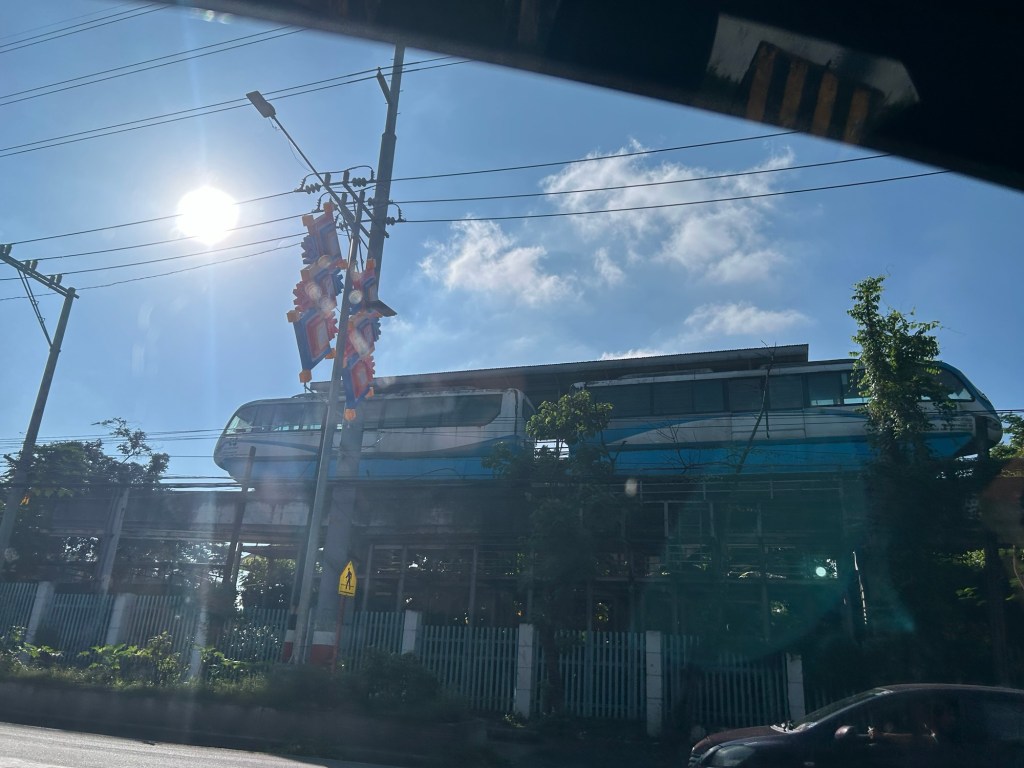
There’s still something worth studying and refining here as the AGT is a product of local R&D. However, there must be a commitment among researchers and the DOST on the way forward. There should also be some kind of buy-in from government agencies especially DOTr to support this development.
–
Looking back on Philippine railway history
The Philippine Railway Conference 2025 is coming up soon. I am very glad to see a lot of people interested in rail – from the technical people running our railways to those involved in planning and management to the advocates and enthusiasts. Rail was not so “fashionable” or “glamorous” (to use these words liberally) many years ago. Perhaps people traveling and experiencing rail in countries where it has persevered and evolved plus social media have changed this – and for the better. Sharing here some papers that were the outcomes of an interdisciplinary research program led by the Third World Studies Center of UP. Rail, after all, is not just about the technical but also the social and human aspects of the mode.
The website for the Emerging Inter Disciplinary Research (EIDR) program supported by the UP System is still up and hosted by the Third World Studies Center. I think it’s something worth a Phase 2. The program leader, Dr. Ricardo Jose, is now retired from UP but is a Professor Emeritus of UP so he can still be engaged. Nevertheless, there are many at UP and other higher education institutions who can be involved in a program that should have a more expanded coverage. There were railways, after all, in other parts the country including Panay, Negros, Cebu and Mindanao.
–
On safety along boring roads
I saw this interesting article about “boring” roads. It seems to be consistent with anecdotal evidence about ordinary roads with unremarkable features especially along adjacent lands. What may be termed as “beautiful” and “remarkable” may not necessarily be distractions to road users. Rather, it may keep people’s attention on the roads and people outside cars or, as the article refers to them, non-motorist car injuries or fatalities. There seems to be some confusing outcomes or perhaps confusing use of terminology in how the article is written (i.e., how perceptions are stated in the article).
Wilson, K. (August 21, 2025) “Study: Boring Roads End Up With More Injuries For People Outside Cars,” Streets Blog USA, https://usa.streetsblog.org/2025/08/21/study-boring-roads-end-up-with-more-injuries-for-people-outside-cars [Last accessed: 8/27/2025]
Quoting from the article:
“Researchers at the University of Connecticut recently analyzed the emotional reactions of more than 81,000 volunteers to a trove of Google Street View images from 56 cities around the world — and found that certain recurring perceptions correlated tightly with how many car crashes involving vulnerable road users actually happened where those photos were taken.
Perhaps unsurprisingly, the participants were pretty good at gauging whether a road was “safe” for walking and biking just by eyeballing it and reporting on how safe it made them feel in general, adding further evidence to the pile that “perceived safety” is a critical metric that every transportation leader should take seriously. Streets that volunteers perceived as “wealthier” also tended to record lower crash volumes — which also might be intuitive, considering that some of the most obvious signs of neighborhood affluence can be great public infrastructure like smooth sidewalks, pristine bike lanes, and ample street lighting.
Roads that were rated as “lively,” meanwhile, were associated with higher crash volumes — though the researchers were careful to note that may just be because there were more people in those images, and crash rates per capita, or per pedestrian- or bike-mile traveled, might actually be lower in hopping human-centered areas.”
In that last paragraph, the term “lively” might have different perceptions depending on the people looking at images of streets. In our case, the street scene in Divisoria, for example, can be described as “lively” yet it may be safer than what is perceived in other countries, especially in the west. I think we have to be careful with the kind of studies as described in the article and to be fair, they did say that their study is still at an exploratory stage.
–
Article on the evaluation of congestion pricing
I want to share this article on the congestion pricing zone in London. This is called the Ultra Low Emission Zone (ULEZ), which also met resistance when it was first implemented.
Selby, O. (January 16, 2025) “ULEZ expansion hasn’t hurt high street spending,” Centre for Cities, https://www.centreforcities.org/blog/ulez-expansion-hasnt-hurt-high-street-spending/ [Last accessed: 2/1/2025]
Quoting from the article:
“The benefits ULEZ has provided to public health have been studied extensively. The data is clear: London has the worst air quality of any UK city and the capital’s emission zone is helping to change this.
So far, card transaction data does not suggest that ULEZ is harming high street spend. This should reassure policy makers in London, who committed to the emission zone a while ago, and strengthen the convictions of policy makers in New York who are now following suit.”
The article is a nice reference not just for evaluation of similar congestion pricing schemes but can also be used for carless streets or zones. I wonder if there are similar work being done for Baguio’s congestion pricing scheme as well as the carless programs in Ortigas Center. Quezon City should also do this for the newly implemented program along Tomas Morato.
–
On a ride-hailing apps algorithm and surge pricing
I am sharing this very informative article on ride-hailing based on an investigation conducted by investigative journalists:
Ilagan, K. and Rainis, F.A. (December 10, 2024) “How we investigated the algorithm behind the Philippines’ largest ride-hailing app,” ijnet.org, https://ijnet.org/en/story/how-we-investigated-algorithm-behind-philippines-largest-ride-hailing-app?fbclid=IwZXh0bgNhZW0CMTEAAR2azviuNxdh5gSbrJKl8lsViL5YRO5k33QHFc24EAFkIi4HTo-Ew4H7LO4_aem_NnVHOD8B1PERNOQYSjVHdg [Last accessed: 12/27/2024]
To quote from the article:
“Once all the fares were broken down, we found that a surge fee was always present. With the help of statisticians from two local universities, we conducted a statistical analysis to scientifically determine whether the waiting time for a ride decreases when the surge fee is higher.
The results didn’t show a significant correlation between the surge rate and waiting times. This contradicts the assumption that a higher rate attracts more cars to the street and lowers waiting times.”
I leave it up to my readers to make their own assessment of what the conclusions to this report state or imply. The bottomline is that the ride-hailing company is making a lot of profit from their surge pricing scheme that really doesn’t make it easier for people to get a ride from their app.
–
On bike lanes contributing to safer roads
Do bike lanes make roads safer? There are obviously mixed reaction to this question especially if you look as social media. If we are level headed about this topic and look at the evidence out there, the answer is yes. But there can be caveats as we try to contextualize in the local setting. The formal studies so far are in countries where the drivers arguably more disciplined than ours here in the Philippines. Driver behavior, after all, is a major factor for road traffic safety. Here is a good article for reference in the discussions and arguments for bike lanes:
Tu, Maylin (November 5, 2024) “How Bike Lanes Slow Drivers and Save Lives,” Next City, https://nextcity.org/urbanist-news/how-bike-lanes-slow-drivers-and-save-lives [Last accessed: 11/10/2024]
To quote from the article:
“Bike lanes with physical delineators (cones or bollards) were more effective than paint-only lanes at calming traffic, echoing a popular mantra for bike activists: “Paint is not protection.” (The lanes were not protected, however, because drivers could drive over the delineators.) For vehicles turning right, top speeds were reduced by 28% and average speeds by 21%. Paint-only bike lanes slowed driver speeds by up to 14% and drivers going straight slowed down by up to 8%…
The study adds that pop-up bike lanes are a cost-effective solution for studying the effects of more permanent solutions — after all, you could just borrow the traffic cones. A city could quickly implement pop-up or temporary infrastructure. Then, armed with data and community feedback, they could invest in making the changes permanent.”
The article also points to a technical paper or scientific article on the traffic calming effect of bike lanes. Here is the link to the article published in the Journal of Urban Mobility: https://doi.org/10.1016/j.urbmob.2024.100071
–
On the need for helmet laws and their implementation to reduce fatal road crashes involving motorcycles
I found this article reporting on findings of their study on helmet laws and their impacts on road safety:
Insurance Institute for Highway Safety (October 20, 2024) Lax helmet laws have killed more than 20,000 motorcyclists, study shows, https://www.iihs.org/news/detail/lax-helmet-laws-have-killed-more-than-20-000-motorcyclists-study-shows [Last accessed: 10/23/2024]
To quote from the article:
“Wearing a helmet is one of the biggest things riders can do to protect themselves from death and traumatic brain injury,” said Eric Teoh, IIHS director of statistical services and the author of the paper. “We understand that requiring helmets for all riders everywhere would be unpopular with some motorcyclists, but this could save hundreds of lives each year. Those aren’t just numbers. They’re friends, parents and children.”
There’s a link to the study report in the article for those who want to have a copy of the report.
–
30th Annual Conference of the Transportation Science Society of the Philippines (TSSP)
I was not able to post on the conference itself but it was definitely a success including the pre conference workshop (Workshop for Young Researchers or WYRe) held for the benefit of young researchers in transportation science.
Here is the link to the TSSP’s official page featuring the program for the Technical Sessions: https://ncts.upd.edu.ph/tssp/archives/2972
There were 6 sessions with papers on public transportation, active transport, traffic engineering and others including port operations and safety. A total of 27 papers were presented and in attendance were more than 150 people, mostly from the academe. The conference was conducted in cooperation with the University of the Philippines Visayas and the City Government of Iloilo. When available, I will also later share information about the very informative and enlightening keynote lecture delivered in the morning of the conference on the topic of Global Health.
–
 Caught (up) in traffic