
Home » Road Safety (Page 16)
Category Archives: Road Safety
Comments on current transport issues – Part 1
I end the year with commentaries on transport issues. I recently responded to a request for an interview. This time, it was not possible to do it in person so we corresponded through email. Here are my responses to the questions sent, which are mainly about the public utility vehicle modernization program of the government.
· Will old-school jeepneys finally disappear on Philippine roads before the term of President Rodrigo Duterte ends, barely three years from now? What is a more realistic timeline of jeepney modernization?
Old school jeepneys won’t disappear from Philippine roads. For one, the modernization program has slowed down a bit and even the DOTr and LTFRB have stated and admitted that it is not possible to have 100% modernization before the end of term of the current administration. It’s really difficult to put a timeline on this because of so many factors that are in play including social, political, institutional and economic ones. The technical aspects are not issues here as there are many models to choose from and suitable for replacing jeepneys in terms of capacity.
· What are the bumps on road to jeepney modernization?
As mentioned earlier, there are many factors in play here. Economic/financial-related bumps pertain mainly to vehicle prices. The new models are quite pricey but it should be understood that this is also because the new ones are compliant with certain standards including technical and environmental ones that most ‘formally’ manufactured vehicles must pass unlike so-called customized local road vehicles (CLRV) like the conventional jeepneys. The financial package is not affordable to typical jeepney operators/drivers. The cost of a modern jitney (the technical term for these vehicle types) is close to an SUV and revenues may not be able to cover the combination of down payment, monthly payments, and operations & maintenance costs of the vehicle.
· Should local government units dictate the pace of jeepney modernization, not national agencies such as the Department of Transportation and the Land Transportation Franchising and Regulatory Board? Why?
I think the word “dictate” may be too strong a term to use. Instead, I prefer the word “manage”. After all, LGUs are supposed to capacitate themselves to be able to rationalize and manage public transport operations. That is why the DOTr and the LTFRB are requiring them to formulate and submit for evaluation and approval Local Public Transport Route Plans (LPTRP). Though the deadline was supposed to be 2020, the agencies have relaxed this deadline after few submissions from LGUs. Few because there were only a few who were capable or could afford consultants to prepare the plans for the LGUs. These plans should be comprehensive covering all modes of public transport including tricycles and pedicabs that are already under the LGUs. Buses, jeepneys, vans and taxis are still under the LTFRB. Plans may also contain future transport systems that are being aspired for by LGUs such as rail-based mass transit systems and other such as monorail or AGT.
· Transport groups like PISTON are against drivers and operators merging into cooperatives. Is consolidation into cooperatives unworkable? Why?
I think consolidation into cooperatives is workable and should be given a chance. Unfortunately, there are still few examples of successful transport cooperatives. And the success also depends on the routes served by their vehicles. And that is why there is also a need to rationalize transport routes in order to ensure that these are indeed viable (i.e., profitable) for drivers and operators.
Another angle here is more political in nature. Note that while PISTON and other like-minded transport groups oppose cooperativism, there are others that have embraced it and even went corporate to some extent. Perhaps there is a fear of a loss in power that the leaders of these opposition transport groups have wielded for a long time? Perhaps there’s a fear that success of cooperatives means the drivers and operators will turn to cooperativism and leave those transport groups? Surely there are pros and cons to this and groups should not stop being critical of initiatives, government-led or not, that will affect them. This should be constructive rather than the rant variety but government should also learn to accept these rather than dismiss them or be offended by them as is often the case.
–
More comments in the next year!
–
On road crashes involving trucks
We were almost late for our flight the last Friday of November because of a road crash involving at least one truck at the intersection of Sales Bridge and the SLEX East Service Road.
 Here was our first view of the crash site showing one streetlamp post almost hitting the pavement if it weren’t for the wires holding it at its position. Waze wasn’t much help as there was only a simple description of a major crash reported. How serious it was wasn’t stated.
 A tow truck and a forklift were already on site to help remove the truck that hit the post.
 Pedestrians continued to cross the intersection with some glancing quickly at the sight of the vehicles involved in the crash and clearance operations. MMDA enforcers were in the area to herd people away from the area.
 An enforcer looked like he was taking photos, video or both of the clearing operations.
 When we arrived in the area, we only saw this truck that was apparently the one that hit the post. The damage to the truck indicated that it likely slammed into another large vehicle. However, that other vehicle was no longer in the area.
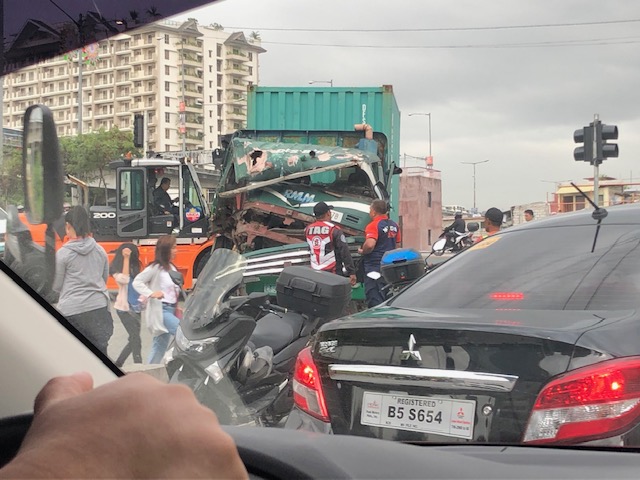 Another look at the truck involved in the crash
 The post obviously was in a precarious position and effectively blocked the path of vehicles that were to turn left at the intersection. Many of these vehicles including ours were heading to the airport.
There seems to be a lot of crashes involving trucks lately. I say so based on my personal observations including passing by crash sites where trucks have been the main vehicles involved. It would be good to see the statistics of truck involvement in road crashes including the typical locations (i.e., black spots), frequency and severity of the crashes. This would correlate with the maintenance and how these trucks are being driven. Too often, we read or hear about trucks losing their brakes or drivers losing control. There are clearly maintenance and driver behavior issues here that need to be addressed if we are to improve safety in relation to these large vehicles.
Despite this incident and the resulting traffic jam, the MMDA enforcers didn’t seem to know how to go about managing the flow of traffic in the area and wanted to reroute every vehicle intending to turn left at Sales towards the airport to Pasong Tamo Extension! This resulted to more confusion and many not to take heed of the enforcer waving at us to head for more congestion after what we experienced. Clearly, this was a case where the motorists knew better than to follow errant enforcers. In these times, you wonder if the MMDA’s enforcers were capable of managing traffic after road crash incidents like this.
–
On pedestrian crossings: innovating on the pavement markings?
I recently saw what looks like a project of the City of Antipolo where several pedestrian crosswalks are being painted over with artwork including a basic road safety message. The photo below shows one in progress across from the Provincial Capitol (aka Ynares) along the Antipolo City Circumferential Road.
 Photo of artwork in progress to cover the existing pedestrian crossing (zebra) pavement markings at the Rizal Provincial Capitol
Recently, I’ve seen news reports and posts by the proponents being shared in social media about the project. From what I’ve learned from reliable sources within the Department of Public Works and Highways (DPWH), this is an initiative with the blessing of the city and did not go through the DPWH. The main concern here is whether this ‘innovation’ of sorts will be effective and if the artist(s) behind the project used the proper materials (i.e., paint for pavement markings that are supposed to be highly visible day or night) for this project. If not, then this is just street art similar to what artists did on the UP Academic Oval a few years ago in front of Palma Hall. Sorry to blow your bubble but its more a publicity stunt than a safety device if proponents do not use the proper materials. I hesitate to use the term ‘design standards’ here because this is supposed to be artwork and perhaps the word ‘standard’ doesn’t apply. But to claim this enhances safety is at this point a stretch.
More first-hand photos soon…
–
We need to work on road safety for children
Working on a project on road safety for children, I have had an increasing appreciation for the need to improve the plight of our children who are among the most vulnerable of road users. I have shared or posted many images showing examples of children being exposed to risk. These include children crossing streets without assistance and those riding on motorcycles with minimal protective gear (not that such gear can really save them from serious injury or worse should they be involved in a motorcycle crash).
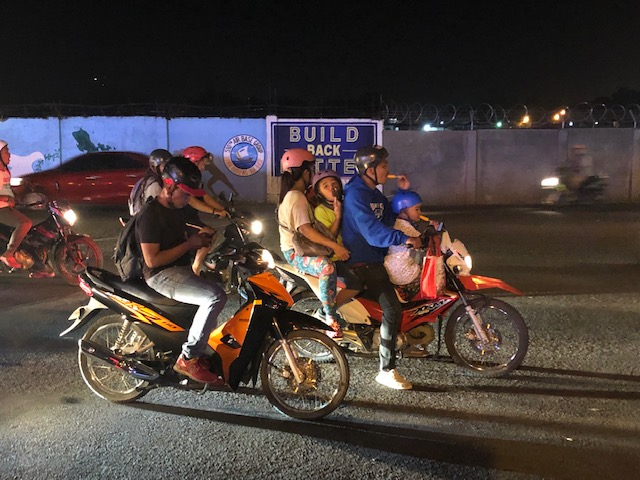 I took this photo as we waited for the signal to allow us to cross a very busy intersection in Zamboanga City. The entire family seems to be coming from dinner or the grocery where they picked up their popsicles. I hope the father is focused on balance and safe riding with his family considering the potential for tragedy here.
Some people may say that such scenes show the norm. But we must realise that treating these as normal means we accept that our children (and all other people) will be hurt one way or another. Is this really what we like or accept to be the situation? Perhaps not. And so the challenge is to find ways to make the journeys of children safer and one aspect we can focus on is the journey between home and school. This is perhaps the most common trip by children is between the home and school (to and from), which covers a significant share of the total trips made everyday.
In order to do this, we need to know, assess and understand the manner of their commutes and the facilities they use. We should collaborate with people who guide them including their parents/guardians and teachers. And we should engage those who are in the position to implement solutions such as government agencies or local governments in effecting interventions.
–
Dangerous situations for school children
We are currently implementing a project to improve the safety of journeys of children between their homes and schools. Ocular surveys of 25 schools in Zamboanga City revealed a lot of issues pertaining to their commutes. Critical locations include the main access roads (e.g., across school gates) and intersections. All schools have reported incidence of road crashes involving their students and mentioned that in many cases, drivers or riders do not slow down upon approaching the critical locations. These cases of speeding are despite the many countermeasures (including informal and creative ones) that schools and Barangay authorities have implemented to improve safety.
Here are some photos we took at Sinunuc Elementary School along the national highway in Zamboanga City:
 Children waiting to cross the highway and on-board motorcycles with their parents/guardians who fetched them from school
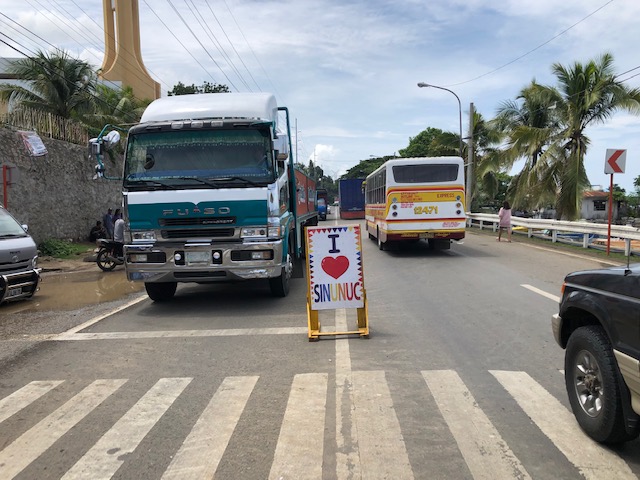 Large vehicles including trucks and buses traverse the highway and the signs offer little in terms of refuge or protection against these for students and other people crossing the highway.
 Child crossing with a parent/guardian
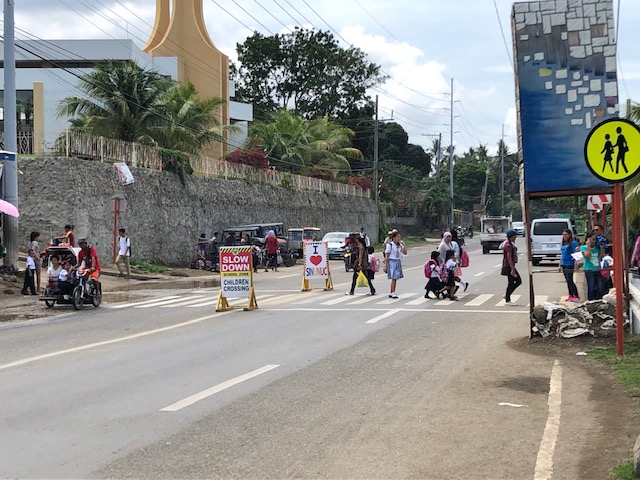 Children crossing the highway – photo also shows a pedestrian crossing sign at the road side along the direction towards the city centre.
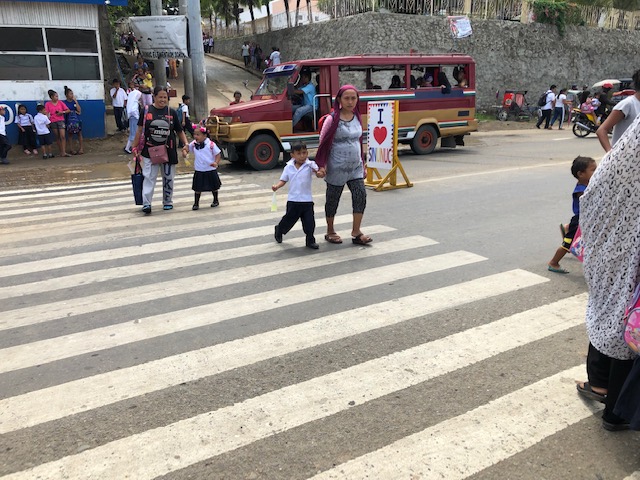 Children crossing with their parents/guardians as a jeepney is stopped right before the pedestrian crossing.
Though it may not be so obvious for some observers or viewers of the photos, these situations present high risks for students and others using the roads. And we hope our assessments in cooperation with the schools, agencies and city officials will be fruitful in improving road safety especially for the children.
–
Slippery when wet
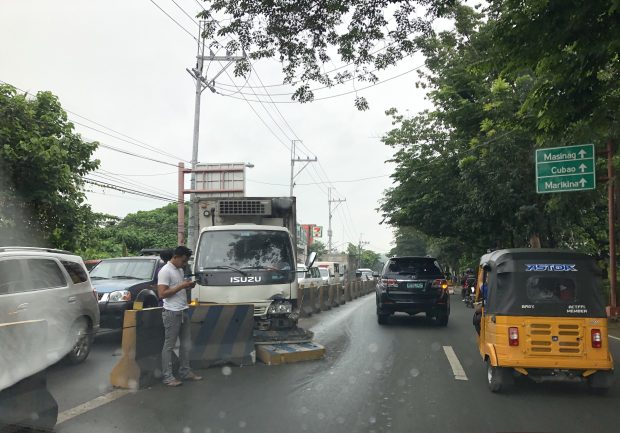
On rainy days like this, motorists need to heed advice to be more careful in driving or riding. Pavement surfaces are slippery and conditions may lead to drivers or riders losing control when they speed or execute risky manoeuvres.
It is not uncommon for road crashes to occur during rainy days. However, most if not all are preventable if people would just exercise extra caution. Slowing down, for one, is among the most effective ways to avoid situations that lead to crashes. You tend to lose control of your vehicle with excessive speeds and so slowing down makes sense.
Spacing also helps; especially between you and the the vehicle in front of you. Braking distances are longer along wet roads so make sure to maintain the proper distance between vehicles. A good rule of thumb is at least 1 car length per 10kph you are traveling. That’s at least 3 car lengths between your vehicle and the one in front, for example, when you’re traveling at 30 kph.
Safety guides for pedestrians and cyclists
Here are a couple of references/resources for pedestrian and cycling safety. These are guidelines and countermeasure selection systems that were developed under the Federal Highway Administration of the US Department of Transportation:
- Pedestrian Safety Guide and Countermeasure Selection System
- Bicycle Safety Guide and Countermeasure Selection System
These guides are designed to be practical and should be helpful to practitioners/professionals, policymakers as well as researchers. These would be people looking for references to use in designing or revising (correcting?) existing conditions or situations in order to enhance safety for pedestrians and cyclists who are among the most vulnerable of road users.
–
Road safety week and some helpful articles
This week is the UN Global Road Safety Week. And so, I will be sharing some articles and references related to road safety including the following pertaining to crashes involving bicycles and motor vehicles:
Bicycle Accident Prevention: Avoiding the 12 most common types of bicycle/vehicle accidents
Link is here: https://www.bicycleaccidentprevention.com/?fbclid=IwAR2JnbQQR9rwg_Vz6rOLZtQ0sxnlyn3zPojBgg_-XoUKED69p0EFFtPdlRY
The only comment I have about the above reference is that it still uses the term “accident” instead of “crash”. The latter is the more appropriate term now being used by professional, advocates and policymakers who are focused on safety; keeping in mind the motto that “road safety is no accident”.
–
On the traffic flow predicament at Tikling junction…again
During weekends, a constant frustration have been the incidence of severe traffic congestion along Ortigas Avenue Extension. Weekday evenings are usually better in terms of traffic compared to Saturdays. But last Monday, the congestion was so severe the congestion reached Valley Golf and vehicles had to crawl to Tikling. As mentioned in previous posts on this subject, part of the problem is the sheer volume of vehicles that make the roundabout set-up inappropriate for the junction. Then there is also the issue about the people who are supposed to manage traffic but end up mismanaging it. From what I usually observe, they tend to favour vehicles coming from Taytay via the Manila East Road leg and seem oblivious to the build-up of traffic along Ortigas Ave. Ext. eastbound.
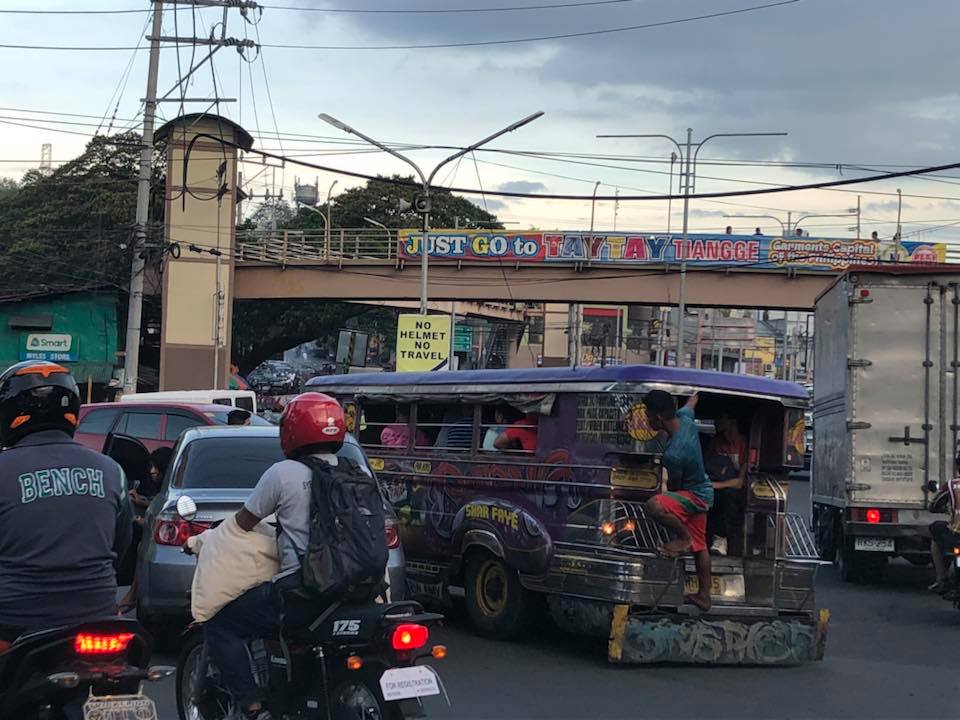 Typical heavy traffic at Tikling Junction
We might finally get a chance to have a solution for this. One of our students took on a topic that will require her to asses the traffic at the intersection to determine, for example, whether the roundabout is suitable or perhaps should be changed into a signalised traffic control. Both analytical approach and microsimulation (using Vissim or the homegrown LocalSim) will be employed. But we will have to wait by May to see some substantial results.
–
Reference on bike-focused street transformations
There’s an update to the “Rethinking Streets” guide with one that is focused on street transformation for bicycles. Here is the link to their site where they now have 2 guidebooks:
http://www.rethinkingstreets.com
You will have to click one of the guides to register (if you haven’t done so before) and download them.
–
 Caught (up) in traffic