
Home » Road Safety (Page 22)
Category Archives: Road Safety
Give way!
Road courtesy can be a scarce thing in many Philippine roads. In many road crash incidents, it can be quite obvious even to the casual observer that one of the problems we have is drivers and riders not practicing common courtesy. Hindi nagbibigayan. This is the case in most intersections where no traffic signals are installed and operational. Congestion occurs as drivers and riders try to impose their right of way over others. The absence of traffic personnel, even those who have limited capabilities managing traffic, further exacerbates the situation as motorists tend to ignore traffic personnel. Based on my observations, the most guilty of ignoring traffic rules and regulations including the enforcer on duty are motorcycle riders, followed by public utility vehicle drivers.
Below is a scene that greeted me one morning during my commute to my workplace. Maj. Dizon is a secondary national road passing through a residential area in Quezon City and Marikina; connecting C-5 with Marcos Highway.
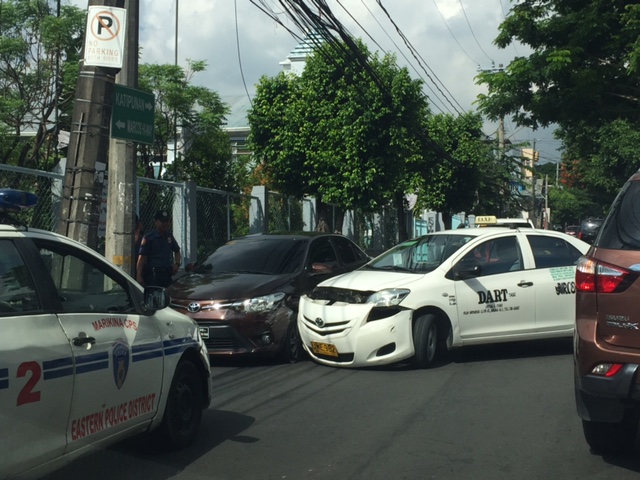
Who had the right of way here? Did the private car have the ROW and the taxi driver tried to impose himself (cut into the path of the private car) thinking that the private car driver will slow down to give way? Or did the taxi driver have the ROW but then the private driver decided to accelerate so as to prevent the taxi from completing the maneuver? Either are likely cases and are often the cause of crashes like this.
Other situations that are common are vehicles maneuvering (e.g., backing or turning) but tricycle drivers and motorcycle riders proceeding despite the clear ROW for the maneuvering vehicles. In certain cases, large vehicles like trucks have blind sides and have resulted in their inadvertently hitting motorcycles who riskily and recklessly maneuver with respect to the trucks.
How do we address such behavior? It likely is rooted from how drivers and riders learn to drive or ride so its starts with that stage. Many people learn to drive or ride from peers or their seniors (e.g., parent, uncle, family driver, company driver, etc.) while others learn via driving schools. Do they learn courtesy from their ‘teachers’? Are driving schools imparting this or just teaching people how to operate a vehicle? Then there is the licensing stage. The Land Transportation Office (LTO) is also responsible for assessing whether those applying for licenses are qualified. Both the written and practical exams should contain elements related to the practice of courtesy. And then there is the enforcement aspect, which has the burden of educating drivers and riders by accosting and reminding (lecturing?) motorists about proper driving and riding etiquette. Of course, you have to have capable enforcers in the field whether they be traffic aides or police officers.
–
On distracted driving vs. other, more urgent, traffic issues
Much has been written and said about the new law against distracted driving. The people who crafted the law, Senators and Congressmen, are in agreement that their intention was mainly to address the rampant use of gadgets including cell phones by motorists. Yet, when the agencies in-charge of implementation drew up the implementing rules and regulations (IRR), their interpretation was the subject of a lot of complaints. Many opined that the IRR didn’t take into consideration actual vehicle dashboard designs or that the definition of the term “line of sight” was open to interpretation. This necessitated another round of consultations with stakeholders leading to the infographic below:
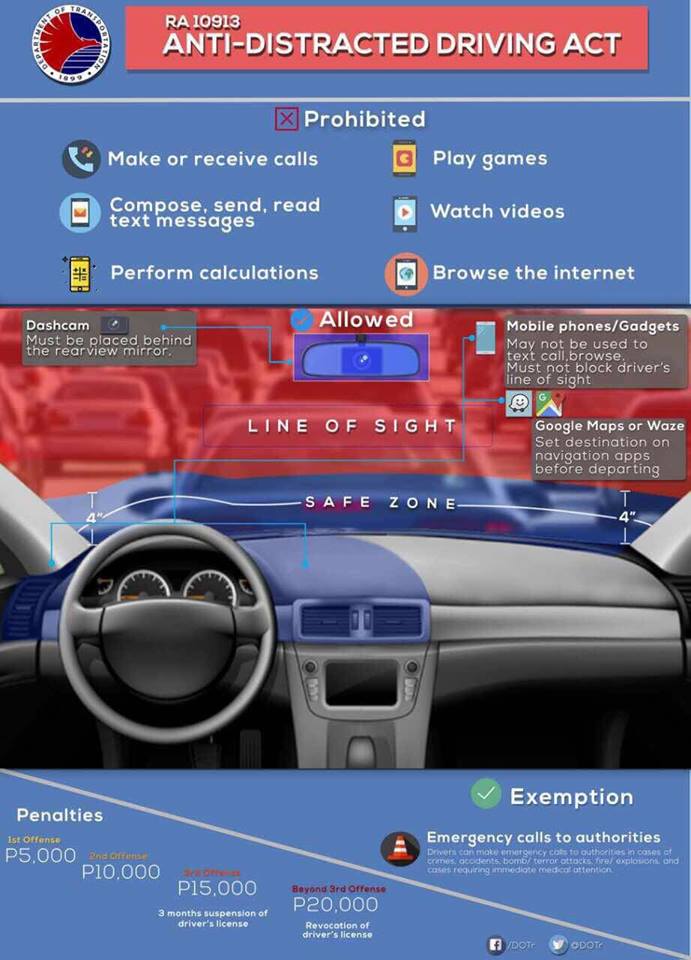
Frankly, I am more concerned about speeding, counter flowing and reckless weaving in traffic. These are equally if not more dangerous than many aspects of the distracted driving law. Quite serious would be the combination of distractions with any of the three behaviors mentioned. More disturbing would be the deliberate (definitely not distracted) or conscious acts of speeding, counter flowing and reckless weaving that are often the cases if one observes the incidence of these three driving behavior. We can only wonder about the likelihood of crashes due to these behaviors.
–
On slippery roads again
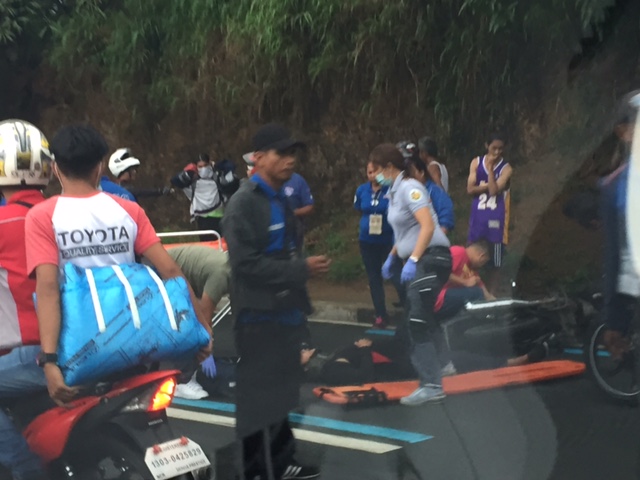
With the onset of the wet season, expect many roads to be slippery during and after rains. As such, extra care should be exercised by travelers especially motorists. It is easy to lose control of vehicles, especially motorcycles, when speeding or undertaking risky maneuvers like overtaking, counter flowing, and tailgating. Traffic enforcement units also need to be active in accosting motorists for risky behavior that may endanger the lives of not only the vehicle occupants but of other people as well like innocent pedestrians and cyclists minding their own business.
Following are a couple of photos of an incident along Sumulong Highway after rains in the area. Apparently, only a motorcycle rider was involved in what seems to be something that would be categorized as a “self accident”. No other motorists may have been involved although I suspect it could also be a case of a “near miss” where the rider lost control after almost hitting or being hit by an errant vehicle.

–
Back to school – concerns about congestion and safety
Many roads again are expected to become more congested as school resumes in most parts of the country especially in cities. But while congestion is usually the top issue along roads near many schools, one concern that usually takes a back seat to congestion is safety. Many public schools in the provinces are located along national highways. Many if not most of their students walk to and from school, usually on the carriageway when the shoulders are too rough, dusty or muddy. This situation for students increase the likelihood of their being hit by vehicles using the road. The risk increases because of their exposure to the dangers posed by motor vehicles. Following are a couple of photos showing typical cases at public schools along national roads. Both are in Antipolo City.
 Typical at-grade pedestrian crossing in front of a school. Students in most public schools often commute by walking or taking public transport like jeepneys or tricycles.
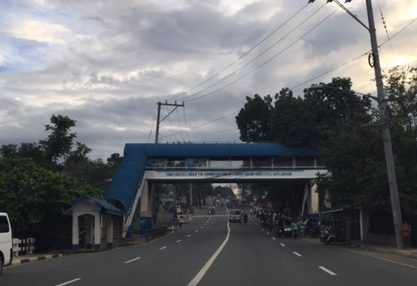 Despite this pedestrian overpass across a public school along Sumulong Highway, most students still prefer to cross on the road rather than go up and down the overpass.
Oftentimes, the seemingly obvious solution of constructing overpasses for safer crossings for students does not pan out as planned or intended. There are many underutilized pedestrian bridges since the natural way is still to cross at-grade. Then there is the issue of providing them safer walking paths or walkways. In both photos above, the sidewalks are only token (“puwede na iyan”) and insufficient for the pedestrian traffic supposed to use them. We need to plan, design and provide such facilities for our pedestrians, especially children, who are marginalized compared to those who have their own vehicles for travel.
–
Road crash at NAIA Terminal 1 parking area
[Warning graphic content]
Last May 30, I was picking up my wife at the airport and heard a loud crash as I was getting my ticket for the NAIA Terminal 1 parking lot. I looked around but could not see anything that could concern me. As I rounded the driveway though, I noticed the vehicles in front of me already slowing down. This was the scene that greeted us:
 Van in an awkward position against the bushes of the parking lot fence and after colliding with a parked SUV. Security staff were already there and one person (the driver of the van?) seemed out of sorts.
As I continued my drive, I saw this gruesome scene of a person who was likely hit by the van when it crashed into the limited access gate of the parking lot:
 The casualty of the incident was lying on the ground with security personnel apparently more concerned about the damaged gate than attending to the person.
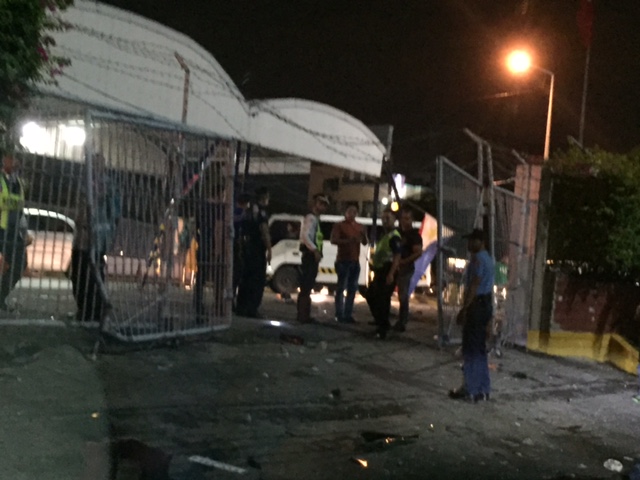 Another look at the damaged gate that the van punched through before finally crashing into the SUV and the bushes as shown in the first photo.
I’m not sure if this incident was featured in the news. It surely is something that would likely be not attract so much attention as it may not be as ‘newsworthy’ as other incidents that have happened recently. That is often the case with road crashes, which seem to be regarded as something typically occurring.
One thing we get and should realize from this is that everyone is indeed vulnerable from road crashes. The casualty in the photo (I assume only one) was likely someone who was there waiting for a relative or a client to arrive. Large groups and even whole families may be found at the airport parking lot as they wait for loved ones to arrive. The victim probably was just wiling his time, even texting people about his status, when tragedy struck that night.
–
On walking and the old pedestrian overpass at UPIS
I decided to go for a long walk one day last April. I walked from our office to the UP Town Center, which was just under 2 kilometers away, to purchase something. I could have taken my car or perhaps rode a jeepney but I wanted to see for myself how easy or difficult it was to walk that distance. It turned out that it wasn’t a difficult walk at all. From Melchor Hall, I crossed the street so that I could walk along the inner part of the Academic Oval. I then took a short cut through the trail in front of Malcolm Hall at the edges of the Sunken Garden, emerging just near the grandstand. From there, I crossed towards Vinzons Hall and then walked towards and along Shuster Street near UP Integrated School. I exited the campus at the portal at the end of Shuster and crossed Katipunan using the old pedestrian overpass that connected the main campus with what used to be UPIS on the other side of C-5.
 The pedestrian overpass is an old structure compared to many of its kind around Metro Manila. The design is quite massive considering it is a concrete structure. The photo above was taken towards the direction of UP Town Center.
 The steps are quite steep on either side of the overpass
 Here’s a photo of a person carefully walking down the steps of the overpass.
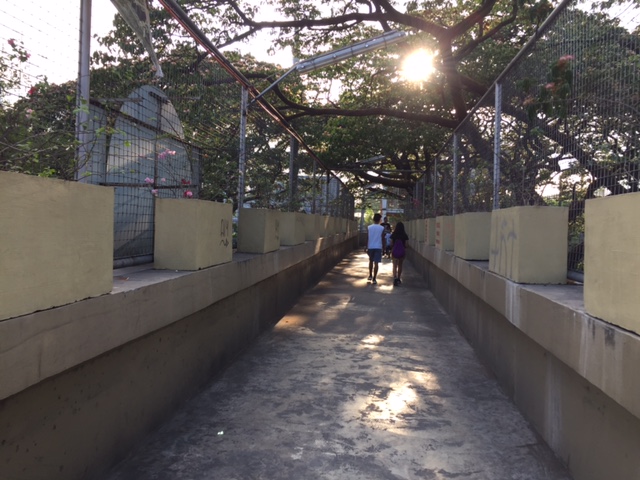 The photo above was taken towards the direction of the UP campus.
The overpass used to be dirty, unkempt, and to many was revolting enough that it was rare to find people using it to cross Katipunan. Most people crossed the busy thoroughfare on the ground, often braving the traffic and taking on the risk of getting hit by a vehicle. Since the overpass was integrated with the UP Town Center (i.e., it is physically connected to the mall and there security personnel posted there), more people now use it. MMDA also fenced much of the median of Katipunan in the area and so the only way to cross the stretch of UP Town Center from Shuster to C.P. Garcia is via either of the two pedestrian overpasses (there’s a second, newer steel structure near C.P. Garcia).
As for the walk to Town Center and back, I thought it was safe, convenient and invigorating (nothing like some walking to help in blood circulation). I took a leisurely pace (not brisk) for my walk so I could enjoy the environment. You tend to see a lot of things when you take such walks and the campus is full of activities, sights and sounds, to help make the walk enjoyable such that you won’t even notice the time and perhaps, won’t even mind the exercise.
–
Resources on traffic calming and recalling statistics on road safety in the Philippines
As I usually post on some interesting and useful articles on transportation and so I just couldn’t resist sharing this find on resources for traffic calming. This is always a timely source of material on how we can improve road safety particularly in residential areas or where there are more pedestrians exposed to transport and traffic. Such exposure increases the likelihood that they may be involved in a crash.
I recall an article from 2015 that appeared on Rappler:
Francisco, K. (2015) Road deaths in PH: Most are motorcycle riders, pedestrians, Rappler, http://www.rappler.com, October 27, 2015.
The WHO Global Status Report on Road Safety 2015 is a good resource for statistics and the report can be easily downloaded along with other information, and in different languages. Here is the entry for the Philippines appearing in the report:

–
On motorcycle taxis becoming the “new king of the road” (cont.)
This is a continuation of the yesterday’s post on motorcycle taxis. The feature appearing in Sunstar Philippines also focuses on the case of Cebu City where there is a rising demand for motorcycles and issues on public transport have given rise to a motorcycle taxi use despite their being basically illegal under current laws/guidelines. Habal-habal as these motorized 2-wheeler taxis are known have been in service in many cities and municipalities but are mostly tolerated in rural areas where conventional public transport services are scarce.
Part II of the feature by Sunstar:
New King of the Road – Part II
There are three articles in Part II:
Ramirez, J.A.C. (2017) Motorcycles on the rise, Sunstar Philippines, Retrieved from: http://www.sunstar.com.ph, April 4.
Ramirez, J.A.C. (2017) Habal-habal drivers form group to ‘professionalize’ services, Sunstar Philippines, Retrieved from http://www.sunstar.com.ph, April 4.
Ilano, M.V. (2017) Hailing a motorcycle taxi with your smartphone, Sunstar Philippines, Retrieved from http://www.sunstar.com.ph, April 4.
Part III of the feature by Sunstar:
New King of the Road – Part III
Ilano, M.V. (2017) Even with BRT, motorbikes still needed in Cebu City, Sunstar Philippines, Retrieved from www. sunstar.com.ph, April 4.
Ilano, M.V. (2017) Will Cebu City lead the way?, Sunstar Philippines, Retrieved from http://www.sunstar.com.ph, April 4.
I hope these articles on motorcycles and motorcycle taxis will generate meaningful discussions pertaining to their applications and perhaps their regulation. One issue, of course, that should definitely be on the table is safety. That is non-negotiable and assurances by motorcycle taxi transport providers should not be enough to persuade their becoming formalized as a public transport mode. The basis for mainstreaming these should be evidence-based including assessments based on crash (accident) data. Here is something that can be studied by the various schools around the country especially universities that have the capacities and capabilities to conduct such studies in aid of policy formulation at the national and local levels.
–
On motorcycle taxis becoming the new “king of the road”
There is a really nice feature on Sunstar about motorcycle taxis that came out today. This was shared by a good friend on his social media account, which got my attention as we just completed a study on motorcycles last January 2017. Here is the feature:
Part I includes two articles:
Ilano, M.V. (2017) Habal-habal invades cities, Sunstar Philippines, Retrieved from http://www.sunstar.com.ph, April 4.
Anunciado, D.D. (2017) Deadly motorcycle rides, Sunstar Philippines, Retrieved from http://www.sunstar.com.ph, April 4.
Here’s a graphic from the second article that says a lot about motorcycle safety in Metro Manila:

I would just like to comment that the graphic shows MMDA-recorded crashes in Metro Manila. There can be a lot of incidents that went unrecorded or unreported with the MMDA. It would be interesting to check with the local government units about their own statistics and compare these with the MMDA’s. Also, “crashes” is the preferred term over “accidents” as road safety practitioners and advocates argue that these are preventable incidents.
Sadly, such statistics can only be shown by cities doing the diligent work of recording such incidents. The Department of Public Works and Highways (DPWH) has already ceased collecting, processing, analyzing and reporting road crash reports many years ago (which is quite surprising for an agency mandated to plan, design, construct and maintain national roads). There is currently no agency (no, the Department of Transportation (DOTr) has not yet taken over the enormous task) that is collecting, processing, analyzing and reporting on road crashes at a nationwide scale and few LGUs do so at their levels.
I will also post about Part II once its out. There is a preview of what articles will be in the next feature and so that is something to look forward to.
–
Vermont Royale pedestrian overpass
There was a comment on a previous article asking if the pedestrian overpass across Vermont Royale along Marcos Highway is already usable. The photo in that article showed a still-to-be modified overpass. Following are photos taken last Sunday of the overpass. It shows the lowered mid-section passing under the Line 2 extension structure.
 The modified pedestrian overpass across Vermont Royale along Marcos Highway
 That’s a pedestrian and a cyclist using the overpass
–

