
Home » Road Safety (Page 28)
Category Archives: Road Safety
“Gatong” comments by traffic enforcers
Friends who have been involved in a road crash have noted that traffic enforcers seem to have the propensity for making unnecessary remarks while attending to a crash scene. I have experienced this first hand. Some of the more common comments that enforcers make include:
– How crash or accident-prone an area is (citing issues in the area);
– How certain motorists are more likely to be involved in crashes (often referring to one of the parties involved); and
– How one party’s behavior leads or led to a crash (essentially blaming one party for the incident).
[You’re free to add a comment you heard yourself or someone else got from a crash scene.]
Traffic enforcers or police should not make such comments at the scene of a crash especially in front of the parties involved. It is not about whether they have the right to do so but whether it is appropriate coming from a person of authority who should first and foremost be neutral in such circumstances. For one, such unnecessary comments could affect how people involved in a crash could behave. Generalized statements could wrongly favor one party over the other simply because a person of authority made a comment to the contrary of how things really happened. Enforcers should be neutral and go about their business in getting the facts about an incident and proceed in making the formal report for the crash. Even the investigator assigned to the scene should be as objective as possible in order to have a fair assessment of the incident.
–
The Philippines Anti-Drunk Driving Law
It’s a Friday and another weekend is here. It’s also payday weekend and so it’s expected that restaurants, cafes and bars will be full tonight and the weekends with people dining, lunching, having coffee, and likely for many – drinking. For many years, the latter has resulted in too many road crashes, a significant number of which have had fatal outcomes – usually cars or motorcycles crashing into one another or by themselves. It’s even more dangerous (and highly likely to be fatal) for motorcycle riders who need to balance themselves on two wheels after getting inebriated. Meanwhile, a lot of driving under the influence (DUI) that in many other countries including the US and Japan don’t get apprehended primarily due to the absence of laws and guidelines for their capture and evaluation. There was no way to test their blood alcohol content (BAC) in the field and traffic personnel couldn’t force people to go to hospitals to be tested.
There’s good new, however, especially for road safety advocates. The Philippines is finally implementing Republic Act No. 10586 – An Act Penalizing Persons Driving Under the Influence of Alcohol, Dangerous Drugs, and Similar Substances, and for other Purposes, which was signed into law in May 27, 2013. Under the law, private vehicle drivers can be arrested and penalized for BAC of more than 0.05% while truck and public transport drivers and motorcycle riders can be apprehended for a BAC of more than 0.0%. For comparison, Japan requires a BAC of 0.0% for ALL motorists.
The Implementing Rules and Regulations for the law may be found here: PH Anti Drunk Driving Law2013 Rules. The Land Transportation Office (LTO) and the Metro Manila Development Authority (MMDA) have already acquired equipment to help them evaluate apprehended persons. These include breath analyzers and staffs of both agencies have already undergone training to be able to implement the law. Unfortunately, traffic enforcers cannot randomly test people on the road but would have to apprehend them first for violating other traffic rules and regulations. But I am sure our traffic law enforcers can be quite creative in how to catch these people who pose dangers to all other road users by their being irresponsible for driving or riding under the influence of alcohol or dangerous drugs. And with the national elections coming up next year, there will be a lot of checkpoints sprouting up along major roads that will also open opportunities for testing and apprehensions.
–
Swapang drivers
Intersections, especially those with traffic signals, typically have road markings indicating the stop line for vehicles as well as the designated pedestrian right of way for crossing at the intersection. Most intersections also have a typical “yellow box” that is supposed to mark the area that is to be clear of any obstructions (including vehicles and pedestrians) in order for traffic to flow efficiently at the intersection. Despite these and the clear policy on where to stop at intersections based on traffic rules and regulations, many motorists choose to violate these rules and encroach or occupy space that is for pedestrians and cyclists. In the process, these motorists endanger the lives or limbs of people that they might hit as they attempt to get ahead of others. This propensity to “get ahead” or panggugulang in street lingo is widespread and indicative of how the poor discipline among motorists.
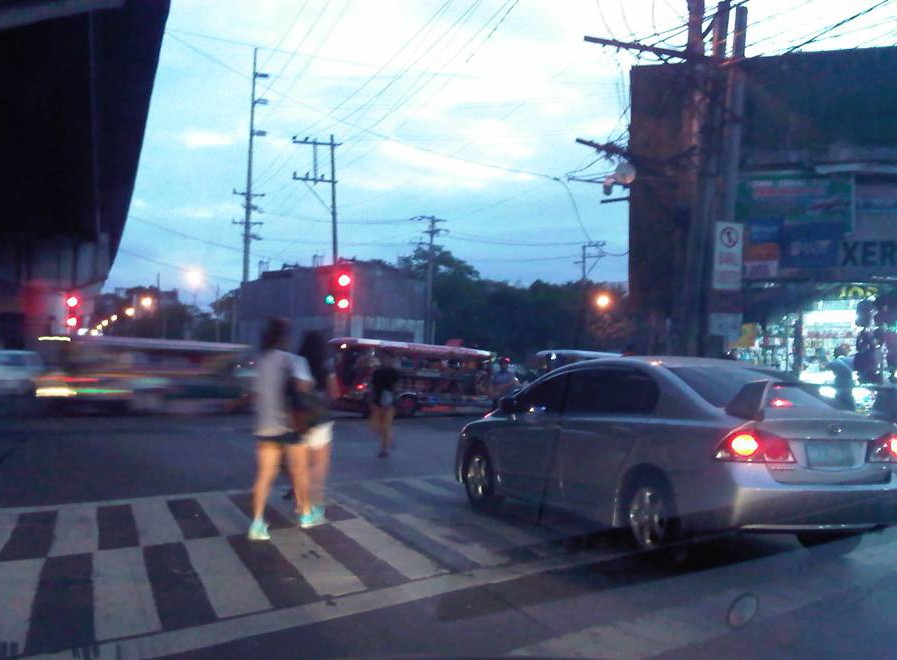 The driver of this car seems to think he could get ahead of everyone else by stopping on top of the pedestrian crossing, which in this case is clearly marked.
There are many cases like this and in some there are traffic enforcers that quickly approach the vehicle to accost the driver. In Makati, erring drivers immediately get a ticket or are fined for such transgressions. The photo taken above was in Quezon City at the intersection of Aurora Boulevard and Katipunan Avenue. There were a lot of enforcers there and very visible but they were only watching traffic and did not mind such cases. I think that if an enforcer was not deputised (i.e., not authorised to give a traffic ticket) then the least he/she could do was to approach the driver, inform him/her of the transgression and then direct the driver to clear the area (basically back up behind the crosswalk).
If and where the enforcer is deputised, then I think they should issue tickets or fine violators to send a clear message that such actions will be penalised immediately and firmly. Word of such actions and their outcomes usually travel fast among motorists especially with social media these days expediting such information dissemination regarding transport and traffic in various areas in the metro. This would be a good way to influence people to improve their behaviour on the roads.
–
Enforcing bus lanes along Commonwealth Avenue
Commonwealth Avenue always seems to be the subject of road safety or traffic discipline initiatives every now and again. Quezon City together with partners in other government agencies like the Philippine National Police (PNP) and the Department of Transportation and Communications (DOTC) have embarked on another program aimed at reducing the occurrence of road crashes and other incidents along this busy corridor. It actually reminds me of the “traffic discipline zone” designation of Commonwealth not a decade ago and before public transport lanes were physically allocated along the highway.
They are failing miserably if I am to base success on observations of the behavior of drivers of public transport vehicles alone along this major highway. They get away with a lot of reckless driving including suddenly switching lanes, speeding, and tailgating. There are also cases where vehicles and pedestrians cross the wide highway at points that are prone to crashes. I am not aware of a lot of apprehensions being made of these reckless drivers along Commonwealth except perhaps at the foot of the Tandang Sora flyover where MMDA enforcers seem to be congregating on most days armed with one of two of the agency’s speed guns. But then it seems “business as usual” for the same drivers and riders along the rest of Commonwealth so the initiatives are not effective deterrents against irresponsible road use.
 You can always see buses on the wrong side of the road along Commonwealth Avenue especially along the section between Fairview Market and Regalado. They do this to get ahead of other buses and then bully their way to make a stop or turn right at an intersection.
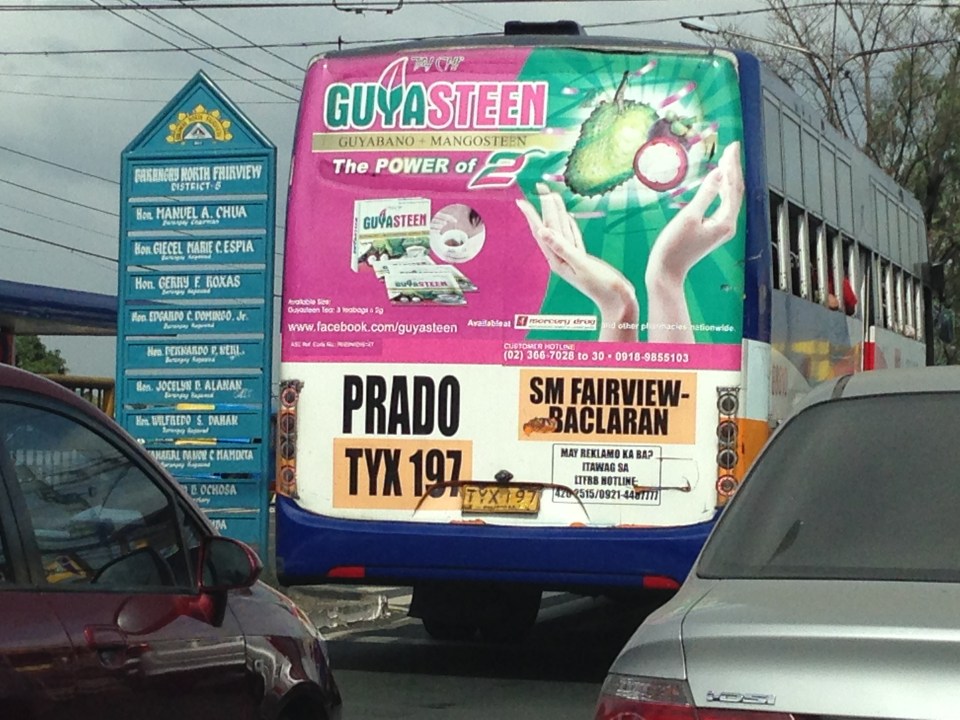 This bus in particular was weaving in traffic, bullying smaller vehicles to give way as it raced other buses along Commonwealth Avenue. Such behavior among public transport drivers is one of the major ingredients for road crashes.
It’s been a year now since the tragic crash involving an out of line provincial bus in the Cordillera. That was partly the result of poor monitoring and enforcement by the LTFRB. While the major reason for the crash was reckless driving (i.e., the driver was allegedly speeding at a critical section of the highway), this could have been avoided if the bus wasn’t operating in the first place. The very same policies along Commonwealth apply to these provincial buses and fatal crashes could’ve been avoided or minimised if the LTFRB can just exercise its mandate effectively.
–
Risky switching of lanes
Many Filipino drivers have the propensity for frequently changing lanes. These happen even at locations where they are not supposed to be changing lanes (e.g., at intersections, while going up or down a steep slope, at curves, etc.). Such maneuvers are risky and basically among the reasons why there are double yellow solid lane markings separating opposing traffic at these sections. I have seen many incidents where in a matter of seconds at least one person is suddenly inconvenienced by the crash. I say at least one person because whether traffic is light or heavy, there will be vehicles slowing down and causing a chain reaction of other vehicles slowing down to stop or avoid the vehicles involved in the collision. These incidents occur because of at least one person’s propensity for suddenly switching lanes.
 The rear bumper of a car gets torn-off (not just detached) by the bull bar of a vehicle whose driver decided to suddenly shift to the right. Apparently, the guilty driver was not able to factor his vehicle’s bull bar when he immediately encroached on the adjacent lane.
 A closer look at the damage on the vehicle in front of us. We had to change lanes ourselves in order to avoid the stopped car. We could only imagine the traffic build-up resulting from the incident at the C5-Lanuza intersection.
I’m not sure how these people learned to drive. Driving schools will likely claim that they did their part in instructing their students/clients the proper way to drive. However, going through driving school is not an assurance for responsible driving. What more can be said for people who learned to drive the informal way (i.e., taught by a friend, relative or other people). Of course, this could have been addressed early on if the licensing system under the Land Transportation Office (LTO) was a lot stricter and exercised due diligence in their licensing examinations.
–
Congestion due to roadworks at Sumulong-Olalia
The Sumulong Highway sections emanating from its intersection with Olalia Road have been experiencing traffic congestion in the mornings the past few days due to road works being undertaken at the intersection, and along Olalia Road and the Masinag-bound side of Sumulong Highway. Some days, traffic has been bearable and its just like having an ill-set traffic signal at the intersection where it would take you several cycles before getting through. Recently, however, many motorists have lost patience (or probably are simply pasaway) and have been encroaching on the opposing traffic lanes, much to the dismay of those who opted to follow rules. This panggugulang or going ahead of others need to be lessened with those guilty being apprehended or turned back to discourage future transgressions of traffic rules.
 Counter-flowing vehicles towards the Sumulong-Olalia intersection
 Queue at the curve towards the direction of Olalia Road
 A look at the side mirror shows a long line of vehicles along Sumulong. The queue sometimes reaches the strip of stalls selling cashew, suman, and other local delicacies.
There’s really very little one can do about traffic management in the area considering the limited space available for vehicles turning to/from Olalia Road. It’s basically one-way at the approach to Sumulong Highway so there will definitely be a queue along the outermost lane of Sumulong due to the constriction at Olalia. However, in the morning, there is an obvious difference in the directional distribution of traffic along Sumulong with most vehicles moving in the direction towards Masinag rather than to Antipolo Church. That means the Antipolo-bound traffic can fit along a single lane while opposing traffic can use three lanes – 2 bound for Masinag and 1 for Olalia. Enforcers may want to use traffic cones for this temporary traffic management scheme as without such tools, there is a tendency for a bit of confusion as impatient drivers resort to encroaching on the opposing lane (counter-flow) and resulting in more severe congestion (and unsafe conditions) as they attempt to merge with traffic at the intersection. Of course, that goes without saying that it only takes one idiot to counter-flow for others to follow.
–
Undergraduate research topics on transportation for AY2014-2015
The Transportation Engineering Group (TEG) of the Institute of Civil Engineering (ICE) recently finalised the researches to be implemented by undergraduate students assigned to the group.
- Calibrating car-following and lane-changing models for local traffic micro-simulators
- Effects of clear yielding rules at weaving sections
- Evaluation of re-opening of traffic signals along Katipunan Avenue
- Shuttle service for University of the Philippines Diliman employees
- Analysing trip-cutting behaviour of jeepneys and UV express with respect tot he LRT Line 2 Santolan and Katipunan Stations
- Assessment of pedestrian facilities along Ortigas Avenue Extension and Marcos Highway
- Study on satellite parking system for UP Diliman
- Road safety audit checklist for expressways
- Study on Philippine National Railways (PNR) station congestion
- Using drones for analysis of weaving sections, and traffic circulation in roundabouts
- Air quality assessment at the Centennial Dormitory along C.P. Garcia Avenue
- Estimating bus passenger demand between UP Diliman and UP Los Banos
- Mode choice modelling of new transport systems
- On-road energy efficiency of alternative fuel vehicles
Note that several topics in the list are focused on issues concerning the UP Diliman campus. These are a continuation of studies geared at providing solutions to transport or traffic problems at UP’s flagship campus sprawled over an area of 493 hectares. The above are working titles at best as students taking up the topics are supposed to develop their research proposals (complete with literature review, methodology and budget) this semester and then implement these in the next semester. Since UP has already adjusted its academic calendar, research implementation will be undertaken from January to May 2015.
–
Lane discipline
Among many peoples’ pet peeves in traffic would probably be the propensity for lane changing among many drivers and riders. This is especially true for wide multi-lane roads like Commonwealth Ave., Marcos Highway and EDSA. While it can be an understandable behaviour for free flowing traffic along long stretches where weaving can be executed safely, lane changes can be quite risky at intersections and may instantly lead to crashes. These are likely the bases for the swerving violations that the MMDA and other traffic enforcers became notorious for issuing for a time.
We chanced upon a scene at the Commonwealth Ave.-Mindanao Ave. intersection in Novaliches where a car seemed to have attempted to cut in front of a bus in order to make a turn but got hit by the bus. From the angle of the collision, it appears that the driver of the car likely maneuvered for a U-turn and made the critical assumption that he could beat the bus for the turn. It was obvious that the bus was in the right position while the car was not. This is often the case for drivers who do not care for positioning themselves along the correct lanes at intersections and seem to rely on their guile to get ahead of others. Such drivers might just be the same ones who would likely do counter-flows also to get ahead of others queued along the right traffic lanes.
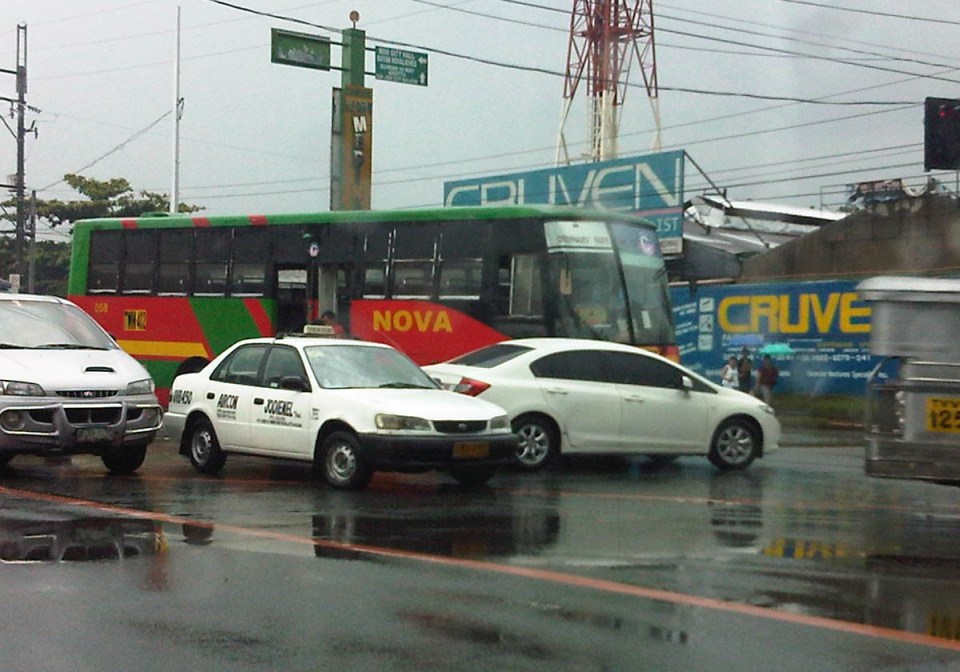 White car attempts to make a U-turn right in front of a bus and gets hit by the bus whose driver likely did not notice the white car sneaking in front of the vehicle.
Lane discipline becomes more important with the revival of traffic signals all around Metro Manila. In addition, it is also important for the appropriate lane markings to be placed at intersection approaches. Such markings are supposed to guide drivers where they should position themselves so that they will not block traffic going in another direction. These can also aid in the enforcement of lane discipline as vehicles on the wrong lanes can be apprehended. This was the case in Cebu City in the 1990s when the city adopted the SCATS traffic signal system, which employed detectors embedded on the pavement along the approaches to intersections. These detectors helped determine whether there is demand for a particular movement (left, through or right) and so requires lane discipline for the system to work effectively. –
Tutok – tailgating
A common practice of motorists along Philippine roads is tailgating. This is not only common in congested traffic, when vehicles are practically “bumper-to-bumper,” but also in free flowing traffic where drivers or riders tailgate for a number of reasons (e.g., to put pressure on the one ahead of them, to display skills in following closely behind another vehicle, etc.), all of which are dumb. There is always the risk that the driver or rider of the vehicle in front will brake to slow down or stop and the driver/rider of the vehicle behind will not be able to brake in time to hit (rear-end) the one ahead. Both time (reaction, headway) and space (distance between vehicles) are factors here as driver or rider reaction times vary and will affect the outcome of the chain of events should the leading vehicles suddenly slow down for any reason.
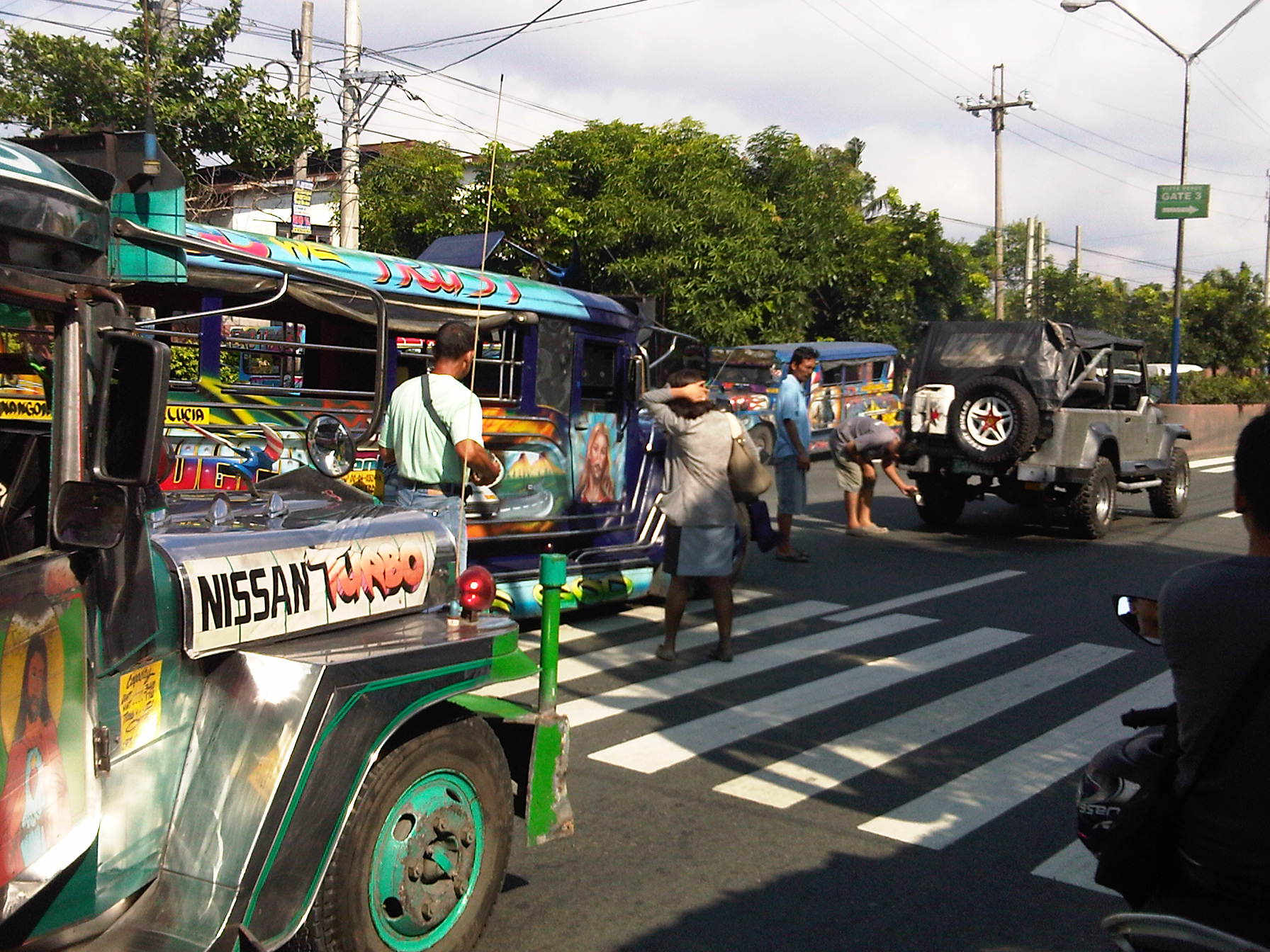 A passenger can only scratch her head as she tries to get back her fare from the conductor after alighting from a jeepney involved in a collision with another vehicle. Meanwhile, the driver of an owner-type jeepney inspects the damage to his vehicle as the driver of the jeepney that hit him looks on.
I was just explaining about Stopping Sight Distance (SSD) to a class of senior students and SSD very much applies to tailgating. Given varying traffic conditions along the roads, tailgating compromises the safe distance between vehicles and therefore too often leads to situations that lead to road crashes. Rear-end collisions in turn often lead to traffic congestion and raise the costs brought about by such incidents. In most cases, this happens because authorities are unable or incapable of managing the aftermath of the incidents where parties involved often argue in the middle of the road without regard for other road users plights. These cases need to be resolved quickly and efficiently in order to remove these obstacles from the road.
–
EDSA: Taft to Tramo
The EDSA-Taft Ave. intersection was in the news a few weeks ago due to the MRT3 train that derailed and overshot the end of the line along EDSA. Being a major intersection for roads as well as for rail (MRT3 and LRT1), it is a very crowded area. Nearby, too, is the Redemptorist church in Baclaran that attracts a lot of people especially during Wednesdays. Following are a few photos of the area showing the conditions on the pedestrian overpasses and at street level.
 The pedestrian overpass at EDSA-Taft is also a mall of sorts given the merchandise being sold at informal shops at the overpass.
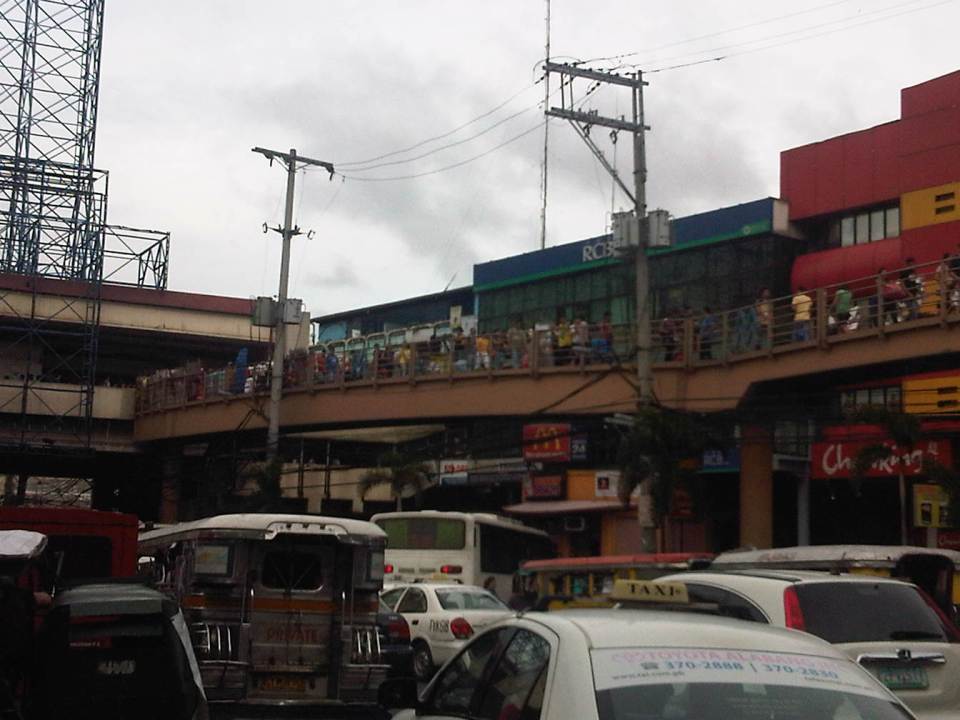 The overpass connects to the EDSA-MRT 3 Taft Ave. Station. This is the MRT 3’s end station and the overpass system connects the MRT 3 Taft Ave. Station with the LRT Line 1 EDSA Station. The connection was not and is still not a smooth one, which has been the subject of criticism from a lot of people.
 The overpass allows people to walk around this large intersection
 Pedicabs freely travel along this stretch of EDSA between Taft and Tramo on lanes designated for public utility buses and clearly violating regulations regarding what vehicles are allowed on EDSA. You can also see in the photo a cart full of merchandise being pushed along the curbside lane.
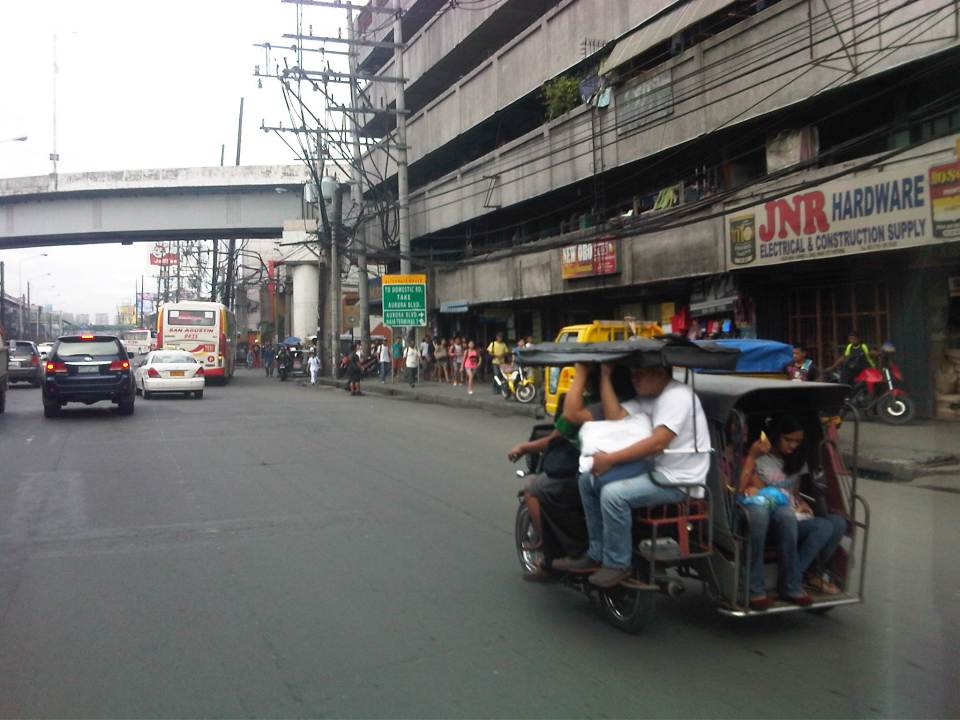 A motor tricycle ferrying passengers along EDSA just before Tramo (that’s the street above which is an overpass from EDSA southbound).
–
 Caught (up) in traffic