
Home » Road Safety (Page 32)
Category Archives: Road Safety
Swapang! or the perils of walking
Walking to the jeepney terminal for a ride to the university, I was irritated by the constant honking behind me as motorcycles rode up the sidewalk to avoid the weaving into congested traffic along Aurora Boulevard. And so I tried to stand my ground allowing only half the space of the sidewalk for these motorcycles to pass through. As far as I’m concerned, I was already too generous giving part of the space that is for pedestrians and not for motorized traffic. Still, there were a few motorcyclists who seem to think they had the right of way as they attempted to convince me give up more space so they could practically take over the sidewalk. I didn’t give way and assumed they were cursing me inside their helmets. Manigas sila! I thought that in the end, sila ang asar at talo in this situation, not me.
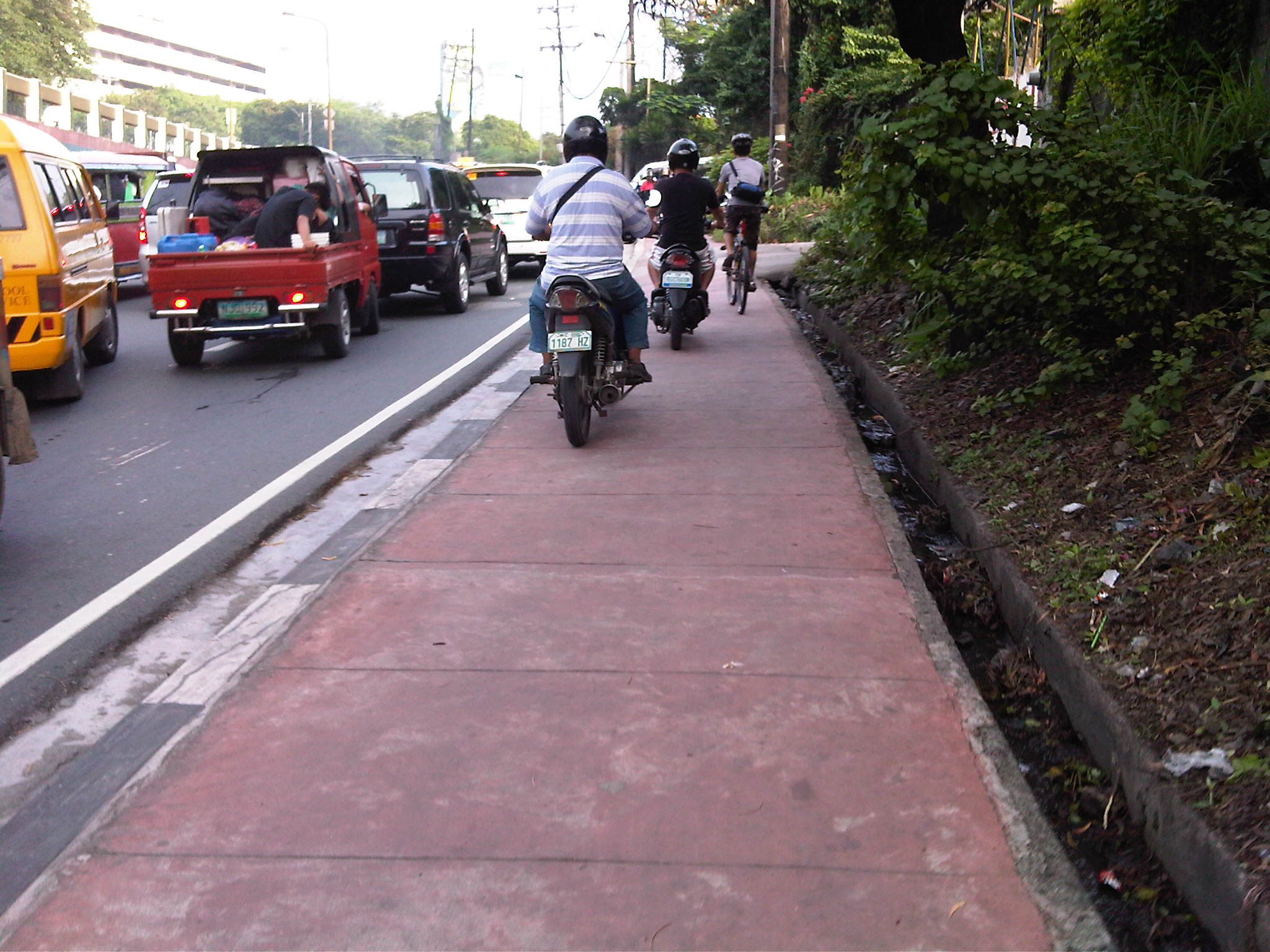 Motorcycles dominating space for pedestrians
At one point, I held my ground and didn’t give way to the motorcycles behind me [Advisory: This is not for everyone especially those who are “pikon” or who are looking for a fight.]. I knew my rights and I was walking on the pedestrian sidewalk. Unfortunately, a bicycle came along and I gave way only because I also appreciated cycling and understood that pedestrians and cyclists are sort of “kindred spirits” in a world dominated by motorized transport. The bicycle was immediately followed by two motorcycles including one that almost sideswiped the cyclist. I took the photo above to better show the situation.
The other day, I chanced upon a similar situation as I was driving in heavy traffic along Amang Rodriguez in Pasig City. What little space was available for pedestrians along a narrow sidewalk along this road connecting Marikina and Pasig cities.
 Motorcycles using a narrow pedestrian sidewalk to avoid traffic congestion along Amang Rodriguez
These cases are clear examples of swapang attitude or behavior that is prevalent among many road users. Unfortunately, these are not apprehended or accosted by traffic enforcers. The latter seem to be more engrossed with number coding and swerving violations, anyway, that they seem to have forgotten all the other traffic violations that included this brazen behavior of motorcyclists. Perhaps enforcers should go back to the basics and take more notice of all those other violations (e.g., speeding, counter flowing, beating the red light, beating the green light, etc.) to improve and promote discipline on our roads.
–
Transport related topics in the 2013 UP College of Engineering Professorial Chair Colloquium
The College of Engineering of the University of the Philippines Diliman is holding its Professorial Chair Colloquium on July 11 and 12, 2013. These will be held mainly at the Melchor Hall, which has been the home of the College since it transferred to Quezon City after the Second World War. The colloquium is an annual event where Professorial Chair holders deliver lectures on selected topics of research being undertaken in the various institutes and departments of the college.
On July 11, 2013 (Thursday) at the Geodetic Engineering Theater, 4th Floor, Melchor Hall, U.P. Diliman:
- Dr. Hilario Sean O. Palmiano, Institute of Civil Engineering, “Traffic Noise Perception in UP Campus Dormitories” [DMCI Developers Professorial Chair] – 0950 to 1010.
- Dr. Nathaniel B. Diola, Institute of Civil Engineering, “Blended Cement for Road Construction” [Prof. Jose Ma. Diago de Castro Professorial Chair in Civil Engineering] – 1010 to 1030.
- Dr. Ricardo G. Sigua, Institute of Civil Engineering, “Blackspots and Their Identification” [Primary Group of Builders Professorial Chair Award in Engineering] – 1050 to 1110.
On July 12, 2013 (Friday) at the Maynilad Room, 3rd Floor, Melchor Hall, U.P. Diliman:
- Dr. Jose Regin F. Regidor, Institute of Civil Engineering, “Transport Infrastructure, Poverty and Inclusive Growth” [Pozzolanic Philippines Inc. Professorial Chair] – 0910 to 0930.
- Asst. Prof. Gerald Jo C. Denoga, Department of Mechanical Engineering, “Optimization of Parallel-Series Hybrid Powertrain for Public Transportation” [Emerson Professorial Chair in Engineering] – 0930 to 0950.
- Dr. Karl B.N. Vergel, Institute of Civil Engineering, “Evaluation of Compliance of Specifications of Customized Local Road Vehicles (CLRV) with Local Regulations and International Standards” [Maynilad Professorial Chair] – 0950 to 1010.
- Dr. Edwin N. Quiros, Department of Mechanical Engineering, ” Coconut Methyl Esther (CME) Performance and Emission Characteristics Using a Common-Rail Direct Injection (CRDI) Engine” [Emerson Professorial Chair in Mechanical Engineering] – 1010 to 1030.
Dr. Palmiano is the current Director of the National Center for Transportation Studies (NCTS). Dr. Diola is the immediate past Director of the Building Research Service (BRS). Dr. Sigua is the head of the Road Safety Research Laboratory (RSRL) of the NCTS. Dr. Regidor is past Director of the NCTS. And Dr. Vergel is the head of the Transport & Environment Laboratory of the NCTS.
Asst. Prof. Denoga is the past Chair of the Dept. of Mechanical Engineering (DME) and has led teams in the design of vehicles that participated and won in international competitions on energy efficient vehicles, representing the country and the university in these contests. Dr. Quiroz is the head of the DME’s Vehicle Research and Testing Laboratory (VRTL).
These lectures as well as others on the mornings of July 11 and 12 are open to the public. Venues are at the Melchor Hall (along the Academic Oval), and the UPAE Hall and the EEEI Building at the College of Engineering Complex along Velasquez Street (across from the College of Science complex).
–
MNTC Donation to UP-NCTS Road Safety Research Laboratory
The Manila North Tollways Corporation (MNTC) recently donated software and equipment to the University of the Philippines Diliman’s Road Safety Research Laboratory (RSRL) at the National Center for Transportation Studies (NCTS). Gracing the Turnover Ceremony were no less than MNTC Chair Manuel V. Pangilinan and UP System President Alfredo E. Pascual. Dr. Hilario Sean O. Palmiano, the current NCTS Director, welcomed guests from MNTC and its parent firm Metro Pacific Tollways Corporation as well as from UP and the media. Dr. Ricardo DG. Sigua provided a background on the RSRL and how the donated equipment would help in the implementation of researches. The following photos show some highlights of the Turnover Ceremony last April 11, 2013.
 UP President Alfredo E. Pascual shaking the hands of MNTC Chair Manuel V. Pangilinan after they delivered messages during the Turnover Ceremony held at the NCTS. Looking on are Road Safety Laboratory Head Dr. Ricardo Sigua and NCTS Director Sean Palmiano.
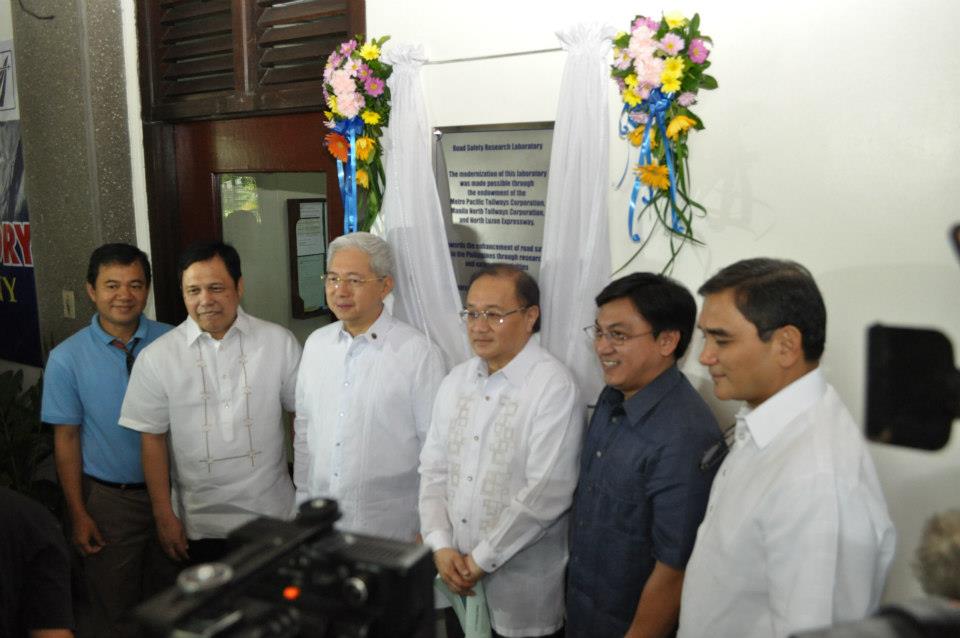 Unveiling of the plaque by (L-R) Dr. Ric Sigua, MNTC President & CEO Rodrigo Franco, UP Pres. Alfredo Pascual, MNTC Chair Manny Pangilinan, Dir. Sean Palmiano, and Metro Pacific President & CEO Ramoncito Fernandez
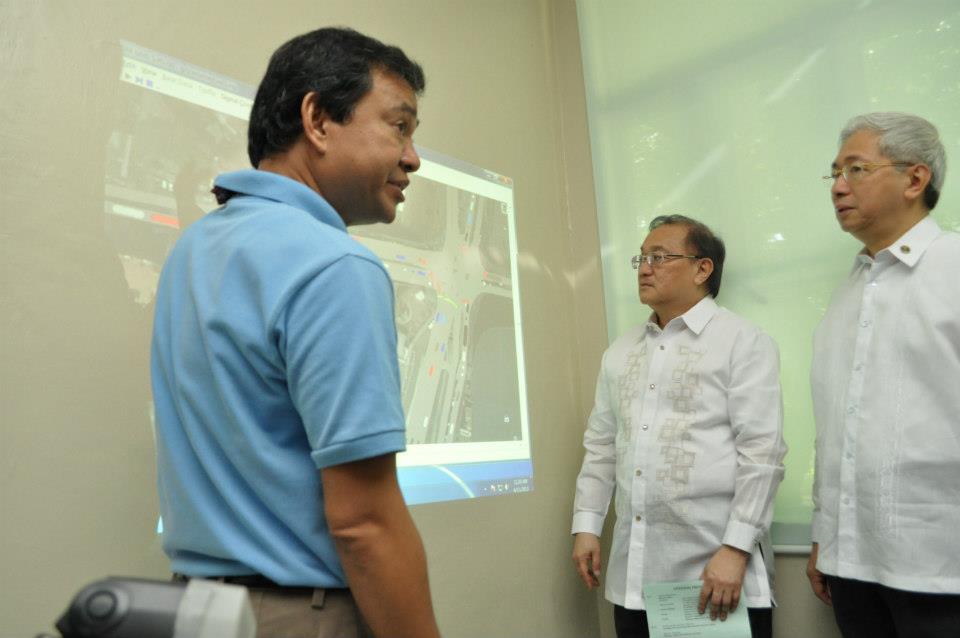 Dr. Sigua demonstrating VISSIM, one of the software donated by MNTC to UP-NCTS
 MNTC Chair MVP making a point about the microsimulation demo as UP Pres. Pascual looks on.
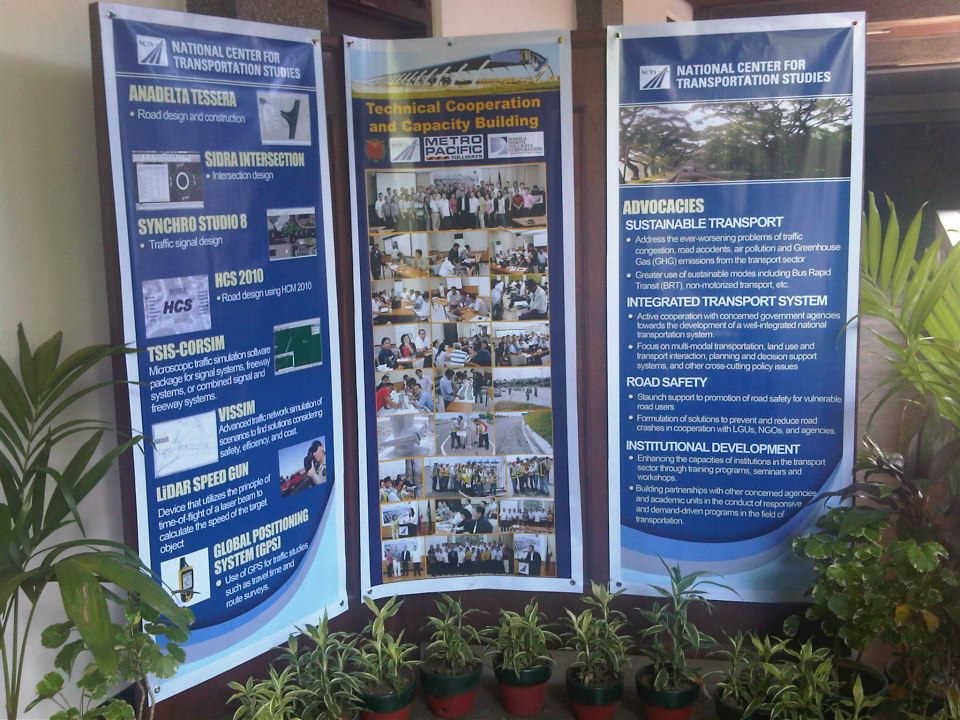 Tarps on display showing a list of donated software and equipment, photos of technical cooperation and capacity building between NCTS and MNTC/MPTC, and the advocacies of NCTS.
The following links are for news items on the turnover:
AKSYON TV ANDAR NG MGA BALITA Road Safety Lab binuksan para sa pagaaral ng kaligtasan sa kalsada
http://article.mediabanc.ws/stream/default.aspx?cc=T0T06d8bb4U%3d&file=k177n0SVBnt2RaICvoFJhiFjxgfZyCtN6NoXOXnMSGyal1UJ64YKNpL2BU77bIOvciz4Fow7jHs%3d&title=t52vKVnKl2UOiPwLKMoBIY7qOmbKBwO1BvxSsh3vvK9bxrfWReUGvonLroiSCcRES9sS3xiZeZJwE1Fge2YBny9SUwnOgsxVTV5 AKSYON Dalawang aksidente kada minuto nangyayari sa buong mundo
ayon sa pag aaral
http://article.mediabanc.ws/stream/default.aspx?cc=T0T06d8bb4U%3d&file=k177n0SVBnsls4maYTmszSUZ5hGB8cannnCtIw38rXSPzVAYSki5Ja9OXLfu2SRW0MoCtizKBHI%3d&title=lpnzG7ZYupO9oIfbLTmmnyPuzDcsckTf7KQri2OPzrjD3PZBucpQvITV0xUGBlObShdIgViH%2fltBVsTf70AwjRR5y3I
+hqdT0uag3PAgkU0%3d
[Note: To view the videos, you must have Microsoft Silverlight installed on your computer.]
–
Buses speeding along Commonwealth Avenue
Traveling along Commonwealth Avenue last Holy Thursday, we couldn’t help but notice the buses racing against each other along the wide highway. One bus speeding along the motorcycle lane almost hit a motorcycle along that lane. Traffic was free flowing and speed limits obviously were not being enforced or followed. Running at 60 kph, our vehicle was always passed by buses and cars alike, their drivers probably enjoying the wide space and the knowledge that there will be few if any traffic enforcers along Commonwealth. We saw a few underneath the Tandang Sora flyover but they were relaxed and seem to turn a blind eye over speeding violations along the highway. The video below was taken last Thursday and showed three buses speeding along Commonwealth, occupying lanes that they are not supposed to be using (Note: Public transport are supposed to run along the two outermost lanes of the highway marked with yellow lines.)
–
Air quality and road safety concerns for public transport
While traveling home one late afternoon, I couldn’t help but take a quick photo of a jeepney in front of me that was belching smoke while also carrying several people as sabit (hangers). Though a bit blurry, the photo still shows clearly the cloud of smoke coming out of jeepney’s tailpipe and the three people hanging behind the vehicle. Not obvious from the photo are the speed and lateral motion of the jeepney as it traversed this section of Marcos Highway.
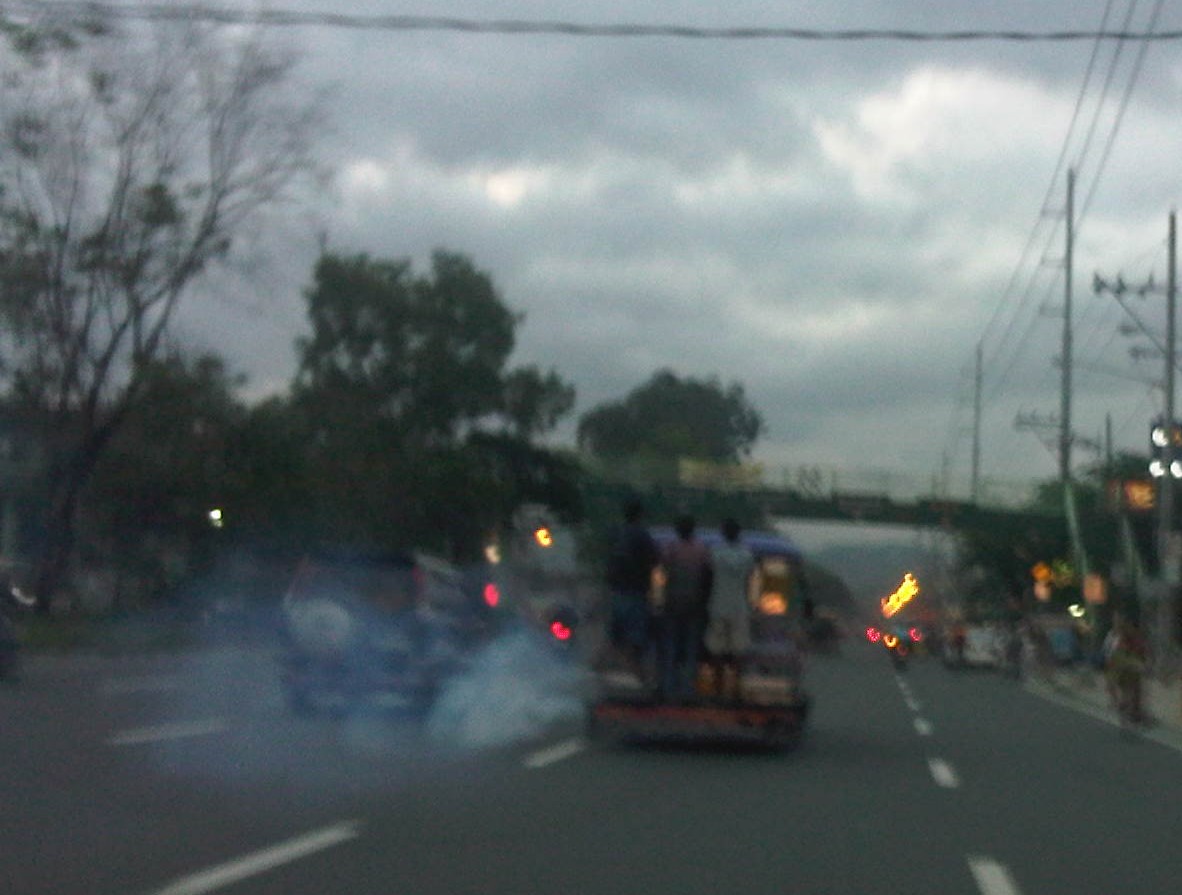
This is a scene we see everyday in our streets despite initiatives or efforts to address problems pertaining to vehicle emissions and safety. The Clean Air Act while enacted more than a decade ago has not been effectively implemented for vehicles. A lot of vehicles are able to register or renew their registrations without really going through a proper emissions test (or smog test for those in the US). “Non-appearance,” the term used for people going through the motions of a test but skipping the measurement itself while getting print-outs stating the vehicle “passed” the test is prevalent throughout the country.
The Land Transportation Office (LTO) has experimented with a lot of schemes to address the problem. These includes the requirement of a photograph showing the actual performance of the emission test on the vehicle. More recent was an initiative where RFID units were supposed to be installed/attached to vehicles and these would be used to ensure that emission tests really were conducted prior to registration. However, with very few Motor Vehicle Inspection Stations (MVIS), the LTO has no choice but to delegate emission testing to private emission testing centers (PETCs). The long standing suspicion, however, is that most of these PETCs collude with vehicle owners and fixers within the LTO to maintain a status quo in “non-appearances” and non-compliance with emission regulations.
Local governments have pitched in with their mobile anti-smoke belching units (ASBUs). In Metro Manila, many cities including Quezon City, Pasig City and Makati City have multiple ASBUs allowing them to set-up several stations along roads in their jurisdictions. These are usually seen along busy roads with policemen assisting them in flagging down vehicles (mostly trucks) observed to be smokebelchers. These vehicles are tested and penalties are imposed on emission regulations violators. The equipment of these ASBUs, however, are only for diesel engines and so are operations of these mobile units are limited in scope from the start. There have also been allegations that some ASBUs have been taking advantage of erring drivers resulting in bribery so as not to be issued violation tickets and penalties.
The bottom line for most cases of emission violations is that most violators are not properly educated about emission regulations including the requirement for them to pass emission tests at any time and not during the registration process only. This is a fact that most drivers or vehicle owners do not understand or choose not to understand, usually because of maintenance cost implications. Nevertheless, we will continue to be in the losing end of the war against air pollution if we cannot properly enforce provisions of the Clean Air Act, particularly for mobile sources that contribute most of the air pollution we experience in this country.
–
Roadside barriers
A few weeks ago, the evening news reported a truck losing control along Marcos Highway and slamming into houses along the roadside. The site of the crash was along the Quezon City-bound stretch of the road between the Marcos Highway Bridge and Bonifacio Avenue in Barangay Barangka, Marikina City. I took a couple of photos of the area when we passed by last weekend from a trip to Antipolo. The first photo shows where the truck went off the road, smashing through the barrier and hitting some houses just beside and below the road. Marcos Highway at this section is elevated because the adjacent land on the north side of the highway is a flood plain. The second photo shows a typical road side section just after the crash site, illustrating the type of barrier used that is supposed to protect residents from wayward vehicles. Clearly, the barriers were not sufficient for the purpose, which brings us to the question of what is appropriate in such cases. Fortunately, no one was killed in the crash.
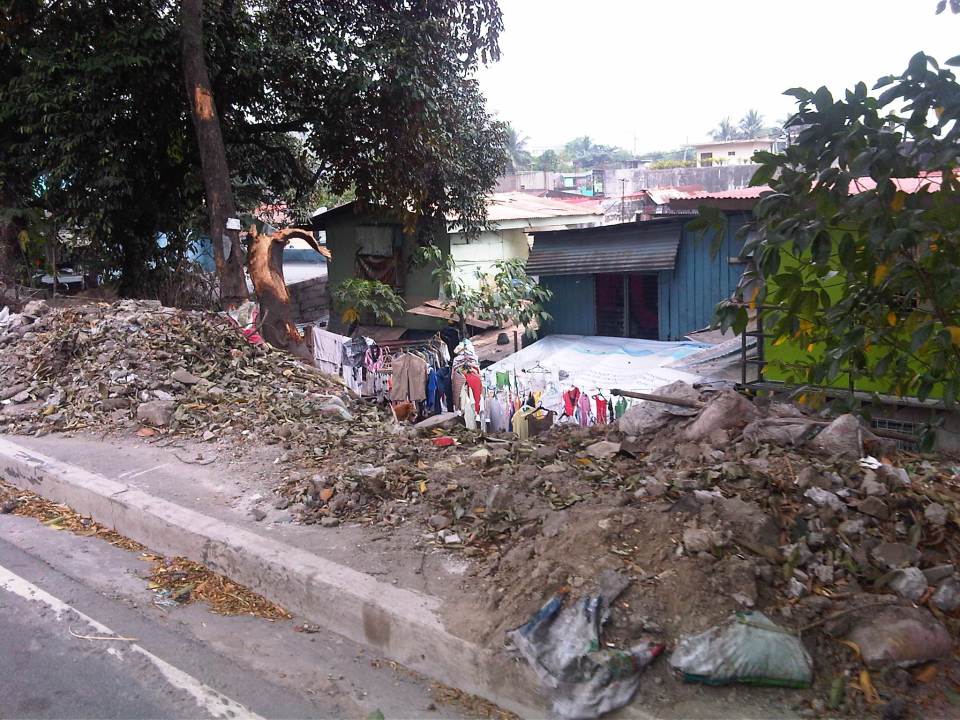 Site where the truck rammed into a barrier and fell off the road into houses in Bgy. Barangka, Marikina City
 Semi-rigid barrier along the Marcos Highway – on the right are houses in Bgy. Barangka, Marikina City
Traffic barriers are used to minimize the severity of potential road crashes that may occur when vehicles leave the traveled way. There are three types of longitudinal barriers: flexible, semi-rigid, and rigid. Flexible barriers are usually of the cable type and depend on their tensile strength to hold off vehicles or pedestrians. Semi-rigid barriers are usually rail and post systems such as the one shown in the previous photos. These combine tensile and flexural strength of the rail and posts to stop vehicles from getting off the road. Rigid barriers are made out of reinforced concrete and are not supposed to deflect on impact. Energy is dissipated by raising the vehicle plus the deformation of the vehicle itself. These are what are usually provided for bridges and overpasses to keep vehicles from going over in cases where there are road crashes or control of the vehicle is lost.

Based on the adjacent land use and the traffic characteristics along Marco Highway along with the incidence of crashes along this section, rigid barriers satisfying Test Level 4 at the very least should be constructed along the roadside. These should be designed to provide adequate protection for people residing along the road given also that vehicle speeds would naturally be reduced by the upward slope of this section. On the side of safety, perhaps Test Level 5 barriers could be provided considering observations of vehicles speeding along this section.
–
Merry Christmas!
Merry Christmas to all!
In this time of celebrations and gatherings among families and friends, may I just remind you – Don’t Drink and Drive! Have a designated driver or take public transportation. Keep our roads safe and make sure there are no tragedies that will make this an unhappy time for you, your kin, your friends and other road users.
–
Let there be light
Driving home after our office’s Christmas Party, I couldn’t help but notice the difference in illuminations between sections of Marcos Highway from Santolan in Pasig City until Masinag in Antipolo City. The stretch from Santolan until Sta. Lucia Mall is relatively dark with the only light coming from vehicles or the establishments along the roadside. The vicinity of the LRT 2 Santolan Station benefits from the lighting of the elevated station, the pedestrian overpass and the medium-rise residential development nearby. It is actually quite dark right after the LRT 2 Station where vehicles stand along the roadside waiting for passengers coming out of the trains terminating at station. Some sections benefit from the presence of 24-hour gas stations and the Robinson’s and Sta. Lucia Malls near the intersection with Imelda Avenue. But for most sections, it is quite dark, which tends to discourage walking and cycling along the highway. The photo below that I quickly took with my phone pretty much describes the lighting conditions along Marcos Highway along a section that’s supposed to be a shared responsibility among the Cities of Pasig and Marikina. There are lamp posts along both sides of the road, courtesy of the rehabilitation works for Marcos Highway that was completed earlier this year. But all seem to be switched off.
 Typical dark section of Marcos Highway from Santolan to Imelda Avenue.
Meanwhile, quite noticeable is the illuminated stretch from Imelda Avenue to Masinag, where Marcos Highway intersects with Sumulong Highway. Lights from the lamp posts along both sides of the highway are all switched on, giving travelers (motorists, pedestrians and cyclists) the benefit of a well-lighted facility through which they could travel safely, at least from the perspective of illumination. One can actually turn off his headlights (though I don’t recommend it) and you won’t really notice the difference because of the lights from the lamp posts. The following photo is another quick shot taken right after the U-turn slot across from the Burger King branch along the highway. The section is within the limits of the Municipality of Cainta and further on, the City of Antipolo, both in Rizal Province and technically outside Metro Manila.
 Typical illuminated section of Marcos Highway
It has already been established that poorly lighted roads lead to road crashes even as it has been established that nighttime crash rates are higher than daytime rates (AASHTO, 2003). There is also evidence that fixed-source lighting can reduce the incidence of crashes particularly along urban streets where there are many intersections and major arterials such as Marcos Highway. In the Philippine setting, illumination also enhances safety and security for pedestrians and cyclists and would definitely encourage the development of a culture of walking. In the case of Marcos Highway, there are already pedestrian and cycling lanes separate from the carriageway. However, these are poorly illuminated along significant sections such as the Santolan to Imelda sections where perhaps people can have the option to walk to and from the LRT station. They are discouraged though because of the risks associated with dark places and so end up waiting for a jeepney ride instead of walking what is actually an acceptable (walkable) distance. Perhaps Pasig and Marikina, two cities currently advocating walking and cycling, should look into this issue in coordination with the DPWH, which has jurisdiction over the national highway. If Rizal’s Antipolo and Cainta can do it, I don’t see why Marikina and Pasig can’t.
–
On pedestrian overpasses again
Pedestrian overpasses in Metro Manila are of various designs. The older ones are mostly concrete structures that were not designed to consider the needs of senior citizens or persons with disabilities (PWDs). Often the stairs are relatively steep and each step can be quite high. More recent ones, particularly those constructed by the MMDA in the last administration were steel structures. The first generation where constructed similarly as their concrete versions, with little consideration to the elderly and the physically-challenged. Many of these overpasses even got flak from women’s groups as the steps featured slits through which women can be taken advantage of by peeping toms. And so some of the “offending” overpasses had their stairs retrofitted to provide some cover for people using these facilities.
A good feature of more recent overpasses constructed has been ramps that allow easier access by persons with disabilities and cyclists. Most new overpasses in Metro Manila also have less steeper stairs and others even have landings to allow people to have some pause while climbing up or down the overpass. Following are a few photos of overpasses along Marcos Highway including one connecting a major shopping mall to the LRT Line 2 Santolan Station.
 Overpass along Marcos Highway in Pasig City featuring a ramp that can also be used by cyclists and persons with disabilities.
 “Conventional” overpass along Marcos Highway – there are no ramps but the stairs are not as steep as the older ones.
 Overpass connecting a major shopping mall to the LRT Line 2 Santolan Station
While such overpasses are necessary along wide roads with heavy motor vehicle traffic, similar facilities are not usually recommended for narrower streets where motorized traffic is manageable. There are discussions now that call for pedestrians to have the right of way along streets. Such discussions have basis given pedestrians attempting to cross at designated areas (definitely not the jaywalkers) have difficulty crossing as motor vehicles disregard them, with some seemingly attempting to sideswipe people (nananadya?). The rule should be that once a pedestrian steps on the pavement at a zebra crossing or crosswalk, vehicles should give way to them. Many drivers and riders are oblivious to this rule and it is not enforced by the MMDA or police. They should, in order to effect behavior change in motorists and to ensure the safety of pedestrians.
–
Mobility for all?
We chanced upon the fellow shown driving an electric vehicle below with what was apparently his wheelchair mounted behind the vehicle. And then I remembered seeing other people in wheelchairs traveling along the traffic lanes of similar streets, and exposed to the high risks of being sideswiped or bumped by motor vehicles. These and other persons with disabilities (PWDs) are among what we usually categorize as transportation poor or those who are marginalized when traveling. Marginalization comes in many forms including the lack of or inadequate infrastructure and facilities for PWDs. Sidewalks are usually narrow, making it difficult even for able people to use, and definitely inaccessible to persons needing the space to move about.

I remember that Tahanang Walang Hagdanan (translated Home without stairs or steps) is located in Cainta, Rizal. We used to see PWDs on their wheelchairs traveling along Bonifacio Avenue in the poblacion to go to church on Sundays. Often, jeepneys, buses and cars come very close to them that you might wince at the near misses of what could easily be a tragedy just waiting to happen given the odd mix of people on wheelchairs mixed with motorized traffic along the carriageway. The local government should have exerted more efforts to put up facilities adequate for the needs of pedestrians in general and PWDs in particular; the latter considering the significant number of constituents requiring such facilities. On a map, you can even see that Tahanang Walang Hagdanan is just beside the Cainta Local Government Complex. I believe the provision of basic facilities to enhance the safety and mobility of PWDs is just one example of what a city or town should be doing towards realizing inclusive transport or inclusive mobility at their level. It would definitely go far in promoting people friendly, sustainable transport for all.
–
 Caught (up) in traffic