
Home » Road Safety (Page 7)
Category Archives: Road Safety
29th Annual Conference of the TSSP
The Transportation Science Society of the Philippines (TSSP) held its 29th Annual Conference today, December 7, 2023. Following is the program for the conference, which featured a panel discussion in the morning and technical sessions in the afternoon.
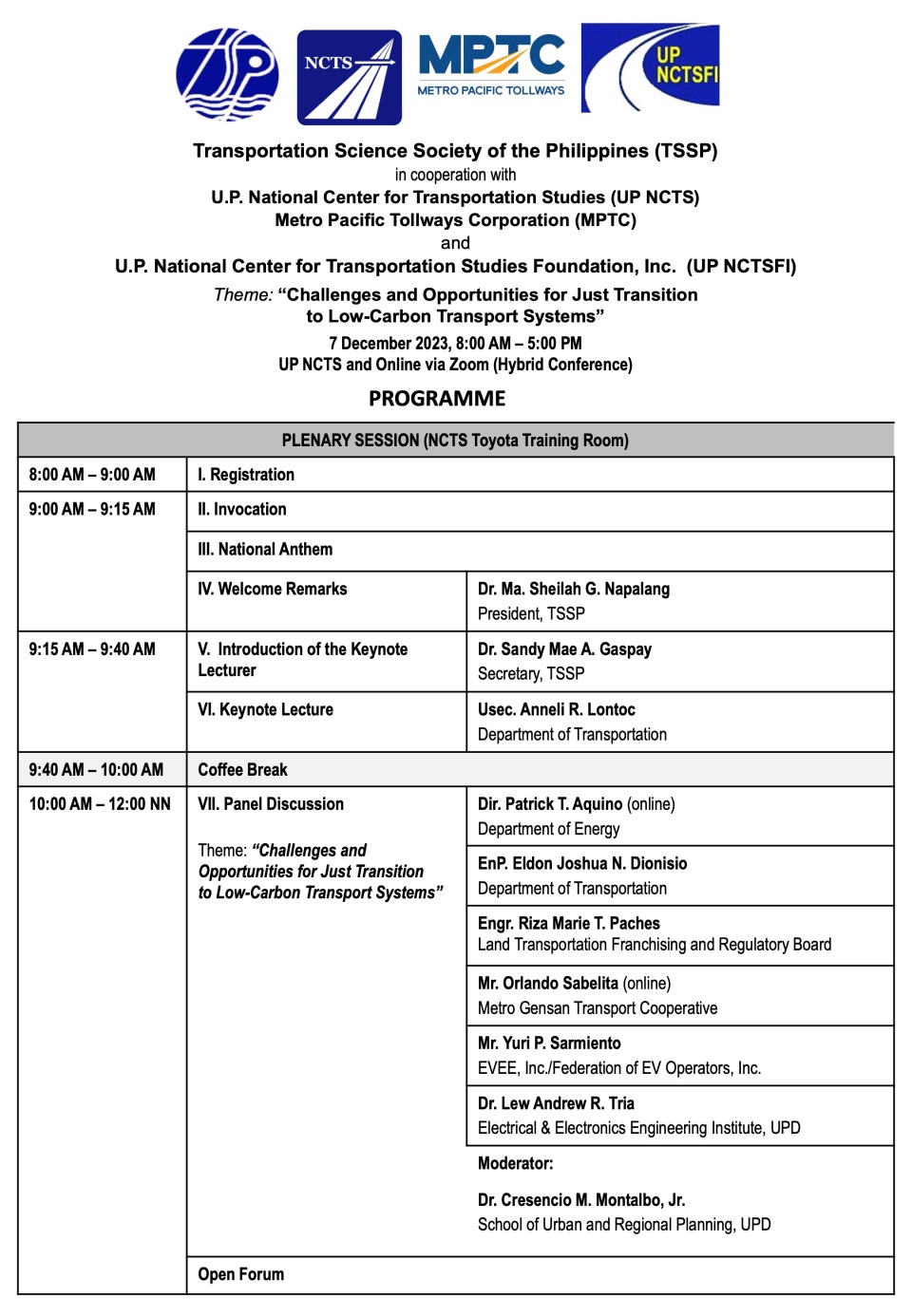
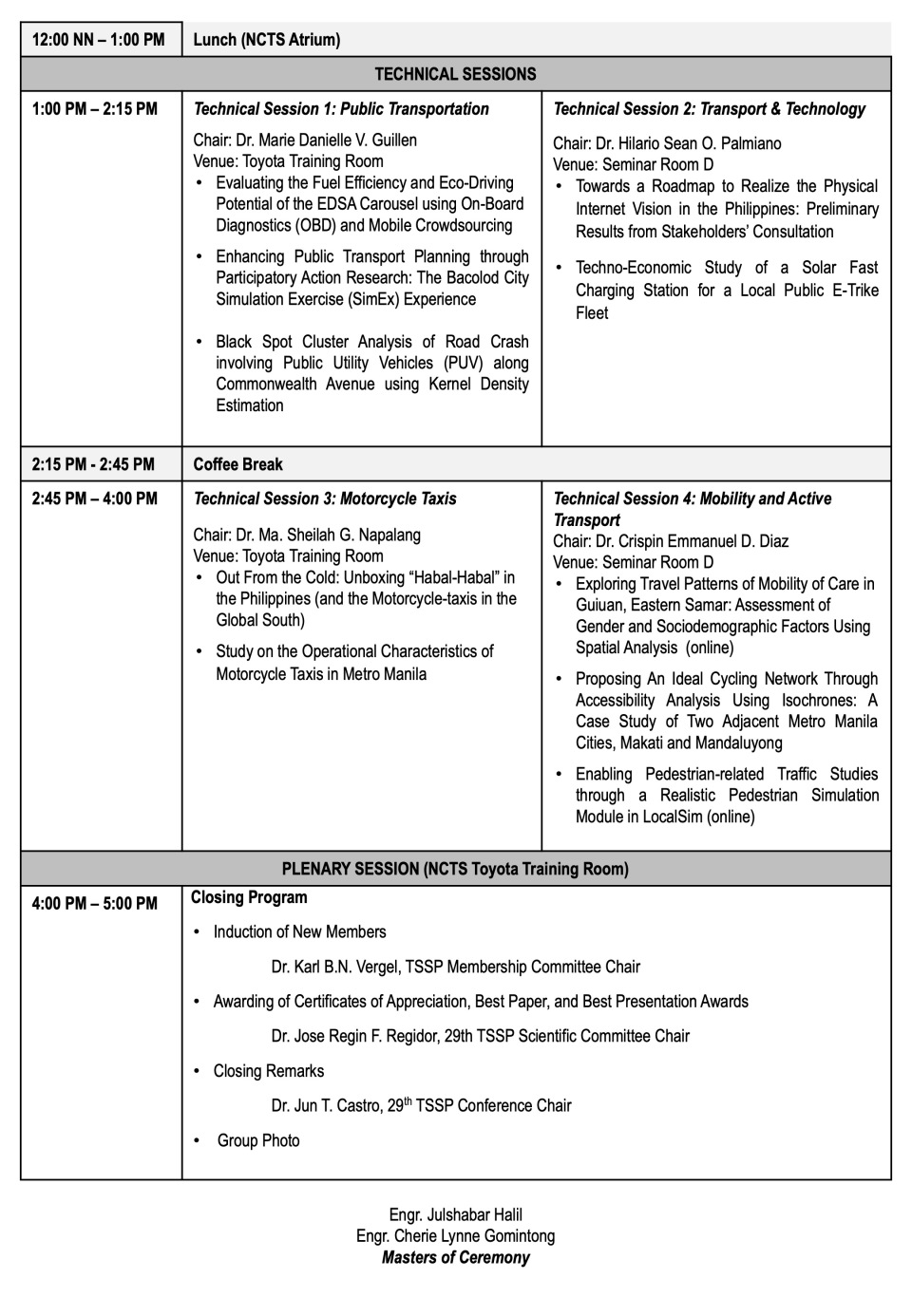
This was the first mainly face-to-face or in-person conference for the society since 2019. Previously, the conferences were online. As reported in the concluding part of the program, there were 84 participants who showed up at the venue while there were 30+ participants who were online via Zoom.
There were a couple of awards at the conference. These were the Best Paper Award and the Best Presentation Award. The Best Paper Award, based on the scores garnered from the blind review of the papers went to:
Maria Belen Vasquez and Jun T. Castro of UP Diliman for their paper entitled “Exploring Travel Patterns of Mobility of Care in Guiuan, Eastern Samar: Assessment of Gender and Sociodemographic Factors Using Spatial Analysis”
There was a tie for the Best Presentation Award. The two were Ms. Vasquez for the presentation of the paper on the Mobility of Care in Eastern Samar, and Mr. Erris Sancianco for the presentation of a paper he co-authored with Noriel Christopher Tiglao, Niki Jon Tolentino, Gillian Kate Hidalgo, Mary Joy Leanda, and Lester Jay Ollero entitled “Evaluating the Fuel Efficiency and Eco-Driving Potential of the EDSA Carousel using On-Board Diagnostics (OBD) and Mobile Crowdsourcing“. These papers will likely find their way to the Philippine Transportation Journal’s next issue.
Though it was not announced, a likely venue for the next conference will be Vigan, Ilocos Sur in the Northern Philippines. The likely host will be the University of Northern Philippines, the premier state university in that province. Previously and most recently, the conference was held in Cebu City (hosted by the University of San Jose-Recoletos) in 2019 and before that in Cagayan De Oro City (hosted by Xavier University) in 2018. TSSP was already organizing the 2020 conference when the pandemic struck and the country went on a lockdown. That conference was supposed to have been held in Baguio City in Benguet, and to be hosted by St. Louis University.
More information on the conference may soon be found at the TSSP’s official website: https://ncts.upd.edu.ph/tssp/
–
On making intersections safe by ‘daylighting’
I came across this interesting article that introduced a somewhat new term to me – daylighting.
Abramson, B. (November 24, 2023) “How to Daylight Your City’s Intersections (and Why It Matters),” Strong Towns, https://www.strongtowns.org/journal/2023/11/24/how-to-daylight-your-citys-intersections-and-why-it-matters [Last accessed: 12/3/2023]
From the article:
“Daylighting is the technical term for a common-sense solution to traffic safety: By removing visual obstructions in approaching intersections, users can better see and more safely cross each other’s paths. “
There are certainly many intersections and even mid-block crossings in our cities and municipalities that could use ‘daylighting’ to improve safety. Many of these intersections and crossings are used by the most vulnerable road users like children, senior citizens and persons with disabilities. Interventions need not be expensive and may also involve the community. Examples are shown in the article, and these can easily be implemented formally or informally with the cooperation of stakeholders including the local government units and national agencies (i.e., DPWH) under whose jurisdiction many roads are.
–
Incorporating bike lanes along local roads – an example in Taguig City
I have not used an old route that we usually take to go to BGC from our place in Antipolo. This is via the Manila East Road, Highway 2000, Barkadahan Bridge and C6. From C6, we usually take Ruhale instead of Seagull Avenue as the former provided a shorter route towards Levi Mariano Avenue and C5. So it was only last weekend that I was able to see the improvements along Ruhale Street and how bike lanes were incorporated along this road. I am sharing the following photos showing a two lane road and Class 2 bike lanes.
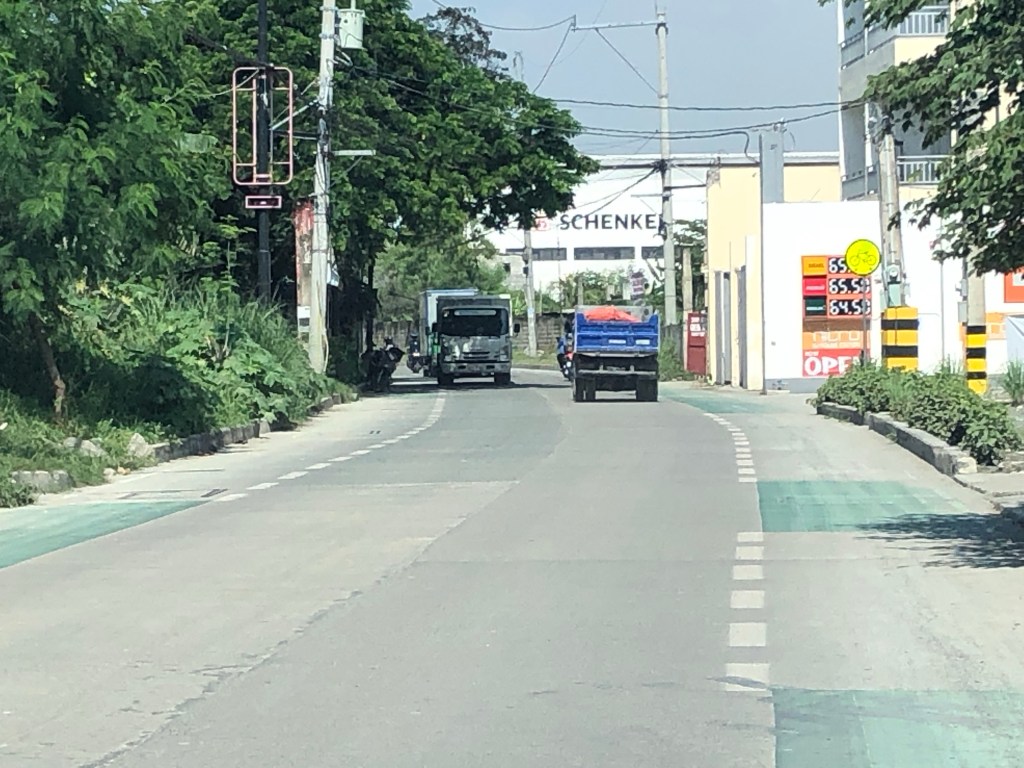 The green pavement markings indicate an intersection or driveway.
 Noticeable are the electric posts that remain along the bike lanes. These need to be transferred so they will not pose danger to all road users.
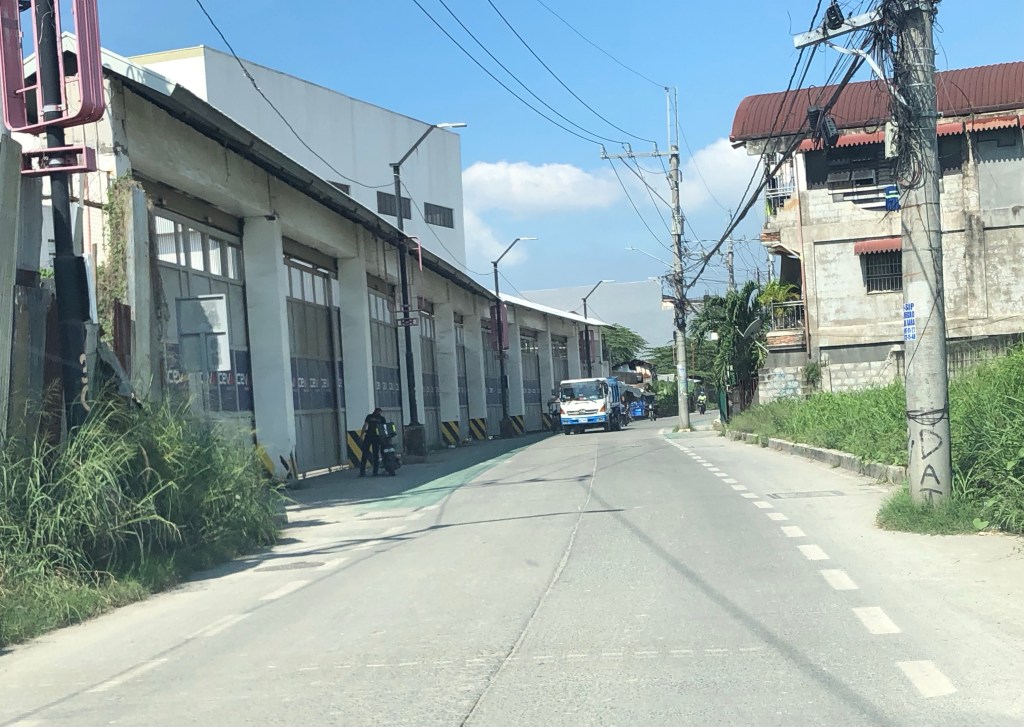 More electric posts along the bike lanes
 Bike lanes in front of an industrial establishment
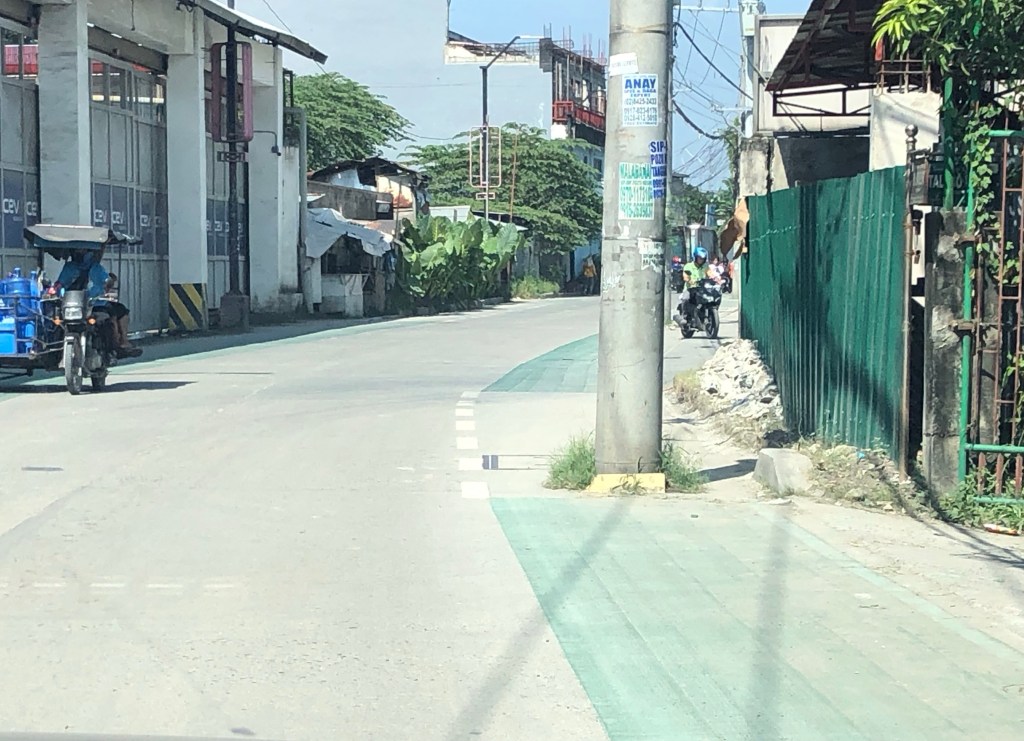 Close-up of a post in the middle of the bike lane.
 Bike lane across another industrial establishment. Again, note the green pavement marking across the driveway of the establishment.
 Bike lanes along a predominantly residential area along Ruhale.
I would consider this as a good practice example that can be replicated elsewhere. Of course, it is not perfect and as shown in the photos, there is much room for improvement including the transfer of electric posts that pose as hazards to all road users. The bike lanes are wide enough that installing bollards for the perception of physical protection vs. motor vehicles can be considered. Ruhale is generally a low speed, low volume road so perhaps the current state with no barriers would be enough for now. Also, we need to appreciate that these are already gains or wins in as far as active transport is concerned. A few years ago, this would not have been implemented by national or local governments.
–
A real battle of Katipunan – the search for a transportation solution
Is it obvious that I was alluding to the classic match-ups of the two major universities – Ateneo De Manila University and the University of the Philippines Diliman – that are located along Katipunan Avenue for the title of this article? That is deliberate on my part as there is a ‘real’ battle along Katipunan Avenue, and it does not involve sports.
Following is a recent article from the Philippine Collegian that reports on the current state of traffic along the corridor:
https://phkule.org/article/971/private-cars-mainly-to-blame-for-katipunan-traffic-transport-experts
I have written before and many times about transport and traffic along Katipunan Avenue. This road has been part of my daily commute since 1988 when I was admitted to UP Diliman as a B.S. Civil Engineering major. Back then Katipunan was not as wide as it is now, especially along the section between UP Diliman and the MWSS complex. That section only had 2 lanes then. What is not a wide center island with large, old acacia trees used to be the frontage of MWSS. So now you can probably imagine how much land was ceded by MWSS for road widening.
I also wanted to write about Katipunan in part as a sort of farewell to the former MMDA Chair and Marikina Mayor Bayani Fernando (BF), who recently passed away. Much of how Katipunan looks like and the traffic situation today can be traced to what transpired during his time at MMDA. I will refrain from writing about this and him for now. I am actually thinking of writing a series about BF and his time as Mayor in Marikina, as MMDA Chair, and his brief stint as DPWH Secretary. This short article will do for now.
Changing for the rains
A common seen these days of the wet season are motorcycle riders stopping to take out their rain gear to wear so they can continue with their travels. I’m not surprised that many if not most already have their rain gear ready if it rained and they needed to use them. Oftentimes, the location would be under any shade or shelter including underneath footbridges, waiting sheds or trees. If there were nowhere to seek shelter, they change right in the open. Following is an example where riders stopped at a parking area of a residential development to don their raincoats and jackets.
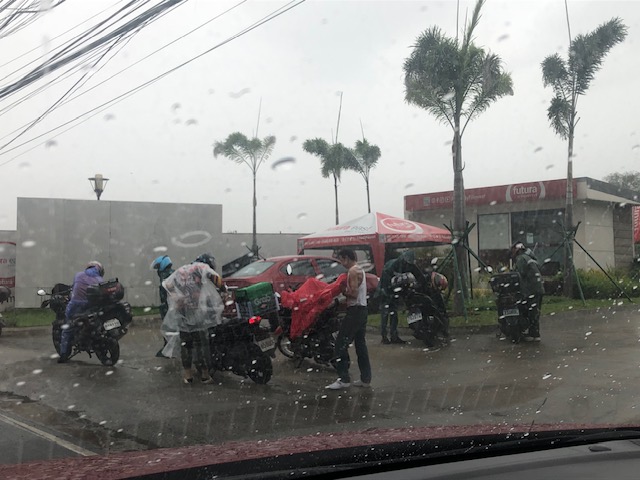
In the above example, riders do not impede traffic flow as they change off-street. In other cases though where they congregate under footbridges, they tend to block traffic and cause congestion where there was none. Perhaps there can be more areas or designated locations for changing to rain gear?
–
On sleepy drivers
I am sharing this article on sleep-deprived driving as there appears to be low awareness of the dangers of this behavior as opposed to the typical drunk driving or driving under the influence (DUI) cases that we often hear or read about in the news (mainstream or social media).
Britt, R.B. (April 18, 2023) “Sleep-Deprived Drivers Might as Well be Drunk,” Medium.com, https://robertroybritt.medium.com/sleep-deprived-drivers-might-as-well-be-drunk-887aab48c1c [Last accessed: 4/21/2023]
To quote from the article:
“A 2016 study by AAA linked lack of sleep in the past 24 hours to dramatically higher crash risk, in hour-by-hour increments:
6–7 hours sleep: 1.3 times the risk
5–6 hours: 1.9 times the risk
4–5 hours: 4.3 times the risk
<4 hours: 11.5 times the risk
The risk of a crash drops to zero if you simply stay off the road, of course. Otherwise, the bottom line is pretty clear:
“You cannot miss sleep and still expect to be able to safely function behind the wheel,” said David Yang, executive director for the AAA Foundation for Traffic Safety.”
So make sure you get your sleep because it is really important for you to function not just as a driver or rider. It also applies to other activities or tasks as well whether you’re working, studying or playing.
–
Child’s perspective of road safety
As adults, many of us seem to have forgotten how it was to be a child and to see things from a child’s perspective. This perspective is important in many cases, situations or scenarios. One area where we can use this perspective to improve how things are is in road safety. As they say, streets that are safe for children are safe for everyone else. I am sharing this guide that also includes a project involving coming up with a reverse periscope. The reverse periscope is intended for an adult to have the view of a child.
How Do Kids Experience Streets? The Reverse Periscope Companion Guide
This guide would be something that can be used in road safety seminars or workshops that include some field activities. Participants can use the reverse periscope to simulate being a child as they walk and cross streets. An activity can be designed for transport and highway officials, even local government staff involved in planning, design and assessment of streets.
–
Article share: Redesigning Streets for Livability: A Global View
I am sharing this article on redesigning streets. It is actually a promotion for a book: “Streets For All: 50 Strategies for Shaping Resilient Cities”.
To quote from the article:
“Streets For All: 50 Strategies for Shaping Resilient Cities is an expansive 270-page volume that explores the evolving potential of the most ubiquitous public space in our cities. It offers ideas, tactics and strategies from across the world on how our streets are being, and, can be rethought, recast, repurposed and redesigned towards greater resilience and resourcefulness. The globally diverse opinions and case studies in this book remind us why cities with limited means can offer profound lessons to affluent societies that take their prosperity for granted. And in turn, how the virtues of effective urban administration and reinforcement seen in developed societies could reassuringly serve to inspire less economically developed ones.”
On getting started on bike commuting
Here is another article on bike commuting. It really is a challenge to get people into bike commuting even if their workplaces or schools are close to their homes. What more for people who have to travel longer distances between their homes and workplaces or schools?
Bassett, E. (December 1, 2022) “The No B.S. Guide to Getting Started Bike Commuting,” Medium, https://erikbassett.medium.com/the-no-b-s-guide-to-getting-started-bike-commuting-5dd0cbb87e5b [Last accessed:
To quote from the article:
“Assume you’re invisible until proven otherwise.
Like every city I’ve lived or ridden in, yours probably paints pictures on the ground and calls them “bicycle infrastructure.” Road designs encourage excess speed; vehicles aren’t meaningfully separated from cyclists and pedestrians; there are conflicting rights-of-way at intersections, driveways, and so forth.
And that is not right. It’s a sad commentary on urban “planning” in most places that anything but car use requires this degree of paranoia. It points to a profound dysfunction that few (with any serious influence) are willing or even interested to change…yet.
But unless or until it improves, the only viable response is to assume you don’t exist in the eyes of whoever’s driving nearby. “If I weren’t here, would they gun it to make a right turn on red?” Well, assume they will. “If I weren’t here, would they merge up there?” You guessed it: assume they will.
This is unquestionably the worst aspect of bike commuting, and if it’s too stressful in your situation, that’s perfectly fine. But in the spirit of a “no-B.S.” guide, I’d be remiss not to drive home a life-saving lesson that all these years of cycling have so deeply ingrained in me.”
The author also states the difference between bike commuting and sports biking including noting the differences in the objectives or goals for each.
–
Why do we keep widening roads?
I’m just going to share this article here. The article from The NY Times asks a question that has been bugging planners and engineers, particularly those who are in government and perhaps under the agencies like the DPWH, DOTr and NEDA. This also applies to planners, engineers and those from other disciplines involved in transportation infrastructure development and particularly roads or highways.
–
 Caught (up) in traffic