
Home » Traffic Congestion (Page 7)
Category Archives: Traffic Congestion
On floods, transport and traffic, again
It’s that time of year again when the heavy rains lead to flash floods along many roads. I took the following photo as we slowly progressed towards Cainta Junction early this week. The Felix Avenue approach was flooded after more than an hour of heavy rains fell upon Cainta and neighboring towns. We learned later that the rains fell on a larger area as EDSA and other major road in Metro Manila also experience flash floods. These cause traffic to slow down if not outright stoppage. Many commuters can get stranded when PUVs are not able to run due to the floods. Deeper waters mean light vehicles including motorcycles and bicycles cannot proceed along certain roads, further exacerbating the traffic situation.
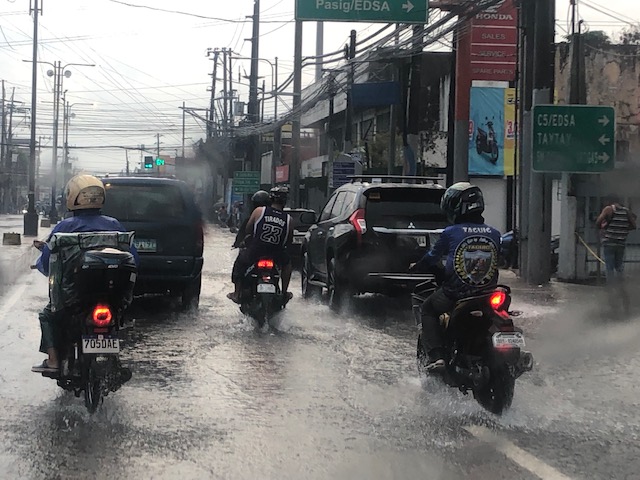 Motorcyclists emerge from their shelters to travel along flooded roads. A common sight when there are downpours are motorcyclists huddling under overpasses, bridges, or whatever shelter may be available to them. Many bring rain gear but opt to just stop and wait it out until the rain stops.
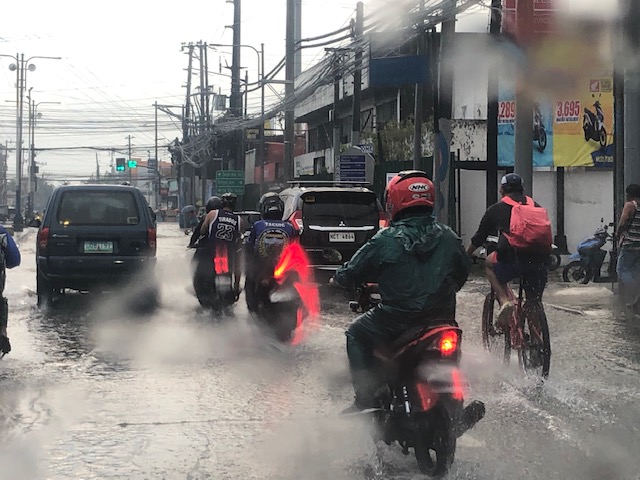 A cyclist braves the floods – while pedestrians will likely stop and wait it out for the rains to stop or for the floods to subside, cyclist might just pedal on. They just have to be more careful as potholes and other dangers may be hidden by the floodwaters.
 Cainta Junction has been submerged by so many floods over so many years. Even with the new drainage constructed under and along Ortigas Avenue Extension, Felix Avenue and Bonifacio Avenue, it seems their capacities are not enough to handle the rainwaters. That or perhaps their intakes need to be redesigned to more efficiently take on the heavy rains and the resulting runoff.
–
Suffering and salvation for transport and traffic
I shared the following photo on social media with the label “Kalbaryo at Kaligtasan”:
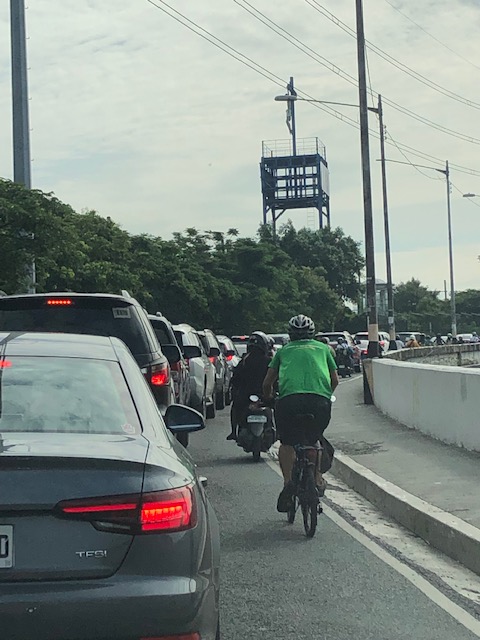 Cyclist pedaling ahead of cars queueing along the C5 ramp towards BGC
The label or title has double meaning. Conspicuous in the photo is the image of the Crucifixion atop what is a small shrine along Circumferential Road 5 across and facing SM Aura. The image appears to be a reminder or symbol of suffering but with the superimposed image of traffic congestion, alludes to the suffering endured by motorists on a daily basis. The “kaligtasan” or salvation part of the photo is in the form of the cyclist or the bicycle (I really have to explain that, right?) that offers an alternative or even hope for those who seek it. One thing the pandemic has taught us is that active transport in the form of walking or cycling is part of the solution to the transport problems we are experiencing. Public transport, of course, is touted as an ultimate solution but the reforms and infrastructure required are and will take time to implement, and these are already encountering problems leading to further delays or ineffectiveness.
–
On phasing out cars in cities
I’m sharing another article on reducing car dependence. The article was referred to by the previous series that I shared recently.
Nicholas, K. (April 14, 2022) “12 best ways to get cars out of cities – ranked by new research,” The Conversation, https://theconversation.com/12-best-ways-to-get-cars-out-of-cities-ranked-by-new-research-180642 [Last accessed: 5/20/2022]
Here are a few excerpts from the article:
“Question: what do the following statistics have in common?
The second-largest (and growing) source of climate pollution in Europe.
The leading killer of children in both the US and Europe.
A principal cause of stress-inducing noise pollution and life-shortening air pollution in European cities.
A leading driver of the widening gap between rich and poor urban residents.Answer: the vehicles on our streets, primarily the not-so-humble passenger car.”
also this:
“The research is clear: to improve health outcomes, meet climate targets and create more liveable cities, reducing car use should be an urgent priority.”
and this:
“To meet the planet’s health and climate goals, city governments need to make the necessary transitions for sustainable mobility by, first, avoiding the need for mobility (see Paris’s 15-minute city); second, shifting remaining mobility needs from cars to active and public transport wherever possible; and finally, improving the cars that remain to be zero-emission.”
You can also listen instead of reading it as it is a narrated article.
–
Articles on examining the role of the planning profession in both perpetuating and solving traffic congestion
Planetizen recently published a three-part series of articles examining the role of the planning profession in both perpetuating and solving traffic congestion:
Part 1: Brasuell, J. (April 13, 2022) “Planning and the Complicated Causes and Effects of Congestion,” Planetizen, https://www.planetizen.com/features/116834-planning-and-complicated-causes-and-effects-congestion [Last accessed: 5/17/2022]
Part 2: Brasuell, J. (April 20, 2022) “How Planning Fails to Solve Congestion,” Planetizen, https://www.planetizen.com/features/116914-how-planning-fails-solve-congestion%5BLast accessed: 5/17/2022]
Part 3: Brasuell, J. (May 12, 2022) “Planning for Congestion Relief,” Planetizen, https://www.planetizen.com/features/117153-planning-congestion-relief?utm_source=newswire&utm_medium=email&utm_campaign=news-05162022&mc_cid=34b0612d40&mc_eid=9ccfe464b1 [Last accessed: 5/17/2022]
I think these articles are a must read especially for students (and not just practitioners or professionals) and is sort of a crash course on transportation engineering and planning. It covers many concepts and learnings from so many decades and touches on certain programs that are most effective in reducing car trips. To quote from the article, the top 12 programs based on case studies in Europe are:
- Congestion Pricing (12-33% reduction in city-center cars)
- Parking and Traffic Controls (11-19% reduction in city-center cars)
- Limited Traffic Zones (10-20% reduction in city-center cars)
- Workplace Mobility Services (37% drop in car commuters)
- Workplace Parking Charges (8-25% reduction in car commuters)
- Workplace Travel Planning (3-18% drop in car use by commuters)
- University Travel Planning (7-27% reduction in car use by university commuters)
- University Mobility Services (24% drop in students commuting by car)
- Car Sharing (12-15 private cars replaced by each shared car)
- School Travel Planning (5-11% reduction in car use for school trips)
- Personalized Travel Planning (6-12% drop in car use share among residents)
- App-Based Incentives (73% – proportion of app users declaring reduced car use)
Are we ready to confront congestion and at the least start discussing these car trip reduction programs? Or are we content with the current discourse, which remains car-centric?
–
On the number coding options for Metro Manila ca. 2022
The Metropolitan Manila Development Authority (MMDA) recently announced that the agency was studying options for a new number coding scheme under its Unified Vehicular Volume Reduction Program (UVVRP). UVVRP is basically a travel demand management (TDM) program focused on vehicle use restraint. In this case, private vehicles, particularly cars, are the target of volume reduction. Here’s a graphic from their Facebook page:

The schemes are not really new as these were also considered before. Are the conditions new at all? Are we assuming things changed due to the pandemic? Or will there just be a return to the old normal in terms of traffic congestion? Here are some past writings on the topic including a 3-part series I wrote back in May 2011:
- From Odd-Even to UVVRP…and back
- Traffic congestion in Metro Manila: Is the UVVRP Still Effective? – Part 1
- Traffic congestion in Metro Manila: Is the UVVRP Still Effective? – Part 2
- Traffic congestion in Metro Manila: Is the UVVRP Still Effective? – Conclusion
I think many of the arguments I made in those more than decade old articles hold or apply to the present. Even with the increasing popularity of active transport in the form of bicycle facilities appear to have not made a dent to the transport problems in the metropolis. Many questions abound and I have seen and read comments pointing to the many transport infrastructure projects currently ongoing around Metro Manila as proof that transport and traffic will be improving soon. Transportation in general may indeed improve once the likes of the Metro Manila Subway, Line 7, Line 1 Extension, and the PNR upgrades come online (i.e., all operational) but we have yet to see their impacts outside the models created to determine their potential benefits. Will they be game changers? We do hope so. Will UVVRP be needed in the future when these mass transit lines (including others in the pipeline) are all operational? Perhaps, but a scaled down version of this TDM scheme might still be needed and may suffice if people do shift from their private vehicles to public transportation. The fear is that most people eventually taking the trains would be those who are already commuting using road-based public transport like buses, jeepneys and vans. If so, the mode share of private transport will not be reduced and those traffic jams will remain or even worsen. Maybe we should be discussing road pricing now?
–
Cities and Automobile Dependence: What Have We Learned?
We end the year with an article from Todd Litman via Planetizen. The topic is something that we really need to ponder on as we or if we are to move towards more sustainable transportation for our cities and municipalities. The experiences during this Covid-19 pandemic should have provided us glimpses of how it could be if we put active and public transport above automobile dependence or car-centricity.
Source: Cities and Automobile Dependence: What Have We Learned?
The main article may be found here (in proper citation for academic/researchers reading this):
–
Back to the old normal?
As traffic continues to worsen after, The MMDA has reinstated the number coding scheme albeit from 5:00 to 8:00 PM on weekdays for now. This is in recognition of the worsening traffic congestion brought about by people returning to their workplaces and the easing of travel restrictions across the entire population. People are now moving about as can be seen in transport terminals and commercial areas (e.g., shopping malls, markets, etc.). With the return of severe traffic congestion, it begs the question whether we are back to the ‘old normal’.
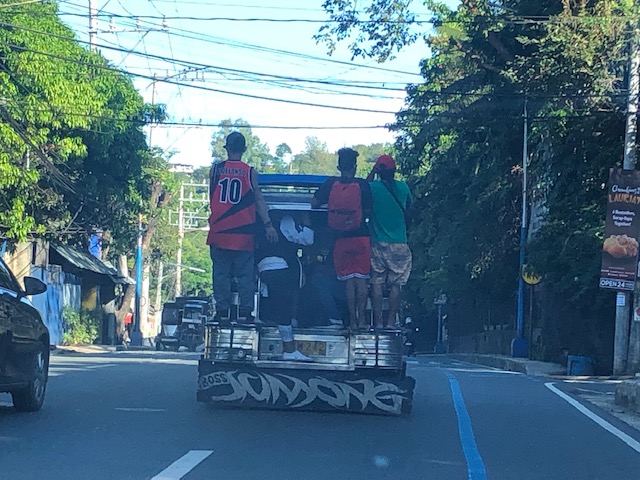
I thought the photo above pretty much describes how it was before Covid-19. The problem is that this photo was taken earlier today and we are still technically in a pandemic. Does the photo show the people’s renewed confidence in using public transportation? Or is it a matter of necessity (i.e., commuters having no choice but to risk it in order to get to their workplaces or home)? If they had motorcycles, these people would likely use them instead of taking the jeepney. I will also dare ask why don’t they bike instead? They seem able bodied enough to try cycling instead. Is it because their commuting distances are long? Or are there other reasons that evade us? If these are the same reasons and Covid-19 is not a major factor for their choice, then perhaps we are back to the ‘old normal’ and have not progressed significantly despite claims by various groups that we are experiencing a paradigm shift in favor of active transport. All the more that we need to urgently revisit and reassess how transport should be in order for us to transition to a more sustainable future.
–
On roadway expansions and induced demand
We start December with another shared article. Here is another excellent article from Todd Litman about roadway expansions and induced demand:
Litman, T. (November 28, 2021) “The Roadway Expansion Paradox,” Planetizen.com, https://www.planetizen.com/blogs/115395-roadway-expansion-paradox?utm_source=newswire&utm_medium=email&utm_campaign=news-12022021&mc_cid=89cc0b2638&mc_eid=9ccfe464b1 [Last accessed: 12/3/2021]
Note the list of references at the end of the article for further reading.
–
On ‘electric cars’ still being ‘cars’
With the current climate talks in the background, there is also a parallel discussion on the impacts of electric vehicles and self-driving cars. Will they help solve our transport or traffic problems? Perhaps e-cars will contribute to the reduction of emissions and greenhouse gases. Perhaps they can also help in reducing dependence on fossil fuels. But can they alleviate congestion? Or will they just promote more car-dependence? Here’s a nice article from early this year that discusses the “big problem” with electric cars:
I also read another article about the issues concerning the batteries (e.g., lithium batteries) used by these e-vehicles. We are only beginning to see how difficult it is to deal with the waste of used batteries not just from e-vehicles but from other sources as well. Renewables like solar, for example, requires batteries for storage. These are issues that need to be addressed ASAP. Otherwise, it will be a losing proposition for people in general as they end up with modes of transport that are not sustainable for the future. Perhaps we can just walk or bike?
–
On housing and transportation
I’ve written about how we should not be trying to isolate transportation as if it is singly at fault for the transport and traffic mess many of us are in at present. There are many factors affecting travel behavior including mode choice. Travel distances, travel times and mode choices are not a consequence of transportation system (including infrastructure) alone. Land development and pricing especially those pertaining to housing are critical in how people decide where to live. These are intertwined with transportation and can be quite complex without the proper data or information to help us understand the relationship. That understanding, we are to assume, should lead us to the formulation of policies intended to correct unwanted trends and perhaps encourage more compact developments that are closer to desirable concepts such as the 15-minute city.
Here is an interesting article to enrich the discussion on this topic:
Dion, R. (October 28, 2021) “Coupling Housing and Mobility: A Radical Rethink for Freeways,” Planetizen.com, https://www.planetizen.com/features/115126-coupling-housing-and-mobility-radical-rethink-freeways?utm_source=newswire&utm_medium=email&utm_campaign=news-11012021&mc_cid=85ec2b565f&mc_eid=9ccfe464b1%5BLast accessed: 11/3/2021]
The first thing that came to my mind are residents of northern and southern Metro Manila and the surrounding provinces. Many chose to buy houses there and beyond (i.e., Bulacan, Laguna and Cavite) and yet work or study in Metro Manila CBDs like Makati, Ortigas and BGC. And they do use the tollways (e.g., NLEX, SLEX, CaviTEX, Skyway) to get to their workplaces and schools.
This is also a relevant and timely topic in the Philippines as many cities are already headed for sprawls that will inevitably put more pressure on transportation infrastructure development that usually leans towards car-oriented projects (e.g., road widening, new roads, flyovers, etc.) rather than people-oriented ones (e.g., modern public transportation systems, bikeways, pedestrian infrastructure). Note that only Tokyo has developed an extensive enough railway system to cover the sprawl that is the Tokyo Metropolitan Area, which if interpreted loosely also includes Yokohama, Kawasaki and Chiba in the sprawl. No, we cannot build as fast to have as dense a railway network as Tokyo’s or other cities with similar rail systems. And so we have to figure out another way to address this problem.
–

