
Home » Traffic Congestion (Page 9)
Category Archives: Traffic Congestion
On commuting characteristics in Metro Manila – Part 1
A friend posted the following two graphics showing commuting characteristics derived from a recent survey they conducted online. The 327 respondents are not much compared to the more comprehensive surveys like the ones undertaken by JICA and there are surely questions about the randomness of the survey. Online surveys like the one they ran can be biased depending on the respondents. This was mainly done via social media and through certain interest groups so statistically there may be flaws here. Still, there is value here considering there is often a lack of hard data on commuting characteristics especially those that are recent or current. We need these to properly assess the state of transportation or travel in Metro Manila and elsewhere.
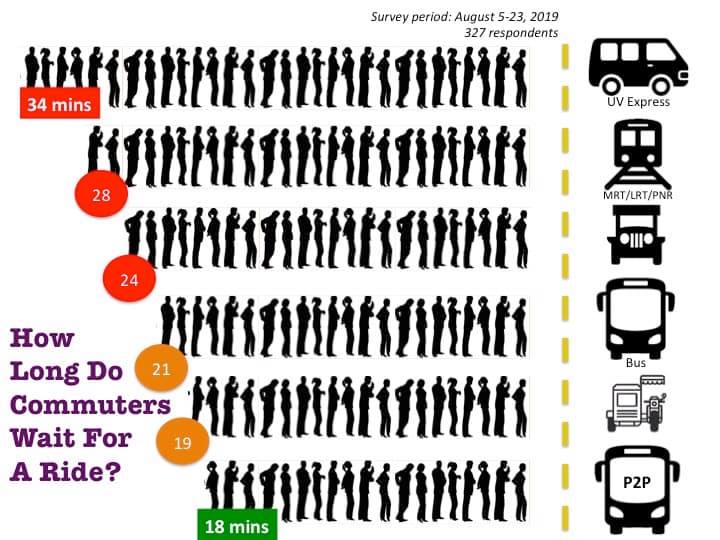 What’s lacking? Information on car and motorcycle users? And why the long waiting times? Are these really just because of a shortage in the supply of public transport vehicles thereby necessitating additional franchises? [Graphic and data courtesy of Toix Cerna via Facebook]
 Again, the mode shares reported are incomplete. With the exception of walking, car and motorcycle shares are substantial and significant. There is some info here about trip chains (i.e., the average of 2 rides per commute) but it is unclear what percentage of the trip is made using whatever mode is used. [Graphic and data courtesy of Toix Cerna via Facebook]
The absence of information about cars and motorcycles is glaring due to their significant share of commuters. Yes, the term ‘commuter’ actually refers to someone who regularly travels between home and office. By extension, this may also apply to travels between home and school. The term is not exclusive to public transport users as is often assumed. Walking between home and office qualifies as a commute.
I am curious about how commutes using cars and motorcycles would compare to public transport commutes. The comparison is quite useful to show, for example, the advantages and disadvantages of car use (this includes taxis and ride share). More detailed information may also reveal who among car or motorcycle users use these vehicles out of necessity rather than as one among many choices for their commutes. One thinking is that if public transport quality is improved, then many people will opt to use PT rather than their private vehicles. However, there is also the observation that in many cases, those already using PT are the first to shift from the lower quality service to the better one. I also wrote about this as I posted my worries about how successful can Line 7 and Line 2 extension be in reducing car use along their corridors. Perhaps the ones who will truly benefit are those who are already taking public transport, and car and motorcycle users will just continue with these modes?
In Part 2, I will share some data we collected more than a decade ago for a study on jeepneys in Metro Manila. I will use the information to explain another angle of this issue on public transport supply and demand.
–
Traffic management schemes for the Marcos Highway bridge rehab
The rehabilitation of the Marcos Highway Bridge in Marikina has necessitated traffic management schemes at the bridge itself and along alternative routes to alleviate congestion in the area. These are collectively called traffic or transport systems management (TSM) schemes with the objective of optimising existing infrastructure and resources without necessarily building something entirely new. These are quite different from travel demand management (TDM) schemes that include number coding and truck ban policies that are already being implemented (though Marikina does not implement the number coding scheme).
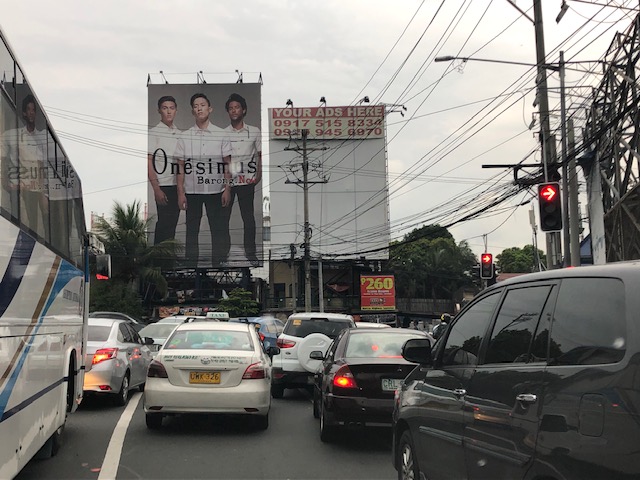 Traffic build-up at the approach to the intersection with FVR Road (To Riverbanks). This is now a signalised intersection as traffic from Blue Ridge/White Plains is now allowed to cross to FVR Road.
 Using the route via FVR Road (Riverbanks) means you don’t have to cross the Marcos Highway Bridge and travellers will merge with those who crossed the bridge just before the Line 2 Santolan Station.
 In the mornings, one lane each is allocated for either the eastbound or westbound traffic. That’s practically a total of 3 lanes (+2 lanes westbound for the SM Marikina Bridge) for the westbound direction and a single lane for the eastbound side. This is logical given the directional distribution of traffic at this time of day and the alternative routes already available to travellers.
Here are a few photos taken on a night time drive. Note that this was taken by a passenger. Don’t even try doing this (taking photos) while driving a vehicle, and especially not while on a motorcycle.
 Entrance to the bridge right after Maj. Dizon – this part is not affected by the rehab works but vehicles position themselves to shift towards the left side, which is the usable part of the bridge.
 Both lanes of the westbound side of the bridge are used for eastbound traffic. Westbound traffic are all along the SM Marikina bridge for a total of 2 lanes each for either direction of flow. The cones are not removed for practicality since they would have to be installed for the morning when one lane is allocated for the westbound traffic.
 Vehicles shift to the right to return to the correct lanes for eastbound traffic along Marcos Highway at the Santolan area. Note the westbound vehicles shifting towards the underpass and SM Marikina on the left.
–
On the impacts of the closure of the Marcos Highway Bridge
The Marcos Highway Bridge was scheduled for rehabilitation in the next four months starting last week. While it will not be totally closed to traffic, the scheme reducing its capacity will surely lead to congestion along Marcos Highway. This congestion should be expected along other roads as well, as travellers, particularly those taking private transport will be using alternative routes in order to avoid this area. Those coming from the east will likely go through Marikina City via the parallel route comprised of Sumulong Highway and A. Bonifacio Avenue. Others will turn to A. Rodriguez (Ligaya). And perhaps others may go via Ortigas Avenue Extension. These alternative routes correspond to the other bridges crossing the Marikina River connecting the Rizal province and part of Marikina and Pasig to Metro Manila.
 A photo of the bridge prior to its partial closure
I will write more on this topic once I get more information on what’s happening to the traffic in the area. Meanwhile, I do know that my usual alternative route via Marikina and Tumana seems to have more than the usual traffic during my commute. While it is easy to attribute this to the partial closure of the Marcos Highway bridge, this could also be just a normal variation in the typical daily traffic for that route.
–
Summer traffic
The summer break for most students meant less traffic along many major roads around the country. That means improved travel times in many cases and during periods when one usually expects congestion particularly for streets that are the main access roads to and from schools. Among the streets affected by the summer break that means less vehicles are major thoroughfares like C-5, Shaw Boulevard, Aurora Boulevard and Espana Boulevard, which are the main access roads to many schools.
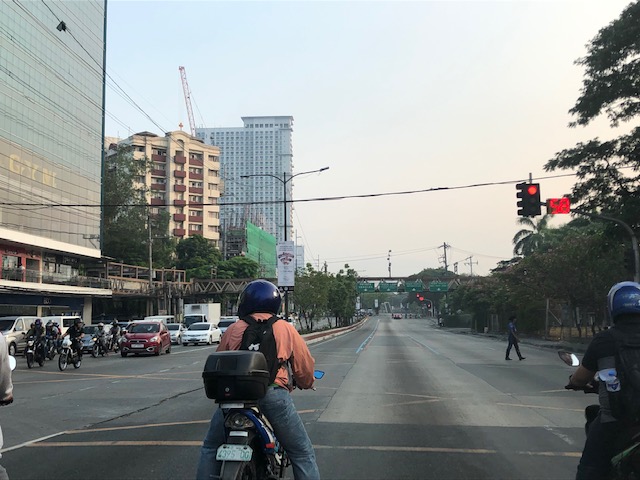 Katipunan Avenue (C-5) near Ateneo Gate 3 during what is usually the morning peak for the area. Obviously, much of the traffic generated by the schools in the area
The new school year, however, is just around the corner; with public schools resuming classes from June 3. In my case, I get to enjoy a bit more of less congested roads along my regular commute since Ateneo, Miriam and UP will be having the mid-year break for their college students from June to July. This is due to the adjusted academic calendars of these universities and college.
–
On phantom traffic jams again
I’m sharing this article on phantom traffic jams:
Seibold, B. (2019) Traffic Ghost Hunting: When the biggest problem with traffic is nothing at all, Nautilus, https://medium.com/@NautilusMag/traffic-ghost-hunting-ac071197695d [Last accessed: 4/9/2019]
Have you wondered why the road or path is congested only to find out there seems to be nothing causing it? This is the phantom or ghost traffic jams caused by simple behaviours of travellers whether on motor vehicles, cycles or people like slowing down their movement or changing lanes. These disruptions cause a “ripple effect” on the traffic stream much as like waves are generated by a stimulus on calm waters.
–
More concerns about ride-hailing/ride-sharing
Here are two interesting (to me at least) articles about the negative aspects of ride hailing or ride sharing. The first is quite a curious one for me as I teach at UP Diliman, which has a sprawling campus in Quezon City. Students can have one class at a building on one end of the campus and have the next class at another end of the campus. I now wonder if there’s a significant number of Grab or Angkas trips within campus.
Kidambi, M. (2019) “Popularity of brief Uber, Lyft rides on campus raises environmental concerns,” Daily Bruin, http://dailybruin.com/2019/01/29/popularity-of-brief-uber-lyft-rides-on-campus-raises-environmental-concerns/ [Last accessed: 2/8/2019]
The second article relates on the a more general context of what’s bad about ride hailing/ride sharing. The author presents not just a list but evidence of each item mentioned.
Schmitt, A. (2019) “All the Bad Things About Uber and Lyft In One Simple List,” Streetsblog USA, https://usa.streetsblog.org/2019/02/04/all-the-bad-things-about-uber-and-lyft-in-one-simple-list/ [Last accessed: 2/8/2019]
As I’ve mentioned in previous articles here, there are still a lot we need to learn about ridehailing in this country and especially in our cities. I guess Angkas’ case can be different because motorcycle taxis were already operating in many areas even before the app-based service. But of course, we also need to understand about his enhanced ‘habal-habal’.
–
On school trip generation
I chanced upon the changing of the shifts for a national high school. This was the time of day when the morning shift students were dismissed (i.e., coming out of school) and the afternoon shift students were coming in.
 Students come out of the school to mainly either walk or take public transport (mostly tricycles) to their homes.
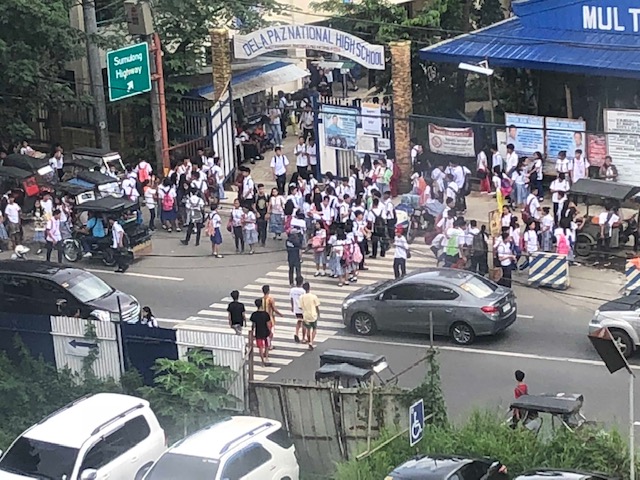 Most vehicles give way to people, especially students, crossing the busy street. There are usually traffic aides in the area who help manage traffic and to ensure pedestrians may safely cross or move about.
There are no severe traffic congestion here unlike those generated by many exclusive or private schools. There is actually a private school just beside this public high school that also generates significant private vehicle traffic but somehow manages not to congest this major road that’s part of the L. Sumulong Memorial Circle the way another private school congests Sumulong Highway in the mornings.
Is this simply because of the school being a public school as compared with private schools? Perhaps it is, given the perceived disparity in income classes concerning those going to typical public schools and those going to typical exclusive schools. But income disparity aside, wouldn’t it be possible for most students to just walk or take public transport to school? I actually envy the public school students in the photos above as they can walk to school. And that is because they likely live near the school, which is something that is a desirable situation if public schools are at least at par in quality with the more established private schools (especially the sectarian ones where many parents likely prefer their children to go to). This disparity in quality leads to people residing in relatively long distances away for the preferred schools to travel (often with their private vehicles) to and from the exclusive schools. The point here is that it really is more complicated than what it seems in terms of trip generation.
–
On the unpredictability of EDSA traffic
Much has been written about the traffic along EDSA, which is perhaps Metro Manila’s most famous (some would say infamous) thoroughfare. These include the unpredictability of congestion along this road. While it is hard to believe that traffic congestion is unpredictable for EDSA because very often it is congested, there are times when you just marvel that its free-flowing during the day or shocked that its packed with cars close to midnight. Last week, we experienced both predictability and unpredictability in the sense that we did expect EDSA to be congested near Ortigas (due to the dismissals of schools in the vicinity) but didn’t expect it to be packed during what we thought was “alanganin na oras” that was around 3PM.
 EDSA northbound traffic taken at Guadalupe last October 1, 2018 at 3:30PM.
Interestingly, there was no congestion after Ortigas Avenue and we quickly made up for the time lost in the congestion we experienced from Gil Puyat Avenue. Is this another case of the phantom congestion where the simple disturbances in the traffic stream can create a ripple effect resulting in congestion? Or is this somewhat like an everyday thing? EDSA is not part of my daily commute so I am not so sure about the regularity of this situation but at least the weather didn’t factor in the equation. Heavy rains usually lead to flash floods along this thoroughfare, and these floods will definitely lead intense congestion.
–
On EDSA transport and traffic, again
There’s a recent decision by the Metro Manila Council (MMC) comprised of the mayors of the cities and municipality of Metro Manila and chaired by the Metro Manila Development Authority (MMDA) Chair that vehicles bearing only one passenger (the driver) will be banned from travelling along EDSA. The problem with this is that by banning cars with one passenger from EDSA, you only succeed in making other roads like C5 more congested. It’s a simple case of transferring traffic and worsening it elsewhere since you’re not doing anything to alleviate congestion along those roads. Did MMDA run this and other scenarios using analytical or simulation tools at their disposal? If so, can these be shown and used to explain the soundness of this policy approved by the MMC? I suspect they didn’t and likely depended more on gut feel based on the data they have including what is often reported as 70% of vehicles traveling along EDSA having only one passenger. Meanwhile, the state of mass transit along EDSA still sucks.
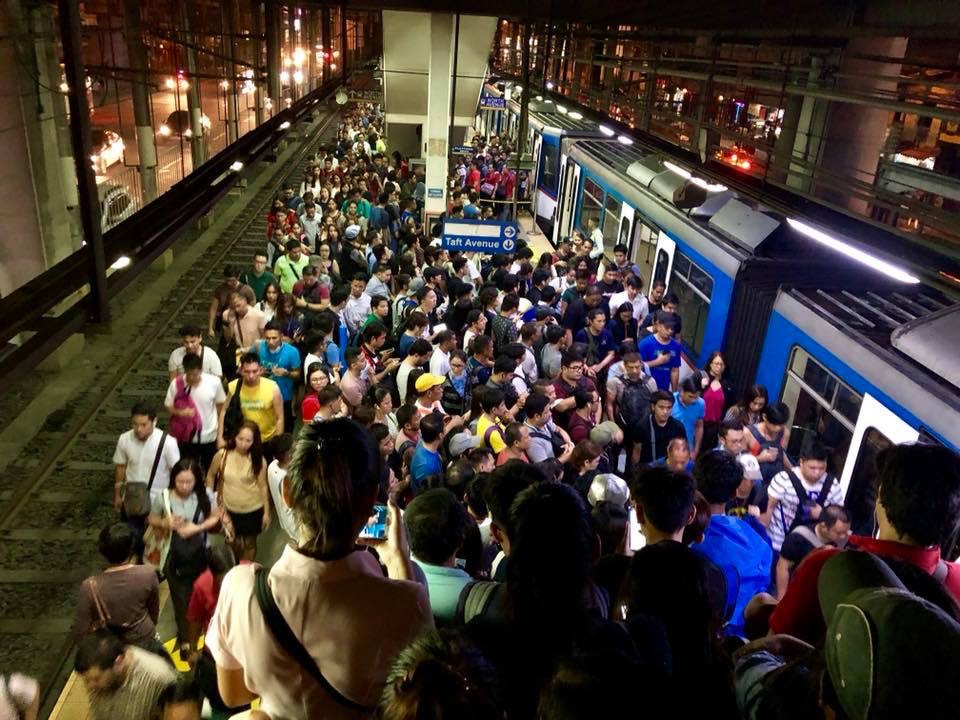 A very crowded Boni Avenue Station platform (photo courtesy of Mr. Raul Vibal)
Of course, the pronouncement from the MMDA launched quite a lot of memes on social media. Some people shared the typical quotes on planning (you know, like the ones about planning for people vs. planning for cars). Some offered their own ideas about how to “solve” traffic along EDSA. And so on…that only succeeded in showing how everyone had an opinion about transport and traffic. Everyone is an expert, so it seems.
Some thoughts and not in any order:
- The government can initially dedicate a lane each for express buses (a la Bus Rapid Transit or BRT). This idea has been circulating for quite some time now and has a good chance of succeeding. The DOTr is already deploying buses that they say are supplementing the MRT 3 trains (i.e., there aren’t enough trains running so passengers have the option of taking a bus instead). Running along the inner lanes of EDSA would mean, however, that they would have to find a way for passengers to cross the road and one idea would be for the stations to be retrofitted for this purpose.
- Those cars along EDSA are not necessarily for short trips so walking and cycling while needing space may have less impact in the immediate term for such a corridor. In the meantime, serious consideration should be made for bike lanes whether on the ground or elevated and improvements to walking spaces.
- But these efforts to improve passenger (and freight) flows should be a network-wide thing and not just along EDSA.
- It’s time to have serious discussions and perhaps simulations (even a dry run) of congestion pricing in Metro Manila. Congestion pricing for all major roads and not just one or two. Funds collected goes to mass transit, walkways and bikeways development. DOTr was supposed to have already discussed an Electronic Road Pricing (ERP) system like Singapore’s with the company and people behind the same in the city-state. That doesn’t seem to be moving along.
- Working and studying from home might work in terms of reducing vehicular traffic but then we generally have lousy internet services so that’s a barrier that needs to be broken down.
- How about legalizing, once and for all, motorcycle taxis? Many are opposed to this citing safety concerns but then we are running out of options outside the usual motherhood statements pertaining to building transport infrastructure. Think about it. Give it a chance. These motorcycles might just surprise us in a nice way; that is, helping alleviate congestion.
- Carpooling and lanes dedicated to High Occupancy Vehicles (HOV) would be good but the LTFRB made a pronouncement about these being illegal as they would be considered ‘colorum’. Such statements do not make the situation any easier and sends mixed signals as to the government’s being serious in considering all possible angles to improve transport and traffic particularly for commuting.
Do you have other ideas to share?
–
School is back and so are safety issues for schoolchildren
It’s school time once again in most parts of the Philippines. Public and private schools including most colleges and universities have resumed classes this month of June while others start this July and August. But with the resumption of classes, there is also the re-emergence of issues pertaining to the safety of these children. Students are exposed to the hazards of commuting. These include the likelihood of being injured or killed by vehicles running along the roads the students use to get to school.
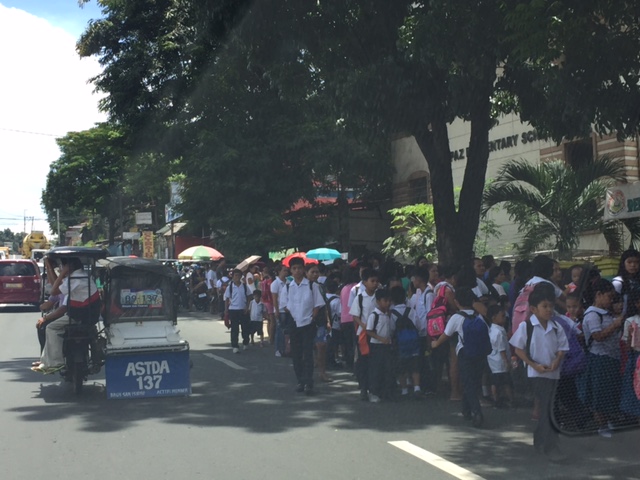 The photo above is a typical scene in front and around many public schools in the country. Schools are located along national roads and often lack spaces for students and their guardians. Many end up occupying the roads and causing congestion. Of course, that congestion is secondary to the safety of these children. Nevertheless, such issues need to be addressed in a more holistic manner rather than attempt to solve one as if they could be isolated.
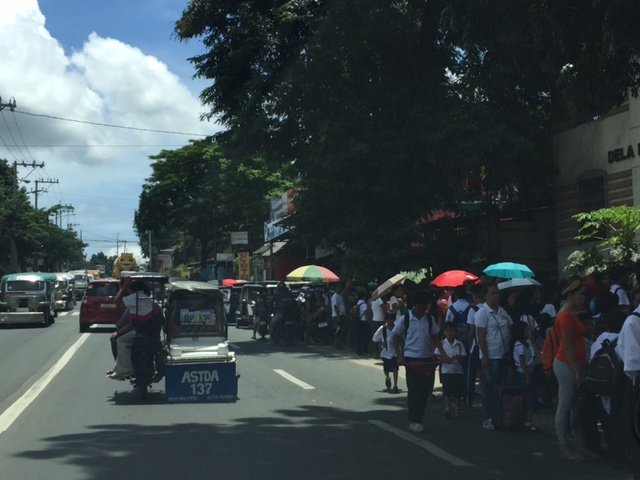 Most students of grade schools and high schools around the country either walk or take public transportation in their commutes. They are exposed almost daily to motor vehicle traffic along the roads and risk being sideswiped or run over by vehicles. In certain cases, small children walk significant distances thereby increasing the likelihood and risk of being harmed by traffic.
Traffic is particularly bad along most roads leading to schools mainly during the morning, mid-day and afternoon periods when students arrive or leave their schools. In Metro Manila, for example, the worst congestion are experienced along major roads like Katipunan Avenue (due to traffic generated by Ateneo, Miriam and UP) and Ortigas Avenue (due to La Salle Greenhills). That means a lot of time and fuel are wasted and more emissions are released into the air that we breathe. However, one can argue that in terms of road safety, this is better since gridlocks mean slow moving vehicles that make it safer for walking or cycling. This is not the same in the provinces or rural areas where there is less congestion and vehicles travel at faster speeds.
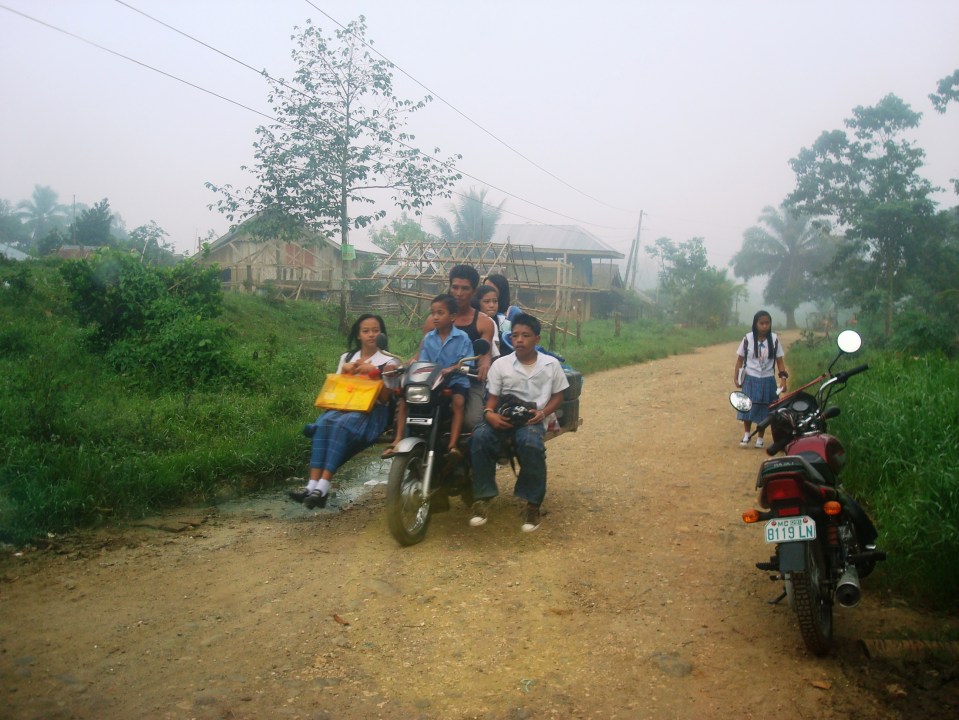 Children heading to school on a ‘skylab’ version of the motorcycle taxi
While there are initiatives pertaining to revisions in speed limits, such are limited (pun not intended) by how much action can be done in order to enforce these regulations. Add to this the requirement of having the instruments to measure and record speeds in aid of enforcement. This was what MMDA did along Commonwealth Ave. and Macapagal Blvd. with the acquisition of two speed guns. I don’t see them using these anymore and wonder if the instruments are still working. Meanwhile, expressway authorities are using these as they continue their enforcement of speed limits along tollways. [I am aware of NLEX and SCTEX enforcement units employing speed guns along those tollways.]
The DPWH is also doing its part by doing road safety audits and identifying measures to reduce the likelihood of crashes involving these students. Among these are rumbles strips and, in some cases, the construction of sidewalks but these are not enough. There were recommendations from an iRAP project many years ago but the agency was resistant to what they thought were new and innovative ideas that were actually already being implemented in other countries. Perhaps these recommendations and that iRAP study could be revisited and solutions drawn from there?
–
 Caught (up) in traffic