
Home » Transport Planning (Page 23)
Category Archives: Transport Planning
Evidence from Montreal: Building bike lanes to reduce car use
I just wanted to share this article showing evidence of car use reduction (and therefore, car traffic along roads) with the provision of bicycle lanes.
Building Bike Lanes Really Does Get More People Out of Their Cars
The article though cautions readers against generalising or assuming great improvements. Some figures mentioned in the article including the following (I took the liberty of copying and pasting):
- “A 10% increase in bike accessibility resulted in only a 3.7% increase in ridership.”
- “…cycling infrastructure also reduced greenhouse gas emissions from cars by 1.7%, a reduction equivalent to converting transit buses to hybrids and electrifying commuter trains.”
These numbers are for the case of Montreal, Canada. Not mentioned are the number of cyclists, vehicle traffic volumes and other pertinent data that are useful in analysis. The article correctly points out the importance of using science (e.g., sound analysis based on good data) in order to convince governments to put up bicycle infrastructure. I would even add that this approach should also be applicable to pedestrian facilities.
–
Standards for integrated railways in the Philippines
With the recent pronouncements about railway projects in Metro Manila including the ongoing Line 2 Extension to Masinag, the impending construction of Line 7 (i.e., along Commonwealth and Regalado Avenues and Quirino Highway) and the proposal for a Line 4 (Diliman, Quezon City to Lerma, Manila), it becomes more imperative to have integrated railway infrastructure including and especially common stations where lines intersect and common specifications guided by standards or guidelines. Do we have such or has there been work towards their formulation in the past? The simple answer to that question is yes. But then we have to qualify that affirmative response because while there was a study a decade and a half ago, the outcomes of that study, which is a comprehensive take on all aspects of railway systems was never formally adopted (again?) by the Philippines.
The following link is for the Executive Summary of the “Study on Integrated Railway Network for Metro Manila (SIRNMM) completed in 2001.
Perhaps there is a need to revisit the outcomes of this study? This can serve as a good platform from which updated guidelines and standards can be developed for a more harmonious development of railways systems not just for Metro Manila but for other cities as well.
–
Mobility for persons with disabilities
I saw these two people traveling along Marcos Highway just after the intersection with Imelda Avenue. I think they came from Tahanang Walang Hagdanan in Cainta. The tricycle is actually modified to allow for a person with disability to operate the motor vehicle. The side car is also customized to carry a person on wheelchair. Note that back of the sidecar? It is actually a ramp that is locked when traveling but can be lowered for wheelchairs to roll-on or roll-off. Since there are two persons on the vehicle, the driver’s wheelchair is seen folded and loaded in front of the lady on her wheelchair.

Such vehicles allow PWDs to be more mobile. Unfortunately, most public utility vehicles do not have features to allow wheelchair-bound people to ride on them. Such features may be seen in city buses in more progressive cities including those in Japan, Europe and the US. Trains can easily accommodate PWDs including those on wheelchairs as their floors are the same level as the station platforms and there is space inside the cars for PWDs. While access for PWDs is already contained in Philippine laws, there is still much to be done in terms of implementing provisions of such laws especially with respect to road-based public transportation.
–
On cable cars as a solution to Metro Manila transportation problems
I was asked about my take on the pronouncement about cable cars being a potential solution to Metro Manila’s traffic woes. I say pronouncement because careful qualification of the news articles on this clearly show that this is not yet a proposal. I leave it to the reader to Google these articles on cable cars for Metro Manila.
The first thing that came to my mind are capacity and demand. What would be the capacity for such a system and what could be the demand given that you would have to determine where stations would be. There’s also the fear factor as many people would not be comfortable riding a vehicle so high up in the air and then of course, there’s the wind that will obviously have to be factored in the operation of such cable cars. Suitability is very much an issue here. Perhaps cable cars like the one featured in the news articles are more appropriate for cities like Baguio, Antipolo and Tagaytay? There are very limited applications for Metro Manila even including perhaps possibilities for Ortigas and perhaps Loyola Heights.
I like what my friend, Rene Santiago, said about the cable being one possible answer but not The Answer to Metro Manila’s traffic problems. I am aware of and quite amused by the comments posted on social media about the so-called ‘cable car solution’ as it is definitely not going to make a big impact on Metro Manila transport. I like comments proposing instead improved river transport as well as protected bicycle lanes around the metropolis. These are well-grounded proposals that have been proven elsewhere to be very effective in reducing congestion while mass transit projects are under construction and to be operational in 2 to 3 years time. I think it would be wiser to put your money on bike lanes and even bike bridges than in cable cars.
I was also asked about what should be the first project the new Department of Transportation Secretary Art Tugade should take on. Metro Manila is still very much a “battleground” for transport and traffic, and there are already projects lined up for implementation like the much delayed MRT 7 and the extension of LRT1. The new administration should strongly support such efforts, whether its via Public Private Partnership (PPP) or public funded. That said, I think the incoming Department of Transportation Secretary should work on an urban mass transport project in one of our major cities. Either Cebu or Davao come to mind as these cities are already also congested and would need to have an urban transit system (rail?) very soon in order to avoid becoming another Metro Manila. There are low-hanging fruits in these cities, for example, with the Cebu BRT ready to be taken on by the new administration for full implementation and Davao already being the subject of public transport studies pointing to it being ripe for a rail transit system.
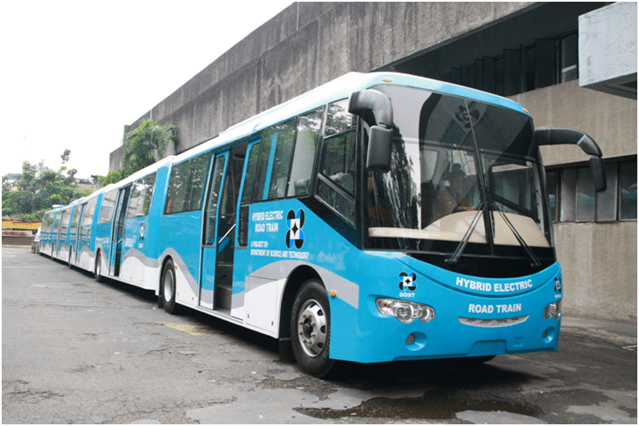
Finally, there are also the outcomes of research & development work by the Department of Science and Technology (DOST). I am referring to the DOST-MIRDC’s road train, AGT and hybrid train projects. The road trains, for example, may be used for Bus Rapid Transit (BRT) lines that are proposed for C5 and Quezon Avenue. I also think it is worth considering for EDSA. BRT is not technology-specific as far as buses go so why not use Philippine-made buses for this? While these are still subject to third party safety and technical certifications, the Transportation Department could lend a helpful hand towards this certification and this could perhaps ultimately lead to building an industry out of these buses and trains.
–
Metro Manila Skybridge: for cars or bicycles?
I was browsing over a not so old, pre-election issue of Top Gear magazine and came upon an article that featured then Senatorial candidate and already former Metro Manila Development Authority (MMDA) Chair Francis Tolentino. The article stated the former MMDA Chair’s frustration that his pet project didn’t get approval from NEDA. The Skybridge he was proposing was basically an elevated road that was to be built on top of Metro Manila rivers. This is in part to save on RROW costs and supposedly to also reduce traffic impacts of construction (note the traffic congestion due to the Skyway Stage 3 construction).
I think that such a Skybridge could have had a positive impact on traffic congestion but for a short time only. The sheer number of vehicles in Metro Manila will only lead to congestion elsewhere being transferred here and, under equilibrium conditions that will eventually be attained as some time in the near future, will ultimately be congested. The concept of tollways is for people to pay for the use of a facility in return for high level of service (read: faster travel). Skyways and other elevated highways cost a lot and the NEDA probably didn’t see a free use elevated structure like the Skybridge having much in terms of ROI.
There is, however, something that may be worth it in terms of potential congestion reduction as well as enhancement of traffic safety and quality of life – a Skybridge for bicycles and pedestrians. This should encourage people to cycle as travel via such mode will be much safer and could possibly be faster. Friends and acquaintances who are cyclists often post about similar facilities in Europe and how these are able to reduce congestion as people opt to cycle and leave their cars at home during the weekdays.
–
Eastern transport terminal in Marikina City
I noticed the roadworks near SM Marikina beneath the Marcos Highway Bridge. These are part of what is being developed as an Eastern Transport Terminal. Although there is a sign there announcing the location as a terminal it is more a garage for UV Express vehicles and jeepneys that eventually proceed to the LRT Line 2 Santolan Station to get passengers.
The terminal is a pet project of former Metro Manila Development Authority (MMDA) Chair Bayani Fernando or BF. His company’s and his name is on a couple of signs proclaiming he gets it done. BF is now a newly minted congressman, having won the seat for the First District of Marikina City. In an upset of sorts, the former congressman who vacated this seat (after the maximum 3 terms), Marcelino ‘Marcy’ Teodoro, defeated incumbent mayor Del De Guzman who was running for a 3rd and final term. The development of the terminal actual started during BF’s stint as MMDA Chair where he conceptualized a terminal near SM Marikina and Santolan Station. Unfortunately, it did not materialize as he had planned with Typhoon Ondoy (Ketsana) flooding the area (and devastating much of Metro Manila and neighboring areas) and BF eventually exiting the MMDA to run for Vice President the following year.
The terminal will probably be completed but there are currently few public transport including provincial routes terminating at Santolan. Most jeepneys, for example, are bound for Cubao with the opposite trip ends in various towns of Rizal. Eastbound buses do not pass through Marcos Highway but instead take the older route through Ortigas Avenue and Antipolo and Teresa. It would take some effort to re-route these or perhaps there can be new routes via Marcos Highway? Provincial routes to the north and south are currently concentrated in Pasay, Cubao and Manila. It makes sense to decongest Cubao and have some buses have their terminal instead at Marikina. However, that means loading Aurora Boulevard, C5 and perhaps the FVR Road (Riverbanks) with additional bus traffic. Those impacts need to be evaluated and I am sure countermeasures can be developed for this transport terminal to work.
–
Some thoughts on transport for President-elect Duterte
My colleagues and I were talking about the not so surprising results of the recent national elections in the Philippines. I say not so surprising because people have been clamouring for change for quite some time now. It did not help the current administration and its standard bearer were hounded by the transport and traffic problems experienced by the country especially in Metro Manila. Here are some thoughts for the President-elect and whoever will be part of his transportation team:
- Come up with a framework for developing transportation in the country. The framework should contain both soft and hard measures. On the soft side would be strategies and policies like those promoting sustainable transport especially low carbon transport systems. This many include promoting walking, cycling and public transport at the local level. Hard measures would include infrastructure for all modes of transport including railways, airports and ports. Local roads development might be something President-elect Duterte’s team should look into as local roads basically provide accessibility for rural areas and contribute to development. The framework will serve as a guide for the next 6 years for whoever will be in-charge of transport-related agencies. He should have a sound game plan so as to be systematic in the approach to address transport and traffic issues.
- Watch out for and appreciate low hanging fruits. I think the current administration has already initiated solutions to pressing problems but mostly in Metro Manila in the form of the LRT Line 2 Extension and the MRT Line 7. There is also the new rolling stock for MRT Line 3. Pres.-elect Duterte’s team should already look into the mass transit needs of other highly urbanized cities such as Cebu, Iloilo and his hometown of Davao. Whether these will be road or rail-based systems should be the subject of studies to determine what can be completed immediately and within the term of the President and which need substantial investments and perhaps engagement with the private sector. The mention of “paralysis by analysis” by critics of the outgoing administration can be traced to the latter’s seeming disregard of the accomplishments of its predecessor, which could have been implemented early on during the term. The next administration should not make the same mistake.
- Just do it. That was the mantra of the late Sen. and former DOH Sec. Juan Flavier, which he got from Nike. Transport and traffic problems in this country has worsened over the years due to the slow development of infrastructure coupled with issues on land use planning. These two actually go hand-in-hand. Metro Manila is already at a stage where indeed it will take long-term planning and infra development to solve (i.e., significantly reduce) congestion (note: You cannot eliminate congestion for a megalopolis like the NCR). Meanwhile, it is not too late for other major cities so investments and infra development should start under his watch. For starters, completing the proposed Cebu BRT and building a mass transit system for Davao should serve as inspiration for other cities to follow. Already there is a need for sophisticated public transport in emerging metropolitan areas like Iloilo, Bacolod, CDO and Angeles-Clark-Mabalacat. These do not require 12 years but perhaps with urgent action be addressed within 6 years. This, of course, should go together with the building infrastructure for walking and cycling where applicable and in relation to transit development.
–
Suggested reading on affordable housing and transit
I had written before about opportunities with the construction of the LRT Line 2 Extension along Marcos Highway and the MRT Line 7 along Commonwealth Avenue, Regalado Avenue and Quirino Avenue. There is a nice article that came out last April 28, 2016 at the Mobility Lab site:
Affordable housing and transit should go hand-in-hand
I am afraid though that despite the developments further north of the Line 7 alignment, it seems land values have increased thereabouts. This means homes there will likely be as expensive as those near the city center. Only, the residential units in Caloocan and San Jose Del Monte are low density (e.g., single detached houses) and not medium to high density (e.g., walk-ups, condominiums). The government should have also invested in land and residential developments like how Singapore did it. HDB-type developments could have made the difference in as far as prices and rent are concerned. This could likely made it more affordable to workers seeking homes to purchase or rent near transit stations.
–
How did Mar Roxas lose? Top 10 transport-related reasons
I started writing this days before the national elections and if we are to base our forecast of Monday’s results on surveys and what’s circulating in mainstream and social media, then “change” will most likely be coming. Whether this change is a breath of fresh air or something that stinks and is just being masked by people around and behind him we will only know once he and his team starts working on rebuilding this country from what seems to be a most tumultuous and divisive campaign.
While it is possible to list down a lot of reasons from different aspects of his campaign, I would like to think that the administration’s standard bearer lost in large part because of his and the administration’s failures in transportation. Here’s my top ten transport-related reasons for why the Liberal Party’s presidential bet lost his bid to become the Philippines’ President:
- MRT-3 mess – the new coaches of the EDSA MRT-3 went into service today. People associate the current administration’s failures with images of long lines at MRT-3 stations and people walking as they leave stalled or defective trains. These are powerful images even as government claimed they were working on solutions to acquire new rolling stock and provide the maintenance the line needed.
- Paralysis by analysis – despite having many “low-hanging fruits” (i.e., projects ready to be implemented) from the previous administration and his predecessor at DOTC, Roxas and his people embarked on their own studies that seemed to take forever to finish. Many of these were with the PPP Center and it seemed that the government didn’t want to have any part in infrastructure development but passed this responsibility to the private sector.
- LRT-1 Cavite extension – this is a PPP project that also until now has not been implemented. Add to that the alleged circumstances for this project and the privatization of Line 1 where one company was most favored over others. Incidentally, the same company seems to have bagged a lot of projects under the current administration.
- BRT – Bus Rapid Transit (BRT) projects in Cebu City and Metro Manila are examples of projects that were developed by the previous administration and were ripe for implementation but are yet to take off.
- NAIA controversies – “tanim bala,” “malas,” delayed flights, blackouts, dirty toilets, the list goes on…you name it and they have it at the NAIA terminals.
- DOTC Sec. EA Abaya – the face of DOTC after Roxas and one who has come to be associated with what is perceived as a poorly performing agency. He should have been fired from the job years ago but for one reason or another he has stayed on at the agency and brought much damage unto the Roxas campaign. One has to wonder why Roxas refused to do some self examination and call for Abaya’s resignation. Hindi ba siya nakahalata na yung mga taong dapat sana ay kakampi ay nakasira ng husto sa chances niya maging Pangulo?
- NAIA Manager Honrado – the capital airport manager’s boo-boos including the “tanim bala” controversies and the bungled renovation of Terminal 1 easily put the manager as a symbol of ineptness. His being associated to the President as a former classmate did not help his cause as “classmate” had become synonymous with being “favored” despite failures.
- PNR – the only remaining long distance railway line in the country is still in a state of disrepair. There have been opinions that this was to government could sell it cheap to the private sector.
- North EDSA common station – the most appropriate location for the common station or grand terminal for LRT-1, MRT-3 and the future MRT-7 is in front of the SM City North EDSA Annex. Elsewhere would not be optimal and yet that is what Roxas started at DOTC, after reneging on an agreement with SM pertaining to the design of the station.
- Transport planning and infrastructure framework – few people seem to know that prior to 2010, there have been studies that led to a proposed National Transport Plan and Policy but this was not adopted by the Roxas DOTC with one Assistant Secretary even claiming that there was no framework. Fortunately, NEDA took the responsibility to develop one with little help coming from the DOTC.
–
Curiosities of transport services in Metro Manila
There are a few interesting observations we can make out of transport services in Metro Manila and chief among them is the poor quality of service that we can generalize among most if not all modes of public transport available to commuters. This poor quality of service of public transport is what drives many people to aspire to own and drive or ride their own vehicle. Already there has been a surge in motorcycle ownership in Metro Manila and its neighboring towns and cities (collectively Mega Manila) and car ownership is also on the rise. These trends have led to increased congestion along many roads. And we will probably not see a significant improvement until the mass transit projects have all been completed. These include the Line 2 Extension to Masinag, the MRT 7 along Commonwealth, the Line 1 Extension to Cavite, and yes, the capacity improvement of MRT 3. Hopefully, there will also be BRT lines along C-5 and Quezon Avenue to complement the rail transport projects.
The UV Express is actually a response to poor public transport services as it evolved out of the FX taxi services of the 1990s that later mixed with informal van and AUV services. These are actually a precursor of today’s ride sharing modes. Only, in those days when the FX service was born, you didn’t have tools like apps to facilitate your ride. People had to agree about the fares and the destinations from terminals like those in Cubao (Quezon City) and Crossing (Pasig/Mandaluyong).
But let us focus on three services that would not have been attractive if only services by their conventional counterparts were (very) satisfactory and if there was a comprehensive and efficient mass transit network in the metropolis. These are Uber, P2P buses and airport express buses.
Uber offers services much like that of the conventional taxi. Its advantages are mainly having recent model vehicles (not dilapidated ones), a better driver (this attribute is quite subjective), and an app-based system for availing services. Fares are generally more expensive than those for regular taxis. And there is a surge pricing for when congestion is really bad. It has a very good feedback mechanism that allows passengers to evaluate their drivers. However, this wouldn’t have been necessary if taxi drivers in general were more disciplined and courteous to their passengers.
P2P buses operated by Froehlich Tours offers services much like that of conventional buses. Its current advantages over conventional buses are that it operates express services, buses are new, well-maintained, and with drivers that appear to be more disciplined than the typical public utility bus driver. A friend’s take is that P2P’s are the bus equivalent of UV Express. It is not at all necessary if the quality of service of regular buses were much better than it is right now. And I am referring to the practically stop anywhere, recklessly driven and poorly maintained regular buses.
Premium airport buses have recently been introduced and these are operated by Air21, which is a freight forwarding company. It is a service that’s long overdue given the many difficult experiences of people to and from NAIA’s passenger terminals. While an airport limousine bus service should have been provided many, many years ago it also is a reflection of the poor quality of airport taxi services. Airport taxis are expensive and according to many stories circulating can be predatory.
What I am driving at, if it is not yet so obvious, is that many ‘new’ services are actually borne out of crappy services of conventional modes. There are many lessons to be learned here in and lest I be accused of neglecting other Philippine cities, I should mention that Metro Manila presents so many lessons to be learned by other rapidly growing and urbanizing areas in the country. At this time we can mention Cebu, Davao, Iloilo, Cagayan de Oro and perhaps Clark/Angeles as metropolitan areas to watch in terms of transport system development. Hopefully, there’s a kind of reverse psychology in their approaches to address their transport needs in that they avoid what has been done in Metro Manila. Surely, transport services in these other cities can do better than Metro Manila’s.
–

