
Home » Transport Planning (Page 36)
Category Archives: Transport Planning
Transport mode shares in Metro Manila
Fairly recent surveys (first quarter of 2011) along major corridors in Metro Manila have yielded the following data on transport modes shares in the National Capital Region. Such data, while quite specific for the corridors surveyed, strongly indicate that most people take public transport. As such, it is quite logical that public transport be prioritized and perhaps provided with the road space they require to be more efficient in conveying passengers to their destinations. There are mixed results in terms of which types of vehicles tend to dominate the road and these are noted below. Note that data for rail is not included but should favor public transport as well. Taxis, in this case, are classified among private vehicles. Trucks are not considered here as passenger vehicles though they do carry people.
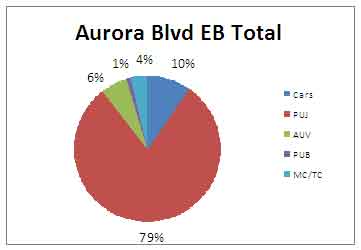 Person trip mode shares along Aurora Boulevard eastbound (to Rizal & Marikina) – jeepneys account for 79% of road-based transport while cars carry 10% of person trips. In terms of vehicle share of the road, cars account for about 25% of the road while jeepneys take up about 59% after converting jeepneys into passenger car units using the assumption of 1.7 pcu = 1 jeepney. Such assumption is also used in other estimates.
 Person trip mode shares along Aurora Boulevard westbound (to Cubao/Quezon City) – jeepneys account for 76% of road-based transport while cars carry 14% of person trips. Meanwhile cars occupy 31% of the road while jeepneys use 57%.
Interesting for the above statistics is the fact that these numbers do not reflect the actual share of public transport given that there is a rail transit service along this corridor. LRT Line 2, however, terminates before reaching the Province of Rizal, which necessitates the transfer of passengers from rail to mainly jeepneys towards their final destinations.
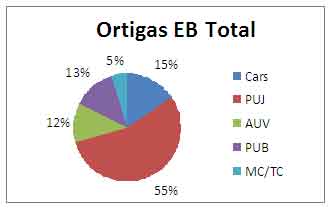
Person trip mode shares along Ortigas Avenue eastbound (to Rizal Province) – jeepneys account for 55% , buses 13% and AUVs 12% of road-based transport (total of 80% for PT) while cars carry only 15% of person trips. Cars occupy 37% of the road while jeepneys eat up almost the same at about 37%. AUVs are quite significant along this corridor taking up 12% of the road. Surprisingly, buses only occupy about 5% assuming 2.5 pcu = 1 bus. Perhaps Ortigas can be decongested if public transport services along the corridor are rationalized with many jeepneys retired in favor of the higher capacity buses.
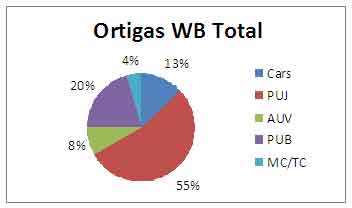
Person trip mode shares along Ortigas Avenue westbound (to Mandaluyong/Manila) – jeepneys account for 55% , buses 20% and AUVs 8% of road-based transport (total of 83% for PT) while cars carry only 13% of person trips. Cars take up 38% of the road, jeepneys also 38%, AUVs 9% and buses only 4.5%.

Person trip mode shares along Commonwealth Avenue northbound (to Novaliches) – jeepneys account for 30% , buses 35% and AUVs 5% of road-based transport (total of 70% for PT) while cars carry 26% of person trips. Cars take up 57% of the road, jeepneys 17%, AUVs 6% and buses about 12%. Meanwhile, motorcycle account for about 8% of road space along Commonwealth NB. Note that Commonwealth is the widest road in the country with sections having up to 10 lanes per direction. The two outermost lanes are typically designated for PUVs while the 4th lane from the roadside is designated as a motorcycle lane.
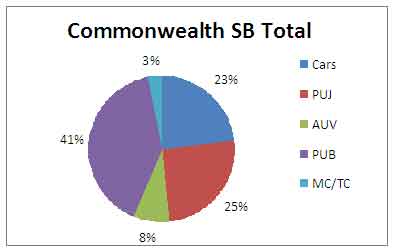
Person trip mode shares along Commonwealth Avenue southbound (to Elliptical) –
Note that there is a proposed MRT 7 to be constructed along Commonwealth and that system will also favor public transport users. Such a system should be more efficient in carrying passengers along the corridor and should provide an opportunity to rationalize PUJ and PUB numbers along Commonwealth. And such an opportunity should be taken and not passed up if government is really serious in improving transport in Metro Manila.
Person trip mode shares throughout the country will surely have similar numbers if not higher shares for public transport compared to Metro Manila. This more than underlines the impetus for providing safe, efficient public transport services for Filipinos – a commitment that should not only be stated or printed but actively pursued with government in the forefront rather than on the sidelines.
Graphs and other stats mentioned derived from data from surveys for the Mega Manila Public Transport Planning Support System (MMPTPSS), 2011.
Memorandum Order No. 25, Series 2011
MALACAÑAN PALACE
MANILA
BY THE PRESIDENT OF THE PHILIPPINES
MEMORANDUM ORDER NO. 25
RECONSTITUTING THE INTER-AGENCY TECHNICAL COMMITTEE ON TRANSPORT PLANNING (IATCTP)
WHEREAS, transportation infrastructure has the biggest share in the country’s infrastructure investment program and will continue to be among the critical drivers of the country’s economic growth;
WHEREAS, a number of government agencies are involved in transport planning activities within their respective areas of jurisdiction;
WHEREAS, the Department of Transportation and Communications (DOTC) is the primary policy, planning, programming, coordinating, implementing, regulating and administrative entity of the government in the promotion, development and regulation of dependable and coordinated transportation network in the country;
WHEREAS, the Department of Public Works and Highways (DPWH) is the lead agency for the planning, design, construction and maintenance of the national road network, which continues to dominate the country’s transport system;
WHEREAS, the Philippine Ports Authority (PPA) is mandated to facilitate the implementation of an integrated program for the planning, development, financing, operation and maintenance of ports or port districts in the country;
WHEREAS, the Maritime Industry Authority (MARINA) is tasked to integrate the development, promotion and regulation of the maritime industry in the country;
WHEREAS, the Philippine National Railways (PNR) is the first instrumentality of the government mandated to provide railway system and services within the integrated national transport system;
WHEREAS, the Light Rail Transit Authority (LRTA), by virtue of Executive Order (EO) 603, is responsible for the construction, operation, maintenance and/or lease of light rail transit systems in the country, which are recommended and envisioned to alleviate traffic and transportation situation in a congested metropolitan area within the context of rational land use planning;
WHEREAS, the Metropolitan Manila Development Authority (MMDA) is tasked, among others, to coordinate development planning, transportation and traffic management, urban renewal and land use planning, urban protection, pollution control and public safety in Metro Manila which is the country’s premier economic and financial capital;
WHEREAS, the Civil Aviation Authority of the Philippines (CAAP), created on 04 March 2008 by virtue of Republic Act (RA) 9497, is mandated to be the technical regulator of air transport;
WHEREAS, the University of the Philippines-National Center for Transportation Studies (UP-NCTS) aims to, among others, conduct research activities on transportation, provide extension services to various government agencies and the private sector, and provide information services on transportation; and,
WHEREAS, transportation affects the country’s economic development and therefore there is a need to effectively coordinate its planning and policy formulation process led by the National Economic and Development Authority (NEDA) in order to achieve the objectives of sustainable economic growth in the country.
NOW, THEREFORE, in consideration of the foregoing premises, the IATCTP is hereby reconstituted in view of the important roles of the other transport agencies in achieving a comprehensive and integrated coordination function in transport planning. The Committee shall now be composed of the following:
| Deputy Director-General, NEDA-National Development Office | – Chairperson |
| Assistant Director-General, NEDA-National Development Office | – Member |
| Director, NEDA-Infrastructure Staff | – Member |
| Director, NEDA-National Planning and Policy Staff | – Member |
| Director, NEDA-Project Monitoring Staff | – Member |
| Director, UP-NCTS | – Member |
| Head of Planning Service/Unit, DOTC | – Member |
| Head of Planning Service/Unit, DPWH | – Member |
| Head of Planning Service/Unit, PPA | – Member |
| Head of Planning Service/Unit, MARINA | – Member |
| Head of Planning Service/Unit, PNR | – Member |
| Head of Planning Service/Unit, LRTA | – Member |
| Head of Planning Service/Unit, MMDA | – Member |
| Head of Planning Service/Unit, CAAP | – Member |
The Committee shall continue to perform the following duties and functions:
a. Formulate and recommend to the NEDA Board Committee on Infrastructure (INFRACOM) comprehensive and integrated transport plans;
b. Formulate standards and guidelines for the preparation of agency plans for transport development;
c. Develop a transport information system that shall serve the information needs of all transport planning and other relevant agencies;
d. Coordinate the conduct of studies, researches and data-gathering on various aspects of the transport sector;
e. Formulate areas of cooperation and coordination among the various agencies and instrumentalities of the government involved in transport programs and projects to avoid duplication of efforts;
f. Provide the NEDA Board with up-to-date information needed in the review and evaluation of transport plans and projects; and
g. Serve as a forum for the resolution of operational problems of transport agencies.
The Committee shall submit to the NEDA Board INFRACOM any issues/concerns that require adoption/resolution by the latter.
The Committee shall meet for the purpose of discharging its functions and may create sub-committees as may be necessary. Other relevant transport agencies and organizations may also be invited to attend meetings when warranted.
The NEDA Infrastructure Staff shall provide secretariat services to the Committee.
All heads of departments, bureaus, offices and instrumentalities of the government are hereby requested to extend full cooperation and assistance to the Committee to ensure the successful execution of its tasks.
This Memorandum Order (MO) shall take effect immediately and shall supersede MO 473 (1974).
DONE, in the City of Manila, this 26th day of October in the year of our Lord Two Thousand and Eleven.
(Sgd.) BENIGNO S. AQUINO III
By the President:
(Sgd.) PAQUITO N. OCHOA, JR.
Executive Secretary

