
Home » Travel (Page 4)
Category Archives: Travel
Dog on board – a cute dog on our Cebu Pacific flight
As we were boarding the plane that will take us to Cebu, we were ‘treated’ to the presence of another passenger. One passenger brought his dog with him on the flight. I don’t know what breed this is but it was really cute. One of the flight attendants carried the dog as the passenger placed his bags to the overhead bin.

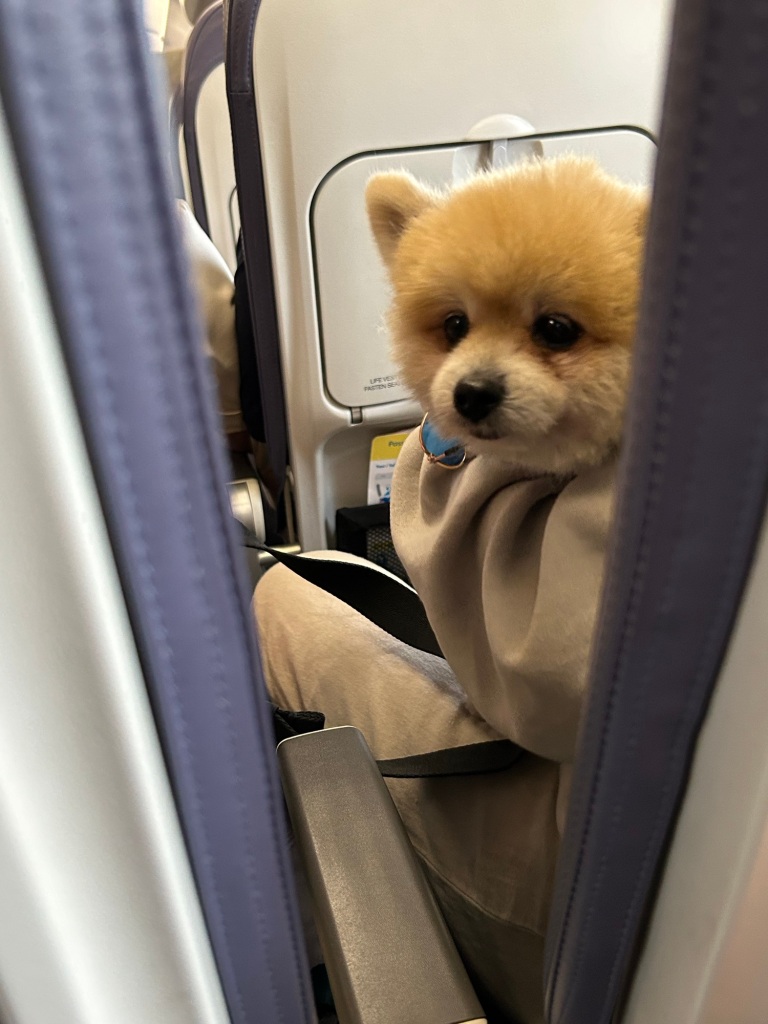
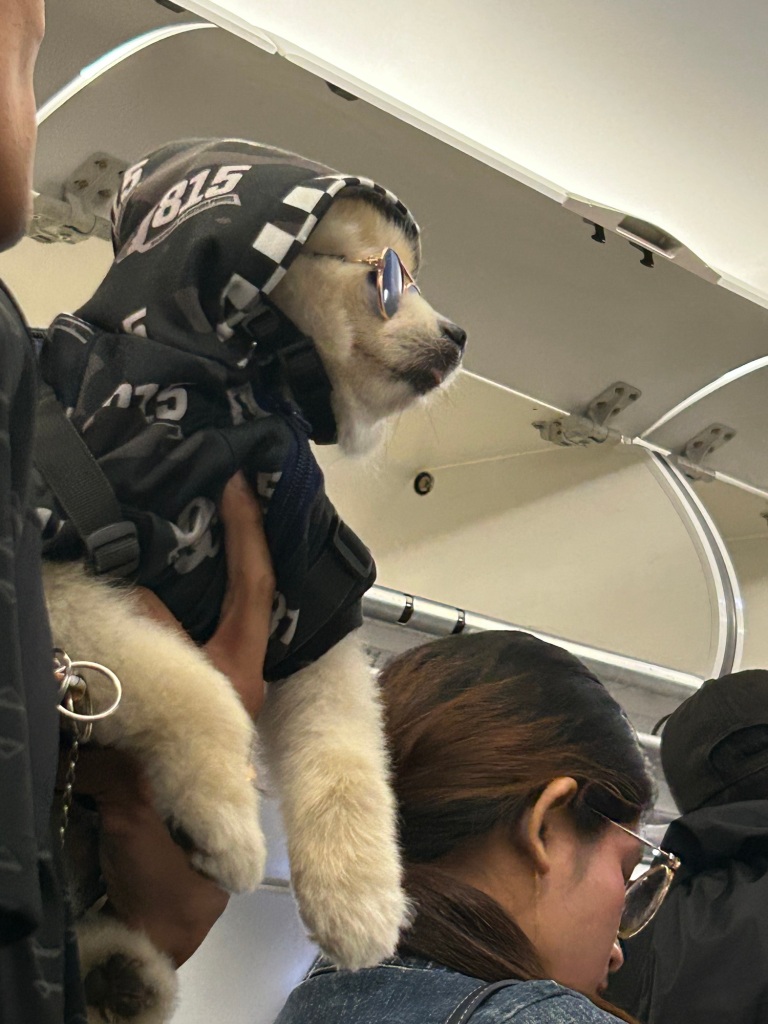 Wearing the shades and hood as they deplaned.
This was the first time I was on a plane with a passenger who had his/her pet with him/her. Bigger dogs would have to be on carriers and transported as baggage/freight. I know some airlines allow for big dogs to be in the main cabin if they have a ticket and a seat like other (human) passengers. There should be some guidelines for this as to what breeds are allowed including whether the dog has a pleasant temperament.
–
Airline food on Thai Airways
We booked Thai Airways for our flight to Bangkok. We had initially looked into both Philippine Airlines and Cebu Pacific thinking they would be cheaper, especially Ceb Pac, which is supposed to be a low cost carrier (LCC) or a budget airlines. They both turned out to be expensive so I suggested to the wife to check out Thai Airways since we were spending anyway and we wanted to have the full service that included decent inflight meals. Lo and behold, Thai Airways was actually cheaper than PAL or CebPac (note that we booked early so we had a lot of options for the latter airlines).
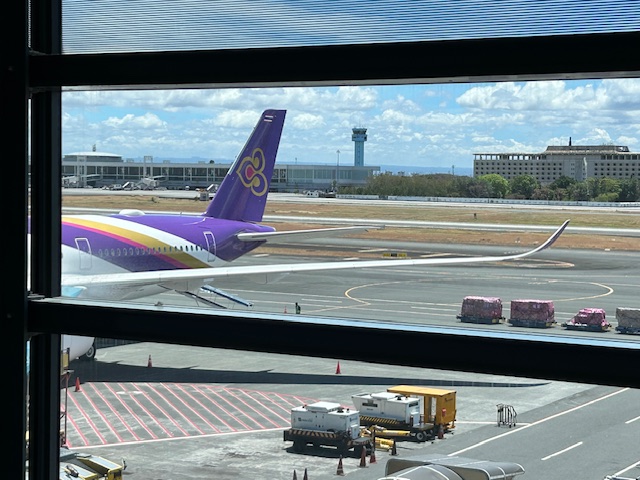 Our Thai Airways Airbus A350 at the NAIA Terminal 3. Also shown in the photo is the old Philippine Village Hotel building that surprisingly has not been demolished despite being abandoned for more than 3 decades. This is the proposed site of a Terminal 5 for NAIA that will be constructed and operated by San Miguel Corporation.
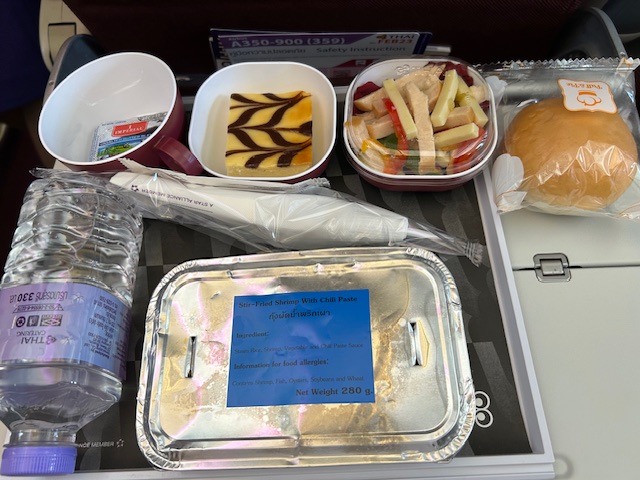 We had two choices for our inflight meal – stir-fried shrimp with chili sauce and rice or chicken in tomato sauce with pasta.
 The stir-fried shrimp with chili sauce came with carrots and young corn on the side. The set included salad, cake for dessert and a bun.
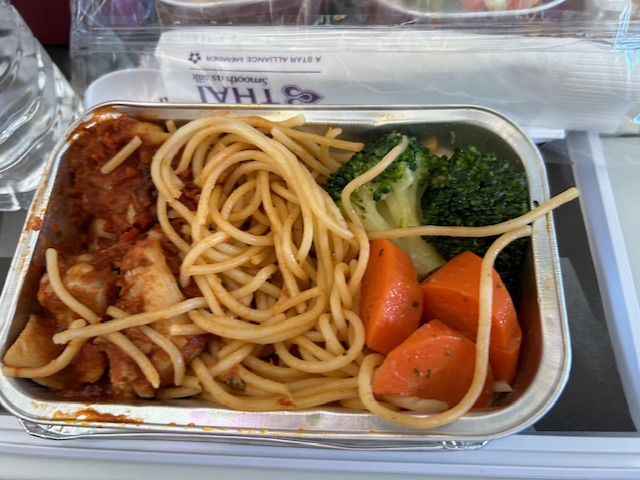 The only difference between the set was the main course. This is the chicken and pasta I eventually ate when I exchanged meals with my daughter who surprised us by preferring the spicy shrimp.
 The A350 was equipped with a tail camera for those who wanted this view of the plane. I took a video of when the plane landed to show my students about the landing including when the plane exited the runway via the rapid exit ramp.
We thought the food on economy class was okay and definitely better than what could have been served on either PAL or CebPac. What are better (on economy) if not similar in quality would be the food on Singapore Airlines and Japan Airlines.
More on our travel to Thailand in the next posts.
–
Back in Bangkok
We’re back in one of our happy places to be in again. Bangkok’s been one of our favorite destinations since the 2000’s. There was a time when we were here twice a year. Those trips were mostly business, actually academic-related as from 2001 to 2008 we had collaborative research network among ASEAN Universities hosted by Chulalongkorn University. I’ve returned several times after but the last time I was in Bangkok was in 2018 for a seminar on road safety. This is the first time we are in Bangkok with our daughter (her second ASEAN country) so we’re only very happy to share with her the experiences in Thailand.
 Clearing immigration at Suvarnabhumi Airport
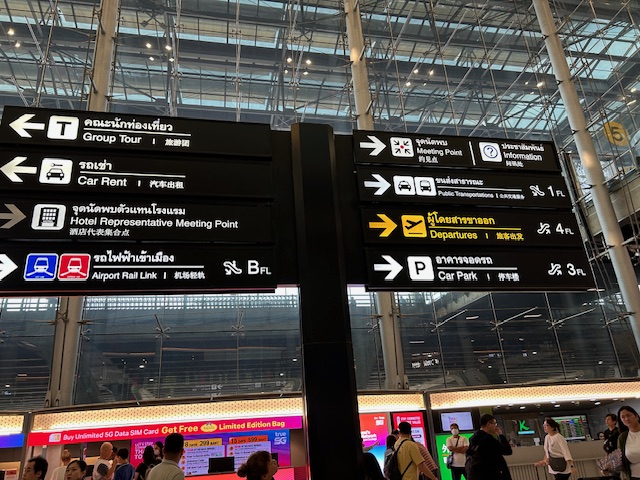 Where to and how to get there? We decided to take the airport taxi to our hotel.
 Marveling at the spacious terminal.
I will post about Bangkok and transport in Thailand in the next posts probably after we return from this trip.
–
Alay Lakad 2024
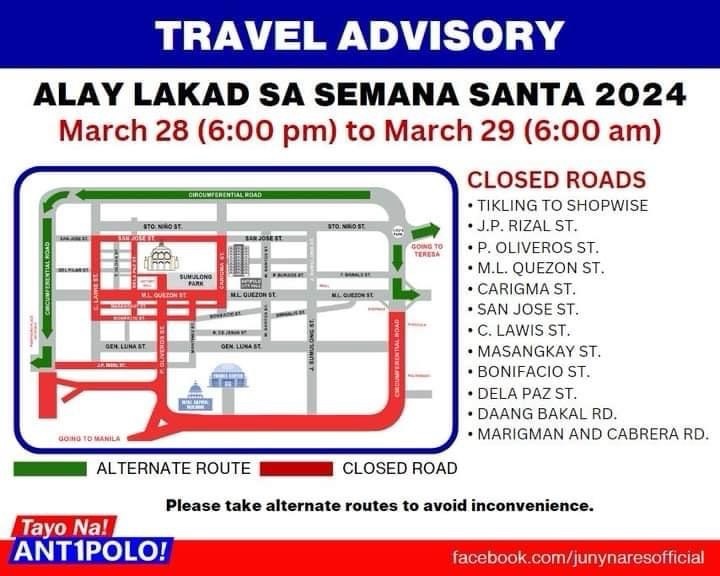
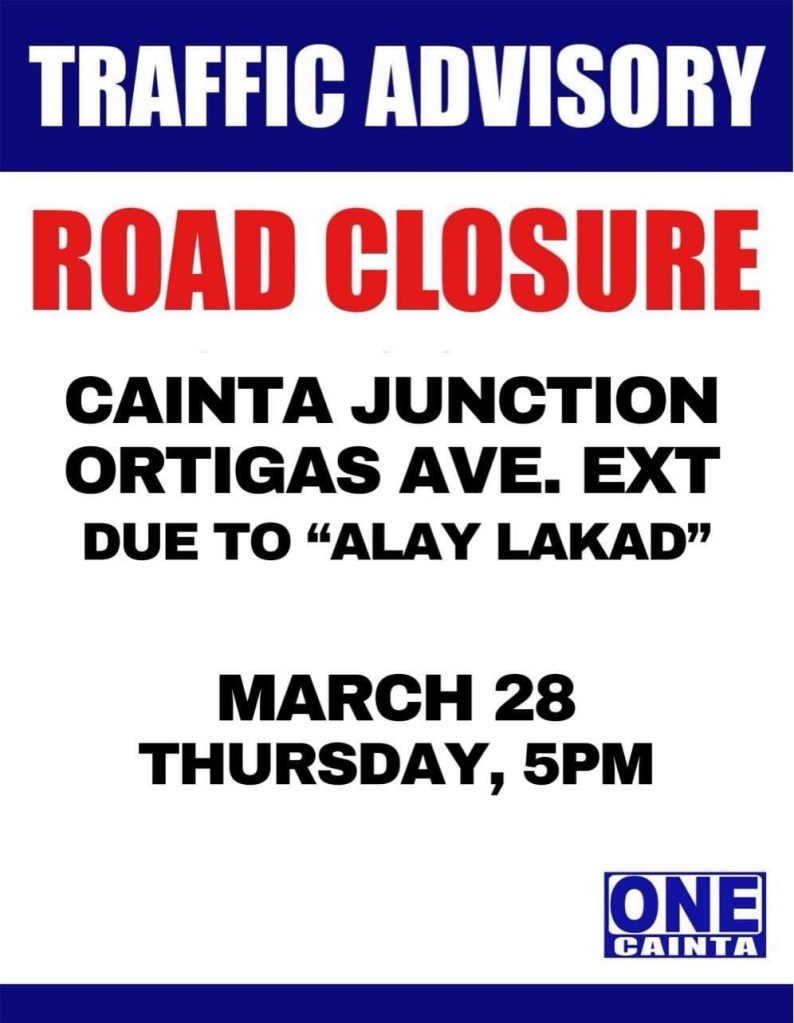
I’m sharing here the announcements and maps shared by Antipolo, Cainta and Taytay regarding road closures and alternative routes during the Alay Lakad this Holy Week. The roads leading to the Antipolo Shrine will be closed from 5pm of March 28 (Maundy Thursday) to 6am of March 29 (Good Friday). Expected are hundreds of thousands of people making the trek to the Shrine of Our Lady of Peace and Good Voyage, which is among the most popular pilgrimage sites in the country.
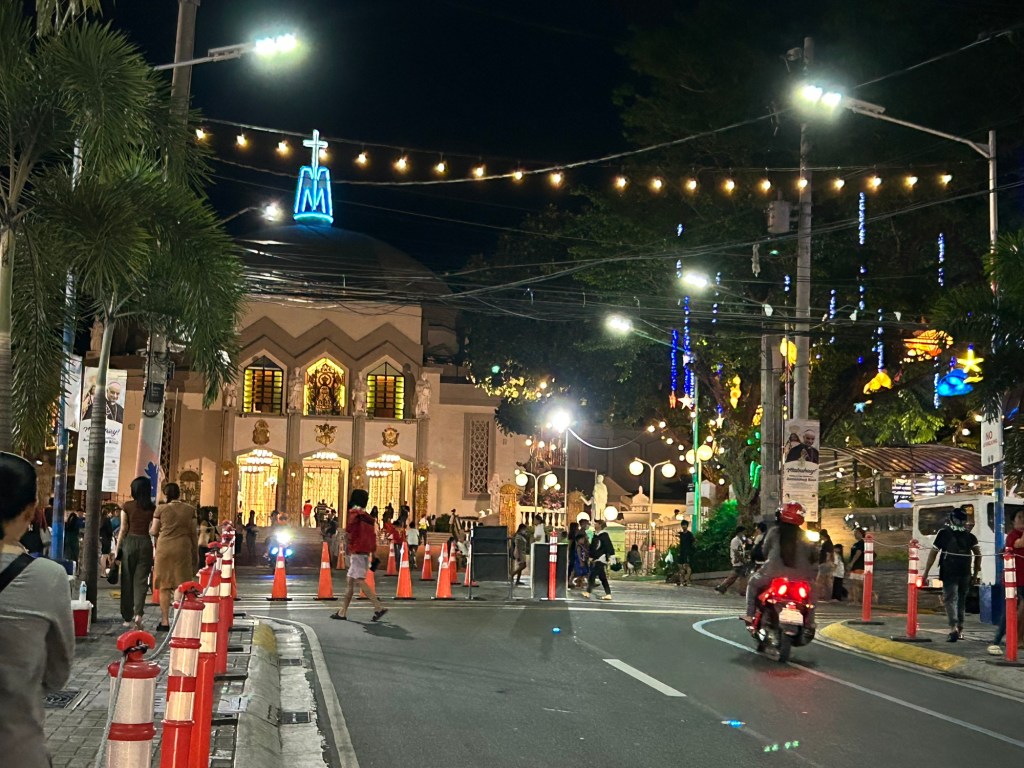
Many are probably walking as part of their panata or commitment in exchange for a favor they have prayed for. This may be healing for an illness or finding work or passing a licensure exam. Of course there are those who also pray for wants rather than needs like a new car, a big house or winning the lottery. And then there are those who are in it for the adventure, treating this as an excursion or a gig with the barkada.
Here are the maps and announcements posted in the official pages of the LGUs:
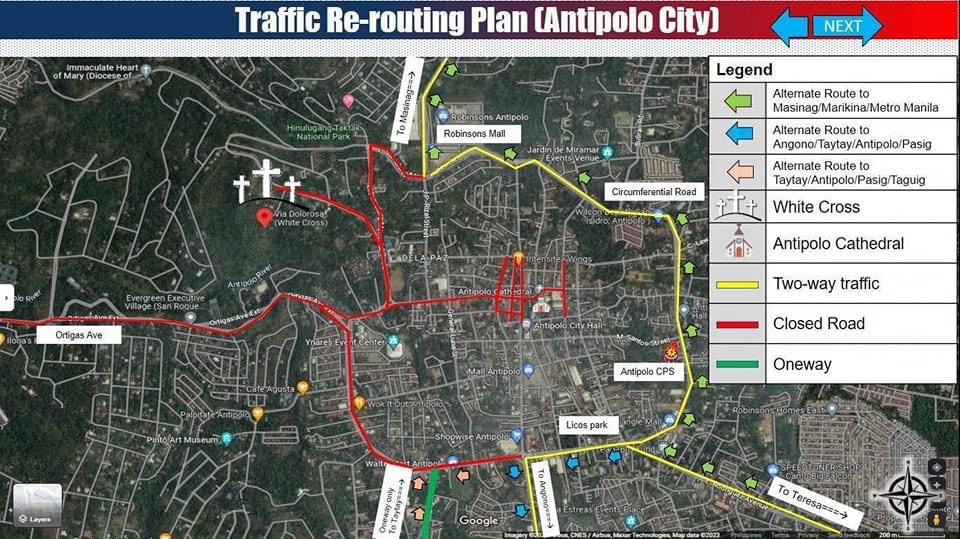
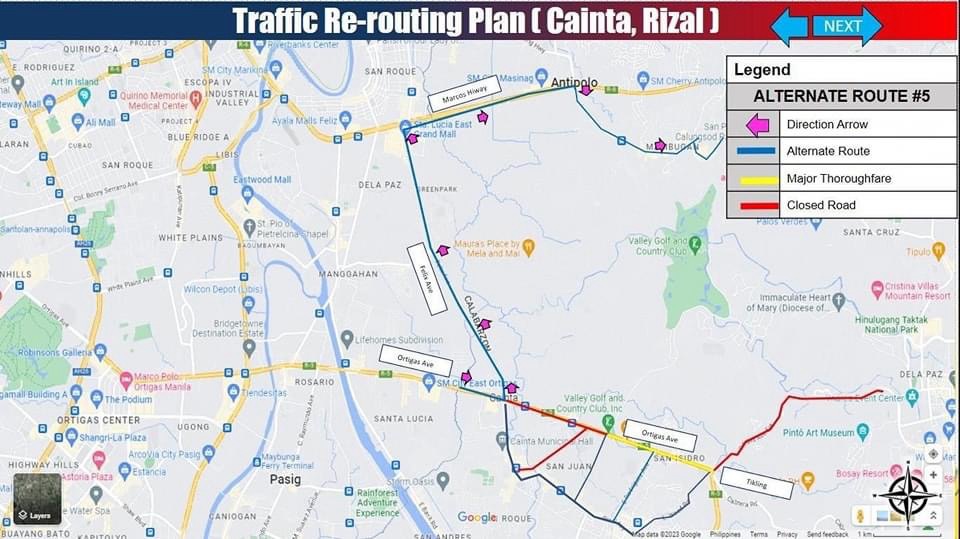
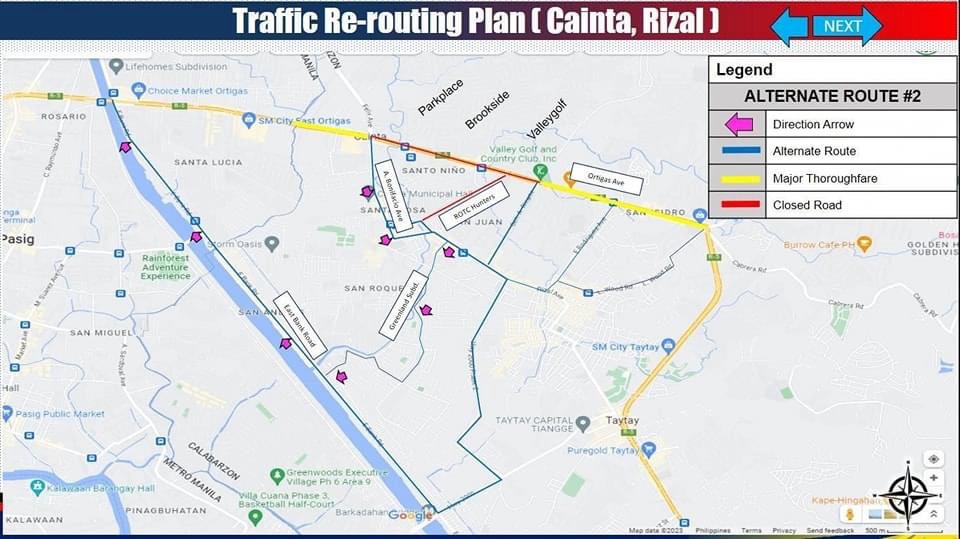
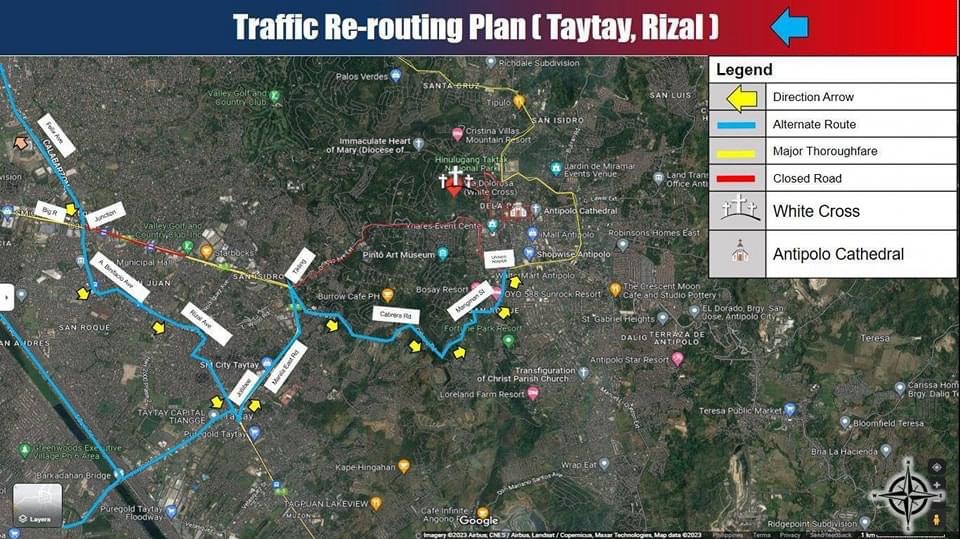
–
What’s new at Zamboanga Airport?
We were back in Zamboanga last week to do some follow-up work on a project on road safety. We also paid a courtesy call to the new City Administrator to reiterate our commitment on helping the city address concerns about child road traffic injury prevention. Of course, I was able to take some new photos of places and food. Among the typical photos I take is of the airport.
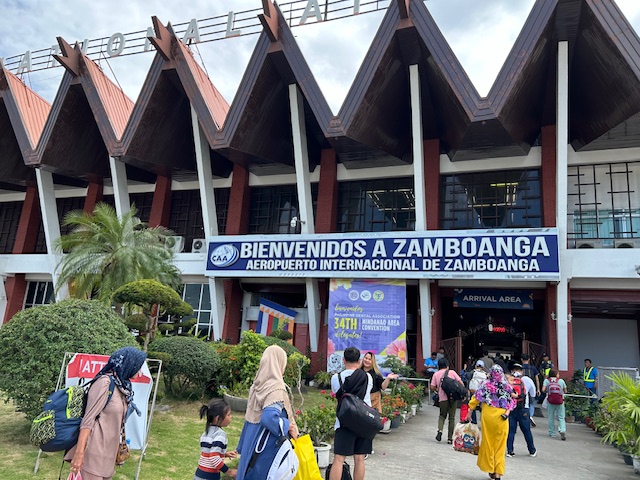 Passengers arriving at the Zamboanga Airport
 We were greeted by what looked like a new baggage carousel at airport
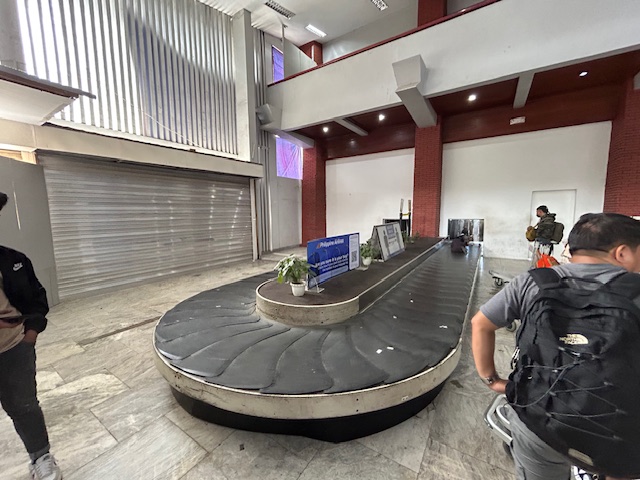 This actually looks like the old one transferred to this position. The new one is currently being set up where the old one was and will probably be operational very soon. That means the airport will be able to separately handle baggage from two arriving planes.
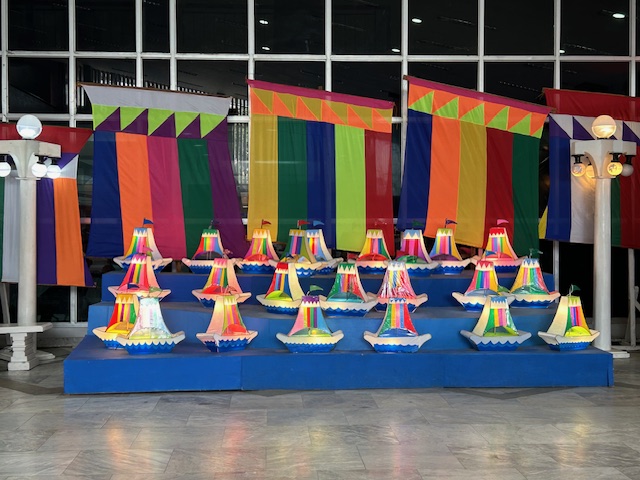 Colorful vintas on display at the arrival area just next to the baggage claim area
–
Congestion near bus terminals during the Christmas season
I attended a formal event yesterday at the Philippine International Convention Center (PICC) in Pasay City. Along the way and back, I already noticed the congestion along Gil Puyat Avenue (formerly Buendia Avenue) as well as the congestion or how crowded the bus passenger terminals were. In fact, the buses at the JAC Liner terminal along Gil Puyat were all on the streets. The terminal itself was filled with passengers, many of whom were queued as they waited to board their buses. Others I assumed were in line to purchase tickets there. The latter apparently have not done so online, which is already an available and more convenient option for provincial travel.
 |
| Buses lined along the Makati-bound side of Gil Puyat Avenue. These are queued towards to the U-turn slot that will take them to the bus terminals on the other side and near Taft Avenue. |
 |
| Other buses are lined along the Pasay-bound side of Gil Puyat Avenue. These come from the South Superhighway where these buses eventually head to after boarding passengers en route to Southern Luzon, Bicol and even Visayas and Mindanao destinations. |
Then as now, the junction of Gil Puyat and Taft Avenues is a major convergence area for transportation especially provincial routes. Even before the construction of the LRT Line 1 (which has a station at Gil Puyat) there have been a number of bus terminals here. Currently, I am aware of the JAC Liner and DLTB bus terminal near the junction. There are others including small terminals or garages for provincial buses. These generate much traffic particularly during this Christmas, which is considered peak season for travel in the country.
–
Back in Davao after 4 years
We conclude the month of November 2023 with a post on a recent travel, which allowed me to take new photos of an airport I’ve frequently used in the past. I was in Davao last week for a national convention. The last time I was there was in August 2019 and before the pandemic so it was a welcome trip for me. Back then and probably even now, Davao was riding high after 3 years of Digong as President. I am glad that Davao is still rapidly progressing. It has so much potential with or without a certain holding key posts in government.

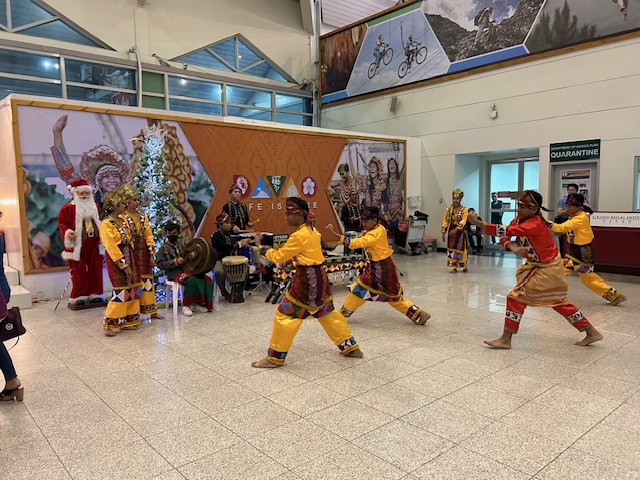
I will be posting about the Francisco Bangoy Airport in the next days. There have been some improvements to the terminal but most remain the same as it was in 2019.
–
On Undas traffic 2023
The past two years, I have not written about the traffic situation or conditions during Undas or the holidays corresponding to All Saints and All Souls Days (November 1 and 2). There wasn’t much to write about really. The usual traffic congestion would be along roads near cemeteries and memorial parks. Marikina City’s Barangka area and Bonifacio Avenue near Loyola Memorial are usually congested due to the city’s public cemetery and the memorial park combining for significant traffic generation during Undas. The days leading to Undas find people traveling, usually back to their hometowns but these days many go out for vacations instead. And so the roads near the airports, seaports and bus terminals are also congested. Tollways and national roads (especially the main corridors) can also be congested with the exodus of people from Metro Manila to the provinces in Luzon Island. I assume something similar occurs for other major cities as well.
Many people I know seem to be vacationing this week as they took advantage of the October 30 Barangay elections and the declaration of November 2 as a holiday to take the week off. Many probably took leaves for the two days that were not declared as holidays – October 31 (Tuesday) and November 3 (Friday). Many if not most schools I know declared a break for the week. It is, after all, an opportunity for students, teachers and school staff to take a breather. At UP though, this week came shortly after its Reading Break so its likely people were not able to gain momentum despite the opportunity to catch up on matters like assignments and correcting exams or papers.
I saw some social media posts early this week about expressways being congested. A few even opined that tollways were a scam because of the toll fees being collected despite congestion. I found those quite amusing as the alternative would have been national and local roads that would also be congested. Tollways have been proven to provide shorter travel times (and therefore higher level and quality of service) compared to the free roads. Also, its a free country so those who have their own vehicles may choose to take free roads. We also have apps like Waze to help us find alternative routes other than those that involve tollways. But for long distance travel (e.g., Manila to Baguio, Manila to Legazpi, etc.), tollways will always have the advantage over free roads. Of course, the timing of the travel also matters and the long Undas week should allow for some flexibility in travel especially those taking the road trips.
Here’s to a meaningful and reenergizing Undas!
–
Inflight meals onboard AirAsia flight MNL-KUL
Airline food is probably among the most maligned among meals. You’ve probably read or heard about complaints on meals served on board aircraft; especially those on Economy Class or coach. You have to be in Business Class or First Class to be served good meals or sets. If you are not the picky kind, then you will likely find the simply joys with the meals served on low cost carriers. These are usually selected and paid for in advance though you can also order in-flight assuming they carry all those items on their menu. Here are some items with AirAsia’s Santan:
 Promotion of in-flight meals on AirAsia
 The Chicken Rending and Vegetable Curry meals look good on paper.
 So are the Chicken Biryani and Vegetable Biryani meals.
 The Chicken Rice and Thai Basil Chicken dishes are also familiar to me. I wondered if the airline got these right and if they would be satisfying to passengers choosing these on-board or perhaps pre-ordering them.
 Nasi Lemak sounded familiar and was perhaps something we tasted when we were still residing in Singapore.
 There’s a vegetarian or plant-based version of this dish.
 I settled for something familiar and enjoyable to me – Chicken Satay
 The rice was curiously prepared and served similar to the ‘puso’ found in the Visayan and Mindanao provinces of the Philippines.
To cut the story short, I enjoyed my simple meal on-board AirAsia. I would dare say that I found my meals on this airline better than what I have eaten on-board Cebu Pacific. The meals also were better than what we recently had on board Philippine Airlines. That says a lot considering PAL is a full service airline. Of course, the meals on board Singapore Airlines and Thai Airways are would be tops on my list even in Economy Class.
Something I wanted to write about is my take on airline food over the years. I have a good memory of my first airline meals on board PAL in the 1970s. And I have had my fair share of various airline meals including First and Business Class meals on various airlines. That should be fun to write about!
–
First impressions of a country or city – Kuala Lumpur
I recently traveled to Malaysia and just making this quick post of first impressions based on one of its gateways – Kuala Lumpur International Airport. This was not my first trip to Malaysia as I traveled there before but by land and from Singapore (we were residing in Singapore). That time, I traveled to Melaka. Here are photos when we arrived in KLIA last weekend.
 |
| A view of KLIA Terminal 2 as our plane approached to land |
 |
| Two towers – air traffic control towers, that is. The closer one is Terminal 2’s while the one at the distance is Terminal 1. |
 |
| A view of Terminal 2 as our plane taxied to the terminal |
 |
| Terminal 2 is designated for low cost carriers, and is the hub of AirAsia. This terminal replaced the low cost carrier terminal at KLIA, similar to what also happened in Changi. |
 |
| Our plane berthed at the satellite building. This meant we had to walk to the bridge to cross to the main Terminal 2 building. The two buildings are not served by a transit system like KLIA Terminal 1 (or HKIA or Changi, for example). |
 |
| The view of our plane as we crossed on the bridge to the main terminal building. |
 |
| AirAsia planes lined up along one of wings of the satellite building. Each wing is essentially a long pier. |
I was impressed by how large and spacious Terminal 2 is. It is designed, after all, to serve the millions of travelers going through this gateway in what is Southeast Asia’s most visited country for tourists. I just thought though that the moving walkways seemed to be an afterthought and that it was a long walk (healthy though) for many people between the main and satellite buildings. Terminal 2 though is located far from Terminal 1 so transport is required in case you need to transfer from one terminal to the other. It is not as seamless as Changi, for example. Still KLIA is much better than many capital city airports that I’ve been to though there is room for improvements.
–
 Caught (up) in traffic