
Home » Trip Generation
Category Archives: Trip Generation
Congested Katipunan again
During the Christmas break, we were reminded just how Katipunan Avenue can be congested due to the trips generated by the institutions along it. These are mainly the schools such as Ateneo, Miriam and UP. Based on my observations and experiences over the past decades though (I started attending UP in the late 1980s), the main culprit is Ateneo with all the private vehicles it generates for its students in all levels (Grade School, High School and College).
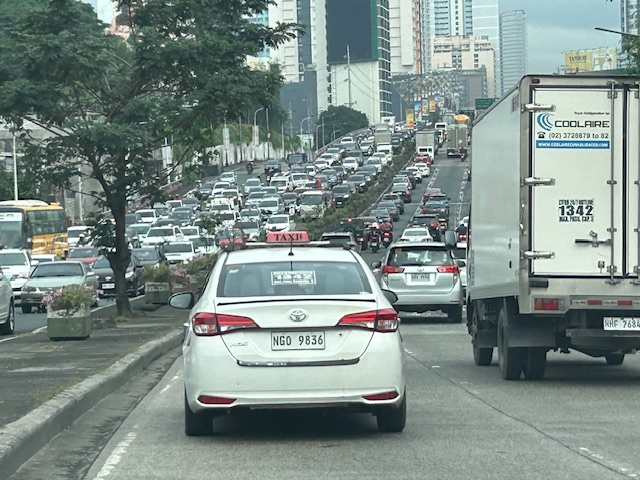 What “normal” traffic looks like on a typical weekday along Katipunan Avenue
My commute during the break is usually under 1 hour (e.g,, 40-50 minutes). But during the times when there’s school, it’s always more than an hour (e.g., 75 to 105 minutes). Will the situation improve? Will there be a mass transit system along C-5 to alleviate the traffic conditions? We can probably hope so but it doesn’t seem to be in the near horizon right now. The Metro Manila subway, after all, is expected to be operational in the 2030s!
–
Traffic congestion along EDSA
I’ve taken some photos of EDSA traffic as well as the EDSA Carousel buses. Here are the more recent EDSA photos I took as I traveled from Makati to Quezon City after serving as a panelist in the Energy Transitions Dialogue last Wednesday.
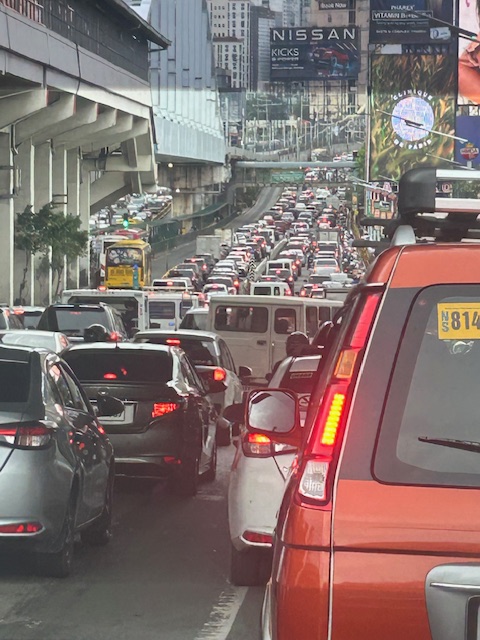 I took this photo as we passed Guadalupe. I like this in the sense that it shows the clear ROW for the EDSA Carousel buses. One wonders why most of these motorists would prefer to drive their vehicles rather than take the bus or the MRT.
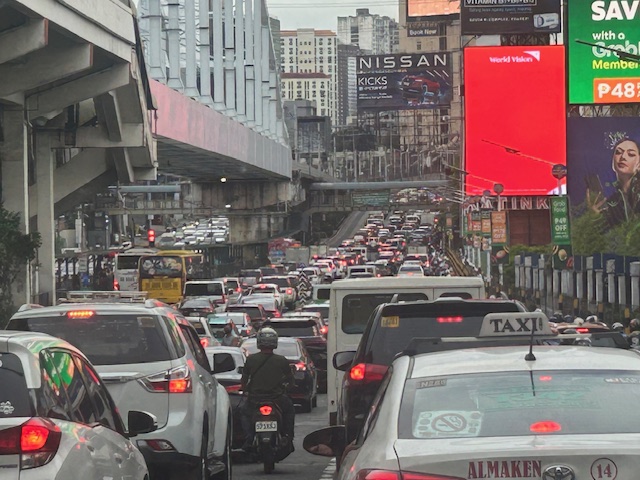 You can see in the photo that EDSA’s northbound side is clogged as far as the eye could see. If you check the image under the MRT bridge, it shows the southbound side was also congested. These photos were taken around 4 PM so this was still an hour before most people would be going home from work.
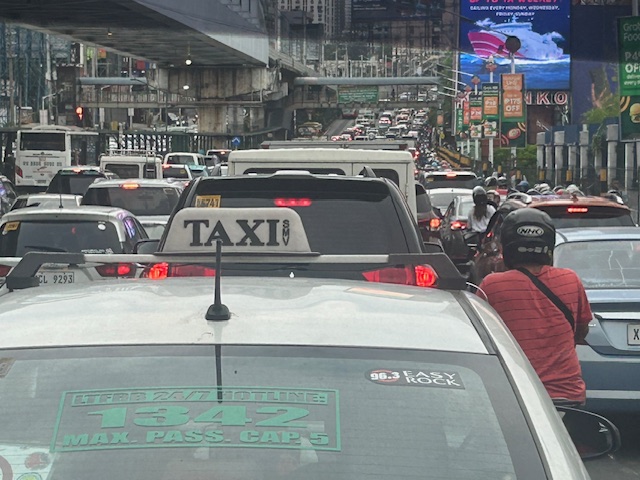 I mentioned in my comments at the panel that one consequence of giving number coding exemption to electric and hybrid vehicles is that this further diminishes the effectiveness (is it still effective?) of the MMDA’s number coding scheme. I don’t have the stats of how many EV’s and hybrids are registered and running in Metro Manila. Those numbers combined with actual counts will tell us how they are impacting traffic. That would be a nice topic for a paper. 🙂
The photos pretty much describe the transport situation in Metro Manila. Many of our major cities will be heading this way unless they improve their public transportation fast. If they do, then public transport mode share will be sustained if not increased. Metro Manila’s is already being eroded by inefficient public transport, motorcycles (including taxis) and perhaps unintentionally, electric and hybrid vehicles.
–
Increase in parking rates at NAIA
A friend shared this notice about the increase in parking rates at NAIA.
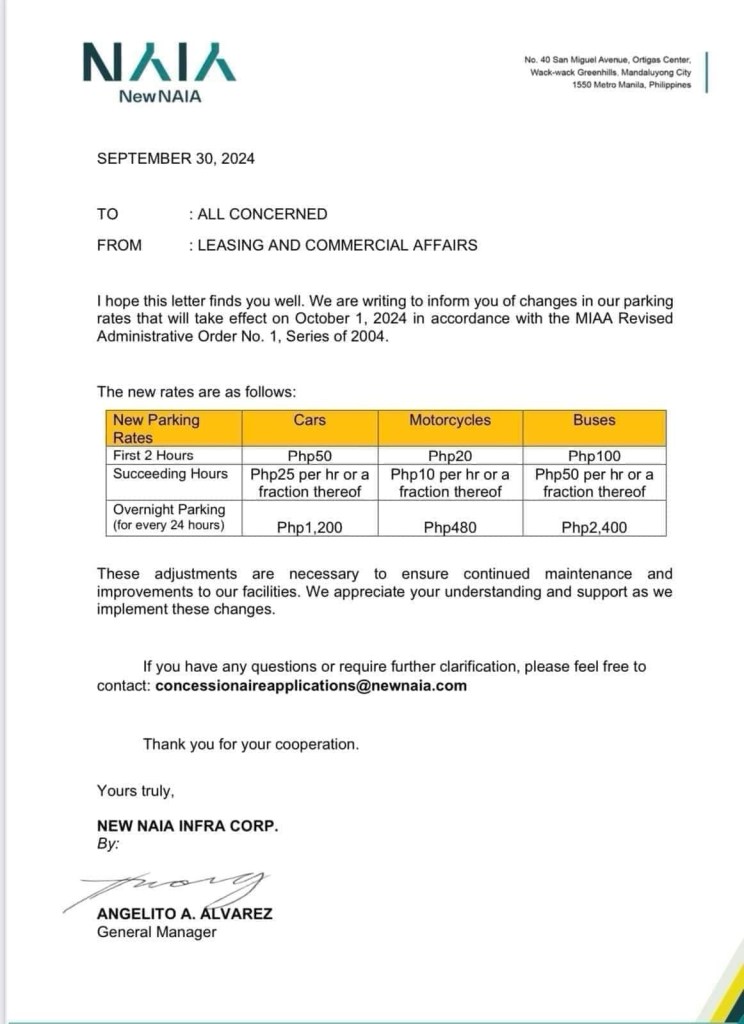
Parking at any of the terminals has been quite difficult if not horrendous. Everyone seems to be bringing their car to the airport for pick up and drop offs as well as leaving them for a night or more while traveling abroad or somewhere in the country. And then there are those who park there because the rates are supposed to be cheaper than the hotels and mall around the airport (e.g., the case of Terminal 3). Will the increase in the rates discourage unwanted or unnecessary parking? Perhaps not because people are still quite dependent on cars as their primary mode in and out of NAIA.
Access to the airport remains road-dependent. Granted there are many options like ride hailing, airport bus and taxis, these are all road based. They share the same roads that are often congested. The tollways are not enough to ease traffic in the area, which aside from airport generated trips include those from offices and industries in the area.
Too long has the need for a rail access for the terminals and government has failed to provide it. It would at least have engaged private sector for this provision but it took so long. Perhaps the Metro Manila subway will change that but we have to wait a long while to find out.
–
A real battle of Katipunan – the search for a transportation solution
Is it obvious that I was alluding to the classic match-ups of the two major universities – Ateneo De Manila University and the University of the Philippines Diliman – that are located along Katipunan Avenue for the title of this article? That is deliberate on my part as there is a ‘real’ battle along Katipunan Avenue, and it does not involve sports.
Following is a recent article from the Philippine Collegian that reports on the current state of traffic along the corridor:
https://phkule.org/article/971/private-cars-mainly-to-blame-for-katipunan-traffic-transport-experts
I have written before and many times about transport and traffic along Katipunan Avenue. This road has been part of my daily commute since 1988 when I was admitted to UP Diliman as a B.S. Civil Engineering major. Back then Katipunan was not as wide as it is now, especially along the section between UP Diliman and the MWSS complex. That section only had 2 lanes then. What is not a wide center island with large, old acacia trees used to be the frontage of MWSS. So now you can probably imagine how much land was ceded by MWSS for road widening.
I also wanted to write about Katipunan in part as a sort of farewell to the former MMDA Chair and Marikina Mayor Bayani Fernando (BF), who recently passed away. Much of how Katipunan looks like and the traffic situation today can be traced to what transpired during his time at MMDA. I will refrain from writing about this and him for now. I am actually thinking of writing a series about BF and his time as Mayor in Marikina, as MMDA Chair, and his brief stint as DPWH Secretary. This short article will do for now.
On reducing vehicle travel
This Sunday, I am sharing this article on the reduction of excess vehicle travel. I noted the use of the word ‘excess’ here, which somewhat distinguishes what is excess from what is necessary vehicle (or car) use.
Litman, T. (September 8, 2023) “How to reduce excess vehicle travel,” Planetizen, https://www.planetizen.com/blogs/125445-how-reduce-excess-vehicle-travel?utm_source=Planetizen+Updates&utm_campaign=b3ced8c873-EMAIL_CAMPAIGN_2023_08_09_05_38_COPY_01&utm_medium=email&utm_term=0_-6cce27a957-%5BLIST_EMAIL_ID%5D&mc_cid=b3ced8c873&mc_eid=9ccfe464b1 [Last accessed: 9/17/2023]
To quote from the article:
“Too often, practitioners undercount and undervalue slower but more affordable, inclusive, and resource-efficient modes such as walking, bicycling, and public transit. This contributes to the self-reinforcing cycle of automobile dependency and sprawl, illustrated below. We have an opportunity to break this cycle by recognizing the unique and important roles that walking, bicycling, and public transit can play in an efficient and equitable transportation system, and the cost efficiency of vehicle travel reduction policies. Telework can help, but only if implemented as part of an integrated program to create a more diverse, efficient and equitable transportation system.”
There is a lot you can pick up from this article, which sheds a light of hope towards addressing the most pressing issues particularly for our daily commutes. Litman is always clear and evidence-based for his discussions. His arguments are very persuasive if only decision-makers are not resistant to the facts about transport.
–
New reclamations at Manila Bay
As our plane approached to land at NAIA yesterday, I saw the current extent of the reclamation projects underway at the Manila Bay.
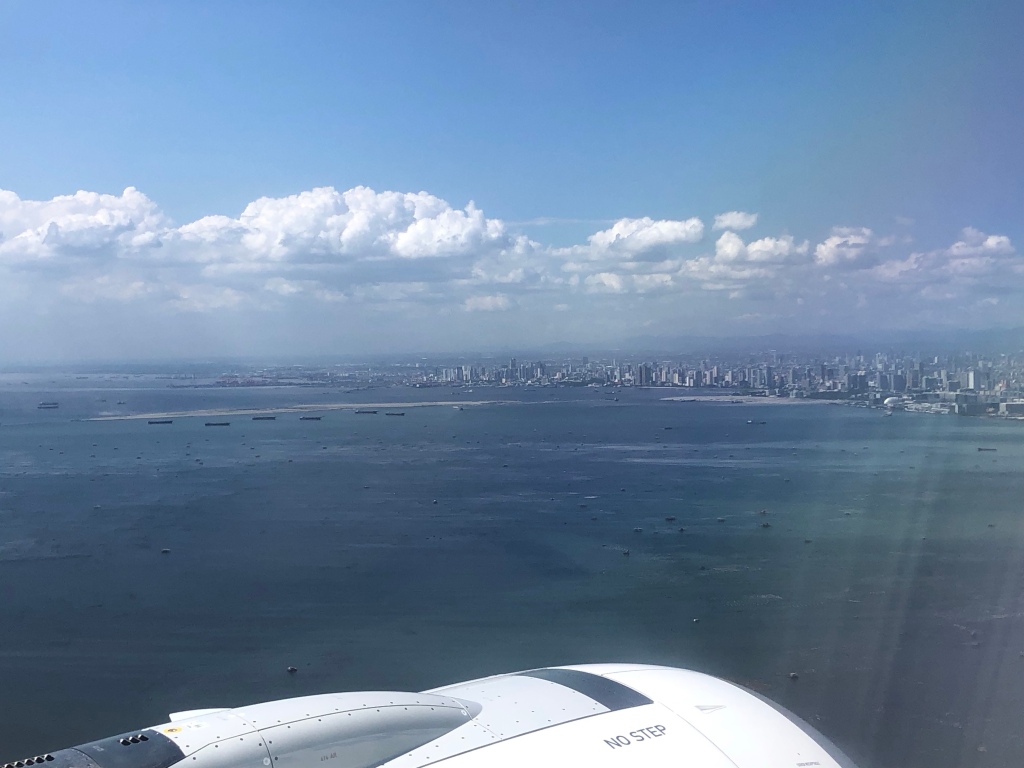


These projects are expensive to implement and will surely lead to even higher real estate prices. This will translate to expensive office, commercial and residential units. So one wonders who will ultimately benefit from these developments. Will government come in and require low cost housing here or will future workers have to commute to these places from the suburbs? The latter will definitely put more pressure on an already deficient transport system.
–
On how communities should be?
This post is related to my recent post about Philippine cities and municipalities already somehow being 15-minute units. I am sharing another article I’ve read and reread for its current relevance.
Litman, T. (March 15, 2021) “A Complete Community is All Mixed-up,” Planetizen, https://www.planetizen.com/node/112565?utm_source=newswire&utm_medium=email&utm_campaign=news-03222021&mc_cid=628c8ee4b1&mc_eid=9ccfe464b1 [Last accessed:
The article is loaded with references that you can download and use in research or practice. And there are these two tables – Walk Score Ratings and Public Amenities – that are quick guides or references to what is desired to be achieved in communities.
Enjoy!
–
On travel restraint and transport options in the time of COVID-19
Previous to the lockdowns associated with the COVID-19 pandemic, there were typically a lot of trips being made that many can regard as unnecessary. These are not the typical “to work” or “to school” trips that are being made on a regular basis (e.g., every week day). With the easing of the quarantine everywhere around the country, it seems a lot of people who felt they’ve been cooped indoors or have been limited in their activities have gone out. Many seem to have thrown caution to the wind, too, as evidenced from the many photos being shared showing people doing mass (bike or motorcycle) rides, shopping in crowded streets, etc. It becomes even more worrying now that Christmas is fast approaching when more people are going out to shop or visit relatives and friends. The following are quite basic while we are still experiencing the pandemic:
a. Required/imposed travel restraint – reimposition of the number coding scheme implemented by the MMDA with variations in certain LGUs such as Makati City (no mid-day coding windows) and those in the periphery (longer coding windows during mid-day), and limited implementation of the truck ban for certain roads (these of course will have certain exemptions for vital goods);
b. Increased number of public utility vehicles – the DOTr and LTFRB have been proceeding so slowly (but surely?) in re-establishing or resuming public transport services as they realized there will be no other opportunities like this to implement their rationalization and modernization plans simultaneously. However, the pandemic necessitates physical distancing and other measures to reduce if not eliminate the risks of infection
c. Making all modes available and viable as an option for commuters – Needless to say but all options must be provided for safe travel (esp. commuting). By ‘all’ I mean both motorized and non-motorized modes must be given as options to commuters, whichever they choose must be a safe option for them. That means providing the necessary facilities for walking and cycling, and, as mentioned, adding or augmenting public transport supply where necessary. By ‘commuters’ I mean those who really require traveling. These include our front liners and essential workers. Despite the push for local tourism, I personally believe this should be limited and LGUs need to discourage excursions that have the potential for spreading the virus.
d. Voluntary travel restraint – this is for everyone to consider rather than set aside. I guess given the easing of quarantine restrictions, many people have already had their fare share of going out including children and senior citizens who can now go out for some fresh air. Those opportunities should have already contributed to easing mental health issues, too. However, with the impending (if not yet here) increase in the infections once again, perhaps we should exercise self restraint during these holidays. This self-restraint can also be considered as sacrifices not just for one’s sake but for others especially loved ones we don’t want to get sick with COVID-19.
We still do not know who among us are or can be carriers and who can pick-up the virus and become very ill. As such, we should still be very careful, and adopt and practice measures to reduce infection risks. This goes very well with the spirit of the season. Let’s make the necessary sacrifices to beat this pandemic. Do not ‘gift’ your loved ones with Covid-19!
–
On data on mobility trends
There are actually a lot of data available on mobility if you know how to look for them. One good source is Apple. Yes, Apple has access to thousands of smart phones that allow them to track individuals (oh you didn’t know that?) movements. Here is the link to Apple’s data:
https://www.apple.com/covid19/mobility
And here is a graph showing mobility trends in the Philippines from that resource:
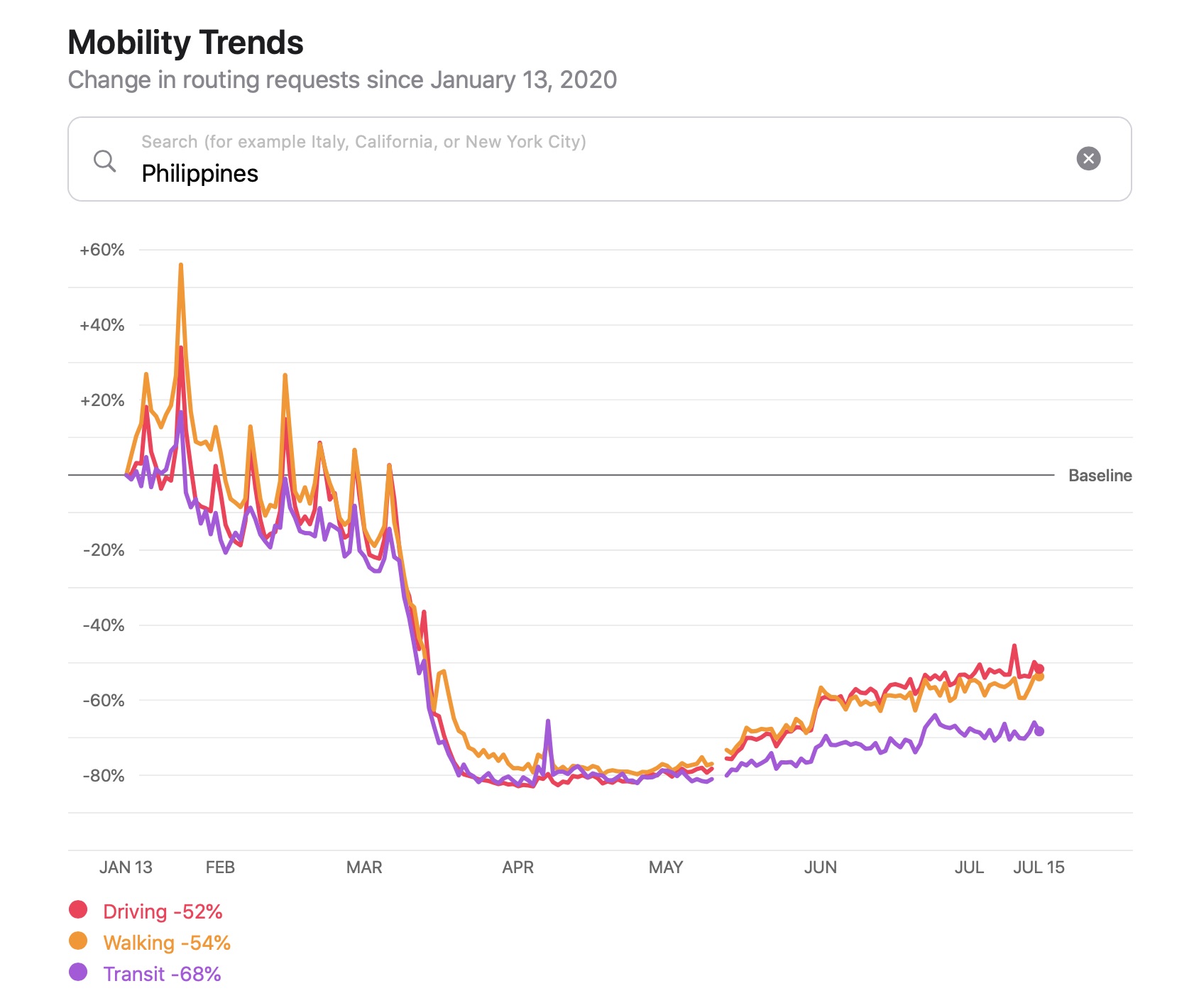
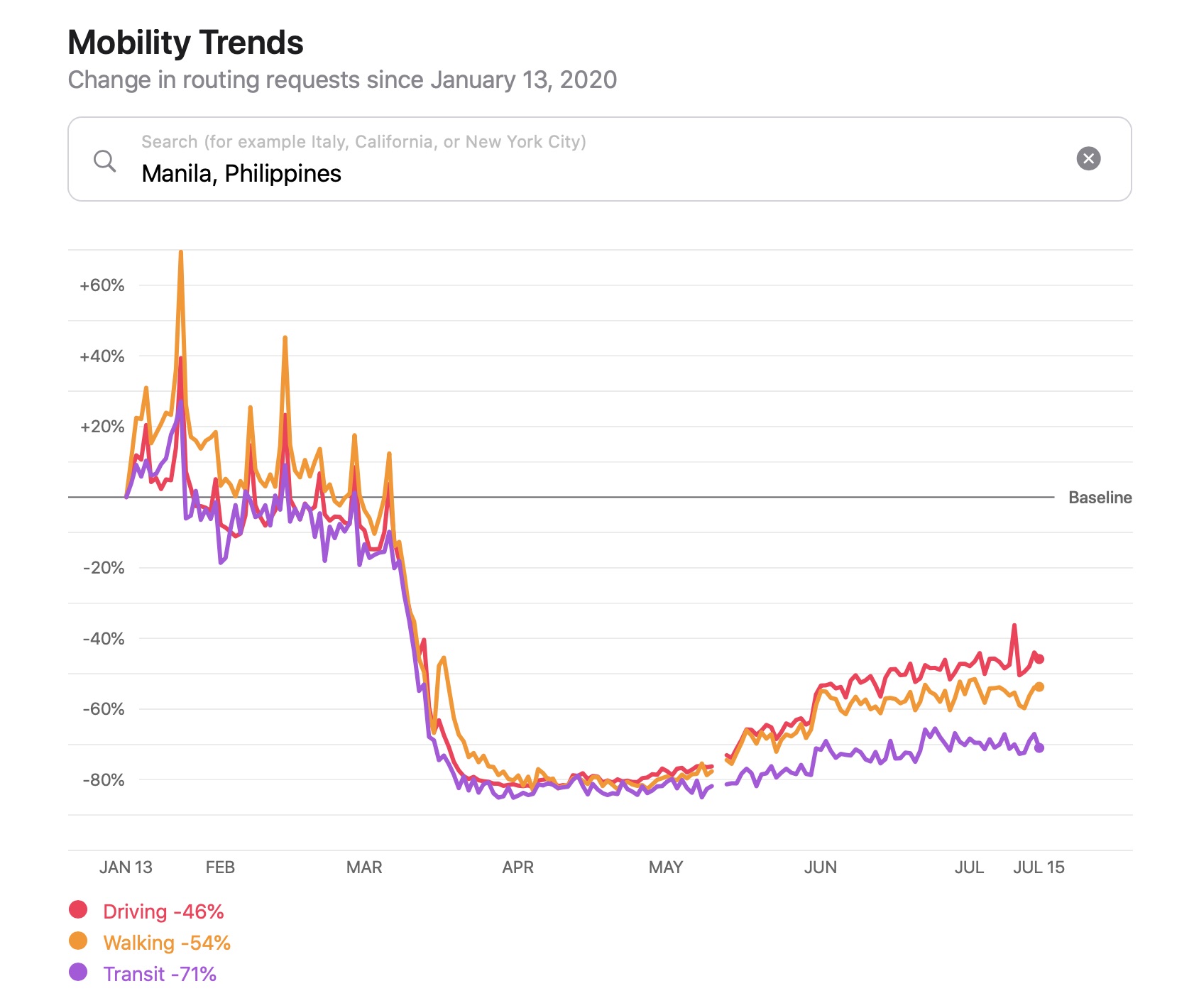
Some politicians and political appointees are now saying that we are in this predicament about COVID-19 because of a lack of discipline. That is bullshit. Many stayed home and/or reduced their movements. And then there’s that study showing 90% wore masks when they go out. No, it’s not lack of discipline that’s the problem but the lack of essential services and goods that are supposed to be delivered by those who are suppose to govern and the deficiencies from the start in addressing the spread of the virus especially from abroad. Perhaps these people criticizing Filipinos should look at their mirrors more closely and look left, right and across from they comfy seats to see what’s wrong with the way government has been handling the pandemic?
–
On empty malls and what’s in store for us under the new normal
I took the following photos inside a mall that’s close to my residence. One had to go inside to get to the drugstore located at the second level of the mall so you can see what it looks like during the lockdown. Not surprisingly, it is deserted but it looks clean and orderly. It seems that mall’s doing maintenance work and I did see a couple of janitors inside. They are probably the skeletal staff of the mall in-charge of making sure the building does not deteriorate during the lockdown period.
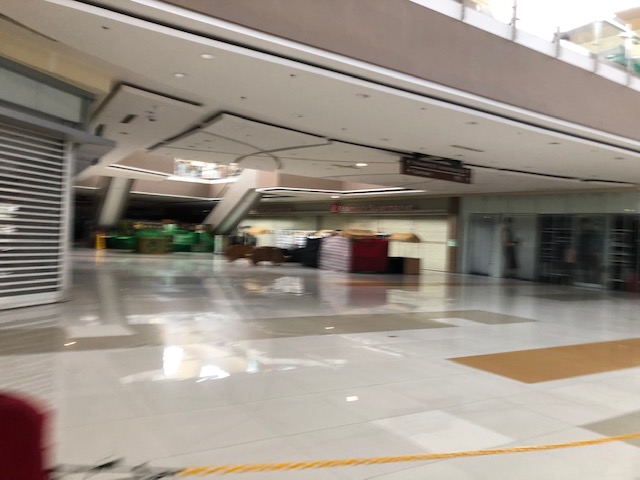 This used to the a very busy area leading to the supermarket and the appliance shop. The area also usually was at the events venue and often set-up here are the weekend stalls selling local items including our favorite cashew butter and sylvanas.
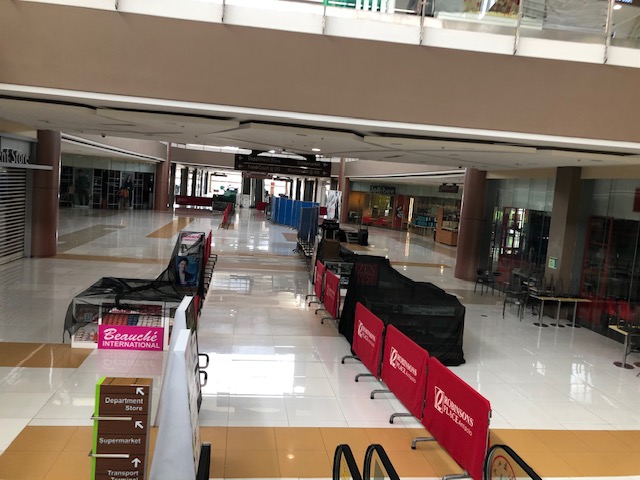 A look back at what was usually a crowded area at the center of the mall as I moved up the working escalator
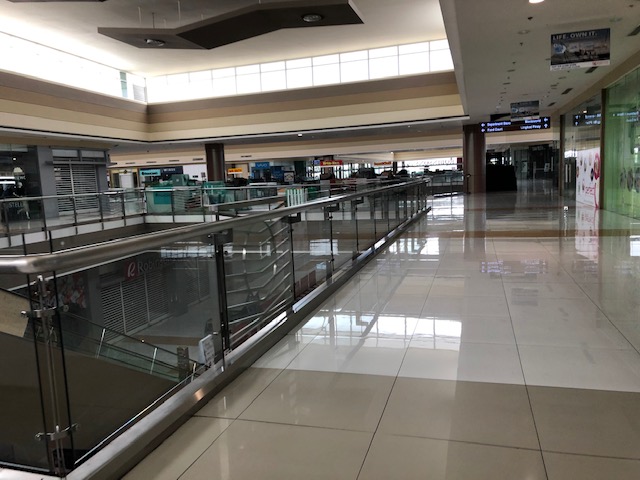 The second level was also practically deserted with only a few customers going to the drugstore and the occasional janitor or security personnel going around
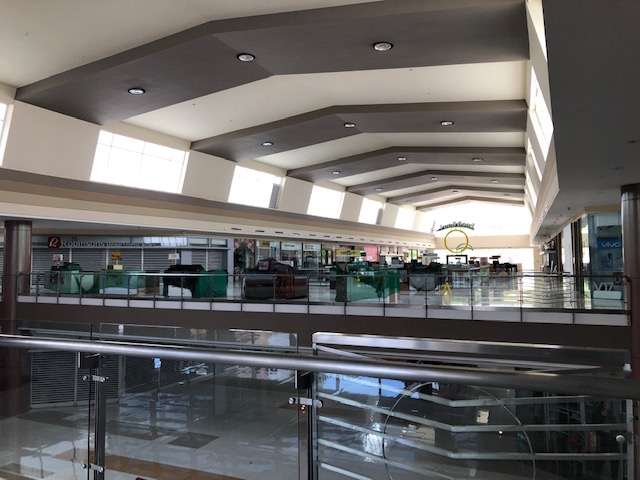 Across from where I was walking was another crowded area as this is the food court with the cinemas just beside it.
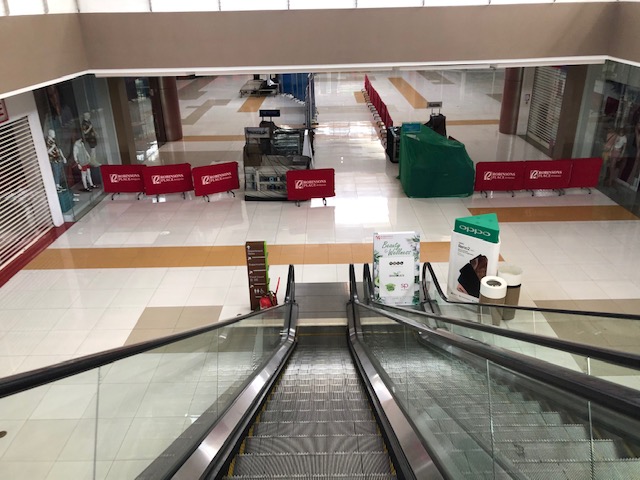 View of the ground floor as I descended on the non-functioning escalator on the other side of the second level.
I saw the photos posted on social media and the news yesterday as people crowded at mall entrances on the first day after the lifting of the Enhanced Community Quarantine (ECQ) in many cities. Of course, they are still under the General Community Quarantine (GCQ) but more people are allowed to go outside their homes with businesses like the malls starting to resume operations. I sure hope this ‘excitement’ and the resulting crowds will not lead to a worse second wave of Covid-19 infections. That will surely lead to the reimposition of ECQ in those areas. There are lessons to be learned from the reopening of businesses like shops and restaurants once quarantines have been relaxed. Those are lessons that are mostly from the experiences of other countries that we should carefully and meticulously consider in order to avoid the mistakes that have led to a second wave of infections. Let us not lead ourselves towards recklessness or irresponsible behavior that can spell disaster to many. Let us not think that things will go back to the ‘normal’ we used to live.
–
 Caught (up) in traffic