
Home » Posts tagged 'academe'
Tag Archives: academe
Looking back on Philippine railway history
The Philippine Railway Conference 2025 is coming up soon. I am very glad to see a lot of people interested in rail – from the technical people running our railways to those involved in planning and management to the advocates and enthusiasts. Rail was not so “fashionable” or “glamorous” (to use these words liberally) many years ago. Perhaps people traveling and experiencing rail in countries where it has persevered and evolved plus social media have changed this – and for the better. Sharing here some papers that were the outcomes of an interdisciplinary research program led by the Third World Studies Center of UP. Rail, after all, is not just about the technical but also the social and human aspects of the mode.
The website for the Emerging Inter Disciplinary Research (EIDR) program supported by the UP System is still up and hosted by the Third World Studies Center. I think it’s something worth a Phase 2. The program leader, Dr. Ricardo Jose, is now retired from UP but is a Professor Emeritus of UP so he can still be engaged. Nevertheless, there are many at UP and other higher education institutions who can be involved in a program that should have a more expanded coverage. There were railways, after all, in other parts the country including Panay, Negros, Cebu and Mindanao.
–
30th Annual Conference of the Transportation Science Society of the Philippines (TSSP)
I was not able to post on the conference itself but it was definitely a success including the pre conference workshop (Workshop for Young Researchers or WYRe) held for the benefit of young researchers in transportation science.
Here is the link to the TSSP’s official page featuring the program for the Technical Sessions: https://ncts.upd.edu.ph/tssp/archives/2972
There were 6 sessions with papers on public transportation, active transport, traffic engineering and others including port operations and safety. A total of 27 papers were presented and in attendance were more than 150 people, mostly from the academe. The conference was conducted in cooperation with the University of the Philippines Visayas and the City Government of Iloilo. When available, I will also later share information about the very informative and enlightening keynote lecture delivered in the morning of the conference on the topic of Global Health.
–
Technical sessions at the TSSP 2024 Conference
I am sharing here the latest draft of the technical sessions for the 30th Annual Conference of the Transportation Science Society of the Philippines (TSSP). The conference will be held in Iloilo City this coming September 13, 2024.
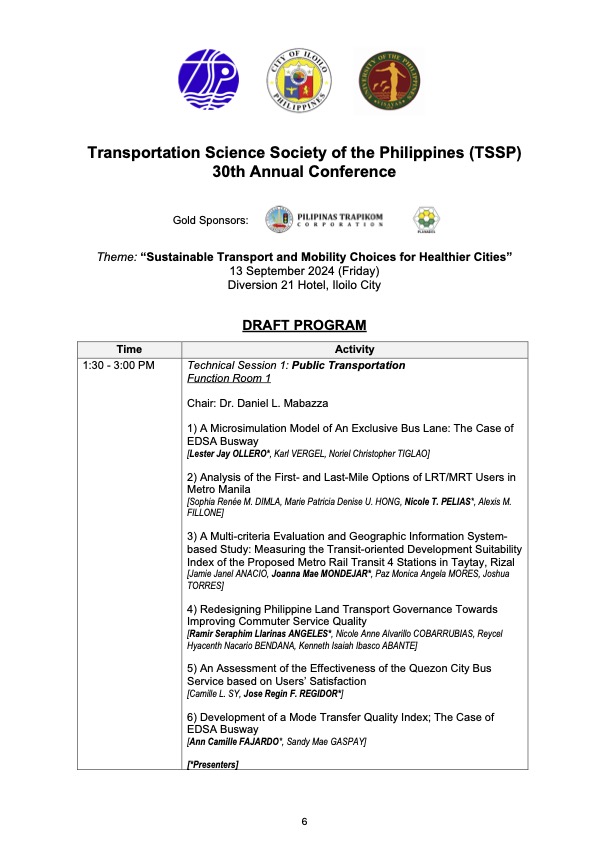
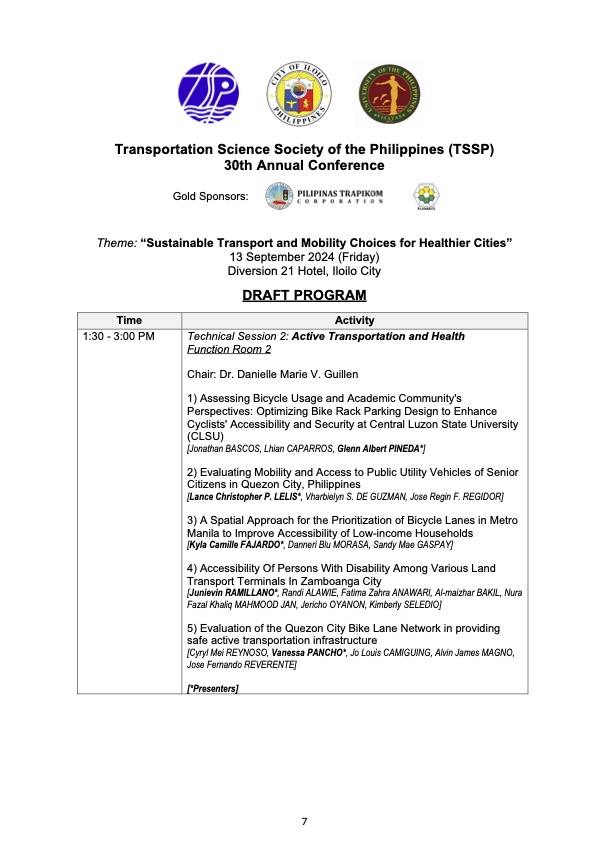
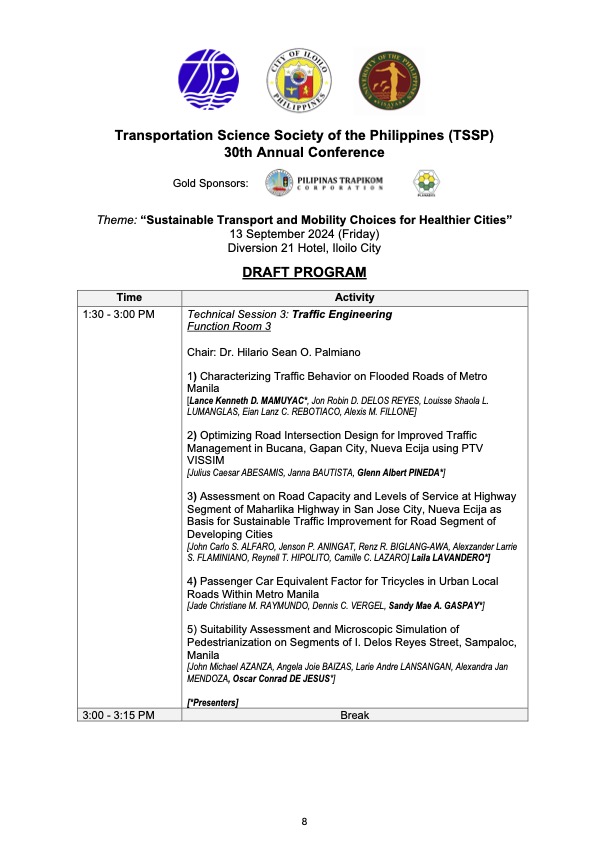
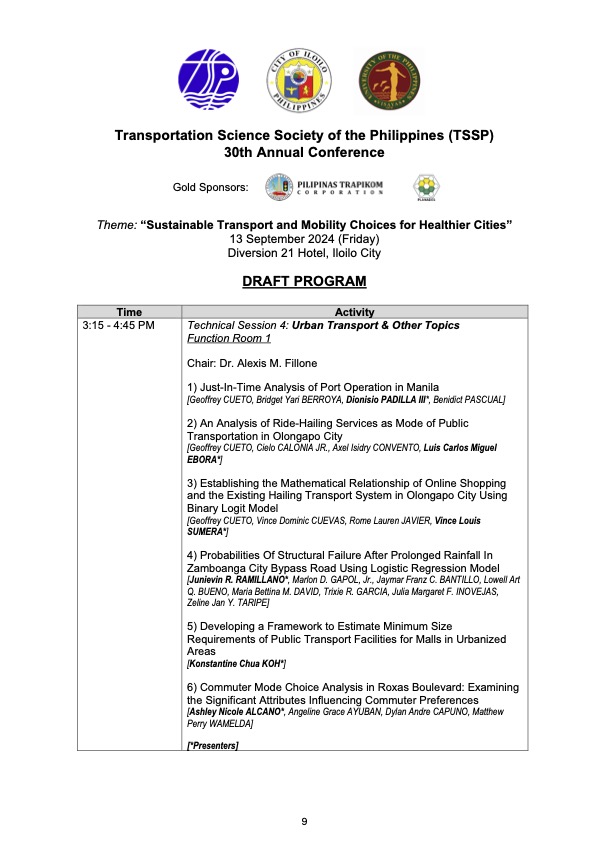
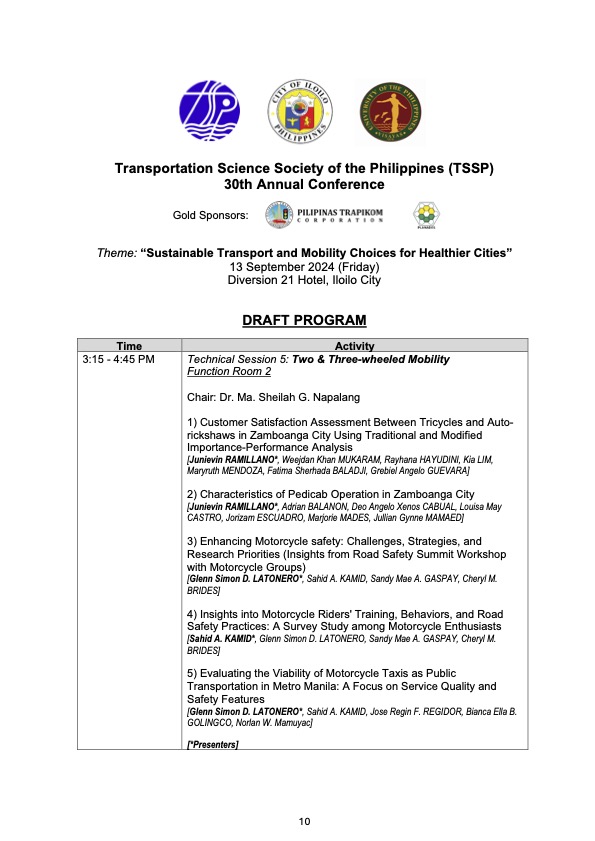
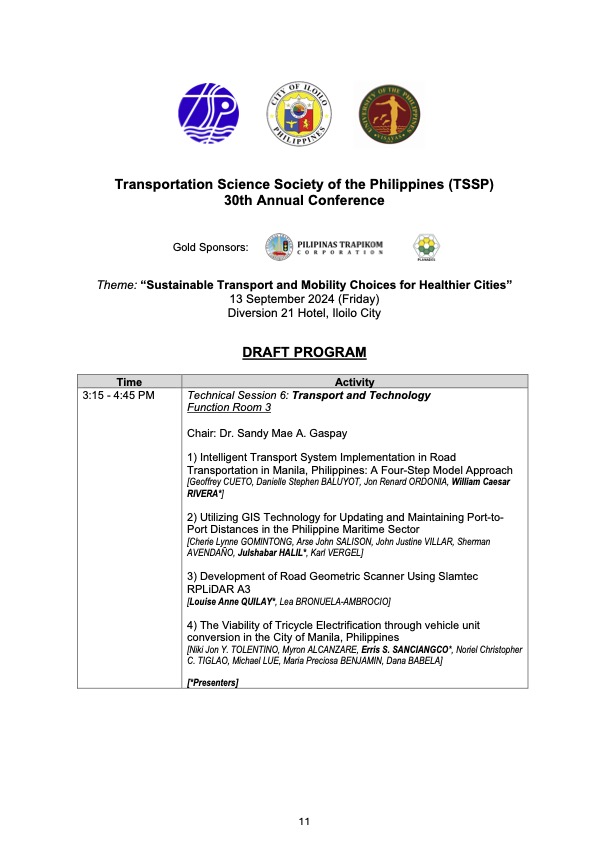
I will share the draft program for the morning plenary session in the next post.
–
Article share: Picking it up as we go: how transportation agencies can learn from university research
Here’s a quick share of an article on the JTA Research Lab. This is a good example of how transportation agencies can learn from university research and also how they can collaborate or cooperate with academe to formulate solutions to various transport problems or issues.
JTA Research Lab has been created to identify critical transportation policy questions, and get academics to help solve them. Pencils sharpened? Nathaniel P. Ford explains…
Source: Picking it up as we go: how transportation agencies can learn from university research
30th Conference of the Transportation Science Society of the Philippines
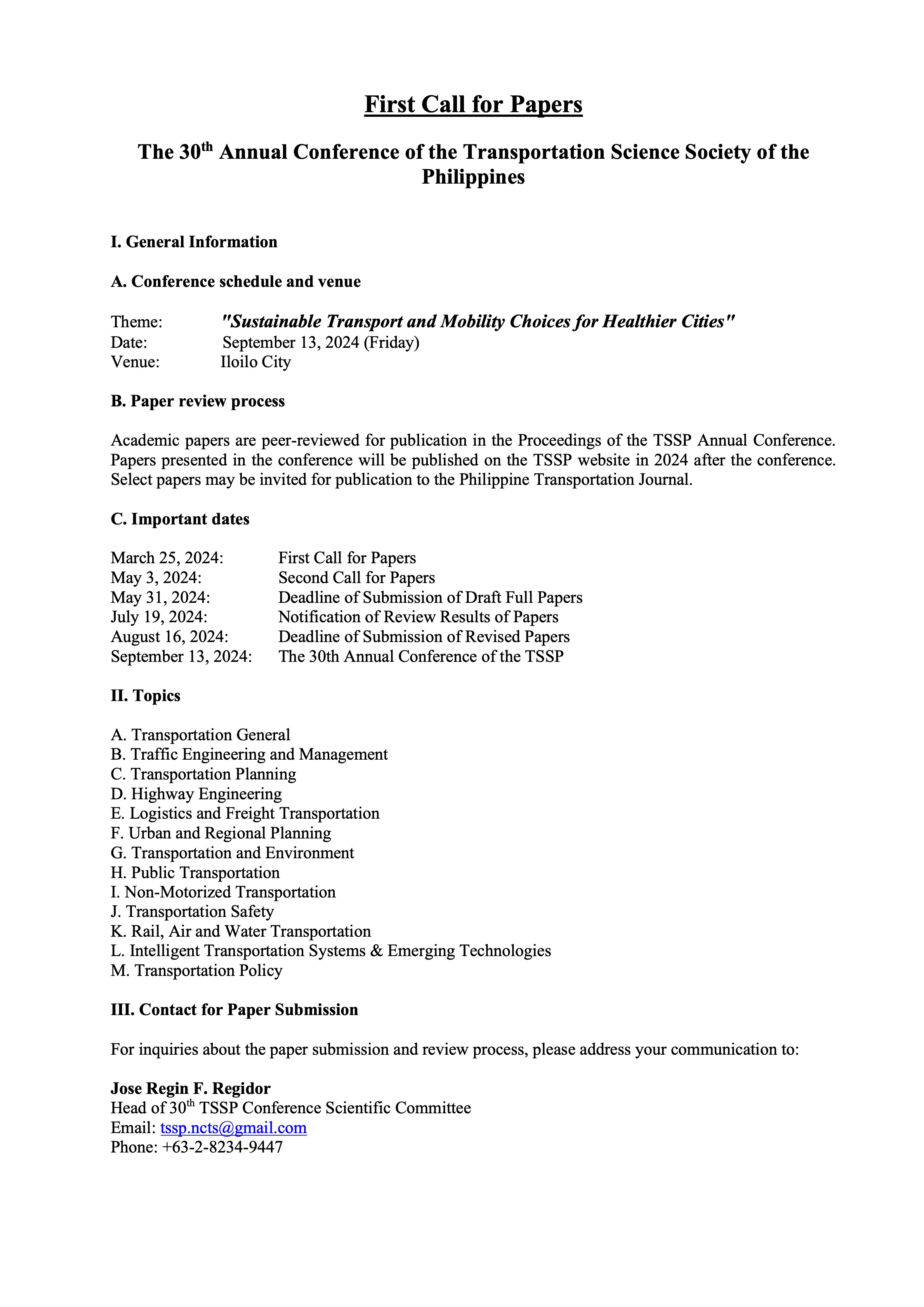
I am sharing here the First Call for Papers for the 30th Annual Conference of the Transportation Science Society of the Philippines (TSSP). The conference will be held in Iloilo City almost to the day of the last time it was held there in Sept. 12, 2014.
Information on past conferences may be found here: https://ncts.upd.edu.ph/tssp/conferences
–
Some takeaways from a lecture
I lecture from time to time at the Philippine Public Safety College. This is the counterpart of the National Defense College. In the latter graduates are conferred a Masters in National Security Administration (MNSA) while in the former, graduates are conferred a Masters in Public Safety Administration (MPSA). It is no wonder that many who take these courses are military or police officers seeking graduate degrees that may later be useful for them after their typically early retirement (military and police officers retire at 56 years old instead of the typical 65 years mandatory retirement for other government employees). There are many civilians who take these programs, too. The MNSA degree actually promotes a person to a high rank as a military reservist. I am not sure about the MPSA degree but graduate degrees like these are useful for promotions in their respective offices.
I lectured recently to a class consisting of two batches of their MPSA program. Each batch consists of uniformed (mostly senior police officers with a rank equivalent to at least a Lt. Col.) and non-uniformed personnel (from various offices and professions including public and private universities, private companies, etc.). I get a lot of questions and comments regarding transport and traffic during my lectures. Some can be out of context or perhaps posed in a smart-aleck fashion but most are well-intentioned. After all, who doesn’t want to “solve” traffic? Among the more notable comments during my recent lecture are as follows (not in any order):
- There is a need to have better urban planning for our cities;
- Investments for transportation infrastructure need to be shared by government and the private sector;
- A holistic approach is required and we cannot isolate transportation or traffic;
- There is a need to have a law restricting vehicle ownership (mostly related to parking);
- There is a need to invest or allocate more resources to develop other cities to help decongest the larger cities.
Based on my experience having lectured at the PPSC over 5 years, these two batches had more listeners and were more sensible when they posted their comments and opinions on the chatbox (the lecture was via Zoom). There were only a couple of comments with ideas I did not agree with:
- Transferring the capital to another location – this seems to be a trendy (read: “nakikiuso”) topic and a very tempting one for discussion but it is not a simple task and has had mixed results in other countries that tried it (e.g., Brazil, Pakistan and Malaysia). Is it worth exploring? Probably.
- Cable cars for Metro Manila – I explained that this is still band-aid solution that does not address the roots of the transport problems experienced by Metro Manila. It is not suitable as for one, it will not have the capacity required for regular commutes and, to me at least, it is more a novelty than a solution. Resources would be better allocated elsewhere such as active transport.
Overall, I thought that this most recent lecture generated the best feedback so far from my students. I look forward to more lectures and interactions like this. And perhaps the next one will be face to face.
–
On university-community collaborations
I’m not a stranger to university-community collaborations. In fact, I even helped draft a proposal for the World Bank to support such collaborations, which I believe would be sustainable and therefore worthwhile to be pursued by potential partner universities and local government units. There are actually many such collaborations but most of these are probably informal with certain faculty members of universities (usually state universities or colleges) being involved in committees or moonlighting in projects implemented or funded by LGUs. I say informal because technically, the school is not involved in the project and it is only incidental that the person or persons involved are affiliated with the university or college.
Here is an article showing an example of university-community collaborations:
National Institute for Transportation and Communities (2022) “Transportation recovery after disasters: A collaborative university/community model,” phys.org, https://phys.org/news/2022-08-recovery-disasters-collaborative-universitycommunity.html [Last accessed: 8/15/2022]
The authors wrote about actions that could be done “to build future economic resilience.” To quote from the article:
-
Increasing pre-disaster investment in resilient transportation infrastructure to reduce the cost of eventual recovery;
-
Improving business resilience practices for high-impact industrial sectors, through education and outreach;
-
Identifying structural barriers to adoption of resilient business practices, and promoting mitigation through recovery.
-
Mainstreaming disaster resilience into economic development by breaking the siloed approach to emergency management and economic development.
While these actions were framed for the community engaged by the University of Utah, they are general enough to be applicable to other communities as well.
I mentioned earlier about the need for formality. The Commission on Higher Education (CHED) encourages and supports what are termed as Extension Works or Extension Projects by higher education institutions. These may be in various forms including committee work, advisory, capacity building/training, or even professional work/services provided to the province, city or municipality (even barangay). But there should be accountability here as well as the proper assignment or allocation of resources.
Just compensation is one of the more sensitive or tricky elements or items here as often, LGUs would like to get something for free or assume that certain services are free. They are not and time and effort should be compensated; just not the international rates you might expect for consulting work from the likes of World Bank or Asian Development Bank.
Here is where contracts (e.g., in the form of Memorandum of Understanding (MOU) or Memorandum of Agreement (MOA)) can be useful to establish the terms of engagement that includes budgets for Personnel Services (PS), Equipment Outlay (EO) and Maintenance and Other Operating Expenses (MOOE). The latter categories should be familiar with LGUs because these are standard items under which details are provided for their programs and projects. State universities and colleges are also familiar with these as standard government terminologies for budgets. Of course, that goes without saying that in certain engagements, there may be third parties such as donor or funding institutions that will should all, most, or part of the costs for collaborative work.
–
TSSP 2021 [27th Annual Conference]
The Transportation Science Society of the Philippines (TSSP) held its 27th Annual Conference last November 19, 2021. Here are the poster and program for the conference:
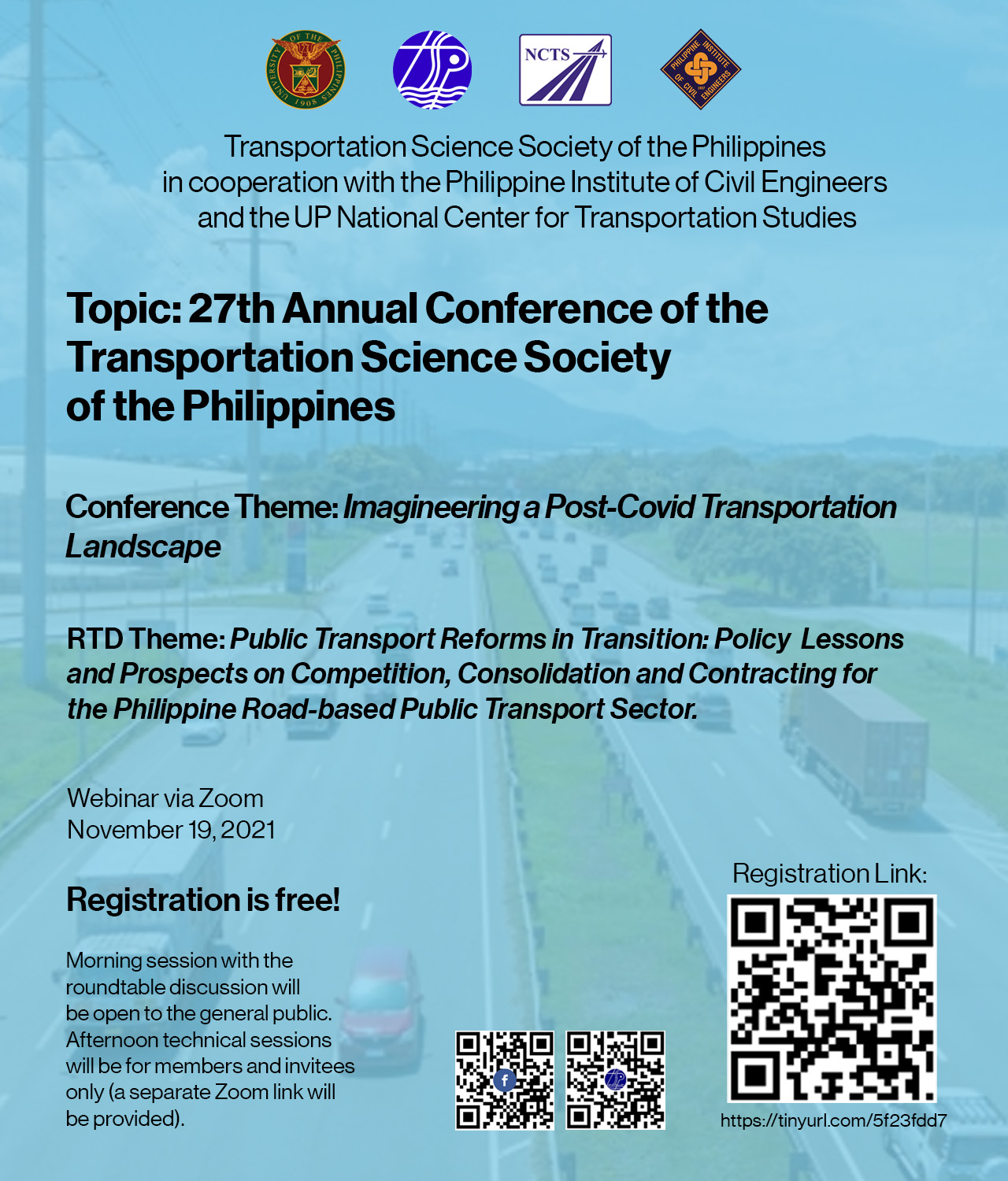
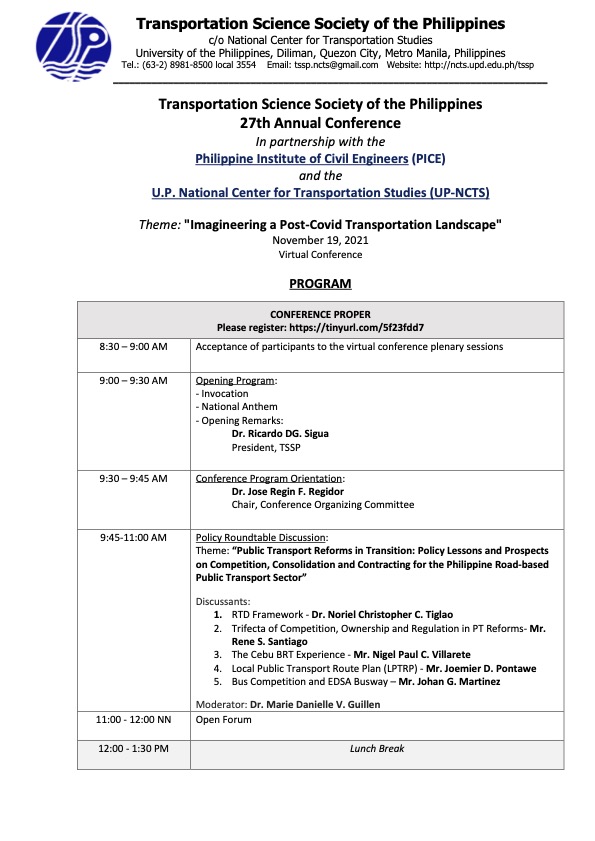
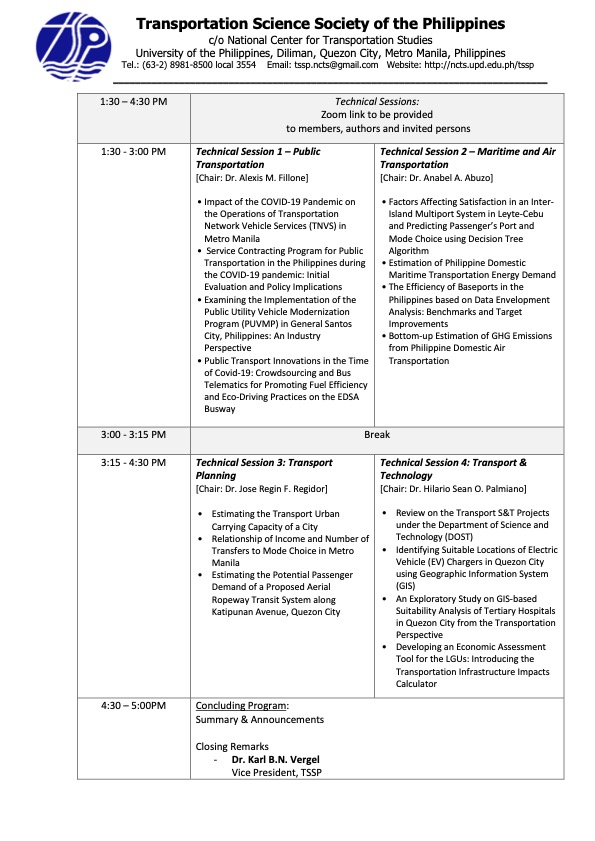
I initially intended to write about the conference before it was held but things got pretty busy last week so this is a post conference write-up. The organizers also announced the final program late (i.e., just a few days before the conference proper) so it seemed sort of anti climactic to post about it. Nevertheless, the conference proceeded as planned and the TSSP has announced it will be posting the proceedings on their official website. It is not yet there but here’s a link to the TSSP official website: http://ncts.upd.edu.ph/tssp/
–
Transportation topics at the College of Engineering’s Professorial Chair Colloquiums
The College of Engineering of the University of the Philippines Diliman started holding its annual colloquiums (plural because each Institute and Department under the College are holding their colloquium mostly during this last quarter of the year).
The Department of Mechanical Engineering already held theirs last September. There were four topics on transportation: 1) Dr. Gerald Ko C. Denoga (Fernando N. Serina Mechanical Engineering Professorial Chair) presented on “Reduction of Light Rail Transport Energy Demand via Powertrain Modeling and Optimization of Operating Parameters”; 2) Dr. Juvy A. Balbarona (Renato M. Tanseco Professorial Chair) presented on “Timetable Optimization for Light Rail Transit (LRT 1)”; 3) Asst. Prof. Roderaid T. Ibanez (Team Energy Professorial Chair) presented on “Energy Demand Quantification and Conservation Strategies of Bus Transport Terminal Facilities along EDSA”; and 4) Dr. Edwin N. Quiros (Federico E. Puno Professorial Chair) presented on “Fuel Economy Results from Diesel engine Tuning for Steady Speed and Drive Cycle Operation”.
There is one transport related topic in the Department of Computer Science colloquium. On October 25, Dr. John Justine S. Villar (Dean Reynaldo Vea Professorial Chair) will be presenting on the “Efficiency Measurement of Domestic Ports in the Philippines Using Data Envelopment Analysis.”
The Institute of Civil Engineering will be holding its colloquium on October 28 – 29, 2021 with the following transport-related topics: 1) Asst. Prof. Rosabelle Louise A. Caram (DCCD Engineering Corporation Professorial Chair), “Utilization of Plastic Laminates in Asphalt Cement Mastic”; 2) Dr. Hilario Sean O. Palmiano (David M. Consunji Professorial Chair in Engineering), “Validation of a Customized Local Traffic Simulator (LocalSim)”; 3) Dr. Jose Regin F. Regidor (Ambrosio Magsaysay Professorial Chair in Engineering), “Pedestrian Safety Assessment Within Public Elementary School Zones in Quezon City using Star Rating for Schools”; 4) Dr. Ricardo DG. Sigua (Dr. Olegario G. Villoria, Jr. Professorial Chair in Transportation/Logistics), “Study of Motorcycle Rider Casualties at Signalized and Unsignalized Intersections”; 5) Dr. Karl B.N. Vergel (Quintin and Norma Calderon Professorial Chair), “Estimation of Transportation Energy Demand of the Philippines”.
Other departments have not posted yet about their schedules or topics yet. The Electrical and Electronics Engineering Institute (EEEI), for example, will have their colloquium this coming October 25 but have not posted a detailed schedule yet. They usually have several transport-related topics including those on traffic signals, vehicle detection, and bike share innovations.
More details and updates including registration to these colloquia may be found at the UP College of Engineering Facebook page: https://www.facebook.com/updengg
–
Papers from the Philippines presented in the EASTS 2021 conference
Here’s a list of papers from the Philippines presented at the recent 14th International Conference of the Eastern Asia Society for Transportation Studies (EASTS). The local society, the Transportation Science Society of the Philippines (TSSP), is affiliated with EASTS being one of the founding societies for what is now the mother organization with members across Asia.
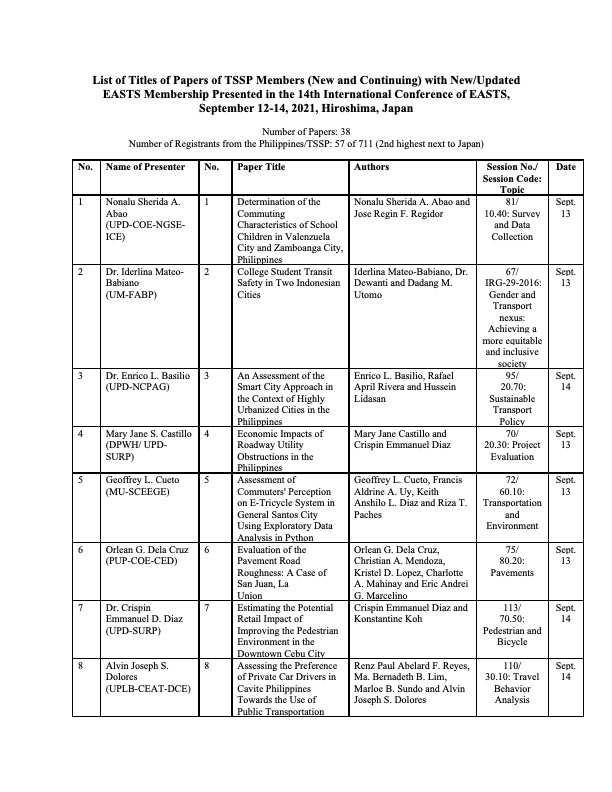


I thought the list would be helpful to those who come to this site to look for research topics. I guess it’s that time of the year for many university/college students who are looking for topics for their thesis or dissertation. There’s a nice mix of topics in the list and shows what are the current topics students and faculty from the different schools are engaged in. Many appear to be from research projects, which are a natural source for technical papers being submitted, presented and published in conferences or journals.
The TSSP is holding its own virtual conference in November 2021. I will also share about that and the papers to be presented in that conference in a future post. Currently, they have not finalized the program and papers submitted are still being reviewed.
–
 Caught (up) in traffic