
Home » Posts tagged 'accessibility'
Tag Archives: accessibility
On accessibility for airline passengers with disabilities
We already know about the ramps they use for boarding and deplaning for most if not all passengers including those on wheelchairs. As we boarded our plane to Legazpi last month, I noticed that there was another way to board aircraft if the passenger was on wheelchair. Here are some photos I took of the elevator access at NAIA Terminal 3.
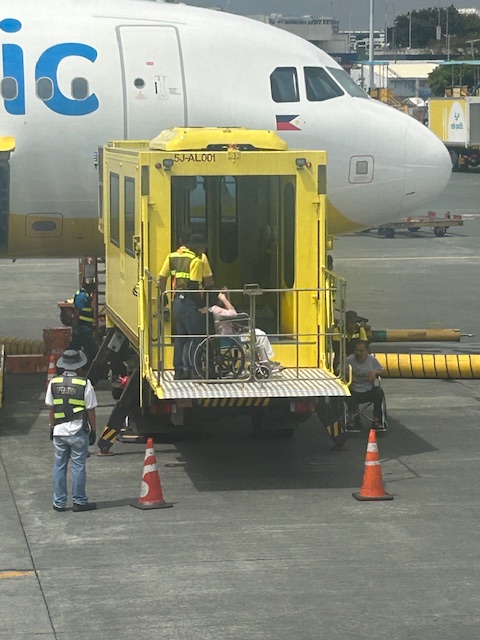 I took this photo of a female passenger being wheeled into the elevator compartment after the ramp was elevated to the compartment level. Notice that there is another wheelchair-bound passenger waiting in the shade at the right in the photo.
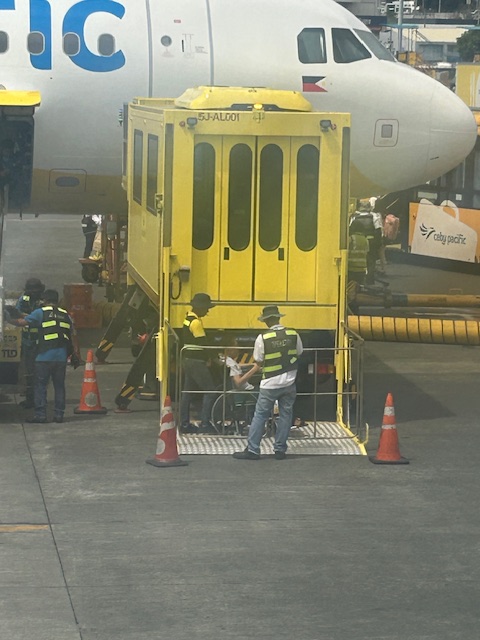 After the female passenger is inside the compartment, the ramp is lowered and the male passenger is wheeled unto the ramp.
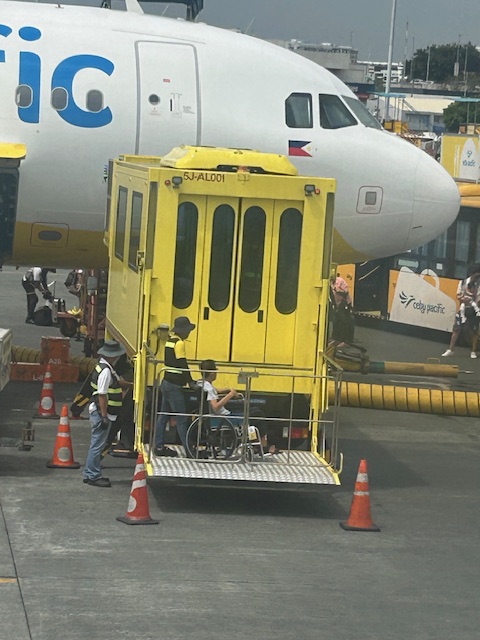 The ramp elevates towards the compartment door.
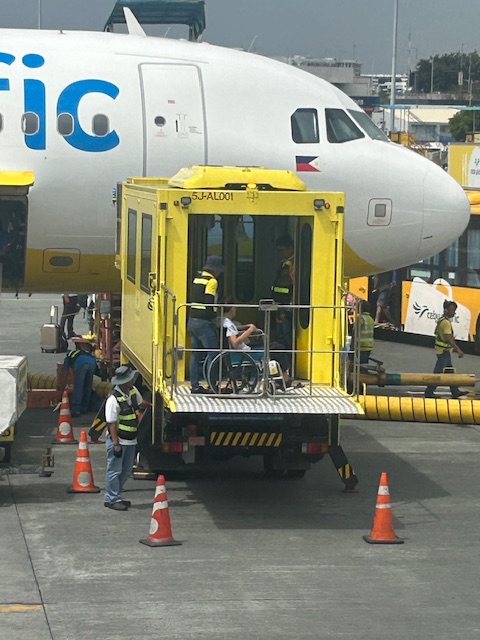 When level, the doors open for the second passenger to enter.
 The doors close and the main elevator goes up with the 2 passengers and the ground personnel assisting them.
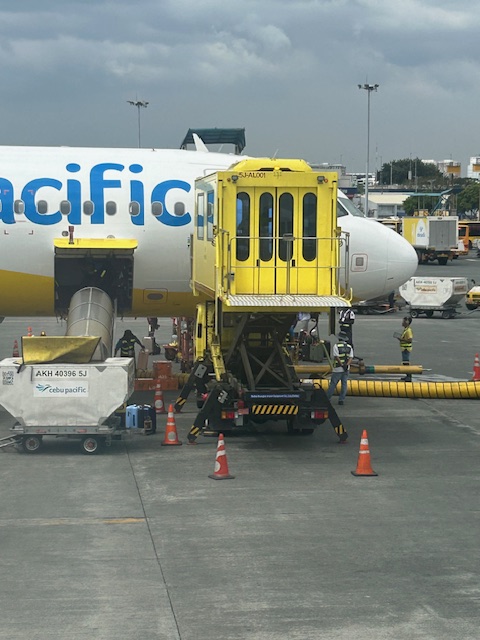 The platform is elevated until its door and ramp is aligned with the plane’s door.
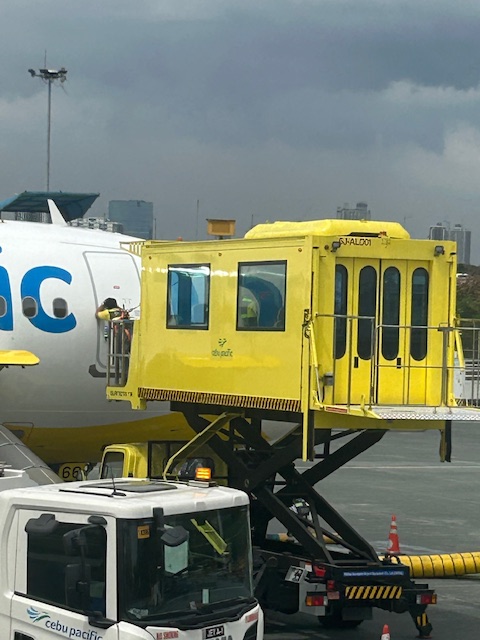 Ground personnel assisting the wheelchair-bound passenger knocking on the door for flight attendants to open it for the passenger.
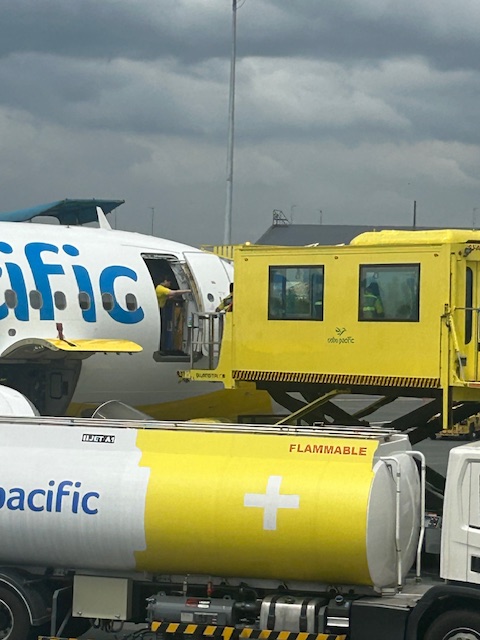 Airline crew opening the door for the wheelchair-bound passengers
This was the first time I saw this equipment at an airport. I wonder if there are similar elevators at the other NAIA terminals or in other Philippine airports where there are no tubes or bridges connecting the aircraft to the terminal buildings.
–
Roads, railways support needed for airport upgrades — analysts
Here’s a quick share on an article on the infrastructure needed to support airport development:
Source: Roads, railways support needed for airport upgrades — analysts
Unlike many capital airports including Malaysia’s Kuala Lumpur International Airport and Bangkok’s Suvarnabhumi International Airport, Ninoy Aquino International Airport does not have rail or mass transit access. It will eventually have rail access via the currently under construction Metro Manila Subway. The airport construction in Bulacan should also have transit access in order to make it more accessible to passengers and other airport users. Railways will provide an alternative to road-based transport that would probably require much road space and likely lead to congestion just like what we experience around NAIA at present.
–
Increase in parking rates at NAIA
A friend shared this notice about the increase in parking rates at NAIA.
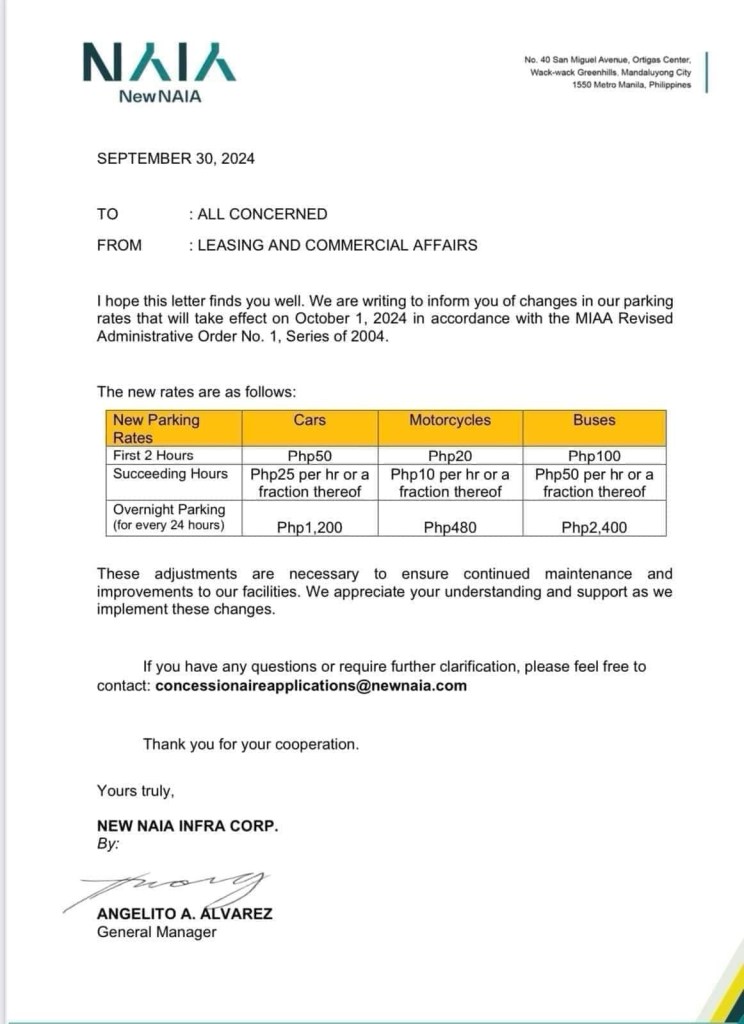
Parking at any of the terminals has been quite difficult if not horrendous. Everyone seems to be bringing their car to the airport for pick up and drop offs as well as leaving them for a night or more while traveling abroad or somewhere in the country. And then there are those who park there because the rates are supposed to be cheaper than the hotels and mall around the airport (e.g., the case of Terminal 3). Will the increase in the rates discourage unwanted or unnecessary parking? Perhaps not because people are still quite dependent on cars as their primary mode in and out of NAIA.
Access to the airport remains road-dependent. Granted there are many options like ride hailing, airport bus and taxis, these are all road based. They share the same roads that are often congested. The tollways are not enough to ease traffic in the area, which aside from airport generated trips include those from offices and industries in the area.
Too long has the need for a rail access for the terminals and government has failed to provide it. It would at least have engaged private sector for this provision but it took so long. Perhaps the Metro Manila subway will change that but we have to wait a long while to find out.
–
Planning for Accessibility: Proximity is More Important than Mobility
Here is a quick share of another very informative article that discusses the importance of proximity and more dense development in order to reduce car dependence.
Source: Planning for Accessibility: Proximity is More Important than Mobility
Here are some excerpts from the article:
“This shows that proximity is much more important than mobility in providing accessibility: location, location, location. For the last century, our transportation planning practices have contradicted this principle. Transportation agencies built urban highways that destroyed and degraded accessible and multimodal neighborhoods to benefit suburban motorists. This was racist and classist, but the mechanism was the way that transportation planners valued increased traffic speeds, measured as travel time savings, while ignoring the loss of accessibility imposed on urban neighborhood residents.
Of course, many other factors affect people’s transportation and neighborhood preferences. Some people need their cars for work or after-work activities, and not everybody can bicycle or use transit even if it is available. However, surveys such as the National Association of Realtor’s National Community Preference Survey indicate that many people would prefer living in more compact, walkable neighborhoods than they currently do but cannot due to a lack of supply.”
Such articles are a must read for those who want to understand why government needs to invest in land at or near the CBDs, and develop that land so people will not need to reside far from their workplaces and schools. Truly, there are many other factors affecting transport preferences or mode choice. Housing is one such factor that we continue to treat separately from transport. It is very (prohibitively) expensive to buy or rent in the city particularly in or near the CBDs. The result is people opting to purchase or rent homes in the suburbs. It doesn’t help that developers are also actively promoting subdivisions there and therefore are contributing to sprawl that puts so much pressure on transportation systems.
–
Of inequitable allocations and accessibility
In the news recently were figures released supposedly by Philhealth showing the top hospitals receiving reimbursements from the agency for claims relating to COVID-19. Southern Philippines Medical Center, a hospital in Davao City received 326M pesos while UP-PGH got 263.3M pesos. I was not surprised that my social media newsfeed included posts from both sides of the fence (The fence sitters among my friends on social media were not commenting about these anymore and seem content in just posting on food or whatever activity they were in.). Each were posting information divulged by the whistleblowers in the ongoing hearings on the issues pertaining to PhilHealth funds.
I will not go into the political aspect of this controversy but will just focus on the transportation aspects of the issue. I will just compare the top two hospitals in the list to simplify the assessment while mentioning others in general.
The claim that the hospital in Davao was the equivalent of PGH in Mindanao doesn’t hold water as the hospital does not treat even 10% of the cases that PGH is handling and for a much smaller geographical area. While UP-PGH is accessible to a larger population and for less travel times, SPMC is not as accessible to say people coming from other major cities like Cagayan De Oro or Zamboanga City. Yes, there are other major cities on the same island that have sizable populations with ‘catchment’ or influence areas comparable to Davao City. They, too, probably need funds to be able to treat COVID-19 patients. It is true that there are many other hospitals in the National Capital Region (NCR) that have the facilities to treat COVID-19 patients. However, many of these are private hospitals that tend to incur more costs for the patient and are not generally accessible (read: affordable) to most people who are of middle and low incomes. Thus, UP-PGH can be regarded as the frontliner among frontline hospitals.
What? There are other public or government hospitals in Metro Manila and surrounding provinces? True, but many of those have very limited capacities in terms of facilities and Human Resources. The same applies to Davao’s case as well because there are also medical centers and hospitals in surrounding provinces. And to round-out the resources available to these hospitals, local government units have also (over) extended their resources to hospitals. Perhaps the allocations and proportions can be explained in another way that is not the “apologist” but based on actual numbers pertaining to cases handled by the hospitals?
–
Mobility for persons with disabilities
I saw these two people traveling along Marcos Highway just after the intersection with Imelda Avenue. I think they came from Tahanang Walang Hagdanan in Cainta. The tricycle is actually modified to allow for a person with disability to operate the motor vehicle. The side car is also customized to carry a person on wheelchair. Note that back of the sidecar? It is actually a ramp that is locked when traveling but can be lowered for wheelchairs to roll-on or roll-off. Since there are two persons on the vehicle, the driver’s wheelchair is seen folded and loaded in front of the lady on her wheelchair.

Such vehicles allow PWDs to be more mobile. Unfortunately, most public utility vehicles do not have features to allow wheelchair-bound people to ride on them. Such features may be seen in city buses in more progressive cities including those in Japan, Europe and the US. Trains can easily accommodate PWDs including those on wheelchairs as their floors are the same level as the station platforms and there is space inside the cars for PWDs. While access for PWDs is already contained in Philippine laws, there is still much to be done in terms of implementing provisions of such laws especially with respect to road-based public transportation.
–
Mobility for PWDs
Inclusive transport also covers persons with disabilities or PWDs as some people refer to them. Persons with disabilities include the blind, crippled, deaf, mute, and others who are physically challenged and therefore would have their movements limited or restricted. There are laws which provide for the needs of persons Republic Act 7277, which is the Magna Carta for Persons with Disabilities. Specifically, for accessibility, there is Batas Pambansa 344, “An Act that seeks to enhance the mobility of disabled persons” by requiring buildings, establishments and public utilities (e.g., transport) to install facilities or devices to enable use by PWDs. These include ramps at pedestrian sidewalks and at the entrance/exit of buildings. These should also include elevators and other devices to help “physically-challenged” or “differently-abled” persons up and down buildings including those elevated LRT/MRT stations. [Note: Quite frankly, I don’t really like all these supposedly politically correct terms but will nevertheless use them in this article.]
 A man on a wheelchair crosses the intersection at Katipunan-Aurora.
Unfortunately, most public transport vehicles are not PWD-friendly. Most buses and jeepneys do not have provisions for PWDs and, on most occasions, do not even bother to stop to accommodate PWDs, especially those on crutches or wheelchairs. The LRT and MRT are now just too crowded even for able bodied people to endure (especially on a daily basis) but access to the elevated stations have always been an issue as there are limited escalators and elevators either seem to be frequently out of commission or there are none at certain stations. A high profile public official even suggested at one point during his stint with Metro Manila that PWDs and the senior citizens should just stay home rather than travel; hinting that these people would just be a burden to others when they travel.
This is not the case in other countries. I have seen in Japan, for example, that city bus designs can readily accommodate PWDs and this includes low-floor buses for easy access between the vehicle and the sidewalk. Bus drivers fulfill their responsibilities of stopping and assisting persons on wheelchairs to board and alight from their buses even if it means they would have to compensate for their scheduled stops. Then there are those I’ve seen riding the BART in San Francisco wheeling themselves in and out of the trains and stations with ease.
Addressing the transport needs of PWDs is definitely an area that needs proper attention especially as groups advocate for inclusive transport. Persons with disabilities are an integral part of our communities and enabling them to travel is a big factor towards encouraging them to be productive despite their physical limitations. They are not asking us to pity them but instead empower them to be the best they could become given the opportunity to be productive, to contribute to society. As such, they deserve the facilities and services that will enable accessibility and mobility that is at the same time safe for them and everyone else.
–
 Caught (up) in traffic