
Home » Posts tagged 'Air travel' (Page 2)
Tag Archives: Air travel
On recent airline incidents in Japan and the US
There were two recent incidents involving airlines the past days. One was on a collision as a Japan Airlines Airbus A350-900 jet arrived at Haneda Airport in Tokyo. The other was a midair incident where an Alaskan Airlines Boeing 737 Max 9 plane lost part of its fuselage. While both are troubling, the first incident provided a good example of how emergency evacuations should be. The second incident reminds us of the importance of aircraft maintenance and tests to make sure planes are safe for use by passengers.
To quote from a New York Times article on the Haneda Airport incident:
“In addition to a well-trained crew and an advanced plane, the safe evacuation of 367 passengers came down to a relative absence of panic.”
I think that basically described “how to survive a plane crash” in the context of the collision at the airport, where passengers and crew had to evacuate the plane immediately.
Meanwhile, the B737 Max crash is a cause of concern since the model was already involved in previous crashes that caused the planes to be grounded worldwide. There will be an investigation on this incident and perhaps the outcomes can help address the problems concerning the aircraft. On the business side, such incidents will further convince airliners to reconsider acquisition and operations of these planes. I am sure they are already thinking about replacing the B737’s with the competition’s aircraft (e.g., A319, A320 or A321).
–
Article share: on aviation security
I found this article on Israel’s national airline, El Al, being the “most secure airline” in the world. That is, the airline has the capability to evade threats like missiles launched against it (i.e., to shoot a plane down). Here is the link to the article on Medium:
I am not aware of other airlines having similar capabilities. Two examples that I know involved passenger airliners being shot down by missile include the ill-fated Korean Airlines Flight KAL 007 during the height of the Cold War 1983 and the Malaysian Airlines MH17 shot down over Ukraine in 2014. Both could have benefitted from the retrofits/upgrades El Al installed on their planes.
–
On weird weather’s impact on air travel
With the wet season comes a lot of thunderstorms and there have been increasing occurrences of lighting alerts around Ninoy Aquino International Airport (NAIA) that led to the grounding of many planes. That resulted in long delays and surely an inconvenience to a lot of passengers. It looks like ‘weird’ weather or extreme weather events are here to stay and may even become worse as we continue to grapple with climate change and warmer weather. I am sharing a recent article about this here:
Hoover, A. (July 13, 2023) “Weird weather is making air travel even worse,” Wired, https://www.wired.com/story/weird-weather-is-making-air-travel-even-worse/?bxid=5bd6761b3f92a41245dde413&cndid=37243643&esrc=AUTO_OTHER&source=Email_0_EDT_WIR_NEWSLETTER_0_DAILY_ZZ&utm_brand=wired&utm_campaign=aud-dev&utm_content=WIR_Daily_071323&utm_mailing=WIR_Daily_071323&utm_medium=email&utm_source=nl&utm_term=P4 [Last accessed: 7/14/2023]
Quoting from the article:
“But there are more complicated, invisible effects of a warming world too. Hotter air is trapped near the ground, and cooler air above. Shifts in temperature gradients affect the wind shear, or the changes in speed and direction between air near the ground and at higher elevations. These eddies create clear air turbulence, which occurs in the absence of clouds. Light turbulence can cause sudden changes in altitude that feel like bumps, but severe turbulence can cause structural stress to the aircraft.
Turbulence isn’t just unpleasant. It’s the cause of more than one third of injuries aboard air carriers, according to the US National Transportation Safety Board, and in rare instances can even lead to death.
Changing wind patterns may also alter flight lengths. If, for example, there are stronger eastward winds, flights from the US to Europe will speed up, but flights in the other direction may take longer. Transatlantic flights may even need to reroute and refuel.
Research from Paul Williams, a professor of atmospheric science at the University of Reading in the UK, found that jet stream changes could increase the amount of time flights are in the sky each day, leading to more fuel burning, higher costs, and more CO2 emissions. Jet streams are high-altitude air currents that drive weather systems. As the Arctic warms, the North Atlantic Jet Stream is changing, leading to more odd weather.
But heat alone can also lead to delays and cancellations, like when a 119-degree day in Phoenix grounded planes in 2017. That’s because high temperatures decrease air density. When the air is less dense, planes need more time and distance to fight gravity as they take off—so they may need a longer runway to become airborne. Not all airports can accommodate these sudden changes.”
–
On delayed flights and being compensated
The last two times we traveled to Zamboanga City, we experienced significant delays to our flights. Last May, traveled twice to Zamboanga City. The first time, our flight to the city was delayed by a couple of hours. That led to a very late arrival and us having lunch at 3PM! Even though the airline could argue that they had nothing to do with the delay, the fact is that the reason (i.e., the standard “late turnaround of aircraft”) is very much due to their operations. Therefore, they should be accountable or made accountable for the inconvenience and discomfort.
While there was no issue for our return flight then, the situation was reversed the second time we traveled to Zamboanga. Our outbound flight from Manila was not delayed but our return flight was. This time though, the airline promptly distributed snacks in the form of water, crackers and biscuits to passengers.

I think that these or perhaps meals could be provided every time there is significant delay whether charged to the airline or to the airport depending on the circumstances. Travelers are paying for a service that are supposed to be delivered in the most efficient manner. Efficiency here should include safety so delays due to aircraft maintenance or technical issues or weather-related should also be covered when compensating passengers. Of course, cancellations would be another matter. Let’s talk about those later.
–
NAIA terminal designations for airlines – reshuffle
Airport authorities in Manila announced that airline designations at NAIA’s four terminals would be reshuffled. I took this photo of the announcement on a tarp at the corner of NAIA Road and Ninoy Aquino Avenue as we left NAIA Terminal 1.
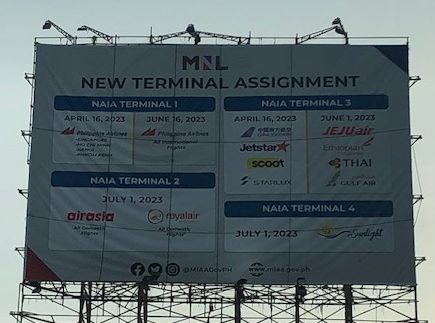
While there seems to be no major concern for the international airlines mentioned in the tarp, there will be a major inconvenience for Philippine Airlines passengers. For most its flights including international ones, transfers were easier and more convenient since international and domestic flights shared the same Terminal 2. There was no need to travel from or to another terminal unless the transfer involved another airline. From June 16, 2023, all its international flights will be via Terminal 1 so there will be a need to transit between T1 and T2 for connecting flights. Cebu Pacific will still enjoy this convenience for most of its flights as international and most domestic flights are via Terminal 3.
–
Covid test kits at the airport
Despite the relaxed stance on COVID-19, the virus is still very much around and evolving or mutating. While airports in the Philippines are lax about the wearing of masks, airlines require masks for passengers on flights. I’m not sure how effective as a preventive measure this is since most people at airports don’t wear masks and there is nothing that will allow for contact tracing anymore.
Meanwhile, COVID-19 test kits vending machines are now common at airports. I guess aside from being a reminder of the pandemic, it is also a convenience for people who want to check, quickly though not so accurately, if they are positive for the virus.

–
Back to ‘old’ normal for air travel in the Philippines
Before we embark on another trip this week, I just wanted to share that it seems all is back to the old normal in as far as air travel is concerned in the Philippines. There are few, if any, exceptions based on what I and colleagues have experienced while traveling domestically. The only difference now from pre-COVID-19 air travel is that people are required to wear face masks inside the aircraft. Inside the airports, masks appear to be optional though most people wear them.
 The March-April 2023 issue of Cebu Pacific’s Smile Magazine features places to go while in Tokyo, Japan, a popular destination these days as foreign travel restrictions have eased.
Cebu Pacific provides passengers with their Smile magazine on-board their aircraft. Philippine Airlines domestic flights don’t have magazines (unless they do on Business or First Class) for Economy passengers. I noticed also that PAL did not have duty free items on-board their aircraft (at least for the MNL-SIN-MNL trips we had recently). I know that other airlines have resumed duty free sales on-board so perhaps this is just a cost-cutting thing for PAL. Meanwhile, Cebu Pacific’s inflight shop is open and selling souvenir items on their domestic flights.
–
Work trips abroad
We are traveling again abroad for work. Work-related travel was mostly limited to road trips and local travel (e.g., to Zamboanga) in the past 2+ years. We used to average at least 2 foreign trips per year with my wife usually raising that average due to the nature of her work that used to make her travel to the US at least twice a year.
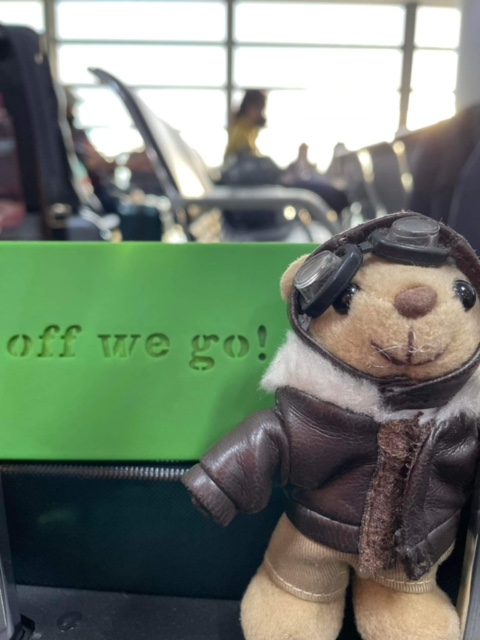 I got this bear in Arnhem, The Netherlands. He’s supposed to be an Air Force aviator, symbolizing one of those who braved the skies to bomb enemy positions or deliver paratroopers during Operation Market Garden as depicted in the movie “A Bridge Too Far.”
–
Safest airlines in 2022/2023?
One magazine published an article recently about the safest airlines in the world. This is very relevant as people have returned to traveling during this period despite the pandemic and the new strains coming out. It is useful especially for people who are traveling overseas since airline choices might be very limited for domestic routes. Here is the article:
Puckett, J. (January 5, 2023) “This is the safest airline in the world,” Condé Nast Traveler, https://www.cntraveler.com/story/the-safest-airlines-in-the-world?utm_source=nl&utm_brand=spotlight-nl&utm_campaign=aud-dev&utm_mailing=thematic_spotlight_010623_2&utm_medium=email&bxid=5bd6761b3f92a41245dde413&cndid=37243643&hasha=cf6c402001bc473063a8744033fe9be3&hashb=ec2bb753c2e6299f5107823241955221da67bd1f&hashc=09f65c608bfb62050199733de500e3cd82827631b36d537ce8386d41a3bd1ff7&esrc=FYL_SEG_APR18&sourcecode=thematic_spotlight&utm_term=Thematic_Spotlight_Afternoon [Last accessed: 1/7/2023]
To quote from the article, the basis for the ranking is as follows:
“The site’s staff analyzes each airline’s records for crashes over the last five years, serious incidents over two years, audits from aviation’s governing bodies and associations; fleet age, expert analysis of pilot training, and COVID protocols. In addition to these criteria, each airline that makes the list is also at the top of the industry in terms of safety innovations and have added cutting-edge aircraft to their fleets, like the Airbus A350 and the Boeing 787…”
There are not so many Asian airlines in the list especially if you don’t include the Middle Eastern airlines. Only Singapore Airlines, EVA Air and Cathay Pacific are in the list. I was expecting at least one Japanese airline and perhaps Thai Airways to be in the list. I was not surprised Philippine Airlines was not on the list considering the criteria.
There’s a separate list for low-cost carriers in the article and Air Asia is one though there are actually several Air Asia companies operating out of Southeast Asian countries. It would be nice to see how Air Asia Philippines compares with the mother company based in Malaysia. Cebu Pacific is categorized under LCC’s but with so many of these companies around the world, it won’t be a surprise they didn’t rank among the Top 20 either.
–
On a canceled trip due to a typhoon
I was supposed to be traveling with my family to Singapore over the Undas long weekend. That did not push through due to the circumstances brought about by Typhoon Paeng. What could have been our daughter’s first travel abroad did not materialize and we were left with sunk costs from the tickets we had already bought online for Universal Studios and the Singapore Zoo. We also had to cancel meet-ups with friends in Singapore.
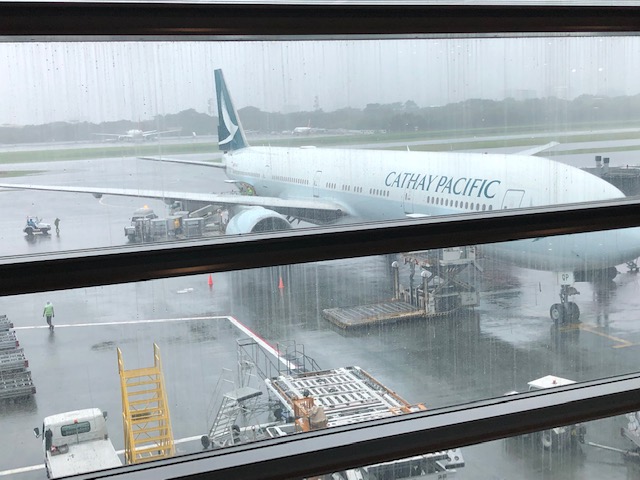 This Cathay Pacific plane landed safely before noon and later departed for Hong Kong without incident.
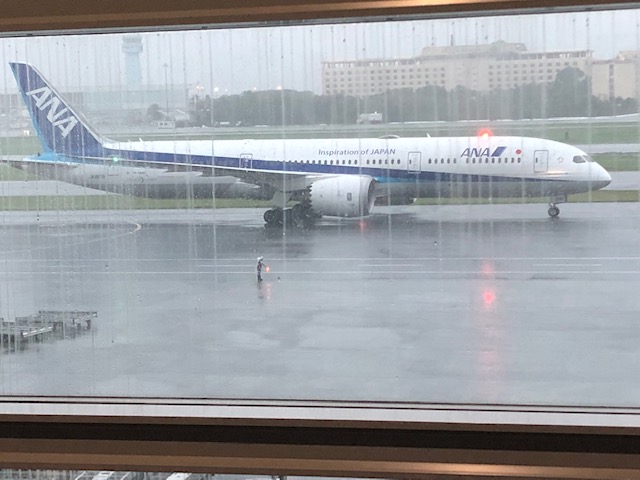 An earlier ANA flight arrived and departed without incident. This one arrived mid afternoon but was similarly grounded due to the typhoon.
The airport announced all flights were canceled just before 6:30 PM. This was a late announcement that some airlines were waiting for. Cebu Pacific apparently had advance information as they canceled all their international flights one after the other around 6:00PM (probably to manage the crowds that would file out of the departure area to reclaim their luggage). We were disappointed that Singapore Airlines did not act immediately and decisively on the matter. We were expecting at least an announcement of when we could expect to be on the next flight. For an airline of their stature, I was also expecting that they could have made arrangements for accommodations due to the great inconvenience brought upon passengers. That was the least they could do if they intended to put us in the next available flight (planes were cleared to operate at 10:00PM that night). Apparently, the typhoon (and its implied acts of nature/acts of God aspect) was also a convenient excuse for the airline (and others, too) to practically abandon their passengers. [Note: A pilot friend intimated that these decisions and behavior by airlines are partly due to policies and actions of the previous administration/government of the Philippines where all the blame was put on airlines for cancellations and they were penalized for acting independently or ahead of government announcements.]
Of course, we later received a series of emails from the airline informing us that we were rebooked to flights the following day. I say ‘flights’ here because these the first email informed us of a flight at 10:00AM. A subsequent email then said we were to be in a 12:00 flight. A third then said that we were to be on a 2:00 PM flight. We got to read these emails around 7:00 AM the following day as they were sent overnight when we were already occupied in finding accommodations during inclement weather. Flabbergasted, we decided to request a refund instead of re-booking and rescheduling our trip. It was already difficult to reschedule as there weren’t any weekends long enough remaining this 2022 and this Undas was the ideal time for a getaway. We’ll try again another time.
–
 Caught (up) in traffic