
Home » Posts tagged 'behavior' (Page 6)
Tag Archives: behavior
Conditioning
Was traffic really bad yesterday, Dec. 21, or was it typical Friday traffic? A lot of people have been talking or posting about how traffic last Friday was expected to be the worst of the year. Apparently, it was not.
Based on posts on my social media accounts yesterday, it seems that traffic was not at all that bad in many parts of Metro Manila, especially along roads that were expected to be hellish in terms of congestion. One post stated that it him only an hour to travel from Ayala to Trinoma by bus. People usually post about really bad experiences about traffic congestion and this crowd-sourcing approach is usually very reliable. I went home early yesterday and it didn’t take me long to travel between stops for errands I had to do along the way home. Media also would have reported about terrible congestion along major roads including EDSA, C5 and the expressways.
Statements like what the MMDA made prior to Dec. 21 are typical of a psychological approach that some agencies seem to have been resorting to in order to manage people’s expectations and perceptions. Conditioning people’s minds is not a new strategy or tactic. The MMDA has been doing this a lot for as long as I can remember, including during the stint of its former chair Bayani Fernando. Many if not most of these “conditioning” activities are done through media with the agency making statements through its officials about issues such as traffic, garbage and flooding. This is no different to the perception of one agency making frequent “power point presentations” (a reference to projects involving the private sector) to announce much delayed projects supposedly for immediate implementation.
One opinion is that this is a form of damage control. People will usually have strong opinions about what government is doing to address issues like congestion. For people not react too strongly against agencies that are supposed to be responsible for the problem, the same agencies have anticipated and preempted the manifestation of their ineptness by stating the obvious ahead of its occurrence. This would not have been necessary if the agencies did what they were supposed to do in the first place. Hopefully, in the near future such conditioning and other psychological tactics will indeed not be necessary once programs and projects are finally implemented and help alleviate or solve problems.
–
Risky switching of lanes
Many Filipino drivers have the propensity for frequently changing lanes. These happen even at locations where they are not supposed to be changing lanes (e.g., at intersections, while going up or down a steep slope, at curves, etc.). Such maneuvers are risky and basically among the reasons why there are double yellow solid lane markings separating opposing traffic at these sections. I have seen many incidents where in a matter of seconds at least one person is suddenly inconvenienced by the crash. I say at least one person because whether traffic is light or heavy, there will be vehicles slowing down and causing a chain reaction of other vehicles slowing down to stop or avoid the vehicles involved in the collision. These incidents occur because of at least one person’s propensity for suddenly switching lanes.
 The rear bumper of a car gets torn-off (not just detached) by the bull bar of a vehicle whose driver decided to suddenly shift to the right. Apparently, the guilty driver was not able to factor his vehicle’s bull bar when he immediately encroached on the adjacent lane.
 A closer look at the damage on the vehicle in front of us. We had to change lanes ourselves in order to avoid the stopped car. We could only imagine the traffic build-up resulting from the incident at the C5-Lanuza intersection.
I’m not sure how these people learned to drive. Driving schools will likely claim that they did their part in instructing their students/clients the proper way to drive. However, going through driving school is not an assurance for responsible driving. What more can be said for people who learned to drive the informal way (i.e., taught by a friend, relative or other people). Of course, this could have been addressed early on if the licensing system under the Land Transportation Office (LTO) was a lot stricter and exercised due diligence in their licensing examinations.
–
Swapang! or the perils of walking
Walking to the jeepney terminal for a ride to the university, I was irritated by the constant honking behind me as motorcycles rode up the sidewalk to avoid the weaving into congested traffic along Aurora Boulevard. And so I tried to stand my ground allowing only half the space of the sidewalk for these motorcycles to pass through. As far as I’m concerned, I was already too generous giving part of the space that is for pedestrians and not for motorized traffic. Still, there were a few motorcyclists who seem to think they had the right of way as they attempted to convince me give up more space so they could practically take over the sidewalk. I didn’t give way and assumed they were cursing me inside their helmets. Manigas sila! I thought that in the end, sila ang asar at talo in this situation, not me.
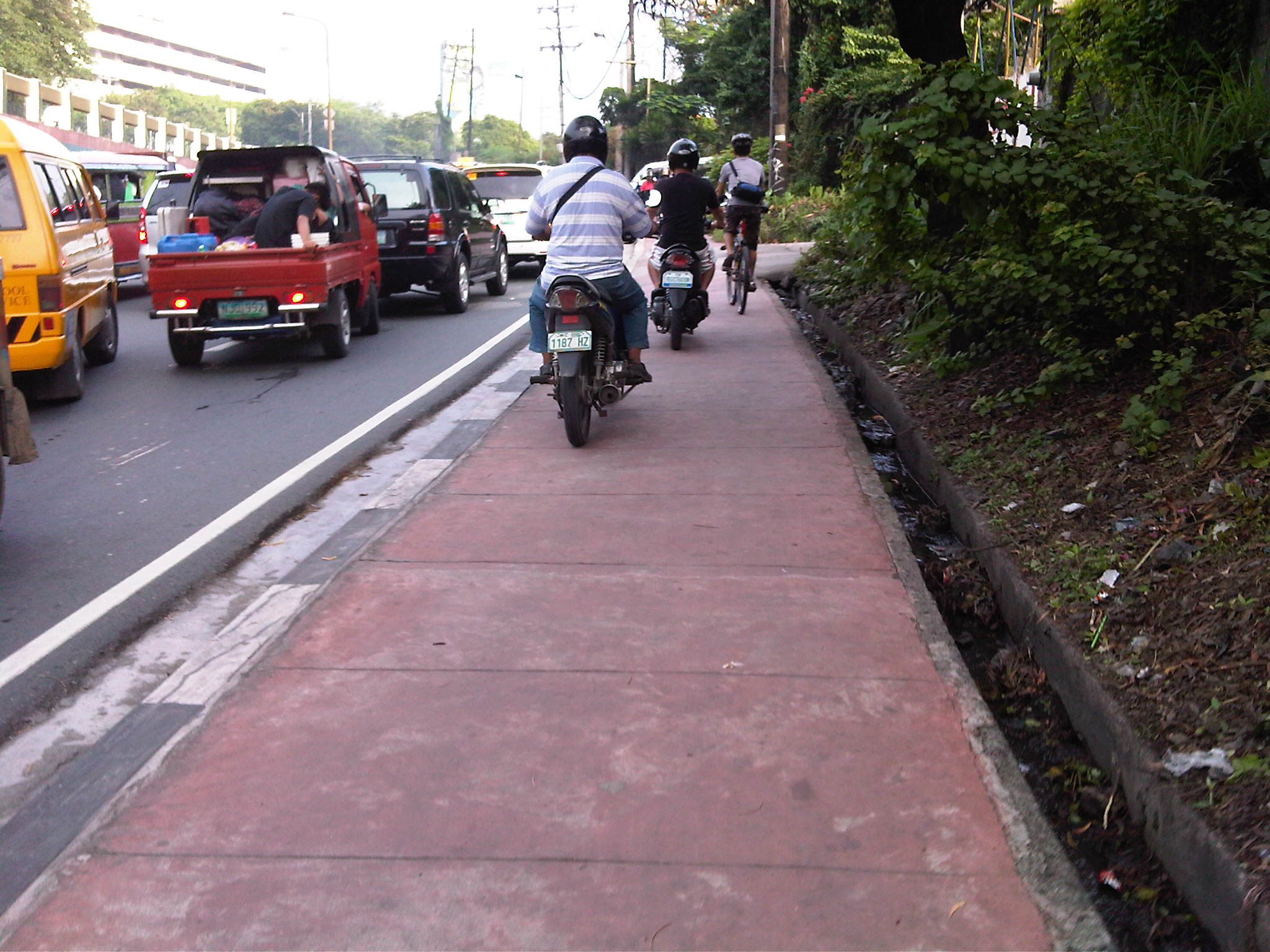 Motorcycles dominating space for pedestrians
At one point, I held my ground and didn’t give way to the motorcycles behind me [Advisory: This is not for everyone especially those who are “pikon” or who are looking for a fight.]. I knew my rights and I was walking on the pedestrian sidewalk. Unfortunately, a bicycle came along and I gave way only because I also appreciated cycling and understood that pedestrians and cyclists are sort of “kindred spirits” in a world dominated by motorized transport. The bicycle was immediately followed by two motorcycles including one that almost sideswiped the cyclist. I took the photo above to better show the situation.
The other day, I chanced upon a similar situation as I was driving in heavy traffic along Amang Rodriguez in Pasig City. What little space was available for pedestrians along a narrow sidewalk along this road connecting Marikina and Pasig cities.
 Motorcycles using a narrow pedestrian sidewalk to avoid traffic congestion along Amang Rodriguez
These cases are clear examples of swapang attitude or behavior that is prevalent among many road users. Unfortunately, these are not apprehended or accosted by traffic enforcers. The latter seem to be more engrossed with number coding and swerving violations, anyway, that they seem to have forgotten all the other traffic violations that included this brazen behavior of motorcyclists. Perhaps enforcers should go back to the basics and take more notice of all those other violations (e.g., speeding, counter flowing, beating the red light, beating the green light, etc.) to improve and promote discipline on our roads.
–
Slippery when wet
The MMDA reported a high of 30 road crashes occurring in Metro Manila. These happened during a very wet day with heavy rains brought about by a typhoon approaching Luzon. Among the high profile crashes yesterday were one involving a bus that fell from the Skyway that cost the lives of 3 people including the driver of the bus. The other involved multiple vehicles including buses (again) and several private vehicles along the underpass section of EDSA near Ayala Avenue in Makati City.
In both cases, those involved and those investigating the incidents all cited the wet and slippery road as the probably cause of the crashes. The statements were all too familiar with drivers stating that they didn’t have enough time and space to stop because of the slippery road. Such reasoning only indicates that there is the likelihood that these drivers did not apply safe driving practices to keep their distance from vehicles ahead of them and to regulate their speeds given that wet roads offer less friction or resistance that would allow for shorter braking distances.
Despite denials, it is likely that the bus that plunged from the Skyway was speeding and that the driver lost control of the vehicle. I would like to believe that the barriers of the elevated highway were designed according to standards set by the DPWH, which are based on international standards that are incorporated in their safe design manual. Despite the standard design for the barriers, the bus still managed to penetrate it, apparently elevating once it hit the barrier.
Barriers are designed according to certain test levels that are deemed suitable for the specific facility. Such test levels that need to be satisfied incorporate elements like vehicle mass, speed, angle of impact and height of center of gravity of the vehicle (Reference: DPWH Highway Safety Design Standards, Part 1: Road Safety Design Manual, 2004). Since traffic along the Skyway consists of a significant number of heavy vehicles including trucks and buses, then the barriers should satisfy the test levels appropriate for these type of vehicles. Thus, it would be easy to check if the Skyway barrier design satisfies standards by checking the as-built specifications of the facility with the DPWH manual.
Nevertheless, speeding and not keeping a safe distance between vehicles are typically causes that may be attributed to the driver. These lead to such road crashes being categorized under driver error as their cause, which is quite justified given that perhaps there are no problems pertaining to the infrastructure/road or the vehicles involved. The weather is not really to blame since it is beyond control but road conditions may deteriorate due to rains if, for example, road drainage is not properly designed or provided. In fact, hydroplaning may occur should there be significant amounts of water on a road and becomes a hazard when vehicles travel at speeds that effectively allow water to come between the tires and the pavement. In such cases, it is also necessary to check whether the tires are able to pump out water as the vehicle runs along the road. In fact, the ridges in tires are supposed to be designed to be able to pump out water, which is the basis for tires to be also checked to make sure that they are suitable for wet roads.
Basically, all drivers should heed the message from a road sign that is provided along roads that are treacherous when the pavement is wet. “Slippery when wet” actually applies to all roads whether it be of Portland cement concrete or asphalt concrete surface, whether of good or bad condition. The mere presence of water on the road pavement presents hazards that can only be addressed if drivers practice safe driving. That is, to regulate their speeds, keep safe distances and lessen maneuvers regarded as risky even when roads are dry.
Tragedy and mockery
Friday the 13th turned out to be tragic to a faculty member of the College of Mass Communications of the University of the Philippines Diliman. Prof. Lourdes Estella-Simbulan was killed when a bus hit the taxi she was riding along Commonwealth Avenue in Quezon City at around 6:00 PM yesterday. By the looks of the crumpled taxi cab shown in photos and videos taken by the media, it would have been a miracle if she survived such a crash.
Adding insult to injury were reports that the bus driver fled after the incident. The name of the bus company is not familiar to me despite our Center currently immersed in a project developing a planning support system for public transportation that included a database component that required us collecting data on companies and operators of public transport in Metro Manila. I suspect that the bus is one of those fly-by-night units taking advantage of the night in operating illegally or maybe one that is part of the kabit system that would be difficult to take to task by the HPG or the LTFRB. It is indeed a mockery of traffic rules and regulations that drivers can get away with murder when they are involved in crashes such as this. It is even more frustrating that the most common reason mentioned by drivers when asked why they drive recklessly is that they are just “naghahanap buhay” or earning a living. Such is unacceptable and those charged to bring order to traffic should be decisive and assertive on acting to prevent such crashes from happening again.
To me there is some irony in what had transpired considering that a couple of days ago, the Philippine joined other countries around the world in launching a program geared towards the reduction of road crashes and victims in the next ten years. Forget about the decade – there is a need to reduce crashes and victims NOW. This is because people are getting killed (or dare I say murdered) now, and there are terrible costs even as I write this post.
The College of Mass Communications is a partner in our advocacy for road traffic safety. In fact, that college produced a video for driver education that was supported by resources extended by the private sector led by the Automobile Association Philippines and Toyota Motor Philippines. I am sure that their faculty are now wondering if their efforts have been to naught considering the proliferation of drivers disregarding traffic rules and regulations, throwing caution to the air when they drive their vehicles.
On my part as head of a Center providing training to public utility vehicle drivers, I feel responsible and frustrated at the same time as I question myself if indeed our efforts are even having the slightest influence to improve PUV drivers’ behaviors. In fact, I have been admonishing participants in our training courses about how they sit in and pretend to learn, and then go out and drive like hell. I just hope that the driver involved in the crash that killed Prof. Simbulan is not among those whom we trained at the Center. It would be a shame and one that makes a mockery out of our efforts in promoting road safety. It is our failure as educators that our students and trainees do not practice what they are taught in terms of road safety. We just take it with a grain of salt, so to speak, that responsibility for such PUV drivers’ behavior can also be linked to a flawed licensing system as well as shortcomings in the regulations of public transport services. Indeed, we have our work cut out for us and we can only hope that our persistent efforts would eventually prevail and lead to a significant improvement to safety along our roads.
Microcosm of society
As me and my colleagues crossed the street at the corner of the College of Engineering towards the Main Library grounds, we heard the distant sound of whistles of security guards posted along the Academic Oval. At first, we didn’t pay much attention even stating among ourselves that the guards may be trying to catch the attention of certain people. There are still many litterbugs on campus and there are street children often going around and trying to collect material they could sell at some junk shop. In some cases, they take whatever they find even those that are not supposed to be taken by them like scrap materials from buildings that are being constructed or renovated. These, after all, are not fair game in as far as the contractors and the university are concerned.
After we had crossed, however, the guards continued to whistle and the frequency and manner seemed to indicate urgency and not just as if they were not just trying to accost someone but were also in pursuit of someone or something. Another guard posted near the library stood up from where he was taking his lunch on a bench under the trees near the road and also started whistling. We soon saw the cause for the alarm – a black BMW 5 series was speeding counterflow along the bicycle lane.
We stopped near the Main Library kiosks to see where the BMW was heading and made our bets that it would be turning left towards the Asian Center and probably towards the exit along Magsaysay Avenue. We were not surprised when the car indeed took a left (and without signals) but towards the driveway in front of Malcolm Hall – the College of Law. I say we were not surprised because there have been many instances before this one when similar vehicles and even those with SUV escorts who have blatantly violated traffic rules and regulations inside the campus. Often, the excuse mentioned is that they were in a hurry. But then aren’t we all?
We did not see who alighted from the car (it was too far to see) but it was parked in front of Malcolm Hall so I assumed it must be a faculty member, a lecturer or a guest of that College who drove or owned the vehicle. It would also be likely that the occupant was a lawyer. This begs the question of what kinds of lawyers are teaching at the College of Law. I know this is quite a generalization and perhaps unfair to many whom I know from that college. But this simple act of violating the one-way scheme along the oval and using a lane dedicated to pedestrians and cyclists despite all the signs and the guards shouting at you, which some people (like lawyers for example) would dismiss as petty are manifestations of more serious things. And I will restrain myself from alleging what those serious things are.
If he or she was a student, then the obvious question is what kind of students do the college have these days? What kinds of lawyers are being bred by the college? And may I dare ask what kind of lawyers have been produced in the past as there are evidences (from the UP Police, the MMDA and other traffic enforcers) that the same professionals are the one most likely to argue with enforcers even when they are guilty of violating traffic rules and regulations.
It is the arrogance of such motorists that is among the common causes of road crashes and the major cause for anarchy and chaos in our roads. The example in UP only shows how far we are from the objective of instilling discipline among our motorists. That same arrogance shows, too, how we regard everyone else including the joggers, walkers, and cyclists who had to give way to a motor vehicle that intruded into their right of way and practically bulldozed its way towards its destination. For these people, it is no matter that they put the lives of people in danger by their actions. After all, they were in a hurry. I believe the pedestrians and cyclists were in no hurry. they were in no hurry to get injured or, God forbid, to die because a motorist in a luxury car had to run against the one-way flow and use road space that is dedicated for pedestrians and cyclists – most of whom happen to be students who have yet to fulfill their potentials, and hopefully for the good of this country.
What irritates you?
Early this week, we realized that only one of the regular hosts of our weekly radio program, Wangwang ng Bayan, would be available for the live broadcast. Being the last week of regular classes didn’t help as we had to consider conflicting schedules that seemed to feature a lot of double and even triple booking of certain time slots. Wednesday proved to be a difficult day what with a mix including undergraduate research presentations, a college board meeting, field survey orientations and our radio program. Good thing that it didn’t become the nightmare we were anticipating as we were able to agree on how to divide ourselves and distribute our times and attentions to the various tasks at hand that day. I won’t delve into the details of what we did with the others but will just talk about how we were able to manage with our radio program.
We figured that we had to have a topic that would be easy for one host and our assistant to tackle while the other host and the producer were out. I figured that an easy topic would be about what irritates us when we’re on the road whether as drivers/motorists, passengers or pedestrians. We would ask our listeners to pitch in on what they thought were their pet peeves on transport and traffic. The result was a very lively show with the host and her assistant fielding questions and comments on just about anything under the sun and on the street.
Prior to the show, we ran a simple survey among our center’s staff, some students and our trainees in our Traffic Administration Course. The survey outcomes allowed us to have a handle on what we can anticipate for responses to the question we would be posing on air. After all, there should be common pet peeves regardless of whether one is driving, riding, walking or cycling. I even volunteered my own top ten list of what irritates me when I’m on the road. These are:
1. Jaywalking/pedestrians crossing anywhere;
2. PUB or PUJ weaving at high speeds in traffic;
3. PUV’s loading/unloading in the middle of the road;
4. Vehicles especially private cars cutting into my lane;
I can go on and identify more pet peeves but it is unnecessary and the top ten pretty much drives the point in as far as irritating things are concerned. When coming up with the list, I eventually felt a little frustration as I came to realize that many of these pet peeves have not been addressed despite many being glaring examples of how chaotic traffic and transport can be in this country. What irritates us the most is the collective chaos we experience everyday, and what seems to be our helplessness and the futility of authorities in addressing these manifestations of an inadequate transportation system.
But there is hope considering that my and other people’s list seem to have lost an entry – wangwangs, or the illegal/improper use of sirens. The success of a campaign enforcing against wangwangs last year showed many of us how it can be done and done right. Perhaps, as I’ve suggested in previous posts, the strategy could be to tackle these irritations one at a time. No MacArthur didn’t return to the Philippines direct from Australia. He liberated lands one island at a time, slowly but surely. Perhaps that should be the approach for us to eventually reduce the list until there are none at all that irritates us. And what a country we would be when we finally realize that progress requires discipline and a bit of soul searching that starts with simple questions like “what irritates you?”
——-
Wangwang ng Bayan can be heard on AM radio. Just tune in to DZUP 1602, the last station on the dial. Livestreaming available over at www.dzup.org

