
Home » Posts tagged 'built environment'
Tag Archives: built environment
Article share – Planning for Love, Part 3: Enhancing human connection through walkability
Here is the third article that argues for walkability in order to generate human connections. To quote from the article:
“The goal isn’t to design cities for dating specifically, it’s to create places where human connection can flourish. The places we often think of as the most romantic weren’t planned with dating as their primary objective. Instead, their priority was creating vibrant public life, walkability and shared spaces. “
Planning for Love, Part 3: Enhancing human connection through walkability
Source: Planning for Love, Part 3: Enhancing human connection through walkability
Article share – Planning for Love, Part 2: What happens to dating in a car-centric world?
I shared the first part of a series relating the built environment with love (or dating). The second part is also very interesting as it focuses on the impacts of car-centricity. To quote from the article:
“Everyone across both groups said they’d ideally like to meet their partner in person, organically, putting spontaneous public interactions and friends at the top of the list while dating apps and social media fell to the bottom.
In practice, however, drivers were getting far fewer spontaneous public encounters than they wanted, turning to social media for dating far more than they’d like.
For non-drivers, their actual dating life and dating ideals were much more in sync: public encounters and social media use both happened at nearly the rate they preferred. One exception was meeting through friends and family, which happened less often than they would’ve liked.”
Planning for Love, Part 2: What happens to dating in a car-centric world?
Source: Planning for Love, Part 2: What happens to dating in a car-centric world?
–
A most beautiful street this time of year – University Avenue
Perhaps one of the most beautiful streets in the country this time of year is the University Avenue of the University of the Philippines Diliman campus. That’s mainly thanks to the sunflowers that are now in full bloom.
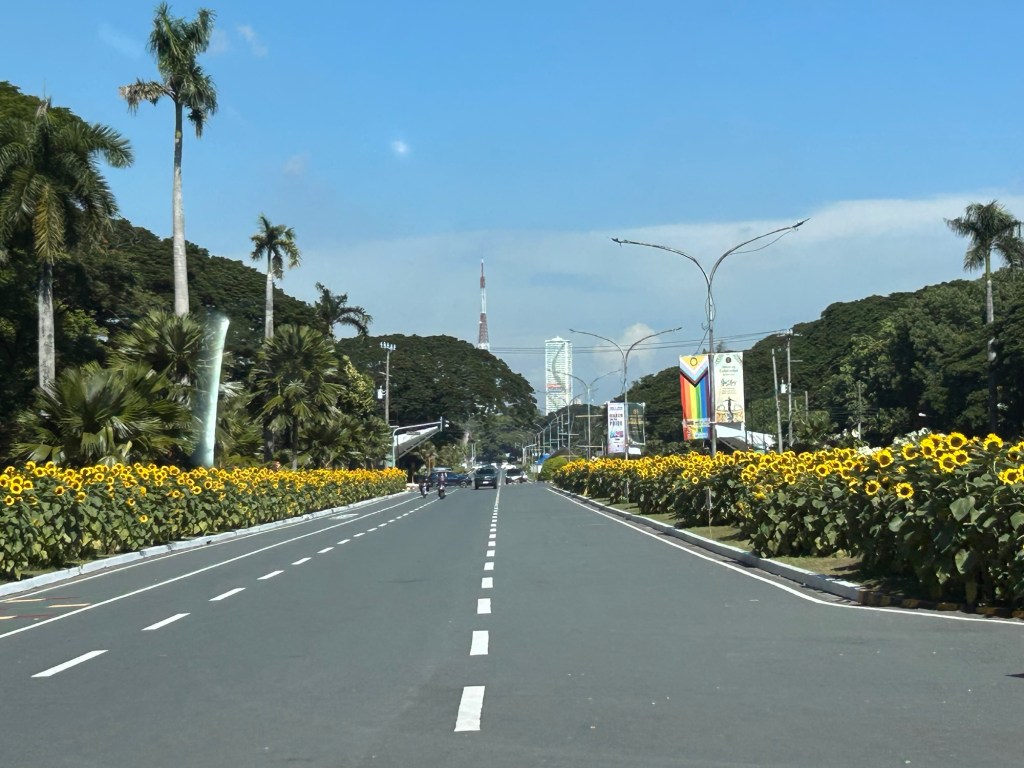

Imagine our streets lined up with flowers or trees? Not only could we probably have aesthetically nice streets but they would be more environmentally compatible. They would probably also contribute to make our days and nights cooler. The sunflowers will also probably keep zombies away 🙂
–
No more Panay-Boracay Bridge?
The news today included two items welcomed by various groups including environmental advocates. One was about the proposed bridge connecting Boracay Island to Panay. The other was on the halt on the tree cutting related to the SALEX project. Both involved San Miguel Corporation. I wrote about the proposed bridge last April and how it was not at all a necessity considering the character of Boracay. It would have been a folly to build a bridge, free or tolled, to a small island that’s main attraction is its beaches. Unlimited, easy access would bring droves of people there and lead to faster deterioration of the conditions including the environment. If the government decides on another freeze in activities for the island to recover, that will surely mean losses for the bridge concessionaire. Do we really need to bring in more traffic to an island that’s exceeded its carrying capacity?
I have not written about the tree-cutting but have written about the loss of trees elsewhere including roads where we have done fieldwork along in the past. I recall the Kamatchile trees that used to line up along long sections of McArthur Highway in Tarlac. They’re lost now after the DPWH cut them down for their road widening projects. The same happened to other trees, including very old one that are hard to replace, along other national roads in many provinces where DPWH implemented its road widening projects despite having no demand for it in many cases. This is the problem if the main Key Performance Indicator (KPI) of the DPWH is kilometers of road widened. Of course, in this case, the question is if the tollway is actually necessary. My frustration and disappointment is that government keeps encouraging tollway development with the private sector when the biggest challenge is the development of mass transit systems for our rapidly growing cities. The incentives should go there instead of more tollways.
–
How the Built Environment Affects Your Mood
Here’s a nice read as we do our storm watch, and probably explains why when we reminisce about college or university as “the best years of our lives”.
Source: How the Built Environment Affects Your Mood
To quote from the article:
“It is not for nothing that older adults often regard college as “the best years of your life” because in some cases it truly is. College years serve as a gateway drug to all the amenities and benefits of urban-core living — until you graduate that is. Then you have to return to your parents’ suburban home (as many Americans do) and suddenly all the amenities you had disappear. Your newfound college friends might make up for the lack of a diverse built environment. Nope, they all have moved back to their sprawling neighborhoods too, probably dozens of miles if not hundreds of miles away from your town. You might get a new car to celebrate your graduation and your new 9 to 5 corporate job. Work will keep you busy! But you know what else? Driving. No more waking up 10 minutes before class and arriving just on time. You might now have to wake up a few hours early to drive to your job through rush hour morning traffic, and do it all again in the afternoon.
You might also gain weight — not because you are eating more, but because you are walking less. Various studies demonstrate the link between car usage and obesity, showing “greater levels of obesity in communities where the private automobile is the dominant means of transportation.” And let’s not forget that obesity leads to other health issues such as diabetes and hypertension, among others. Mental health conditions such as depression are more prevalent in adults with obesity. Hence once college ends, graduates stop socializing, stop enjoying public amenities every day, start driving everywhere, stop walking and hence gain a little more weight in the process. Then it is no surprise that young graduates feel unfulfilled, and sometimes even depressed after college — for them, it feels they were robbed of an integral part of their new lives.
Our surroundings impact our mental and physical health. Living in neighborhoods with negative qualities can increase the risk of mental health conditions such as depression. At the same time, the pandemic made us appreciate diversity in our lives and what happens when we are deprived of it. Walkable cities are not “just a preference”; they develop happiness by fostering community trust, promoting physical activity, and offering nearby amenities. As learned, these spaces encourage healthy behaviors, reduce car dependency, and create opportunities for social interaction — all things that are crucial for our well-being.”
Based on this, no wonder I love to stay at the University of the Philippines campus in Diliman. I’m sure my colleagues in UP Los Banos feel similarly.
–

