
Home » Posts tagged 'car ownership'
Tag Archives: car ownership
On parking for typhoons
The Metro Manila Development Authority (MMDA) recently issued a memo to shopping mall operators in Metro Manila in relation to the anticipated arrival and onslaught of a super typhoon. I reproduce the memo below:
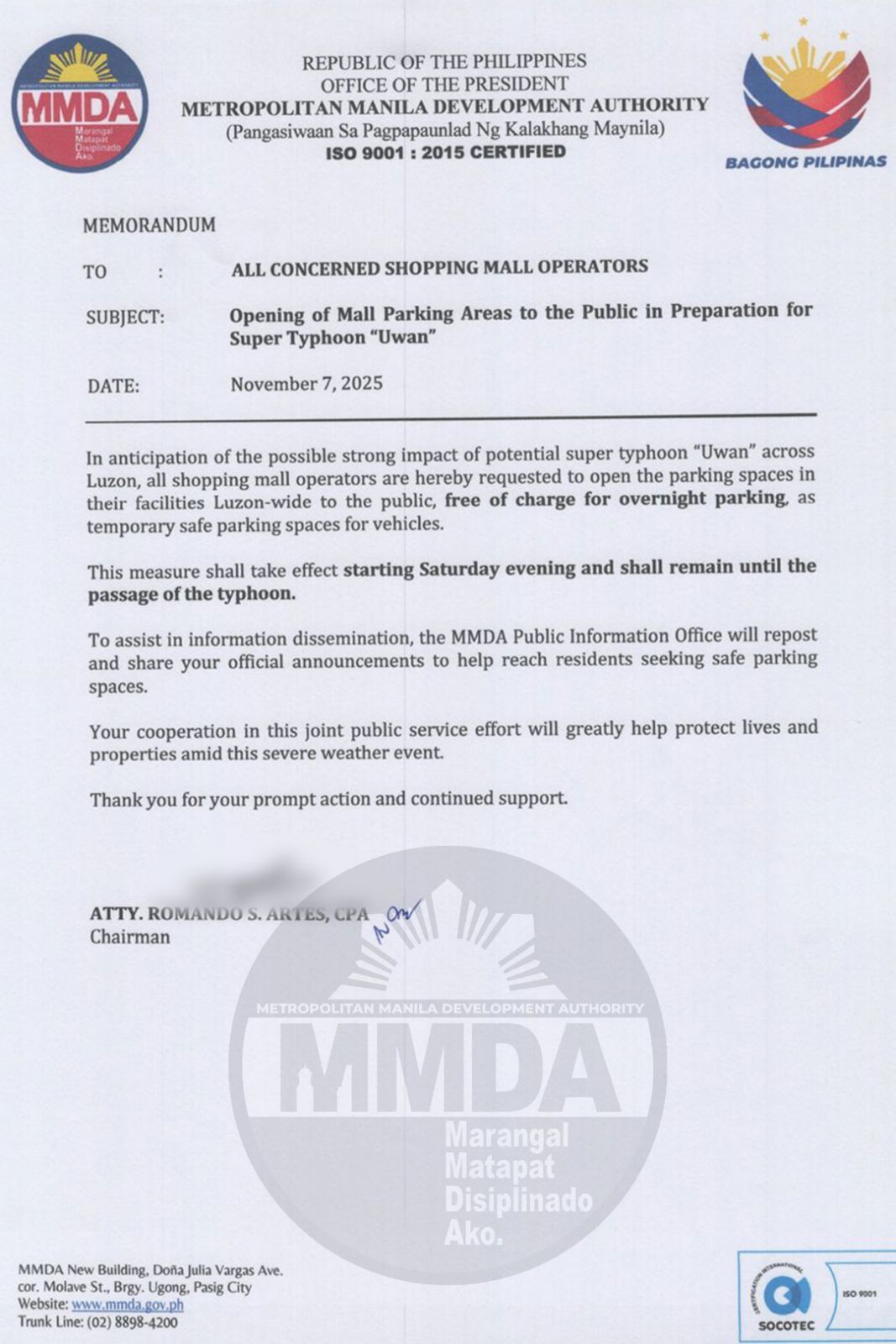
As of this morning, most if not all mall operators (at least all of the major ones – SM, Robinsons, Ayala and Megaworld) have responded positively. Some observations this morning though shows a lot of people already lining up their vehicles at the malls to take advantage of the free parking. It seems a lot of people have misunderstood the memo and responses (from the malls) to mean there’s free parking from today til Monday. Let’s assume that most of these people live in flood prone areas and that many of them probably don’t have garages in their homes. This somewhat shows us another angle of vehicle ownership and the lack of parking for many. It also somehow tells us something about our dependency on cars and how we really need to have a better transportation system.
–
On vehicle maintenance
We own 2 vehicles – one 11 year-old and another that is 7 years old. Both are well maintained but the older one recently required repairs including replacement of its shock absorbers. Recently, we had some trouble on its air-conditioning and eventually had it checked and repaired (defective evaporator).
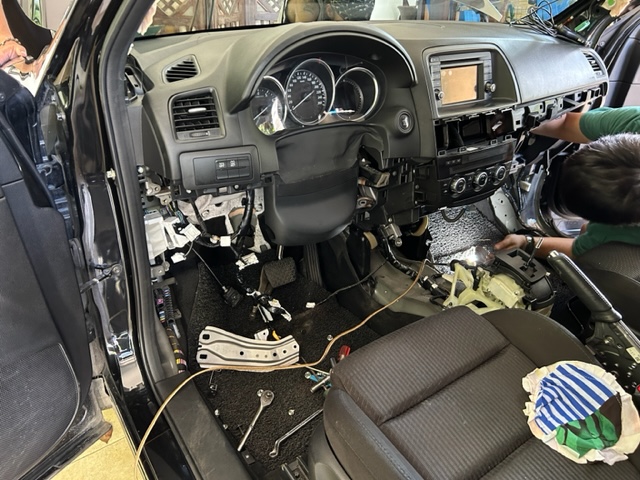 We had our vehicle serviced at home. The shop sent their service people to work on the vehicle at our garage. Here’s what the dashboard looked like while they were working.
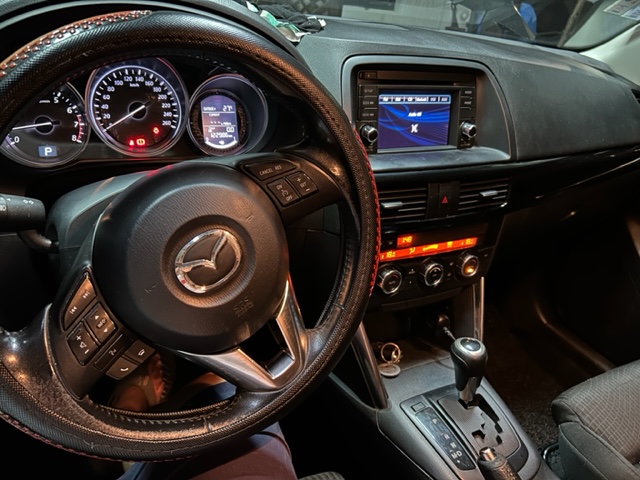 Here is what it looked like after the repairs. The air-conditioning is back strong and smelling all clean.
I joked about all the parts, screws and all, that came out when they disassembled the dashboard. I was worried they won’t be able to remember where to put these back. Of course they were able to assemble them all back and the car and the air-conditioning are all running well now. Vehicle maintenance costs are notable expenses and if you don’t do the routine maintenance works on your vehicle, you might just be surprised at how expensive it would be for major repairs. So far, we have been lucky with our vehicles after the losses due to Typhoon Ondoy (Ketsana) that resulted in 2 damaged vehicles. Maintenance costs are considered by some as hidden costs in owning vehicles. This shouldn’t be the case if you have a regular maintenance regime and keep track of the actual costs.
With the new hybrid and electric models coming out, who knows when the conventional vehicles will be phased out. Those new models would be different in terms of maintenance costs as well. I guess we’ll know soon how much it will take to maintain these new vehicles.
–
Ownership is not equal to use – on bike ownership in the Philippines
There is a nice graphic going around social media about bicycle and vehicle ownership in the Philippines. It is attributed to the Social Weather Stations (SWS), which conducted a survey on vehicle ownership in the country during the first quarter of 2023. Most conspicuous is the inclusion of bicycles considering that past national surveys (especially those conducted by the PSA or NSA) did not include bicycles but only motor vehicles in their surveys.
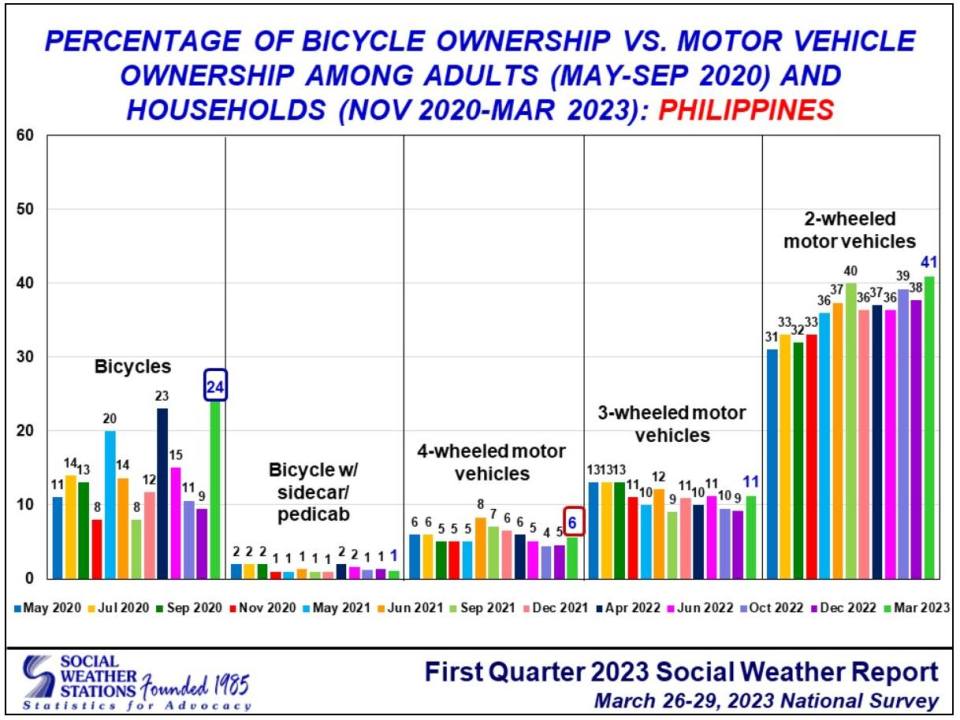
The graph shows many households owning bicycles (24% as of Mar 2023) while those who owned 4-wheel motor vehicles are only at 6%. The quick conclusion I see in many social media posts is that only 6% of HH use cars and that 24% use bicycles. This is actually fallacious and therefore misleading. Such assessments and conclusions is far from being factual considering ownership in this case does not necessarily translate to use, particularly for the most important trips made during the day – commutes to work and school. In other words, a household owning at least one bicycle does not mean they use it for their regular commutes.
The graph also states that the data is for the entire country. Thus, it does not give us a more accurate take for cities, particularly the highly urbanized ones. Are the % the same for cities like those in Metro Manila? How were the samplings conducted? These are important because if we have the wrong data and assumptions, we won’t be able to understand the problem at hand. We will not be able to formulate the most suitable solutions to address the transport problems we are experiencing. On the part of SWS, they should be clarifying what the data means rather than be content of people using their data to mislead or peddle narratives for advocacies that may be worthy yet use misinformation as a means to an end.
–
Article share: On a future with fewer cars
Advocates of sustainable transport including those pushing for more efficient public transport and more bike lanes often cite what is supposed to be car ownership data from past studies like the one conducted by JICA for Mega Manila. Most recently, I read an article that mentions only 5% of Filipinos own a car so they shouldn’t be hogging the road space against the rest. It seems so simple yet does not take into consideration geographic and demographic factors. It seems to underestimate vehicle ownership across the country and especially in cities. Also, do we equate vehicle ownership with just car ownership? Many may not have cars per se but own and operate motorcycles or tricycles.
I share the following article from the Washington Post as it presents on initiatives and studies from the Institute of Transportation Engineers concerning car ownership in the US. The data is presented in a way that we can clearly understand car ownership from various perspective including income level, household size, age and disability, among others.
Aratani, L. (February 18, 2023) “How a future with fewer cars may change how communities are designed,” Washington Post, https://www.washingtonpost.com/transportation/2023/02/18/automobile-ownership-street-design/ [Last accessed: 2/27/2023]
Here is an excerpt from the article: “There are people who are car-free and those who are carless. The car-free are the people who are choosing not to have a vehicle because they have access to other means of transportation or they work from home. The carless are people who either can’t afford or don’t have access to a car for other reasons.”
It would be nice to have a similar data set and analysis for the Philippines so we can really understand mode choice or preferences with respect to various factors including household income. Among the data sets we can probably use are the census data and the Family Income and Expenditure Survey (FIES) that are regularly collected and from which we can ascertain vehicle ownership vs. various parameters.
–
On car ownership and car use vs. public transport use
Here is another quick share of an article regarding car ownership and car use vs. public transport use. It is written in the first person as a the author relates her experience and what contradictory feelings she’s had with the decision to acquire and use a car.
Noor, D (June 21, 2021) “Buying a Car Improved My Life. It Shouldn’t Have.” Gizmodo, https://gizmodo.com/buying-a-car-improved-my-life-it-shouldnt-have-1847106068 [Last accessed: 7/10/2021]
I think many people in the Philippines (not just Metro Manila or other highly urbanized cities in the country) have similar experiences. They really don’t want to get a car or a motorcycle but their circumstances and the conveniences have outweighed their initial stand. Why do we need to have our own private vehicle anyway? Is it because its difficult to get a ride using public transport? Is it because of the quality of the ride? Is it due to health or safety-related reasons? In that last question, perhaps the fears of getting infected by Covid-19 present a overwhelming justification for car use and not just car ownership.
We also have to distinguish between vehicle ownership, car ownership and car use. ‘Vehicle ownership’ is a more general term that should include both motorized and non-motorized vehicles. Thus, if you have don’t have a car but instead have a bicycle, you are still a vehicle owner. Of course the term is more widely applied to motor vehicle owners but we need to expand this and distinguish between motor and non-motor vehicle ownership. Otherwise, let’s just be specific about the vehicle. ‘Car ownership’ is not equal to or does not correspond with car use. It is possible that one owns one or more cars or vehicles but does not use them at least for his/her regular commute. People in Singapore, for example, have cars. The same for people in Japan. However, most of these car owners choose to take public transportation most days. In their case, owning a car may not have improved their lives considering the excellent public transport services they have and requirements for people wanting to own cars in those places. Elsewhere, such as the Philippines, owning and using a car may provide better transport options depending not the circumstances of the person(s), even considering the costs of ownership and operations.
–
It’s not that simple: the math on vehicle sales and registration
I read the statement of a government official about vehicle sales, and the subsequent responses it got. He cited math and seemingly joked about not being good at it while trying to make sense of the numbers. It is not as easy as he supposes. And I think that is partly why we fail to address the transport problems. For one, we think it is just about road capacities. For another, it may be about public transport supply. These are not mutually exclusive but rather intertwined along with so many other factors.
Housing, for one, (i.e., its availability, affordability and location) is among the most important factors that affect or influence how we commute. I have been asking the question about housing affordability in CBDs such as Makati, Ortigas and BGC. Lucky for those who already reside at or near those places but most people working there have to contend with expensive mortgages, leases or rents. How much is a condo unit in BGC, for example? If you have a family of 4, you certainly can’t and won’t opt for a studio unit just because its near your workplace. It’s obvious here that you also would have to consider where your children will be going to school as well as the workplace location of your partner if he or she is also working. No schools for now but imagine how it was and would be once our children go back to physical school. Such facts of life seem lost to many pundits commenting or offering opinions about transportation.
I think to be fair this should also be framed from various perspectives. For example, those vehicle purchases don’t necessarily mean additional vehicles on certain roads. like what one MMDA official claims. These will be distributed across the network of roads, and these will be operating during certain times of the day. Some of these vehicles were purchased by new car owners. Others as replacements to older or unserviceable units (e.g., upgrades). It would be nice to see, for example, the stats from 2008, 2009 & 2010. Thousands of vehicles were doomed by Ondoy in the greater Metro Manila in 2009 resulting in their replacements late that year until 2010. Then there was the boom in sales in the following years as people ventured into TNCs (Uber and Grab). The recent surge in private car use and what seems to be strong sales of these vehicles in the wake of the Covid-19 pandemic is more out of necessity (why do you think people aren’t taking to cycling for their commutes as much as is desired?)
The question why people still prefer to purchase and use their own vehicles has not been answered in the most honest way because different people with their own agenda tend to paint different pictures of the car owner. In some cases, car owners are being portrayed as ‘evil’ while those taking the more environment-friendly modes as ‘good’. Again, it should be obvious that this is not a ‘good’ vs. ‘evil’ discussion nor is it something that is black and white. We should pay (a lot of) attention to the grays, which can have so many different shades when it comes to transportation. No one really wins a “holier than thou” exercise where people on opposite sides tend to take hard line stances and close their minds to constructive ideas from either side.
–
On people’s reactions to the pandemic – more cars?
There is this article that argues that one result of the pandemic and the scare that it caused to a many is that people have resorted to car use during and after the lockdowns:
Vanderbilt, T. (2020) “People Are Buying Cars Because of the Pandemic. Cities May Change as a Result,“ Medium, https://gen.medium.com/people-are-buying-cars-because-of-the-pandemic-cities-may-change-as-a-result-e0657584f45e [Last accessed: 6/20/2020]
It was amusing for me to read the reference to cars as a sort of PPE but it comes as no surprise. It is psychologically like a suit of armor to some people and I guess this affects them the same way as some people’s personalities change when behind the wheel.
Whether this is true for the Philippines’ case we are now seeing somewhat but I say ‘somewhat’ because of the deficiencies in public transportation especially in Metro Manila. Government agencies in-charge of transportation seem to have found the perfect situation to roll out and push for both route rationalization and modernization. Major public transport routes have resumed operations but with buses instead of jeepneys. And slowly but somehow surely the “modern jeepneys” are being allowed but following the terms and conditions of the DOTr and the LTFRB.
–
What if Ondoy happened today?
With the news of the devastation of Houston by Hurricane Harvey comes articles about transportation in that city. An interesting articles is this one:
Davies, A. (2017) “Hurricane Harvey Destroys Up to a Million Cars in Car-Dependent Houston“. Wired.com. September 3, 2017. https://www.wired.com/story/harvey-houston-cars-ruined?mbid=nl_090317_daily&CNDID=%%CUST_ID%% (Last accessed 9/4/2017).
The article reminded me of a very personal experience back in 2009 when Typhoon Ondoy (international name: Ketsana) submerged much of Metro Manila and its adjoining provinces in what was believed to be at least 100-year floods. Greater Metro Manila or Mega Manila is not too dependent on private cars for transportation with an estimated 70% of trips taking public transport (about 30% use private vehicles including motorcycles and taxis). Much of this public transportation, however, is road-based and so the floods did much to affect transportation in the area for the weeks after Ondoy. Car-owners rebounded quite quickly and car sales surged afterwards with many people purchasing SUVs in response to the likelihood of floods.
But what if Ondoy happened today? What if people were as unprepared as in 2009? Perhaps the damage would have been even greater than back in 2009. Mega Manila has become more dependent on cars since then with the current estimates of private vehicle mode shares at around 35%. The increase includes not only taxis and motorcycles, which have enjoyed steep increases in the past decade, but also ridesharing services (i.e., Uber and Grab).
Uber and Grab vehicles are predominantly comprised of vehicles purchased for the main purpose of being driven for income instead of the original concept of ridesharing where the vehicles are already owned and operated only during the free times of their owners (i.e., they provide services only on a part-time basis). Their proliferation and popularity means a lot more vehicles could have been damaged by Ondoy and that the owners of these vehicles likely would not have recovered from the loss even despite their auto insurance coverages.
Metro Manila and other Philippine cities under the threat of similar severe weather systems such as typhoons should build resilient transportation systems. Not surprisingly, among the more resilient modes of transport are non-motorized such as walking and cycling. Pedicabs where almost immediately back on service in Tacloban after Yolanda practically destroyed that city. But then again, an efficient public transport system is also necessary and buses and trains may provide relief from flooded cities. Maybe, a proposed subway system can also contribute if it includes the construction of subterranean drainage systems similar to that of Tokyo’s. These are not easy to develop or build with infrastructure costing much over the long term. However, Metro Manila needs to start building them now as these won’t get cheaper in the future.
–
 Caught (up) in traffic