
Home » Posts tagged 'commuting' (Page 6)
Tag Archives: commuting
To commute or not to commute
To commute or not to commute? That seems to be the question many people would like our political leaders and government officials to ponder the answer to. Of course, the word “commute” itself refers to traveling whether by public or private transport. However, in the Philippines we have equated “commuting” with taking public transportation. Anyhow, the reality is that most of our top officials, elected or appointed are car owners and are most likely to drive or be driven between their homes, offices and appointments. This is what is perceived by many people as “The Reason” why public officials have little or no appreciation of the difficulties experienced by the commuting public.
While sympathy is usually assumed or claimed by responsible persons, it is empathy that is most desirable from our public officials as they should feel how most people feel when they commute every working day. But how can you empathize if you have not experienced the difficulties of commuting in Metro Manila or other city? How can you say you understand the plight of pedestrians, cyclists and those taking public transport if you prefer or opt to drive or be driven in your car or SUV to and from your office? Did you really commute when you were in high school or college? Or maybe you were one of those cool guys or gals driving their own cars?
Almost every week, I have left my car at the office to commute or hitch a ride with my wife where our routes overlap. I have used public transportation since I was in high school so I am quite familiar with taking pedicabs, tricycles, jeepneys, buses and trains. I have also commuted whenever I am on trips to other cities including those abroad. Public transport is part of the experience whenever I am on trips and when I am in a new place, I make it a point to take long walks first to explore the surrounding area. It is a familiarization of sorts and makes me comfortable with the area. I remember that when I was a student in Japan, I would try to look for the nearest church to where I was staying, especially if I was there over the weekend.
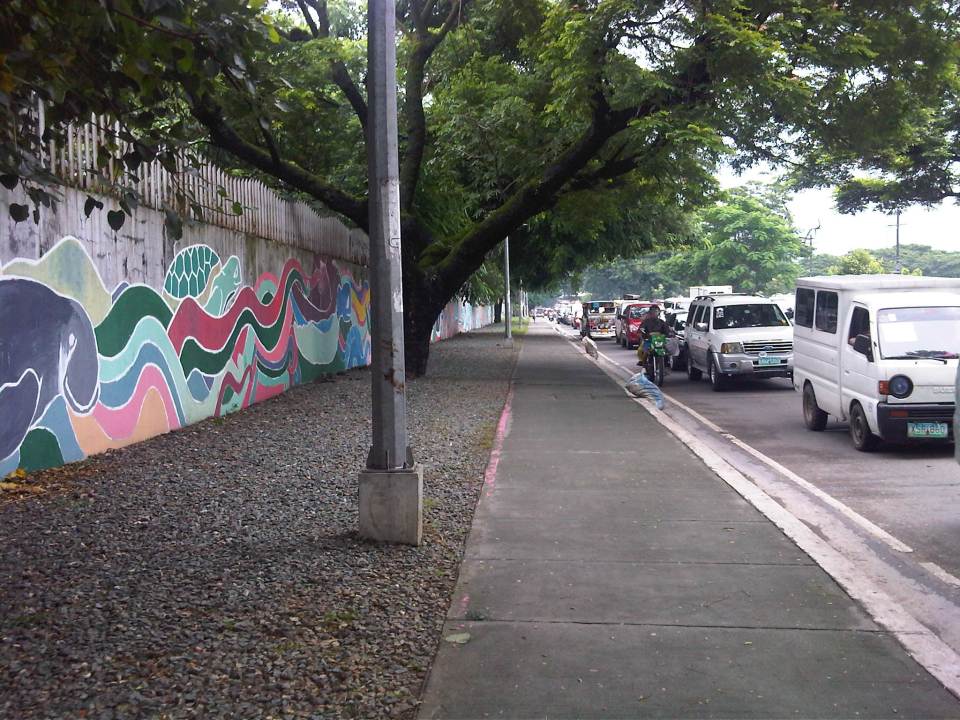 Walking is part of commuting and I am thankful that where I work, the surroundings are basically pedestrian-friendly. The photo above shows the sidewalk along Katipunan Avenue on the side of the university.
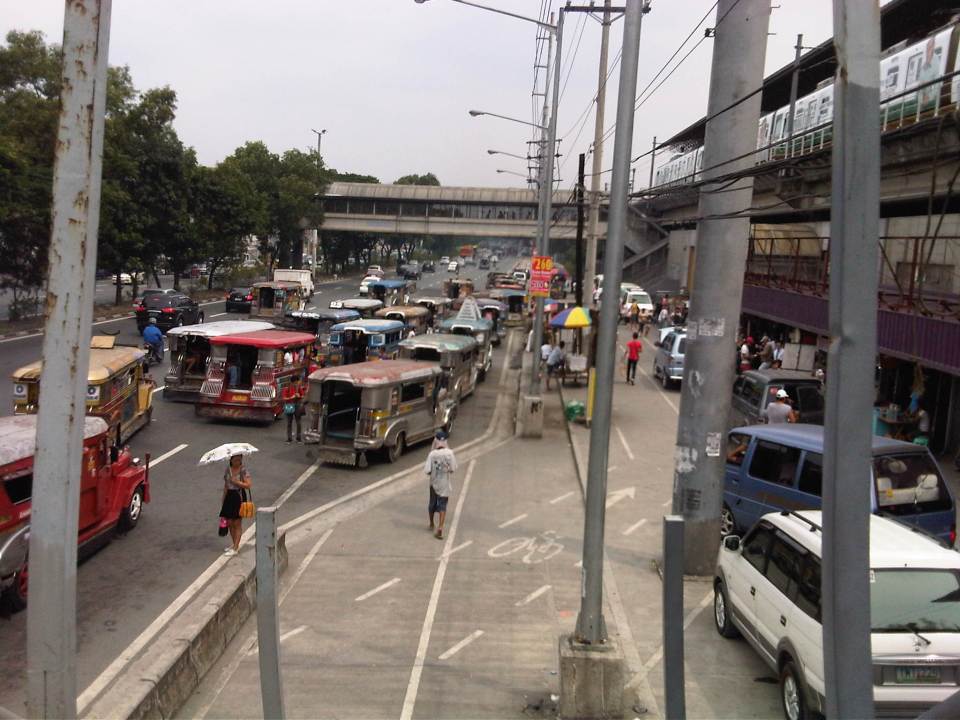 Seamless transfers are not yet quite the norm in the Philippines. The photo shows one of the better examples where transfers between modes are more convenient. This is at the LRT 2 Santolan Station. Note the markings for the bicycle path. I took this as I was descending from the pedestrian overpass that connected with a nearby mall by the Marikina River.
While traveling within other cities, whether in the Philippines or abroad, the first option for many if not most people would be to take public transportation. Taking out a rental vehicle is not common and taxis are considered as part of the public transport system. As such, we try to get information on how to get to places of interest from relatives, friends, hosts or staff of the hotel we are staying at. These include maps like the old fashioned ones we can get at airports, train stations and tourist booths. Nowadays, there’s a wealth of information available online and apps that can help us navigate around cities.
We tend to comment on how good the public transportation is in the places we’ve visited or how easy it was to commute in these cities. And upon returning to our country we are quick to criticize our public transport, pedestrian and cycling facilities. The irony, of course, is that many of those who are quick to criticize don’t even use public transport, walk or cycle. Even more tragic (for lack of a better word, I think) is that we don’t demand for better public transport, pedestrian or cycling facilities. Perhaps that should change and in this New Year, we should resolve to push the government and its partners for better transit, pedestrian and cycling infrastructure for our cities. And part of that push is by getting involved in advocacies, including projects, for these causes on transport. We should not forget that though we need and seek champions for public transport, walking and cycling among our leaders, we should also be champions in our own ways.
–
Pedicab fares
Tricycle and pedicab fares are set quite variably depending on the service areas and those regulating the services. In many cases, it is the pedicab association comprised of drivers-operators who set the fares, which are then supposed to be approved by local officials like those in the barangay or municipal/city hall. I say “supposed” here since most rates are not formally regulated in the manner like how the Land Transportation Franchising and Regulatory Board (LTFRB) sets fares for buses, jeepneys and taxis. While the principles of “willingness to pay” is applied to some extent, pedicab and tricycle fares are usually imposed (to use a strong word) by tricycle and pedicab associations with very rough estimates of operating costs or, in the case of NMTs, the equivalent of physical effort, required to convey people.
In residential subdivisions or villages, associations may have a say in the fare rates. Where I live, the association sets the standard rates and these go to the extent of differentiating between day time and night time rates. There is even a rate for when streets are flooded! There is also a definition for regular and special trips and rates are according to the general distance traveled by pedicab. That is, fares to Phase 2 are generally higher than those for Phases 1 and 3 because Phase 2 streets are generally farther from the reference origin/destination, which is the village gate. Given the effort of pedicab drivers to transport passengers, I think the rates are just right. The only part there that seems unusual is the rate of PhP 1/minute for waiting time, which to me seems to high. Nevertheless, there is nothing to stop passengers from showing their appreciation for hard work in the form of tips. And there is no limit to the generosity of some passengers who choose to pay more to the (pedi)cabbie.
 Tariff sheet displayed inside the sidecar of every pedicab of our village. The information is useful especially to guests or visitors who are not familiar with pedicab rates in the area.
–
More pedestrian facilities please!
I took a couple of photos one late afternoon on a weekday on my way home. I wanted to have a picture of typical jeepney overloading during the afternoon peak. Typically, jeepneys would allow “sabit” or passengers hanging from behind the jeepney. This practice is actually prohibited and carries a fine if jeepney drivers are apprehended. And that is usually a big “if” considering enforcers turn a blind eye to the practice especially during peak periods when it is difficult to get a ride.
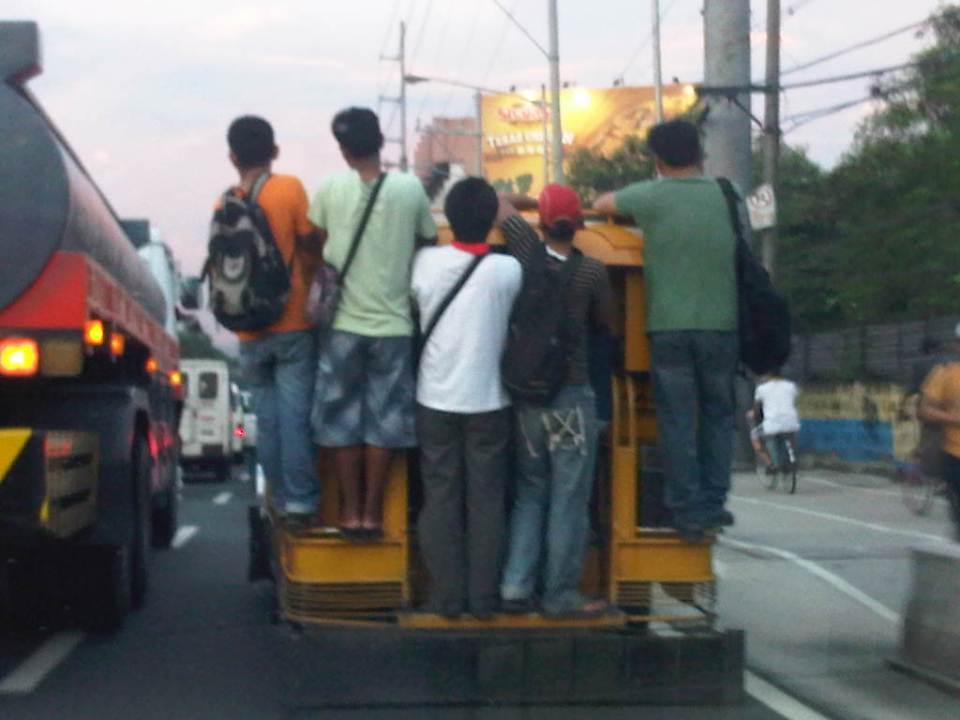 Jeepney full of sabit or hangers-on in heavy traffic along the eastbound side of a major highway
I also happened upon an opportunity to take a photo of the overloaded jeepney together with pedestrians walking along the walkway at the roadside. Though the photo was not so clear, it captured the image I wanted with people opting to walk while others took a risky ride on a jeepney. The cyclists in the photos were just bonuses and added to the visual of alternatives for mobility.
 Pedestrians and a cyclist along the widened walkway/bikeway along Marcos Highway
Walking remains as the mode of transport with the highest share when all modes, motorized or non-motorized, are compared. While there is a strong clamor from cyclists for bikeways and for cycling to be taken up by more people as an option for commuting, the reality is that cycling is not really for everyone. It is a viable and healthy mode but should also fit in a hierarchy of modes. Most people walk and walking should be encouraged over distances where it is most suitable. Facilities for walking need to be provided and properly designed so that people can walk safely and most efficiently like the example in the following photo taken during another weekday late afternoon.
 People walking along Marcos Highway
Local governments help promote walking by making sure sidewalks are provided and clear of obstructions. Perhaps walkability can be used as an indicator or parameter for a city to be qualified as livable and true to the advocacy of sustainable transport. Walking should be encouraged to promote healthy living as it incorporates exercise in our daily routines. More people walking should also increase awareness for the advocacy for clean air and help initiatives to improve air quality, particularly efforts to reduce harmful emissions by motorized vehicles. Thus, it is not difficult to understand how investing in pedestrian facilities and promoting walking is not a smart move and a beneficial one for any politician’s constituency.
–
 Caught (up) in traffic