
Home » Posts tagged 'cycling' (Page 4)
Tag Archives: cycling
On the future of bike lanes in Metro Manila and other cities and municipalities in the Philippines
My friends and I were talking about the current buzz about the bike lanes including statements made by certain personalities (influencers, advocates, government officials, etc.) about biking and bike lanes. There were many recent pronouncements of motorcycles being allowed to use bike lanes or the outright removal of bike lanes. We all agreed this was backward and the way forward is to build on the current network and facilities. What we have in our cities and municipalities are not perfect and far from ideal but they are a start and perhaps the foundation for a bikeway network that can eventually make a dent on the car-centric transportation we have.
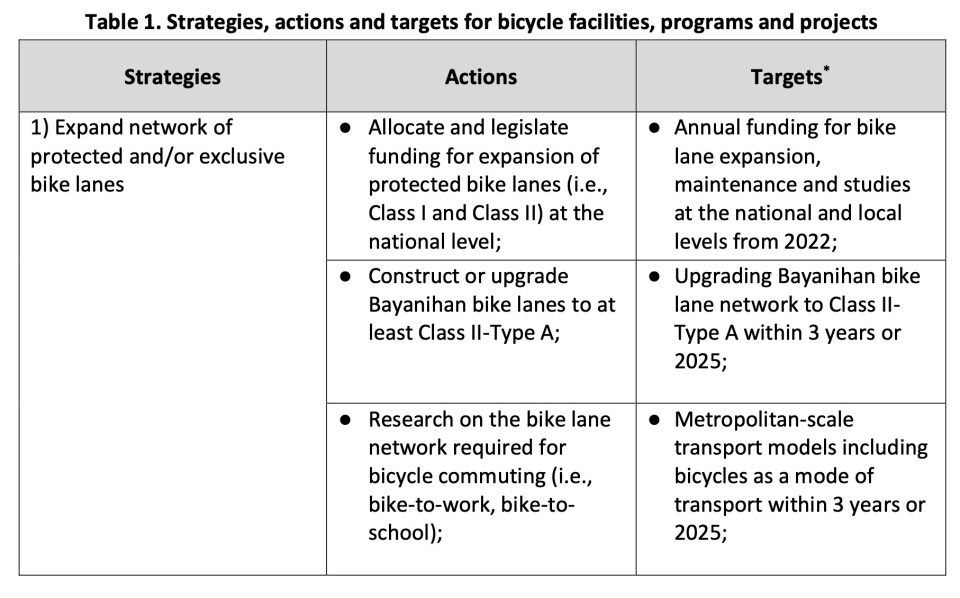
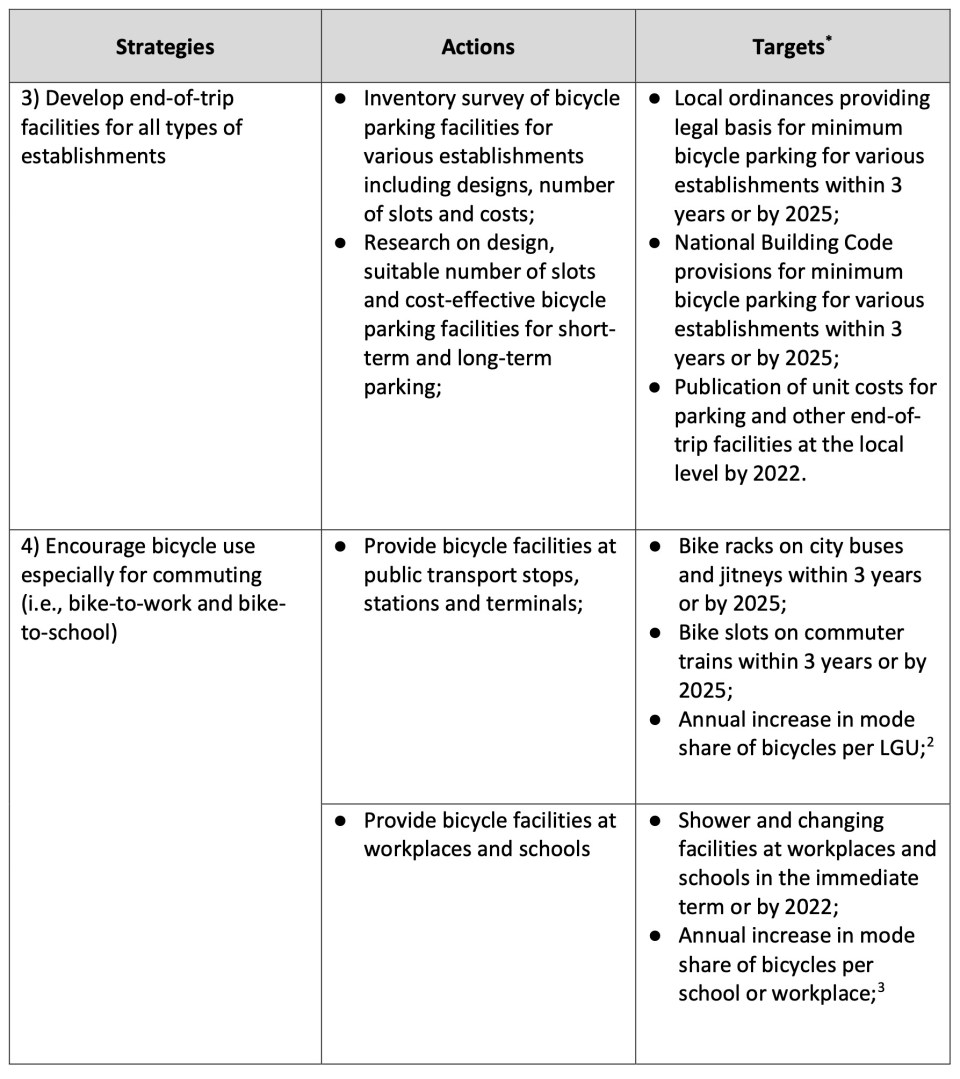
I share below the strategies, actions and targets for bicycle facilities, programs and projects from the Network Planning for the Establishment of Bike Lanes in Metro Manila, Metro Cebu and Metro Davao that was completed middle of 2022. The project is DOTr’s with support from the UNDP. The table is from the Final Report of the project.


A Happy Christmas to all!
–
Shared article: Active and Micro Mobility Modes Can Provide Cost-Effective Emission Reductions–If We Let Them
I’m sharing this article on active and micro mobility modes from Todd Litman, published in Planetizen.com:
Source: Active and Micro Mobility Modes Can Provide Cost-Effective Emission Reductions–If We Let Them
From the article:
“Common Active Transportation Leverage Effects:
–Shorter trips. Shorter active trips often substitutes for longer motorized trips, such as when people choose a local store rather than driving to more distant shops.
–Reduced chauffeuring. Better walking and bicycling conditions reduces the need to chauffeur non-drivers (special trips to transport a passenger). These often require empty backhauls (miles driven with no passenger). As a result, each mile of avoided chauffeuring often reduces two vehicle-miles.
-Increased public transit travel. Since most transit trips include walking and bicycling links, improving these modes supports public transit travel and transit-oriented development.
-Vehicle ownership reductions. Active mode improvements allow some households to reduce their vehicle ownership, which reduces vehicle trip generation, and therefore total vehicle-miles.
-Lower traffic speeds. Active travel improvements often involve traffic speed reductions. This makes non-auto travel more time-competitive with driving and reduces total automobile travel.
-More compact development. Walking and bicycling support more compact, multimodal communities by reducing the amount of land devoted to roadways and parking, and creating more attractive streets.
-Social norms. As active travel increases, these modes become more socially acceptable.
The article is a must read if we are to understand how important active transport and micro mobilities are in the context of today’s transport conundrum. Of course, part of the contextualization and perhaps ‘localization’ on these modes will be related to land use or development. The latter is a big challenge especially for the likes of Metro Manila and other rapidly developing cities in the Philippines where housing in the cities (related to compact development) has become quite expensive and has driven more and more people to live in the suburbs. As I’ve mentioned in previous posts, this has resulted in more pressure to develop transportation systems but infrastructure development cannot play the catch up game given the limited resources for their construction. Meanwhile, services are also behind in terms of quality and requires reforms and rationalizations.
–
On intersection treatments for bicycles
With the increasing popularity of bicycles as a mode of transport particularly for commuting (e.g., bike-to-work, bike-to-school), we should be redesigning our intersections to include elements essential for the safety of all users, whether on motorized or non-motorized modes. Here is a short but very informative article on how a simple intersection treatment can significantly improve safety for everyone especially cyclists and pedestrians:
Grief, N. (December 2, 2022) “How Green Paint Can Save Cyclists’ Lives,” Bicycling.com, https://www.bicycling.com/news/a42124210/bike-boxes-intersections/ [Last accessed: 12/3/2022]
To quote from the article:
“A bike box, on the other hand, seems to be the ideal middle ground and the option of the three that these researchers recommend. Cyclists feel more comfortable when compared to the free-for-all of a mixing zone because they have a designated area to be and they’re out ahead of vehicles, but according to the eye movement analysis, they remain alert and watchful for vehicles.”
Here are a couple of drawings showing bike boxes at intersections from the recent Bike Lanes Master Plan for Metro Manila, Metro Cebu and Metro Davao that was developed by DOTr with assistance from the UNDP:
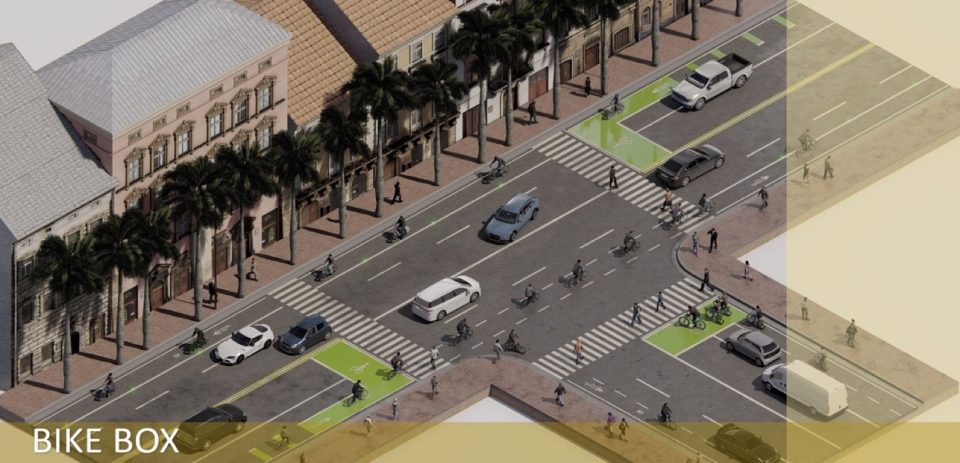 Bike boxes on a typical three-leg intersection (DOTr and UNDP, 2022)
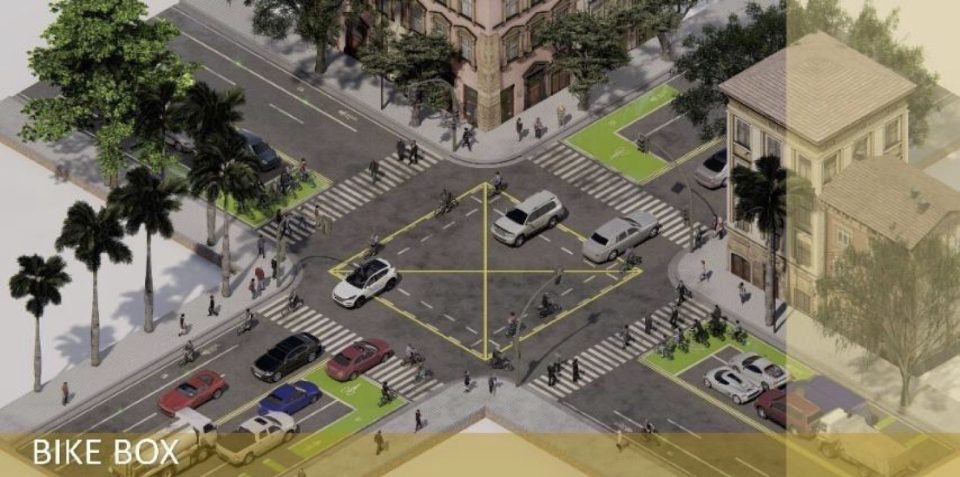 Bike boxes on a typical four-leg intersection (DOTr and UNDP, 2022)
The preceding drawings adhere to the DPWH design guidelines that mainly follow AASHTO Guidelines. Of course, there are other design references such as NACTO and the manuals of other countries (e.g., Netherlands, Australia, Singapore, etc.) were the best practice designs can be adopted for local applications.
–
Who can design bikeways?
I have read many comments about how bike lanes and other bike facilities are sub-standard or unacceptable because they were designed by non-cyclists. From an academic perspective and perhaps also from a point of view of someone who values empathy, the planning and design of bicycle facilities should not be so limited. The objective of education, and particularly for schools whose graduates become professionals like engineers, architects and planners, should be to have the latter be able to plan and design the most suitable infrastructure and facilities for all users. Suitability here should include equity considering the many elements involved for people of different gender, physical ability or disability, age, health conditions, etc. That said, it is the responsibility of agencies such as the Department of Public Works and Highways (DPWH) to revise and update their design manuals and guidelines to ensure that these are according to International standards and mindful of the best practices in various cities and countries that are now very well documented.
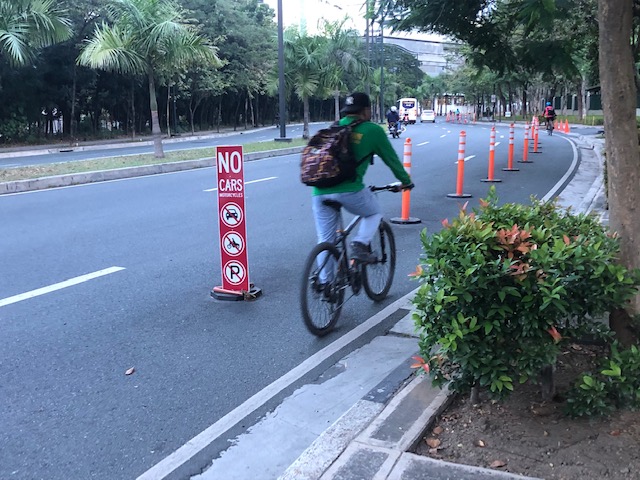 Bike lane in BGC,Taguig City
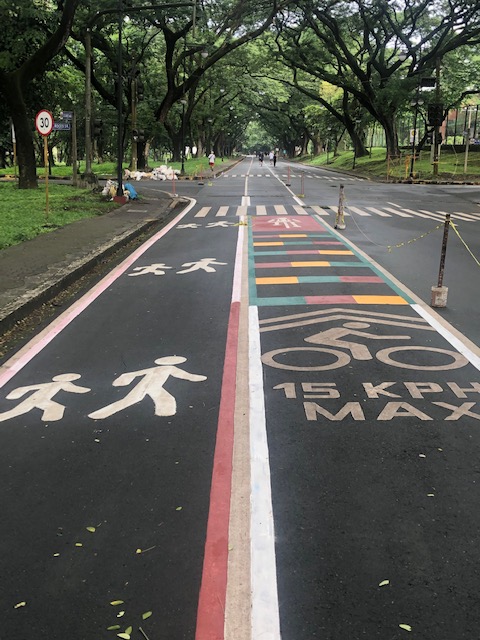 Bike lane and jogging/walking lane in UP Diliman
–
Towards safer streets – on the best street improvements
We conclude the month of September with an article on road safety and particularly on best or good practices towards improving safety:
Brey, J. (September 16, 2022) “What Are the Best Safe-Streets Improvements,” Governing, https://www.governing.com/community/what-are-the-best-safe-streets-improvements [Last accessed: 9/29/2022]
The article points to improvements concerning pedestrians have the best results in terms of reducing the injury rose and death. To quote from the article:
“The data suggested that interventions which give more street space to pedestrians have the best results for lowering the risk of serious injury and death. Somewhat to the department’s surprise, that includes curb extensions, also known as “neckdowns,” which reduce the distance that pedestrians have to cover to cross a street. Those interventions were associated with a 34.1 percent decrease in deaths and serious injuries, according to the report.”
There is an interesting table in the article listing the top safety treatments in terms of injury change and KSI (killed or seriously injured) change. For the latter, the top treatments in order of highest change are:
- Pedestrian island
- Curb & sidewalk extensions
- Road diets
- Leading pedestrian intervals
- Protected bike lanes
- Turn calming
- Conventional bike lanes
With the push for more segregated bike lanes (as opposed to shared lanes), it is interesting to note from the article that:
“Another important takeaway was that conventional bike lanes, which involve little more than paint, did result in significantly fewer deaths and serious injuries. Protected bike lanes, which are separate from traffic by medians, parking space or other infrastructure, were more effective — but painted lanes are also useful…”
This a good reference and taking off point for those who are doing studies on road safety and want to contextualize it from the perspective of the complete streets concept.
–
On the impacts of bicycle use
I’ve probably read a lot of posts on social media advocating for bicycle use. Here is another article that provides us with evidence about the impacts of cycling on travel, emissions and health:
Timmer, J. (August 20, 2022) “Here’s What Happens When Countries Use Bikes to Fight Emissions,” Wired, https://www.wired.com/story/bike-more-curb-global-emissions/ [Last accessed: 8/24/2022]
To quote from the article:
“Globally, adopting a Danish level of bicycle use would reduce annual emissions of CO2 by 414 million metric tons, approximately equivalent to the UK’s emissions in 2015. Boosting that to a Dutch level would eliminate nearly 700 million metric tons, or most of the emissions from Germany in that year.
The researchers also noted that countries like the Netherlands and Denmark have much lower rates of obesity than their peer countries. Based on the known health risks there, they estimate that, globally, we’re already avoiding 170,000 deaths annually due to cycling. Expanding this globally, they found that Denmark-equivalent bicycle use would prevent 430,000 deaths per year. Dutch levels of cycling would prevent 780,000 deaths.
That said, the vulnerability of cyclists to cars poses its own lethal risks. But these aren’t anywhere close to outweighing the benefits from exercise and lower obesity. (They’d add about 90,000 and 160,000 additional deaths per year for the two levels of use.) And if fewer drivers are using cars, there’s a chance that those numbers would come in even lower.
It’s worth noting that these numbers almost certainly underestimate the benefits of shifting to bikes. Bicycles use far fewer resources to produce, and they last longer than most cars. Maintenance is likely to be far less resource-intensive as well. So simply focusing on the use of the bike omits a lot of things that would show up in a detailed life-cycle analysis.
The researchers are certainly correct that there are a lot of locations where weather makes cycling a less-than-ideal option—and the range of places where heat makes it a positively dangerous option is expanding in our changing climate.
But some of the other issues are less severe than they might appear at first. For example, the advent of bicycles with electric assist means that hilly locales aren’t necessarily the barrier they might have been a decade ago. And while a number of countries have large open spaces where cars will remain a necessity, the trend toward urbanization means that most people in those countries will live in places where cycling can be made an option.
So, the biggest barrier is likely to remain the social will to rethink transportation.”
Indeed, social will (as well as political will) is perhaps the biggest barrier in our country. Many people may not agree but the evidence for this is so clear and obvious that one has to be naive or oblivious to not see it. How else will one explain people sticking to their cars and more readily shifting to motorcycles rather than the bicycle. Of course, there are other factors to be considered and the article actually cites wealth and geography as strong prerequisites in developing a cycling culture. We need to do much more to determine where interventions are needed including land use planning and land development as well as the provision of affordable housing closer to workplaces, schools, shops and other places of interest (Hello 10- or 15-minute cities!).
–
On the benefits of developing and investing in active and public transportation
Here is another quick share of an article with a very relevant and timely topic – the business case for multimodal transport planning:
Litman, T. (July 2022) “The Business Case for Multimodal Transportation Planning,” Planetizen, https://www.planetizen.com/blogs/117697-business-case-multimodal-transportation-planning?utm_source=newswire&utm_medium=email&utm_campaign=news-07142022&mc_cid=03c159ebcf&mc_eid=9ccfe464b1 [Last accessed: 7/15/2022]
To quote from the article:
“Conventional planning tends to undervalue non-auto mode improvements by assuming that each additional mile of their travel can reduce, at best, one vehicle mile traveled. In fact, in many situations they can leverage much larger reductions in vehicle travel, meaning that each additional mile of walking, bicycling, or public transit can reduce more than one vehicle mile … As a result, walking, bicycling and public transit improvements can provide much larger vehicle travel reductions and benefits than is commonly recognized.”
There is a box referred to in the preceding quote. I will not reproduce it here so I leave it up to the reader to go to the original article by Litman to find out how active and public transport can leverage additional travel reductions. Understanding these and the extend by which we can be independent of car-use (referring to non-car travel demand) will allow for a better appreciation, travel-wise and economics or business-wise, of the advantages of developing and investing in active and public transportation infrastructure and services.
–
A Bike Master Plan for Metro Manila, Metro Cebu and Metro Davao
Before Active Transport Week concludes this weekend, I would just like to share this collage from one of our staff at the National Center for Transportation Studies of the University of the Philippines Diliman. It is about the Master Plan developed for the three metropolitan areas in the country – Metro Manila, Metro Cebu and Metro Davao. I will share more details about this soon including a link or links to where you can download a copy of the plan.

The project concluded recently with the submission of the Final Report but most important is the Master Plan document that can serve as a reference for further development of bike lanes in the metropolises. I’ve seen the Master Plan and many of its provisions and recommendations can easily be adopted or is replicable in other cities and municipalities in the country. Perhaps, there should be a National Master Plan?
–
Bike lanes at Bonifacio Global City
After settling down at our new ‘tambayan’ at BGC, I decided to take my regular morning walk around the area to familiarize myself with the environs and to establish a route that I and the wife would likely be taking for our constitutionals whenever we are staying at BGC. I took the following photos of the bike lanes along 38th Street where most of the locators are international schools.
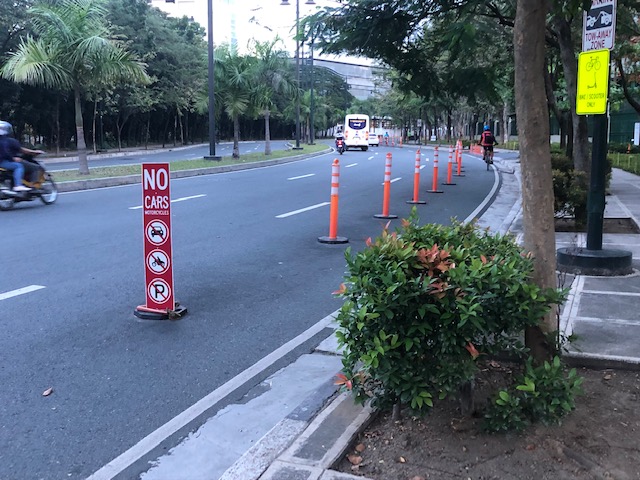
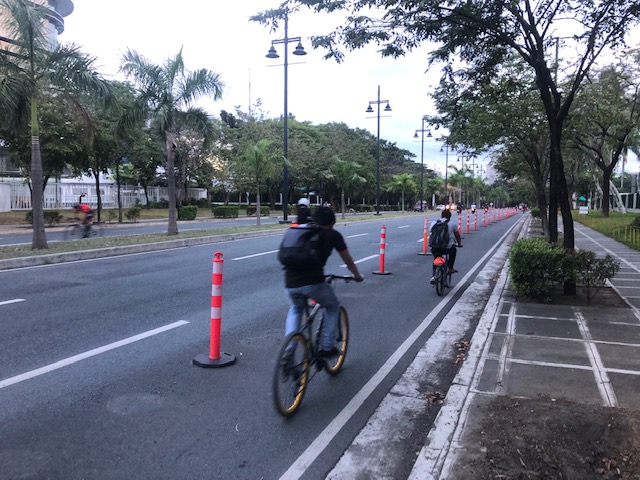
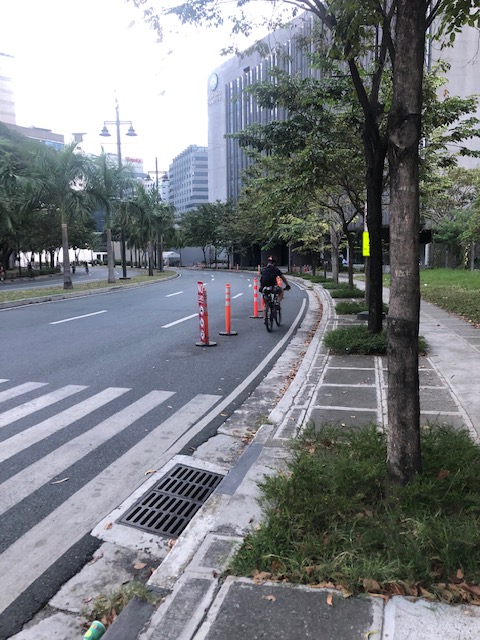
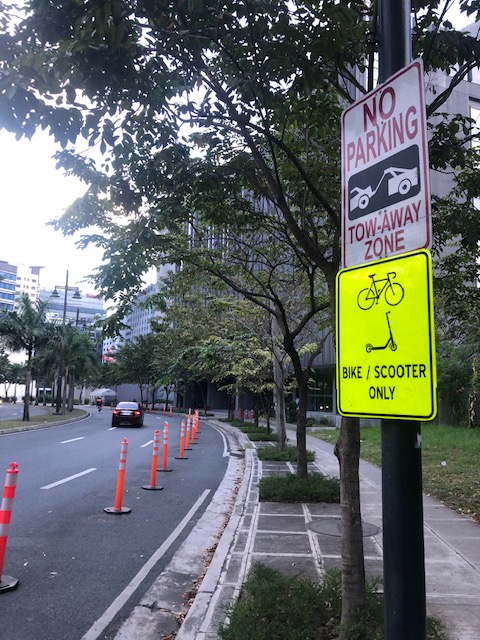
During Saturday and Sunday mornings, the bollards are moved to the sidewalk as many cyclists use 38th Street for laps. I wonder if the bike lanes will be retained once the schools resume face-to-face classes. That would mean a tremendous number of private vehicles generated by the international schools and colleges here. My opinion is that the bike lanes need to be retained as it is a step in the right direction for transport and encourages people to cycle or take PMDs to work and perhaps to school. These and others like it in Metro Manila and around the country need to be sustained and further developed to be attractive and viable to many seeking another option for mobility and their regular commutes.
–
Bike-friendly fast food
While doing field work early this week, we decided to do a quick drive through for refreshments. As we queued for the drive through window, we came upon this recent addition to many fast food restaurants in light of the increasing popularity of cycling amidst the Covid-19 pandemic. Here are a few photos of the Bike & Dine at McDonald’s along Rodeo Drive in Alabang.
 Our first close look at the bike & dine section of a fast-food restaurant ironically was via the drive through of a restaurant.
 McDonald’s bike & dine facility – many if not most of their newer branches have allocated space for bikers. These clearly show that such facilities or features can be included in the space layout and design of such restaurants.
 Cyclists may park and secure their bikes on one side (left with a slot for a wheel) and sit to eat and/or drink on the other side of the table.
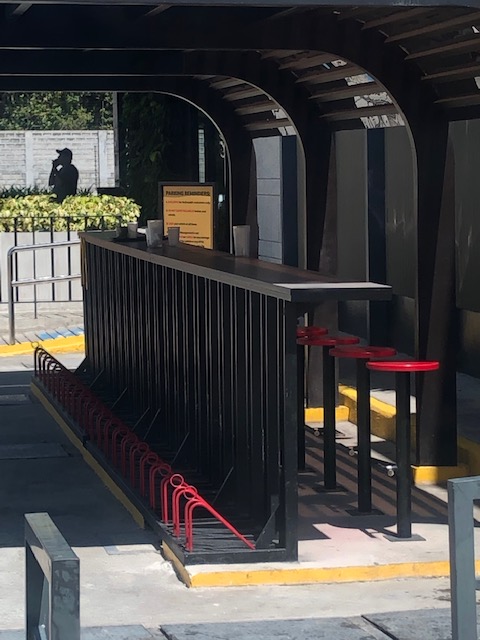 A close-up of the table, seats and bike slots
More and more establishments are now putting up bike facilities such as parking and bike & dine. We hope that these will help encourage more people to cycle while also proving that active transport is good for business.
–
 Caught (up) in traffic