
Home » Posts tagged 'cycling' (Page 8)
Tag Archives: cycling
On mass transit and active transport
I recently gave a talk on transport in the new normal. There are a lot of materials that you can refer to if you want good visuals for a presentation. It helps to capture the attention and maybe the imagination of your audience, which in this case was varied. While I assume many to be in the physical, chemical & social sciences, and engineering, I knew that there were also people from media and those who were just interested in the topic. And so I made sure there were a lot of infographics mixed in with bullet points to drive the message clear about mass transit systems being the backbone of transport in highly urbanized cities, conventional transit like buses and jeepneys supplementing and complementing these, and active transport enabled and encouraged as a safe option for many.
I wasn’t able to include the following graphic shared by a friend advocating bicycle use especially for work and school trips. The following graphic comes from TUDelft, which is among the major universities in the forefront of research in transit and cycling. Clicking on the graphic will take you to their Facebook page and more links to their programs.

Note the essential information relating bicycles and transit in the graphic. Do we have similar data in the Philippines (or at least for the National Capital Region)? I hope this stirs interest for research work. There are a lot of topics to take on including even data collection to capture the information required for substantial studies on cycling, transit and their relationship.
–
Why cycling or bicycles are good for the economy?
You saw that meme shared in social media where they say “why bicycles are bad for the economy”? There’s some humor there but it doesn’t necessarily convince many people to support cycling or biking over motor vehicle use.
Here goes one and note the logic:
“Cycling or bicycles are good for the economy because…it helps reduce car use/dependence. That means less dependence and expenses to fossil fuels. That means more money available to the household for more important stuff like food, homes and education.”
Can you come up with something like that?
 Workers on bicycles crossing the Marcos Highway bridge from Marikina towards Quezon City.
–
On walking, running and cycling for exercise during the Covid-19 pandemic
We had been walking in the early mornings prior to the so-called “total lockdown” implemented by our Barangay. There were others like us in our community who walked, jogged or cycled during the same time we took our walks. However, we all practiced physical distancing and used masks while outdoors. We could afford to do this because the village where we resided in had relatively wide streets and there were few houses and residents compared to other residential areas. In our case, we usually walked in areas where there were even fewer houses and people. It is highly unlikely we could get Covid-19 during our morning walks. Afternoons were different as we observed more people going around including those who appear to be joyriding with their motorcycles.
Is there actual evidence that walking, jogging, running or cycling actual aid the spread of Covid-19? So far, there isn’t and what we have are mostly simulations. Yes, simulations like those that appear in articles that are going around the internet; often shared in social media. Here is a more informative and objective article about this topic that articulates more the importance of physical activity (i.e., in the form of walking, jogging, running or cycling) in combatting the virus while also emphasizing the need for social or physical distance and the use of masks:
Niiler, E. (2020) “Are Running or Cycling Actually Risks for Spreading Covid-19?”, Wired, https://www.wired.com/story/are-running-or-cycling-actually-risks-for-spreading-covid-19/?bxid=5bd6761b3f92a41245dde413&cndid=37243643&esrc=AUTO_OTHER&source=EDT_WIR_NEWSLETTER_0_DAILY_ZZ&utm_brand=wired&utm_campaign=aud-dev&utm_mailing=WIR_Daily_041420&utm_medium=email&utm_source=nl&utm_term=list1_p4 [Last accessed 4/15/2020]
I appreciate the efforts of those in our Barangay to make sure no one gets infected (there are zero incidents so far). However, sometimes the overeagerness seem to trump the need to practice common sense in these times. I believe there is a need to make an even bigger effort to ensure people are able to maintain physical and mental wellness through exercise or activity. I believe we are in a community where people are educated, aware and responsible enough to make this work.
–
On Pasig’s ordinance promoting and supporting the use of bicycles
I am posting a couple of LGU issuances that would be good references to other LGUs as we all tread along through these quarantines, curfews and lockdowns (or whatever it is they call it these days). First off is the Ordinance from Pasig City. The city has been in the news quite frequently for the very progressive, responsible and active handling of the situation led by its popular mayor Vico Sotto. His policies and programs are claimed to be based on data or information on his constituents that his team is using with much efficiency. This shows us how data analytics can prove useful in times of crisis such as the Covid-19 pandemic. The ordinance also shows a grasp of realities for transport and the so-called “new normal” that people have been talking about once we transition out of the quarantines and lockdowns.


I guess it begs the question if Pasig is also coming out with a formal policy or statement regarding other modes of transport such as tricycles, jeepneys and buses. They did allow tricycles for a while until national government told them to cease tricycle operations citing health issues while not really delving into details to find a way to improve people’s mobility during these times. Meanwhile, other LGUs specifically one that is close to the President’s heart has defied the very same orders from national agencies to restrict tricycle operations as public transport. I will post that issuance next…
–
Safety guides for pedestrians and cyclists
Here are a couple of references/resources for pedestrian and cycling safety. These are guidelines and countermeasure selection systems that were developed under the Federal Highway Administration of the US Department of Transportation:
- Pedestrian Safety Guide and Countermeasure Selection System
- Bicycle Safety Guide and Countermeasure Selection System
These guides are designed to be practical and should be helpful to practitioners/professionals, policymakers as well as researchers. These would be people looking for references to use in designing or revising (correcting?) existing conditions or situations in order to enhance safety for pedestrians and cyclists who are among the most vulnerable of road users.
–
Road safety week and some helpful articles
This week is the UN Global Road Safety Week. And so, I will be sharing some articles and references related to road safety including the following pertaining to crashes involving bicycles and motor vehicles:
Bicycle Accident Prevention: Avoiding the 12 most common types of bicycle/vehicle accidents
Link is here: https://www.bicycleaccidentprevention.com/?fbclid=IwAR2JnbQQR9rwg_Vz6rOLZtQ0sxnlyn3zPojBgg_-XoUKED69p0EFFtPdlRY
The only comment I have about the above reference is that it still uses the term “accident” instead of “crash”. The latter is the more appropriate term now being used by professional, advocates and policymakers who are focused on safety; keeping in mind the motto that “road safety is no accident”.
–
Article on sustainable transport’s role in “saving the world”
Here is another quick post on another article I am sharing showing the importance of sustainable transport:
Milner, D. (2019) How sustainable transport can save the world, medium.com, https://medium.com/@djjmilner/how-sustainable-transport-can-save-the-world-f2f64517dc52 [Last accessed: 4/9/2019]
It goes without saying that sustainable transport has a lot of potential for helping mitigate climate change and other issues but much is expected of our leaders for policies and program & project development & implementation towards achieving sustainable transport in our cities and municipalities.
–
On the need to increase NMT and public transport use
A recent report reinforces what many of us already probably know or are aware of – that we need to shift away from dependence on car use to more sustainable modes of transport in the form of non-motorised transport (NMT) and public transportation. Here is the article from the AASHTO Journal:
Global Climate Report Calls For Expansion Of ‘Non-Motorized’ Transport And Public Transit (2018)
There is a link to the report in the journal article. The report is conveniently available in PDF form and is very readable (i.e., not overly technical).
Incidentally, I was involved some time ago in a project led by the group Clean Air Asia (CAA), which involved several experts from across ASEAN as well as Japan that attempted to determine the necessary transport programs and projects in the region to stave off the projected increase in global temperatures. In all the scenarios evaluated, non-motorised transport (NMT) and a rationalised public transportation system By the term ‘rationalised’ I am referring to the use of higher capacity vehicles as against the taxis and tricycles that typically carry few if not one passenger. Here is a link to the final symposium for that study that has links to the materials presented:
The Final Symposium on the “Study on Long Term Transport Action Plan for ASEAN”
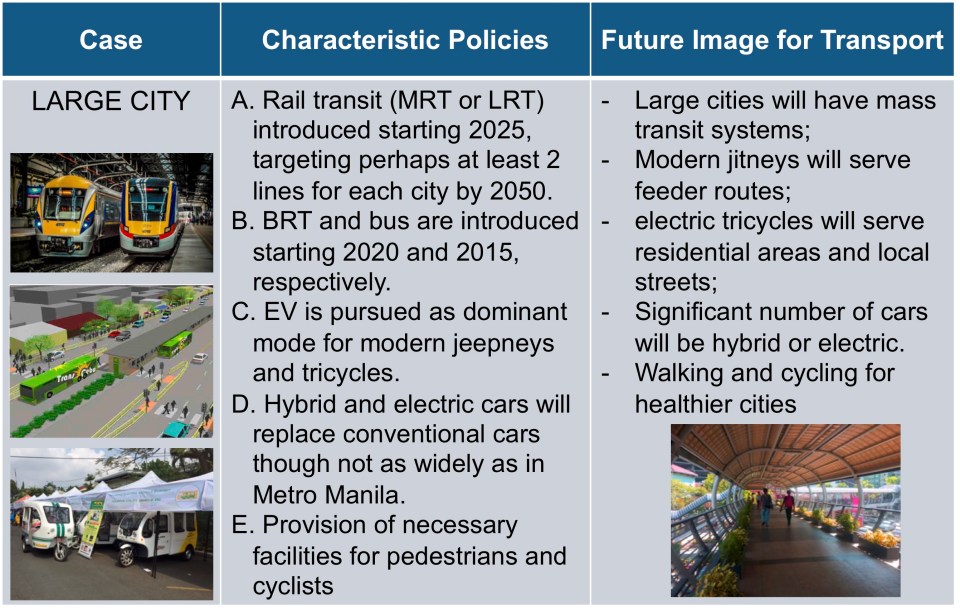
Here’s a slightly updated slide on the future image for a large city in the Philippines:
–
On riding bicycles slowly
I saw this interesting article on cycling/biking that I thought was quite relevant to the situation we have on campus. The University of the Philippines Diliman campus has a bike lane along the inner side of its Academic Oval that has been used by various cyclist types. There are those who use their bikes for commuting or going around campus (e.g., students traveling between buildings for their classes, messengers bringing documents, etc.). There are those biking in a more relaxed manner (i.e., for recreation). And then there are those who bike for fitness including those racing around the oval. It is from the latter that UP Diliman has received complaints about conflicts with joggers, motor vehicles and fellow cyclists. But then UP has maintained that the bike lane is not for racing or taking laps around the oval. It was created to have a segregated (and in the future maybe protected) lane to enhance mobility more than any other purpose.
Babin, T. (2018) “How to ride a bike slowly (and why you would want to),” Medium.com, https://medium.com/shifter/how-to-ride-a-bike-slowly-and-why-you-would-want-to-b544ec869846 [Last accessed: 2/4/2018].
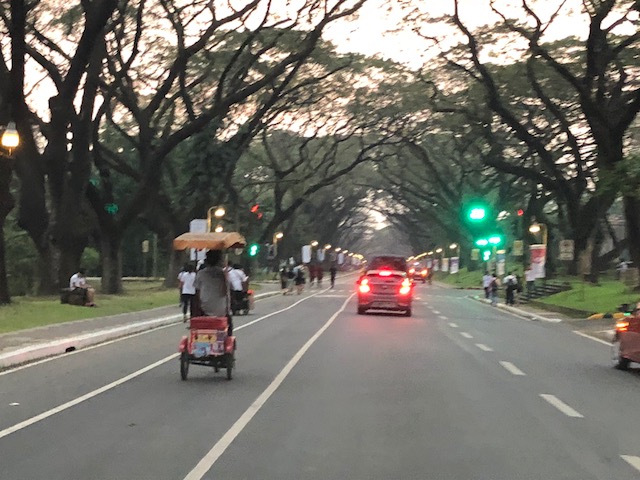 UP Diliman’s Academic Oval now features a bike lane between a jogging/walking lane and the lanes assigned for motorised traffic. The ice cream vendor on a NMT 3-wheeler is running on the bike lane.
–
Article on building support for walking and cycling infrastructure
There is another recent article on non-motorized transport (NMT). This is a good read and something that I think should be required for those who are little too serious or staunch about their advocacies.
Doyon, S. (2017) “Building support for walking and bicycling infrastructure” Public Square, A CNU Journal, https://www.cnu.org/publicsquare/2017/11/11/building-support-walking-and-bicycling-infrastructure (Last accessed 11/11/2017)
I believe that if you want to convince people to appreciate and support your cause, you should not take the hardline. Instead, there should be a more persuasive process for wooing people. This is especially true in transportation and the advocacies for walking and cycling. You will not get a lot of support, for example, by condemning car users and telling everyone they should bike instead.
–

