
Home » Posts tagged 'DOTC' (Page 3)
Tag Archives: DOTC
Resistance is futile? The case against electric jeepneys
There is a strong sentiment against electric jeepneys along the route where the COMET is currently operating. This opposition has always been there even before the COMET came about. I would like to think that this is partly due to the perception among many operators and drivers that conventional jeepneys would be phased out and replaced by e-jeepneys. But then isn’t this replacement supposed to be an upgrade in terms of having a more energy efficient and therefore economical vehicle that had a significant bonus of being low emission as well.
I finally got a photo of the sign Katipunan jeepney operators and drivers put up at the terminal below the Aurora Blvd. flyover.
 Protest against electric jeepneys written on Manila paper and posted on overpass column at the Katipunan jeepney terminal
Given the recent innovations and the rapid advances in electric and other fuel vehicles, it should come as no surprise that more reliable and more efficient models of these vehicles will be available in the market. In the case of the Philippines where the thrust for e-vehicles is focused on public transport, there will eventually be a model that will comprehensively beat conventional jeepneys in every aspect. That is, if there is not yet a model that good. Arguably, the COMET and the latest e-jeepney model (BEEP) are already better than conventional jeepneys. However, their acceptability is pending with operators and drivers who seem uninterested with the case against conventional jeepneys. Perhaps these people are being fed false information by another party? Hopefully, they will open their eyes and mind to the reality that will eventually catch up with them if they do not embrace change.
–
Another example of mismatched plates
My most recent post was on the inappropriateness of the new license plates issued by the LTO to public utility vehicles. New taxis, UV express and jeepneys suddenly had the back and white license that’s supposed to be issued only to private vehicles. This meant that it would be difficult to distinguish the legitimate PUVs from colorum or illegally operating ones. In the last post, I was able to show an example each for these license plates on a taxi and a UV Express van. Yesterday, I was able to get a photo of a jeepney bearing this “anomalous” plate as I was caught in an unexpected traffic jam along an otherwise free-flowing road in Rizal.
 Jeepney bearing the black and white license plate issued to private vehicles
–
End game: flyover frenzy
The Manila Bulletin featured news on the Japanese government extending a loan to the Philippines for road projects in Metro Manila that include the construction of several major interchanges. An excerpt from the article is as follows:
The Japanese government will be providing some P4 billion to the Philippines for road projects aimed at decongesting monstrous traffic jams in Metro Manila.
Noriaki Niwa, chief representative of the Japan International Cooperation Agency (JICA), said the loan will cover major interchanges to address traffic congestion in Metro Manila, including flyovers, and road links.
Among them are the interchanges on EDSA/Roosevelt/Congressional, EDSA/West/North, and C-5/Green Meadows and North/Mindanao Avenue.
“This is to help Metro Manila sustain growth and develop it as an attractive investment destination,” said Niwa.
While these interchanges have been recommended many years ago and are also reiterated in the recent transport roadmap for Mega Manila, one cannot help but make the observation that these projects will not alleviate congestion over the long term. Instead, it will likely encourage more vehicle traffic (with the availability of more road space – part of a vicious cycle).
Other major projects that are ongoing in Metro Manila include the NAIA Expressway, which is an elevated tollway connecting to the Skyway. A friend commented that this is basically a glorified flyover project as I will explain later in this post.
 NAIA Expressway construction in full swing – a column rises near NAIA Terminal 3
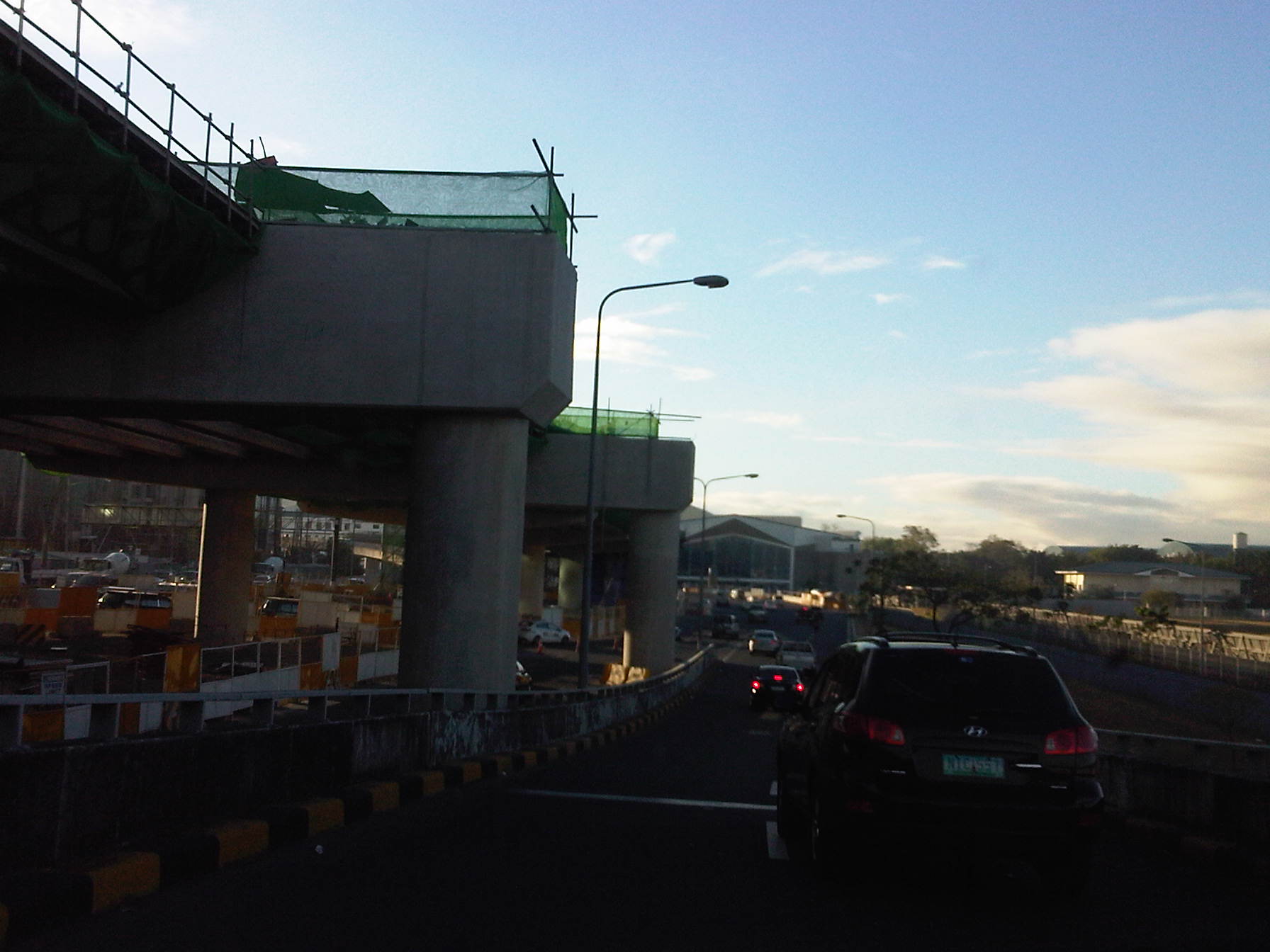 NAIA Expressway elevated sections nearing completion across from Terminal 3
The term of the current administration concludes next year (2016) and so we are almost in the endgame, to borrow a term from chess. What seems to be a frantic move for the government to build all these flyovers (and elevated tollways) can be interpreted as a way to compensate for the underspending and underachieving ways of the government in putting up the necessary infrastructure to address transport and traffic problems in urban areas. Unfortunately, all the funding (public and private) seems to be going to road projects instead of to mass public transport systems like rail and BRT that should be the priority because these could provide the positive impacts over a longer term than what road projects could deliver in terms of mobility and sustainability.
A friend reminded me of a similar situation back in 1991/92 when government embarked on a slew of flyover projects in an effort to leave a legacy in transport. That administration’s excuse for failing to deliver any mass transit project was that it was transitioning from a dictatorship. However, it also failed to deliver on power projects, which led to the energy crisis that had to be solved quickly (but with costly PPP power plant projects). There is a looming energy crisis now but more worrying is a transport crisis as we continue to procrastinate about public transport infrastructure. Should we be hopeful of transport with the next administration? That is still a big question as of now.
–
Legit or kabit? Follow-up
I wrote about the “kabit” system last February. I mentioned that the EMBC bus I saw was actually operated by another company (RRCG) that seems to have also engaged another company (Jasper Jean) to provide bus units operating the EMBC routes. Unfortunately, I was not able to get a photo showing information on the original operator of this bus company and its lines to Rizal and Laguna via the eastern route through Antipolo. I was finally able to get a photo of an EMBC bus bearing information on the original operator/company for comparison with the information on the bus in the previous post. It clearly states here that EMBC is the operator of this bus.
 Information printed on the bus as required by law
–
“No” to additional jeepneys?
I finally got a photo of a banner that I’ve seen on many jeepneys plying the Katipunan route. This appeared on jeepneys a couple of weeks ago and the message on it is clear: “No to more jeeps, to more traffic in Katipunan.” I became curious about this as I noticed that list of transport groups that had their names printed at the bottom of the tarpaulin. Noticeable is the absence of one group, Pasang Masda, among the list that includes, among others, LTOP, ALTODAP and the party list group 1-Utak, which used to have a seat in the Philippines House of Representatives.
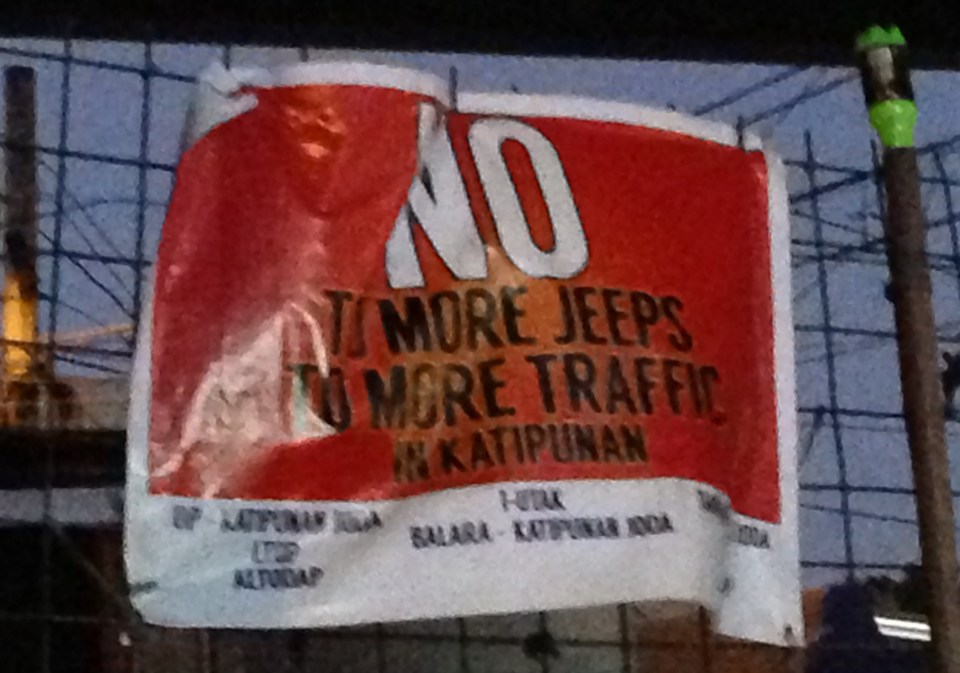 Tarpaulin sign hanging at a wire fence at the Katipunan jeepney terminal under the Aurora Blvd. flyover.
Pasang Masda is supporting the Comet jitneys currently plying the North EDSA-Aurora Boulevard route (via Mindanao Ave., Congressional Ave., Luzon Ave. and Katipunan Ave.). In fact, the head of the group is reported to have bought a few units, likely convinced of it as a good investment. Is it? Only time will tell considering its route is not necessarily the best for it, overlapping with several jeepney routes including the UP-Katipunan route. Is the Comet a game changer? So far, it isn’t and that’s mainly because of its single roue that’s not exactly favorable for a demonstration of the vehicle’s capability and claimed advantage over the conventional jeepneys. A colleague even says that it seems the route approved for it doomed its operation in the first place. But that’s an entirely different story from the opposition to it that’s stated in the tarps at the Katipunan jeepney terminal and some of the jeepneys plying the route.
So, is it a “no” to more jeepneys because their numbers are really already excessive OR is it a “no” because the additional jeepneys are from other groups or those not affiliated or in league with the undersigned? It seems that the latter case applies here and this should be taken as an example of what to expect along the way as initiatives to phaseout or replace conventional jeepneys get going. It is a bit complicated due to mainly to the social aspects of a phaseout or replacement but it gets more complex with the personalities involved including and especially the leaderships of various transport groups.
–
Resurrected bus companies
I posted something recently on an old bus line plying routes between Rizal and Metro Manila. I mentioned there about bus companies somehow being resurrected many years after what I thought were my last sightings of their buses. Of course, it is known that some bus companies have closed shop for one reason or another including what was a government-owned and operated Metro Manila Transit Corporation that used to operate the popular Love Bus. One of the major causes for bus companies folding up is labor problems. Among those that reportedly succumbed to this were Philippine Rabbit, Pantranco and BLTB Co. A few years ago, however, we was surprised to see a familiar bus along the South Luzon Expressway but upon closer look, we found that it wasn’t the old BLTB Co. that was written in the livery but DLTB Co.
BLTB Co. stood for Batangas, Laguna, Tayabas Bus Co. The name alludes to the provinces served by their buses including Tayabas, which eventually became Quezon and Aurora provinces. Their terminal was landmark along EDSA in Pasay City. It is still there along the southbound side and near the junction with Tramo. That will be just beside the left turn overpass from EDSA to Tramo and towards NAIA.
 The livery on this bus is very familiar to many who rode on the old BLTB Co. buses many years ago. Was this deliberate from the owner/operator who obviously wanted to use this to their advantage? People are still familiar with the BLTBCo logo and brand so seeing these buses evoke memories of long distance travel back in the day.
There were few large bus companies in the old days. Among them were Victory Liner, Dangwa, Philippine Rabbit, Pantranco and BLTB Co. Victory, Dangwa and Philippine Rabbit served routes to the north of Manila while Pantranco plied both northern and southern routes. The latter company eventually split into Pantranco and Philtranco, with the northern routes under Pantranco (whose terminal was along Quezon Avenue where Fisher Mall now is located) and the southern routes under Philtranco (terminal is still there along EDSA in Pasay City). Pantranco is no more but Philtranco survives despite the current competition from many other bus companies plying routes south of Metro Manila.
Dangwa’s terminal was in what is still now being referred to as Dangwa in Manila, where you can get all the flowers you’ll need for all occassions. It was, after all, the “bagsakan” of flowers from the north, particularly from Baguio City. Victory’s old terminal is still the one in Pasay though it now has a couple in Cubao. It has expanded its points of destination and is perhaps the largest firm now operating north of Metro Manila.
The Philippine Rabbit Bus Co.’s terminal was at the northbound side of EDSA in the Balintawak area. It has a curious story about it; the stuff of urban legends. The name of the bus company is supposed to be Philippine Rapid Transit (another and real bus company). One time they asked their new buses to be painted, the instructions were misunderstood. “Rapid” sounded like “Rabbit” and that stuck to this day. They also had a labor problem and did not operate for a while until they resolved these issues with their drivers and conductors.
–
Legit or kabit?
Traveling one morning from Antipolo, I spotted a bus with a familiar company name – EMBC. The last time I saw these buses operating as public transport was when I was in college, and I thought that the company folded up after losing money. However, I have seen some of their buses being used as shuttle services. It seems that the company has been revived but how is a bit unclear. EMBC stands for Eastern Metropolitan Bus Corporation, which was an old company that served the towns of Rizal along with the Antipolo Bus Co., G-Liner and CERT buses during the 1970’s and 1980’s. EMBC buses competed with the Antipolo Buses with their routes overlapping between Tikling Junction in Taytay, Rizal and Divisoria via Ortigas Avenue, E. Rodriguez Ave. (C-5), Pasig Blvd., Shaw Blvd., and Aurora Blvd. These two had overlapping routes with G-Liner and CERT, which plied the Taytay/Cainta to Quiapo route via the same Ortigas Ave. Extension.
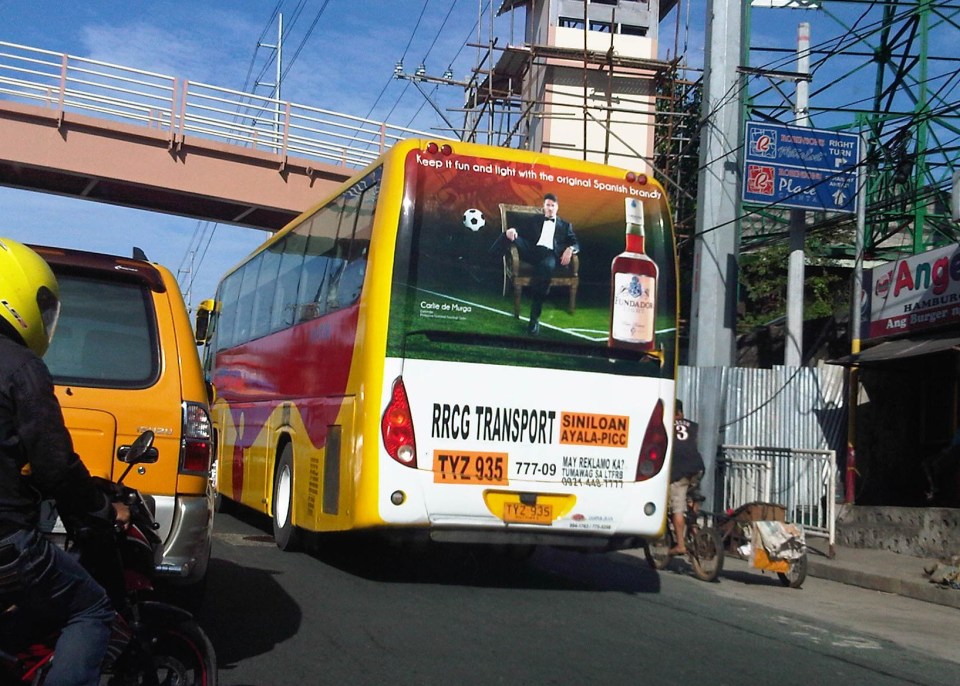 The back of the EMBC bus states that it is run by RRCG Transport with a route connecting Siniloan, Laguna and Ayala Avenue-PICC (it probably turns around at the PICC, where Gil Puyat/Buendia Ave. terminates).
 Closer inspection reveals that the bus is operated by Jasper Jean, another bus company that is better known for its Fairview-Alabang services.
EMBC is an old company and one that has been dormant if not extinct for quite some time. Was its franchise resurrected like what allegedly happened to another old bus company, BLTBCo. a few years ago? In this latter case, certain LTFRB officials were supposed to have been axed as they were allegedly behind the revival or “resurrection” of the franchise. I think it is not a “resurrection” case as I have also seen what looked like legitimate EMBC buses with information on the bus body showing EMBC as the operator of the bus unit. Unfortunately, I haven’t had the opportunity to take a photo of such examples. Thus, it is likely that the bus in the photo above is a case of “kabit.”
The concept of “kabit” (literally “connect” in English) in public transportation is not a new one. It has been used (and abused) in many cases) where the existing franchise holder(s) along a specific route could not deploy the number of vehicles necessary to address the demand for transport. In such cases, the franchisee (an operator) enlists other entities to provide the vehicles. And so there is an agreement among the formal franchise holder/operator and the “kabit” entities outside the contract between the government and the franchisee.
This is one reason why it is not necessarily the main company (franchise holder) that can be the guilty party in an incident involving one bus. However, the penalties (e.g., suspension and fines) are imposed on the franchisee and not necessarily to the “kabit” operators. The latter’s vehicles in turn continue to operate despite the suspension being technically applicable to ALL vehicles bearing the company’s name. Such are among the many issues concerning “kabit” and perhaps also among the strongest arguments to put a stop to this practice that is detrimental to the interests of people taking these buses.
–
Some questions on a gloomy Saturday morning
On gloomy Saturdays like today, I often tend to sort of contemplate on some questions coming from events and articles the past few days. I don’t really want to answer these questions right now and immediately but would rather let these and the follow-ups play around in my mind. I would rather not do some shout outs on social media about these questions as some friends tend to be sensitive and I don’t really want to make a lot of effort carefully framing posts on FB just so they won’t appear to be offending certain persons who might be over-zealous about their advocacies or who would be so defensive of their organizations. Here are some questions running around in my brain right now:
1. Does DENR have the mandate to require sidewalks and bikeways along all roads? Design and implementation-wise, isn’t this supposed to be under the DPWH (for national roads) and the LGUs (for local roads)? Is this more a policy statement? But then shouldn’t this come from DOTC?
2. Is going out of your way really the way to get noticed and be awarded? Are there no points for people doing a great job at what they are supposed to be doing?
3. Shouldn’t an agency first check if they are doing what they are supposed to do and the outcomes reflect their objectives? Are emissions testings and monitoring successful or do we still have a lot of smoke-belchers on our roads? If they already have their hands full with their tasks according to their mandate, shouldn’t they first mind their business before even encroaching into another agency’s tasks?
4. Does media have to give so much airtime to a driver of a luxury vehicle who assaulted a traffic enforcer?
5. Why does it seem to be so much fuzz about Uber? Is it just on social media? Do most other commuters give a damn about it when they really can’t afford availing such services?
6. Are government engineers bereft of an appreciation for the arts, culture and heritage? Are they too mechanical or dumb to understand what planning and design really is all about?
–
Proof of concept
I recall a quote from the cold war era when Nikita Kruschev was supposed to have asked “how many divisions did the Pope had under his command?” This was basically a challenge to the Pope after the latter made some statements regarding the Soviet Union and its military action in Eastern Europe and elsewhere. A similar challenge could be made, albeit vastly reworded, for many advocates of various transport programs and projects to prove they had the numbers or the proof to support their calls for certain projects or programs to be implemented. Often, the proof comes in the form of examples or demonstrations of their proposals. Simplest perhaps would be to present examples of best or good practices in other countries (e.g., bicycle paths in Europe, transit in Singapore, walkways in Japan, etc.).
One that is still fresh in my mind is what has been said to be the “challenge” of Malacanan to the DOTC to present a “proof of concept” for BRT as a pre-requisite of the proposed project in Cebu to be approved. This “challenge” boggled the minds of many experts and advocates of public transportation as BRT is well established around the world and there are many cities with BRT systems worth emulating (To be accurate, there have also been failures but these were mainly due to compromises made that led to the systems not adhering to essential BRT requirements.). What’s stranger was the response from DOTC to do a demonstration via an experiment at Bonifacio Global City to simulate BRT operations. Obviously, this experiment could not be a really good approximation of BRT (something along Commonwealth would have been more suitable) given the conditions at the Fort.
With the recent approval of the Cebu BRT project, we now look forward to its construction and operation. I am aware of how much work was put into the non-technical aspects of this project (i.e., social and institutional) and so a lot of eyes will be on changes to Cebu City’s transport system once the BRT becomes operational and the expected rationalisation of the existing public transport routes and vehicles would take place. There will definitely be a transition period and it is not known how long this will be or how much opposition the change will encounter. Doing workshops and consultations, and getting commitments here and there is one thing. Having the BRT operational and actually affecting the operations (and revenues) of conventional road transport is another matter.
Many cities will look to Cebu’s experience and probably emulate it should the BRT be a success. Metro Manila is too complicated for other cities to identify with unlike Cebu, which likely has similar transport and traffic issues to cities like, for example, Iloilo, Bacolod, Cagayan De Oro or Legazpi. Of course, there will be exceptions and unique problems for each but density-wise, Cebu compares well with more cities in the country than Metro Manila. Here’s hoping that the BRT would finally have its true and actual “proof of concept” in Cebu and that this can demonstrate the benefits of such a system to other Philippine cities along with a necessary rationalisation of existing public transport modes.
–
Required reading on sprawl, transit and the poor
A friend recently posted an article on Facebook that I thought should be required reading for urban and transport planners in the Philippines whether they be with government or the private sector. There is a strong link between land use and transport, we need to be able to understand the complexities and subtleties in order to maximize the benefits to society. It is not a coincidence that the article specifically mentions the poor as it discusses opportunities lost due to flaws or inefficiencies in land use and transport. The article is found in the following link:
Suburban sprawl and bad transit can crush opportunity for the poor
I hope that this will be read and understood by officials at DOTC, LTFRB, LRTA and PNR, as well as those of the Housing and Urban Development Coordinating Council (HUDCC) and the Housing and Land Use Regulatory Board (HLURB). These agencies are responsible for planning and regulating transport and housing in the country. Of course, it is also important for local government units to be able to understand these challenges especially since they will be in the forefront of addressing issues on sprawl and the provision of suitable transport systems. Here’s a related article that I posted earlier this year on New Year’s Day:
Opportunities with the MRT-7 and LRT-1 Extension
–
 Caught (up) in traffic