
Home » Posts tagged 'DPWH' (Page 5)
Tag Archives: DPWH
End game: flyover frenzy
The Manila Bulletin featured news on the Japanese government extending a loan to the Philippines for road projects in Metro Manila that include the construction of several major interchanges. An excerpt from the article is as follows:
The Japanese government will be providing some P4 billion to the Philippines for road projects aimed at decongesting monstrous traffic jams in Metro Manila.
Noriaki Niwa, chief representative of the Japan International Cooperation Agency (JICA), said the loan will cover major interchanges to address traffic congestion in Metro Manila, including flyovers, and road links.
Among them are the interchanges on EDSA/Roosevelt/Congressional, EDSA/West/North, and C-5/Green Meadows and North/Mindanao Avenue.
“This is to help Metro Manila sustain growth and develop it as an attractive investment destination,” said Niwa.
While these interchanges have been recommended many years ago and are also reiterated in the recent transport roadmap for Mega Manila, one cannot help but make the observation that these projects will not alleviate congestion over the long term. Instead, it will likely encourage more vehicle traffic (with the availability of more road space – part of a vicious cycle).
Other major projects that are ongoing in Metro Manila include the NAIA Expressway, which is an elevated tollway connecting to the Skyway. A friend commented that this is basically a glorified flyover project as I will explain later in this post.
 NAIA Expressway construction in full swing – a column rises near NAIA Terminal 3
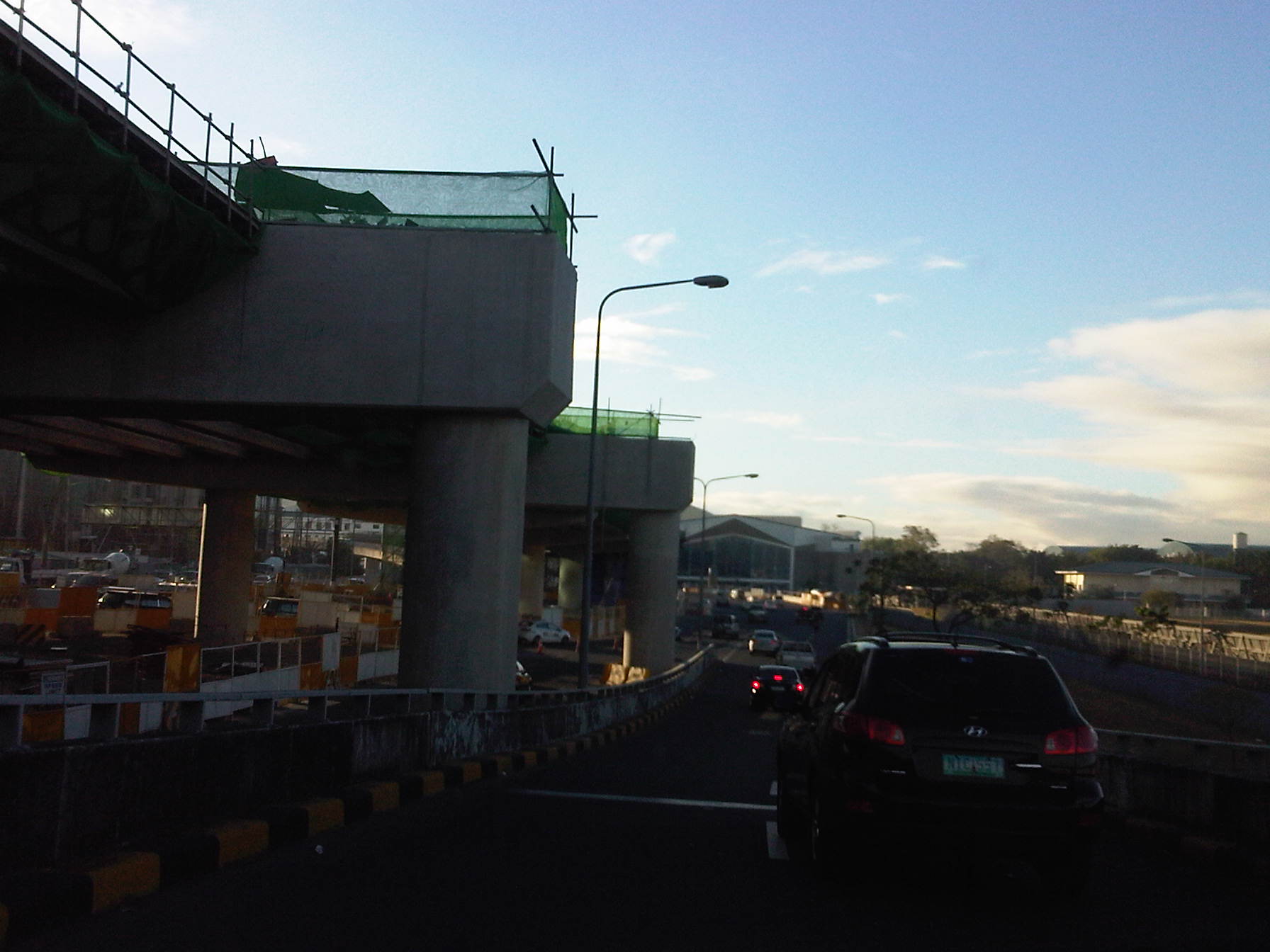 NAIA Expressway elevated sections nearing completion across from Terminal 3
The term of the current administration concludes next year (2016) and so we are almost in the endgame, to borrow a term from chess. What seems to be a frantic move for the government to build all these flyovers (and elevated tollways) can be interpreted as a way to compensate for the underspending and underachieving ways of the government in putting up the necessary infrastructure to address transport and traffic problems in urban areas. Unfortunately, all the funding (public and private) seems to be going to road projects instead of to mass public transport systems like rail and BRT that should be the priority because these could provide the positive impacts over a longer term than what road projects could deliver in terms of mobility and sustainability.
A friend reminded me of a similar situation back in 1991/92 when government embarked on a slew of flyover projects in an effort to leave a legacy in transport. That administration’s excuse for failing to deliver any mass transit project was that it was transitioning from a dictatorship. However, it also failed to deliver on power projects, which led to the energy crisis that had to be solved quickly (but with costly PPP power plant projects). There is a looming energy crisis now but more worrying is a transport crisis as we continue to procrastinate about public transport infrastructure. Should we be hopeful of transport with the next administration? That is still a big question as of now.
–
Some questions on a gloomy Saturday morning
On gloomy Saturdays like today, I often tend to sort of contemplate on some questions coming from events and articles the past few days. I don’t really want to answer these questions right now and immediately but would rather let these and the follow-ups play around in my mind. I would rather not do some shout outs on social media about these questions as some friends tend to be sensitive and I don’t really want to make a lot of effort carefully framing posts on FB just so they won’t appear to be offending certain persons who might be over-zealous about their advocacies or who would be so defensive of their organizations. Here are some questions running around in my brain right now:
1. Does DENR have the mandate to require sidewalks and bikeways along all roads? Design and implementation-wise, isn’t this supposed to be under the DPWH (for national roads) and the LGUs (for local roads)? Is this more a policy statement? But then shouldn’t this come from DOTC?
2. Is going out of your way really the way to get noticed and be awarded? Are there no points for people doing a great job at what they are supposed to be doing?
3. Shouldn’t an agency first check if they are doing what they are supposed to do and the outcomes reflect their objectives? Are emissions testings and monitoring successful or do we still have a lot of smoke-belchers on our roads? If they already have their hands full with their tasks according to their mandate, shouldn’t they first mind their business before even encroaching into another agency’s tasks?
4. Does media have to give so much airtime to a driver of a luxury vehicle who assaulted a traffic enforcer?
5. Why does it seem to be so much fuzz about Uber? Is it just on social media? Do most other commuters give a damn about it when they really can’t afford availing such services?
6. Are government engineers bereft of an appreciation for the arts, culture and heritage? Are they too mechanical or dumb to understand what planning and design really is all about?
–
Repair C6 now!
The existing roads that comprise what has been designated as Circumferential Road 6 is an important link that serves as an alternate route for people and goods traveling between the eastern towns of Rizal province and Metro Manila to urban centres in Makati (Ayala CBD) and Taguig (Bonifacio Global City) as well as the southern areas of Metro Manila all the way to Laguna and Cavite. During the last dry season or summer, the roads conditions have been quite good such that travellers from Rizal could easily reach BGC or Makati in less than an hour give and take typical congestion during the peak periods.
The situation has significantly worsened since the onset of the wet season as the pavement quickly deteriorated with the combination of heavy rains and heavy vehicles utilising the road. Highway 2000 from Taytay, Rizal was already in bad condition during the summer so it became only worse once the rains came. However, it is the C6 segment from Pasig to Taguig that has deteriorated and is now in a state of disrepair. Following are photos that show how bad the conditions are and which have led to travel times worsening to more than double than what it should be if the roads were in good condition.
 Section in Taguig along the shores of Laguna de Bay where even large trucks avoid the deep holes along the road. These situations along C6 constrict traffic everyday.
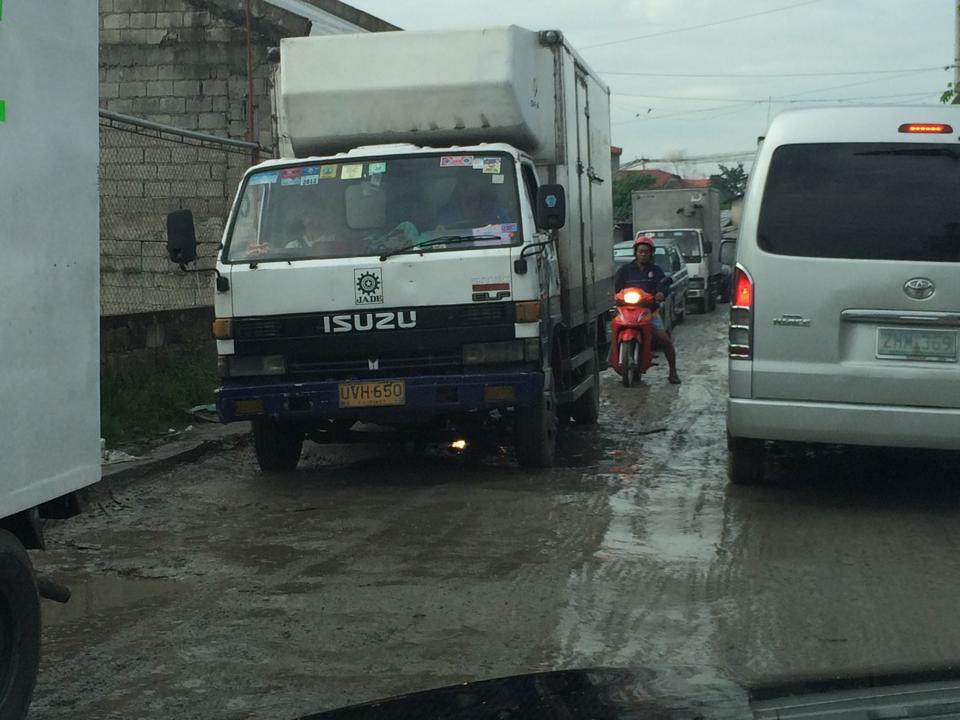 C6 section in Pasig City where what used to be asphalt is now a muddy mess.
 Another section in Pasig City where C6 passes through a relocation area (Lupang Arenda) where local traffic affects through traffic and C6 is probably at its narrowest.
The section from Pateros to Taguig was built as a road dike protecting these areas from floods brought about by the increasing level of Laguna de Bay during the wet season. While it is basically a secondary road compared to the other circumferential roads, traffic has significantly increased along C6 due to many people discovering that you can travel faster between Rizal and Makati or BGC via this road. Sadly, there seems to be little or no attention given to its current state.
I understand that the DPWH has a process for determining whether a road needs to be repaired and given limited resources, the agency also applies a process for prioritisation of road repairs (i.e., there are many other roads that also need repairs). However, there should be a way to allocate resources for the repairs of the road and this includes involving the LGUs whose constituents benefit from the use of the road. Rizal province and towns and Pasig City should take the initiative to find ways to improve the conditions along C6. It is also in the interest of Taguig to improve this road as many of its residents use it, too. Hopefully, the road will be repaired sooner rather than later and travel times will improve again. Of course, this should be the case whether or not the proposed C6 expressway is realised.
–
Preventable tragedies
Last Friday, a provincial bus plunged into a ravine somewhere in the Mountain Province. The bus rolled several times before coming to a stop, instantly killing 14 people. Among the fatalities in this crash is a popular comedian/media personality who went by the name Tado and part of a group doing civic work in the area. Foreign visitors were also killed in the crash, leaving many to wonder if perhaps the Department of Tourism (DOT) should also get into the act as it is in the interest of the department to also establish that “It’s safer in the Philippines!” as part of its “It’s more fun in the Philippines!” tagline.
According to initial reports, the driver lost control due to defective brakes but later one report suggested that the driver had dozed off and awoke too late to bring the bus back in control. The slope of the road was downwards and there was significant curvature. This combination is definitely a challenging one for most drivers, even professionals who, like the bus driver, would probably have encountered such combinations of slope and curvature many times, even on a daily basis along mountain routes. One has to be awake and focused on maneuvering a vehicle for such sections. It didn’t help that probably, and I base this on photos of the section I’ve seen online, the road’s barriers were not up to standard in as far as stopping large vehicles like the bus from falling off and into the ravine.
These are preventable incidents, preventable tragedies that occur on a daily basis around the country. It is clear to many that the LTFRB needs to address these problems by taking steps to insure that public transport vehicles such as provincial buses are properly maintained and drivers are fit and in the best condition to drive these vehicles. To do that, they have to be proactive in evaluating bus, jeepney, UV express, and taxi and other franchises under them. These evaluations should delve into involvements in road crashes as well as the frequencies and types of traffic violations drivers have been involved in. Such records of crashes and violations should form part of a set of criteria to suspend and ultimately revoke franchises of public transport entities.
The LTO also has a responsibility here because they are the agency in-charge of licensing drivers. They should make sure that those applying for professional licenses are indeed qualified and not just to drive any vehicle. Therefore, perhaps there is a need to have different types of licenses for different types of professional drivers. Public utility vehicles differ in size and maneuverability so a different skill set and experience is required for buses compared with taxis. Another type of license should apply for those seeking to drive trucks as well as heavy equipment such as payloaders and bulldozers. The TESDA has certification programs for these that are sought out by people who want to drive professionally abroad. These should also be made as requirements for those seeking to drive professionally here. These would ensure that drivers will be qualified and competent as they are responsible for lives and property.
It is also clear that the DPWH and local authorities in-charge of road safety along roads should look into how to make travel safer by investing more into safety devices such as barriers. Crash or accident prone sections can be identified and sturdier barriers designed to keep vehicles on the road should be constructed/installed in order to prevent such types of fatal crashes (i.e., barriers would not prevent head-on collisions, etc.). That is why the DPWH and local governments need to have capacity and capability to assess road safety along national and local roads. These actions address vulnerabilities. These actions save lives.
What can you do to help in this effort? You don’t have to be part of an organized group or a lobbyist to be involved in promoting road safety. You can be involved in simple ways. Be aware of your rights on the road and your being among those vulnerable to road crashes. I am sure you don’t want to be involved in a crash nor would you like a loved one to get injured or, God forbid, perish in a crash. If your bus, jeepney, UV express or taxi driver drives recklessly, be firm in reminding him of his responsibility. You may enjoy a fast ride but are you sure your destination isn’t the afterlife? Think about it. Act on it. Save lives!
–
 Caught (up) in traffic