
Home » Posts tagged 'driver behavior'
Tag Archives: driver behavior
On reducing deaths due to road crashes
Following is a link to an article on the increase in road crash-related deaths in Singapore. The city state prides itself as one of the safest places in terms of transportation yet road crash deaths recently hit a 10-year high.
From the article:
“Cellphone-related driving violations surged 39.1% to 4,193 cases, the report showed. Motorcyclists, who make up just 15% of Singapore’s vehicle population, accounted for 54.8% of all traffic accidents and 53% of fatalities.
Speeding violations jumped 25.9% to 253,550 cases, equivalent to roughly 695 motorists caught daily. While speeding-related fatal accidents dipped from 46 to 41, red-light running accidents surged 27.1% to 122, resulting in seven deaths. Drink-driving accidents fell from 166 to 156, but the number of fatal drink-driving accidents held steady at 12 in both years…
…”Road safety requires a culture of mutual respect and graciousness among all road users,” the police force said. “Simple acts of courtesy, such as maintaining a safe following distance of at least three seconds, giving way to pedestrians, reducing speed near junctions and being patient during peak hours, can create a better road culture.” “
What can we learn from Singapore’s experience? Are we capable and equipped to improve road safety in the Philippines? Can we be more courteous, respectful and gracious in the way we drive or behave as road users?
–
Let’s act on road safety crisis!
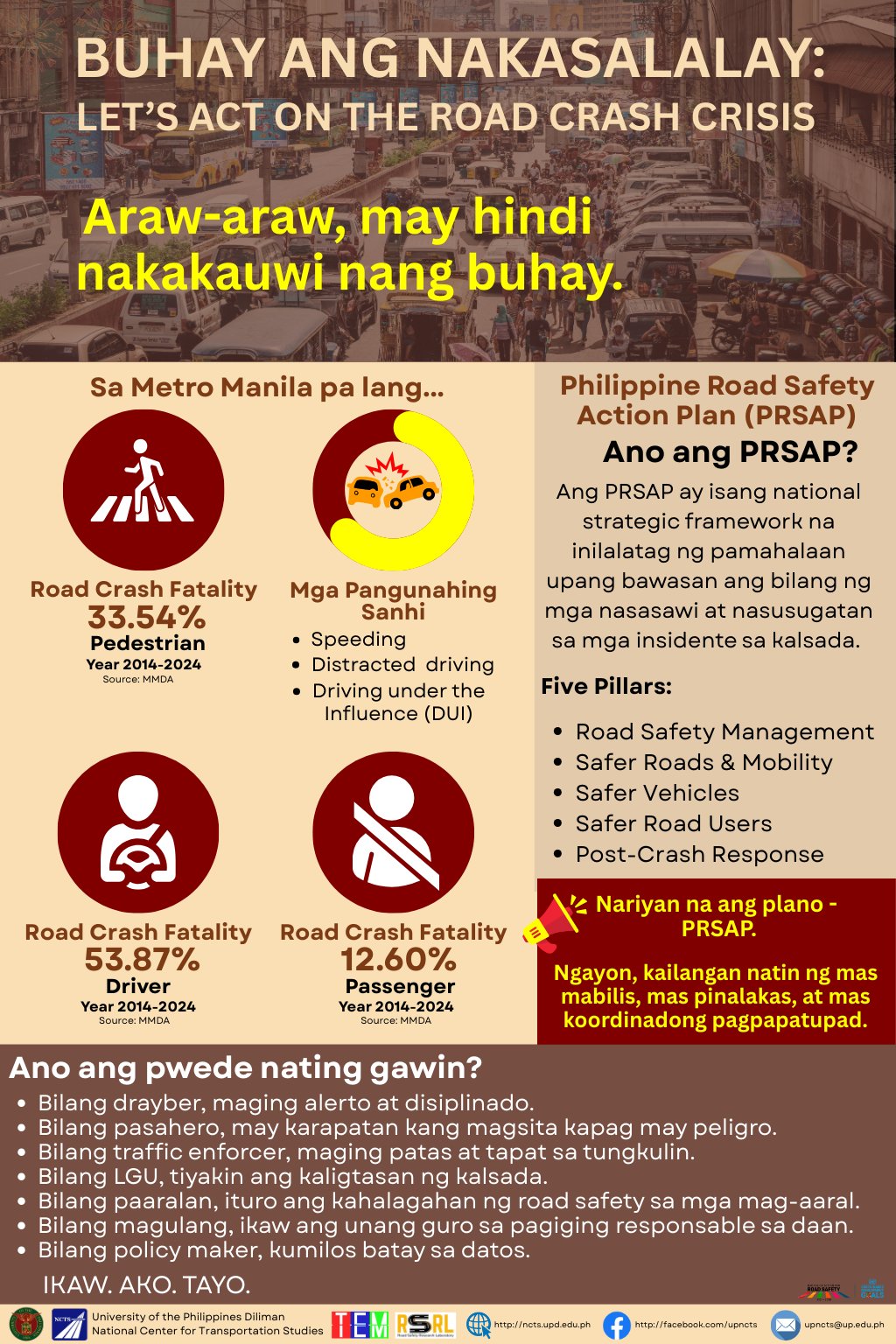
May is Road Safety Month. It’s quite ironic that we started the month with some of the most gruesome crashes including one at SCTEX and another at NAIA. There is indeed a crisis on road safety but many are in denial or perhaps insensitive to the impacts of these crashes. We need to act and only together can we be most effective in reducing the risks for all road users.
So what can one do? How can one contribute to making roads safer? Sharing this poster from the Road Safety Research Laboratory (RSRL) of the National Center for Transportation Studies (NCTS) of the University of the Philippines:
–
On gruesome road crashes and how they are reported
The past days have been terrible in terms of road crashes that have been reported. Of particular interest is the one last week involving four vehicles – a provincial bus slamming into 2 passenger vehicles against a stopped truck, and crushing both vehicles and their occupants. This was along SCTEX as vehicles were approaching a toll plaza. The trucks and passenger vehicles were stopped in a queue when a bus slammed into them. As of now the reports state at least 10 have lost their lives. One child miraculously survived the crash but lost both parents as per reports.
While mainstream media seems to be still conservative in how they report these incidents, social media offers much graphic, unedited content. Last Thursday and Friday, friends have shared posts by different people who have videoed the aftermath. It was gruesome and I will not describe them here nor share those videos that also appeared in my Facebook as reels. While there is the shock effect to the shared videos, one wonders whether these ultimately contribute to improving road safety or just add to what is now regarded as another category of porn (you’ve probably heard or read about food porn, tourism porn, shopping porn and poverty porn). These now have become more like spectacles that are viewed more for (sick) entertainment rather than to move people to action to address the road safety issues we face. While there are many responses offering comfort or prayers, how many would really act and actively call for safer transportation? As one friend exclaims – “Where’s the rage?”
–
On safe school zones
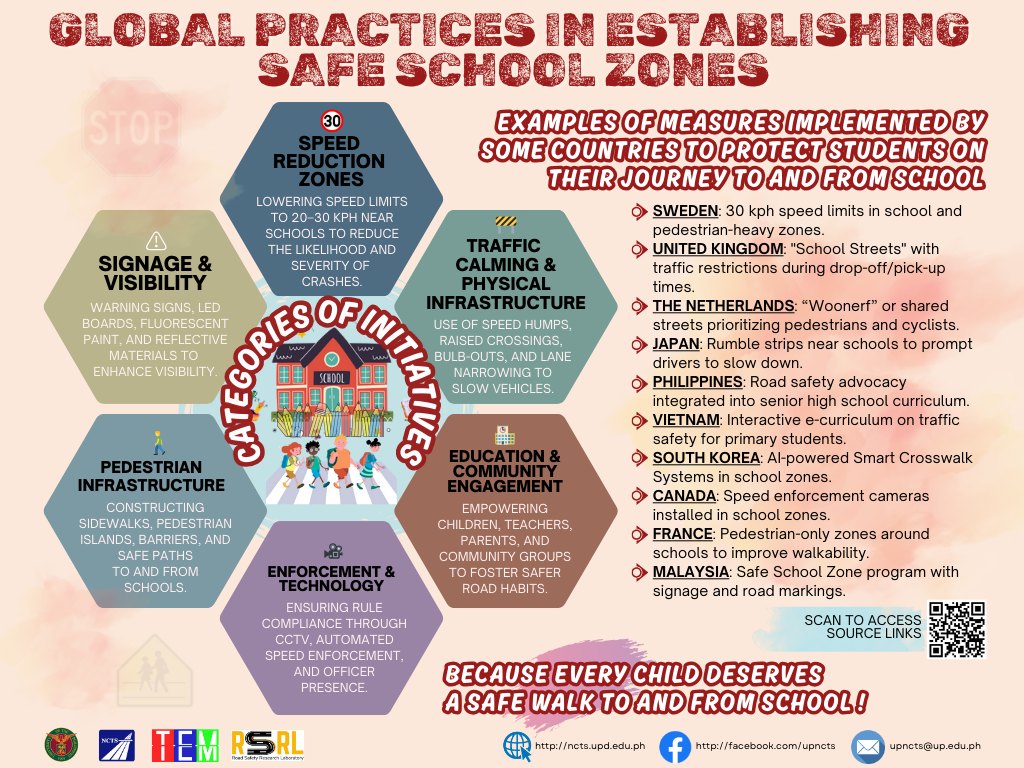
We’ve been working for safer roads since I started practicing as a transportation engineer/planner. Most recently, we were working on a program supported by UNICEF on Child Road Traffic Injury Prevention (CRTIP). The work towards safer roads especially for those who are most vulnerable is always challenging but it is something that is definitely worthwhile. As we approach May, which is Road Safety Month in the Philippines, I will try to write more about road safety.
Here is an infographic shared by the Road Safety Research Laboratory of the National Center for Transportation Studies of the University of the Philippines:
–
On reckless driving and riding, road rage, and kamotes
A story went viral a couple of weeks ago about a motorcycle rider getting shot by a driver. Many discussions and videos have been shared with some sympathetic to the driver and others to the riders. One thing is definite from the videos shared when you filter the commentaries and biased opinions – both the driver and the riders are guilty of reckless driving or riding. With all due respect to the root crop often invoked and associated with these kinds of motorists, kamotes as they are called seem to have increased no thanks to many of these learning to operate motor vehicles without being properly trained, oriented, evaluated and tested if they deserve having licenses. The increase and documentation of incidents of road rage should be taken very seriously by the LTO and serve as reference for improving the licensing system.
Here’s an informative material on reckless driving from the National Center for Transportation Studies’ Road Safety Research Laboratory:
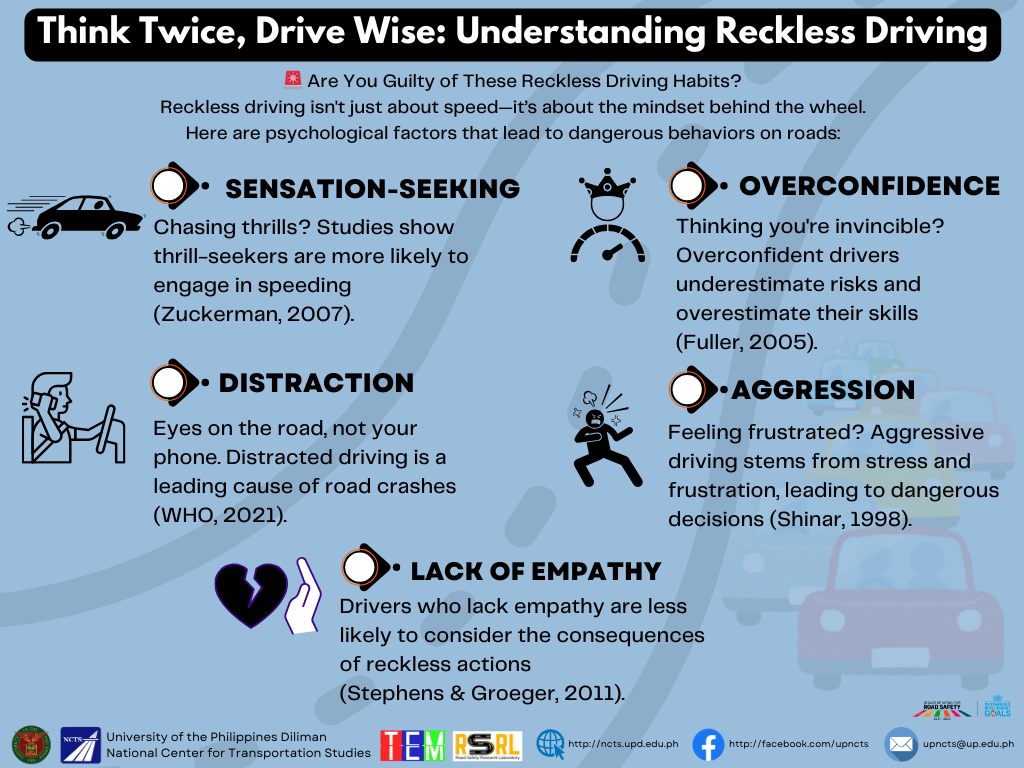
This Holy Week, there are many who are using the roads whether for long distance travel (e.g., spending the holidays in their hometowns away from the metro) or for the typical religious trips (e.g., pilgrimages, Visita Iglesia, etc.). Motorists should exercise caution as they drive or ride. We should be more mindful of the impacts of our behavior to other travelers whom we share the roads with.
Safe travels to all!
–
Safety or speed?
We start June by sharing a video on why safety and vehicle speed are incompatible:
I saw this video while browsing an article on “Dangerous by Design”. The article discusses a new publication where road designs are evaluated from the perspective of safety. Most of our roads have been designed with speed in mind. That is, how to facilitate the movement of motor vehicles to ensure they travel faster. Forgotten or, even worse, disregarded is the most important element of safety. Why do we widen roads or insist on higher speeds in populated areas or school zones? Such questions are not addressed directly or not answered at all by agencies in charge of planning, designing, constructing and maintaining roads and bridges. The same is true for agencies or units in charge of traffic regulations or management. The result not surprisingly is an increase in the number of road crashes, fatalities and injuries due to our roads being ‘dangerous by design’.
–
Article share: on using optical narrowing to make streets safer
I’m sharing this interesting article on the concept and application of optical narrowing to improve road safety:
Erfurt, E. (September 15, 2023) “How to Use Optical Narrowing to Make a Street Safer,” Strong Towns, https://www.strongtowns.org/journal/2023/9/15/how-to-use-optical-narrowing-to-make-a-street-safer?fbclid=IwAR147sLmkMBwStj51FR1ehNcVsi1YpN70etrpGOwv9DHL4ZhJIDLzP8cb1s [Last accessed: 3/14/2024]
To quote from the article:
“We all perceive the world around us through visual reference points. As we look around, we are next to the wall, or across the street from the bank—in other words, we position ourselves relative to what we see. This is even more apparent when we are driving: you may perceive yourself as behind another car, or between the lines on the road.
Drivers make decisions based on these visual cues. If things are further away, we are more inclined to speed up. The auto industry has marketed this as the “freedom of the open road,” and the visual of a wide open road is paired with the acceleration of the car. If no one is near and all the fixed objects, such as curbs and buildings, are far away, then the perception is that we have less risk and we throw caution to the wind.
If things are closer, we are more inclined to slow down. Our natural inclination is caution and possibly a little bit a fear that we may hit something. When you drive on a street where the lanes are a little narrower, or the buildings are at the back of the sidewalk, our reference points become closer. We have to focus, and in an abundance of caution we drive slower. The perspective is that we have more risk, and we pay more attention to counter that risk.”
This would be a good quick reference to planners and engineers who are involved in road safety, particularly in applying complete streets concepts to reduce the risk of crashes along streets.
–
On reducing driving and its inherent risks
Ever since the automobile was invented and eventually mass-produced, there has been an increasing risk associated with motor vehicle traffic. Laws, policies and regulations have also been influenced to favor the car rather than people. And so we now have what is termed as a car-oriented and dependent transportation system that seems so difficult to undo as most people appear to be enamored by the car. Owning a car (or even a motorcycle if you want to extend this idea of individual ownership) remains an aspiration to a lot of people.
Here is a link to the compact version of a comprehensive report by Todd Litman that presents and argues for a new paradigm where driving is considered a risk factor. There are data and a table comparing old and new traffic paradigms to help us understand the situation and what needs to be redefined or re-framed in order to achieve our safety targets or vision.
Litman, T. (October 20, 2022) “Driving as a Risk Factor: A New Paradigm,” Planetizen, https://www.planetizen.com/blogs/119287-driving-risk-factor-new-paradigm?utm_source=newswire&utm_medium=email&utm_campaign=news-10202022&mc_cid=beacdc2a04&mc_eid=9ccfe464b1 [Last accessed: 10/28/2022]
To quote from the article:
“Safer vehicles, roads, and driving may reduce crashes but achieve few other goals, and sometimes contradict them. Transportation demand management and smart growth policies increase safety in addition to helping to achieve other planning goals, and so can be considered win-win solutions.
More comprehensive safety analysis tends to support social equity goals. Many conventional safety strategies, such as larger vehicles with more passenger protection, and wider roads with fewer intersections, tend to increase walking and bicycling risks. In contrast, lower traffic speeds, TDM, and Smart Growth tend to improve safety, mobility, and accessibility for people who cannot, should not, or prefer not to drive.”
The key takeaway here should be that people should have the option of not driving at all in order to reduce the risks associated with driving as well as reduce congestion. A more comprehensive
–
On gender and transportation safety
There was a nice discussion among colleagues about which among male or female drivers were the safer motorists. My take based mainly on observations is that female drivers were safer or practiced safe driving and riding more than males. Road crash data should be able to validate (and perhaps support) this observation. My colleagues were also in agreement with this view. Here is an article providing some statistics from the US that clearly show female to be safer drivers and riders:
Egan, L. (August 17, 2022) “Road To Zero Fatalities: Male vs. female drivers,” KSLTV.com, https://ksltv.com/503038/road-to-zero-fatalities-male-versus-female-drivers/ [Last accessed: 9/2/2022]
Some quotables from the article/report:
“The girls are more teachable, they want to learn how to be a good driver,” he explained. “The boys really do think they already know how.”
In 2020, males accounted for 72% of all motor vehicle crash deaths and 92% of motorcyclist deaths, according to the institute’s analysis of data from the U.S. Department of Transportation.
In Utah, crash data from 2017 to 2021 showed that 85% of motorcycle crashes involved males, according to the Utah Department of Public Safety.
“Males are more prone to make riskier decisions and tend to be a little more thrill seeking,”
Again, we need to get the data and present these in a meaningful way. You can take the cue from the article above how data can easily be presented to provide insights to driver and rider behavior. More information or details (e.g., age, years of experience in driving/riding, etc.) can lead to even deeper analysis that will allow us to draw or formulate suitable measures to improve safety for everyone.
–
On floods, transport and traffic, again
It’s that time of year again when the heavy rains lead to flash floods along many roads. I took the following photo as we slowly progressed towards Cainta Junction early this week. The Felix Avenue approach was flooded after more than an hour of heavy rains fell upon Cainta and neighboring towns. We learned later that the rains fell on a larger area as EDSA and other major road in Metro Manila also experience flash floods. These cause traffic to slow down if not outright stoppage. Many commuters can get stranded when PUVs are not able to run due to the floods. Deeper waters mean light vehicles including motorcycles and bicycles cannot proceed along certain roads, further exacerbating the traffic situation.
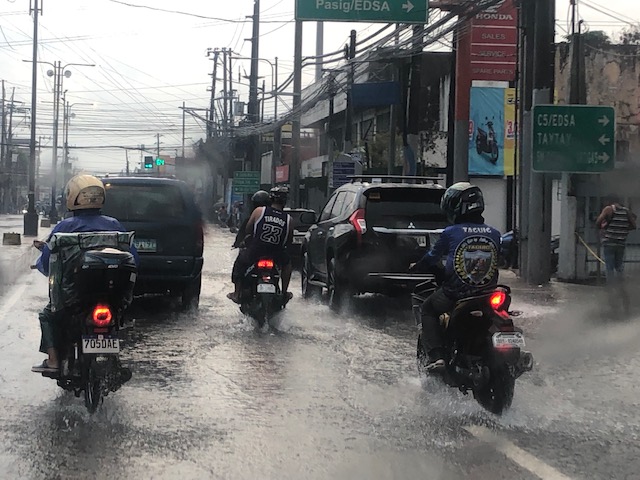 Motorcyclists emerge from their shelters to travel along flooded roads. A common sight when there are downpours are motorcyclists huddling under overpasses, bridges, or whatever shelter may be available to them. Many bring rain gear but opt to just stop and wait it out until the rain stops.
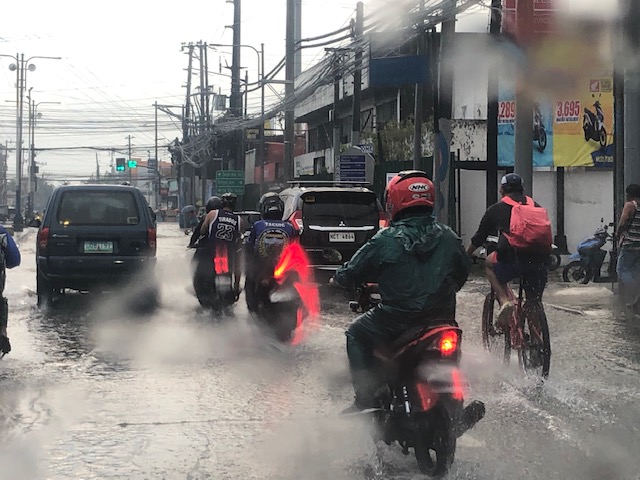 A cyclist braves the floods – while pedestrians will likely stop and wait it out for the rains to stop or for the floods to subside, cyclist might just pedal on. They just have to be more careful as potholes and other dangers may be hidden by the floodwaters.
 Cainta Junction has been submerged by so many floods over so many years. Even with the new drainage constructed under and along Ortigas Avenue Extension, Felix Avenue and Bonifacio Avenue, it seems their capacities are not enough to handle the rainwaters. That or perhaps their intakes need to be redesigned to more efficiently take on the heavy rains and the resulting runoff.
–
 Caught (up) in traffic