
Home » Posts tagged 'emissions'
Tag Archives: emissions
On using Google Maps to determine the best route from the pollution perspective
I saw this article on digital maps (i.e., Google Maps) being used to determine the best route for traveling between an origin and destination on land. It is interesting because what we usually use as basis for selecting our routes (assuming we can do so since people taking public transport basically have fewer options due to PUVs having mostly fixed routes) are travel time, travel distance and travel cost. Here is the article discussing the addition of fuel efficiency and emissions to the criteria:
Calma, J. (July 25, 2023) “People are using Google Maps to cut down tailpipe pollution,” The Verge, https://www.theverge.com/2023/7/24/23805652/google-maps-fuel-efficient-routes-transportation-emissions [Last accessed: 7/29/2023]
To quote from the article:
“According to Google’s own analysis, many drivers are taking the path of least pollution in their cars. To calculate the tailpipe emissions that prevented, the company compared how much fuel Maps users likely consumed on the routes they drove to how much fuel they would have burned through had they taken the fastest route without its eco-friendly routing tool. The savings amounted to 1.2 million metric tons of avoided CO2 emissions between October 2021, when Google launched the tool, and December 2022.”
While this seems to be a first foray into the including of eco-friendly items in route choice, these items are already and actually included in many travel planners including those used by people selecting which flights to take. We probably just didn’t notice them before or the information were not explicitly stated or posted. Would this really affect or influence the way we travel like how it is reported in the article? Or do we continue to go with the usual and familiar routes?
–
On electric vehicles not being the fix we need for transport
Much has been said and written about how electric vehicles could be the game changer for transport. Those include supportive material and also those that are more critical and provide different perspectives to EVs. Here is another article that discusses EVs in the context of the avoid, shift, improve framework:
O’Riordan, V. (November 30, 2021) “Electric vehicles aren’t a fix for carbon emissions. These 3 things need to change—fast,” Fast Company, https://www.fastcompany.com/90700832/electric-vehicles-arent-a-fix-for-carbon-emissions-these-3-things-need-to-change-fast [Last accessed: 12/17/2021]
There’s a recent article about the environmental impacts of manufacturing EVs including the batteries used by these vehicles. I will share that in another post.
–
Another look at the ‘avoid, shift and improve’ framework
The transport and traffic situation during this pandemic has revealed a lot about what can be done and what needs to be done about transportation. Discussions about what and how people visualize their ideal or acceptable transportation system reminded me of the backcasting concepts and the tools. The following diagram is sourced from the SLoCaT homepage: https://tcc-gsr.com/global-overview/global-transport-and-climate-change/
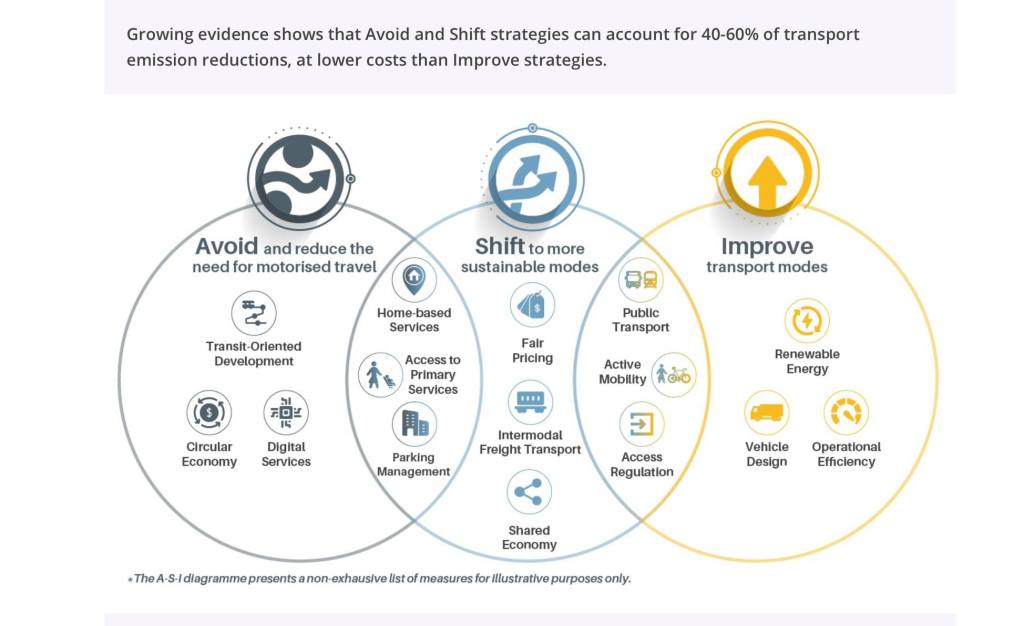
Note the overlaps among the three? Do you think its possible to have a measure that’s avoid, shift and improve at the same time?
Note, too, that if we contextualize this according to the Covid-19 pandemic, these measures even make more sense rather than appear like typical, ordinary measures we have about transportation. The pandemic revealed many weaknesses or vulnerabilities of our transportation system. We are presented with the opportunity to address these and implement certain measures that would have met with a lot of opposition before but can probably be rolled out now such as public transport priority schemes and protected bike lanes. “Work from home” is not really new since the concept has been proposed and implemented before but not as widely as was required by the pandemic situation. So perhaps we should take advantage of this forced reboot of sorts for our transportation system to be able to implement this A-S-I framework.
–
On pollution due to ride shares
We close February with another article I share about ride sharing and its environmental impacts:
Hawking, A.J. (2020) Uber and Lyft generate 70 percent more pollution than trips they displace: study, The Verge, https://www.theverge.com/2020/2/25/21152512/uber-lyft-climate-change-emissions-pollution-ucs-study [Last accessed 2/29/2020]
I guess, this sort of validates our suspicion of ridesharing becoming unsustainable. Again, we note its origins when it had the potential to reduce car ownership and car use. The original ride shares were closer to carpooling as well as took advantage of under-utilized vehicles while giving extra income to people who could share their vehicles on-demand. Eventually, the ride shares morphed into taxis with people purchasing cars to get into the business. Soon, a lot of them were roaming the streets as they awaited bookings and this type of operations generated a lot of emissions. They might not have required more parking spaces like the conventional car users but this benefit was eventually overcome by the pollution they produced.
–
Smoggy Metro Manila and a look forward to improving transport and air quality in 2019
I took the photo as we were driving up to Antipolo one morning this month when the opportunity presented itself for a quick photo of Metro Manila:

This serves as a reminder for those working to improving air quality in Metro Manila and elsewhere. It has already been established that much of the air pollution in Metro Manila and its adjacent areas can be attributed to mobile sources (i.e., motorised transport). A reduction of motor vehicle use, particularly cars, combined with more efficient engines and cleaner fuels should be lead to significant air quality improvements and, ultimately, an improvement in the quality of life. Of course, there should be parallel efforts to improve facilities for walking and cycling, and implementing the mass transit projects that will carry most people between the origins and destinations regardless of the distances.
Here’s to the approaching 2019 and the optimism that comes with the New Year!
Manigong Bagong Taon sa lahat!
–
 Caught (up) in traffic