
Home » Posts tagged 'EST'
Tag Archives: EST
Article share: On improving the Philippines’ transport system
I share this article on the desire for a sustainable transportation system for the country. This was written by a former Assistant Secretary of the Department of Transportation (on secondment) who has returned to teach at the School of Urban and Regional Planning of the University of the Philippines Diliman. Here is the article published by the Philippine Daily Inquirer:
To quote from the article:
“The present condition of the Philippine public transport system is indispensable to the desired transition from more sustainable, in this case, electric forms of transportation—to a better public transportation system. A good public transportation system is defined by reliability, accessibility, safety, and security…
The imperative to consolidate is clear and crucial. It is not just a technical necessity, but a pathway to inclusive growth where all stakeholders benefit from the transition, and where we can truly create an inclusive and sustainable system for public transportation.
Improving public transportation, by making it cleaner, safer, and more accessible, will directly enhance the quality of lives of Filipinos.”
–
Article share: On the benefits of sidewalk networks
Here is another quick share of an article by Todd Litman on Planetizen. The article contains a lot of information or data about why we should be investing in sidewalks or pedestrian facilities (i.e., for walking).
Litman, T. (August 6, 2023) “Completing Sidewalk Networks: Benefits and Costs,” Planetizen, https://www.planetizen.com/blogs/124999-completing-sidewalk-networks-benefits-and-costs?utm_source=newswire&utm_medium=email&utm_campaign=news-08142023&mc_cid=cd3b2e2ba5&mc_eid=9ccfe464b1 [Last accessed: 9/23/2023]
To quote from the article:
“Walking is the most basic and universal travel mode, and sidewalks are the most basic walking infrastructure, but they are often overlooked and undervalued in transportation planning. Completing and improving sidewalk networks can help achieve many economic, social and environmental goals.
Recent case studies indicate that typical North American communities spend $30 to $60 annually per capita on sidewalks, and would need to double or triple these spending levels to complete their networks. This is a large increase compared with current pedestrian spending but small compared with what governments and businesses spend on roads and parking facilities, and what motorists spend on their vehicles. Sidewalk funding increases are justified to satisfy ethical and legal requirements, and to achieve various economic, social and environmental goals. There are several possible ways to finance sidewalk improvements. These usually repay their costs thorough savings and benefits.”
–
Article on “Fair Share Transportation Planning”
I am sharing this new article from Todd Litman on fair share transportation planning. The content is relevant and very timely in the Philippines considering many people including and especially transport officials are struggling with the thought of allocating resources to provide or improve facilities geared towards more equitable transport systems (e.g., more facilities for active transport).
Here’s the summary as quoted from the article:
“To be efficient and equitable, a transportation system must serve diverse demands. A diverse transportation system allows travelers to use the most efficient option for each trip—safe walking and bicycling for local errands, efficient public transit when traveling on busy travel corridors, and automobiles when they are truly the most cost-effective mode considering all impact—and it ensures that people who cannot, should not, or prefer not to drive receive their fair share of public investments.
Current transportation planning practices are biased in various ways that overinvest in automobile infrastructure and underinvest in more affordable, inclusive, and efficient modes. It is time for planners to reconsider our analysis methods and funding practices to ensure that non-auto modes, and therefore non-drivers, receive their fair share of transportation resources.
This is not anti-car. Motorists have good reasons to support more investments in non-auto modes that reduce their traffic and parking congestion, reduce their chauffeuring burdens and crash risk, and provide better options when their vehicles are unavailable. Everybody wins from a more diverse and efficient transportation system.”
Another look at the ‘avoid, shift and improve’ framework
The transport and traffic situation during this pandemic has revealed a lot about what can be done and what needs to be done about transportation. Discussions about what and how people visualize their ideal or acceptable transportation system reminded me of the backcasting concepts and the tools. The following diagram is sourced from the SLoCaT homepage: https://tcc-gsr.com/global-overview/global-transport-and-climate-change/
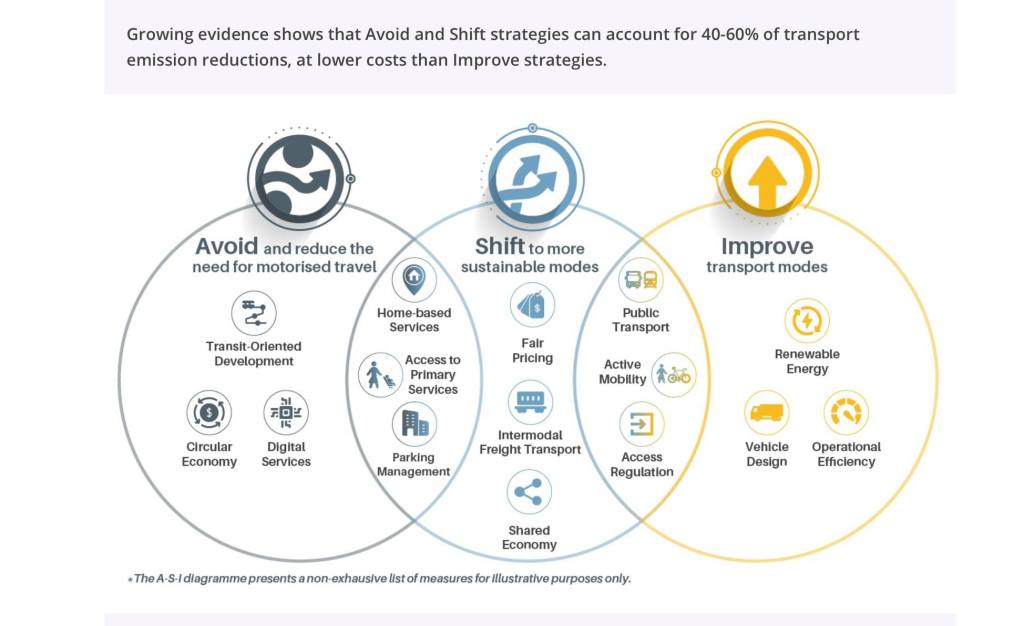
Note the overlaps among the three? Do you think its possible to have a measure that’s avoid, shift and improve at the same time?
Note, too, that if we contextualize this according to the Covid-19 pandemic, these measures even make more sense rather than appear like typical, ordinary measures we have about transportation. The pandemic revealed many weaknesses or vulnerabilities of our transportation system. We are presented with the opportunity to address these and implement certain measures that would have met with a lot of opposition before but can probably be rolled out now such as public transport priority schemes and protected bike lanes. “Work from home” is not really new since the concept has been proposed and implemented before but not as widely as was required by the pandemic situation. So perhaps we should take advantage of this forced reboot of sorts for our transportation system to be able to implement this A-S-I framework.
–
On the burdens of car dependence
Here is a quick share today. This is another excellent article from Todd Litman who makes a great argument for why planning should move away from its being car-centric and contribute towards a significant reduction in society’s dependence on cars.
Litman, T. (December 15, 2020) “Automobile Dependency: An Unequal Burden,” Planetizen.com, https://www.planetizen.com/node/111535?utm_source=newswire&utm_medium=email&utm_campaign=news-12212020&mc_cid=e746a044a3&mc_eid=9ccfe464b1 .
Much have been said and written about this topic in many platforms including social media but in many of these, I noticed that the discussion often deteriorated into hating or shaming exercises rather than be convincing, constructive arguments for reforms in planning and behavior and preference changes in transport modes. Litman is always very fair and comprehensive and employs evidence or facts in his articles that should be clear for most people to understand. I say ‘most people’ here because there are still many who are among those considered as “fact-resistant”. Happy reading!
–
References for improvements for active transportation
Here’s a nice link to a National Academies of Science, Engineering and Medicine pointing to the wealth of researches supporting improvements for active transportation:
Paths to Biking, Walking Improvements Supported by Wealth of Research
Link: https://www.nationalacademies.org/trb/blog/paths-for-walking-and-biking
The references listed should aid researchers, practitioners, advocates and policymakers in their work towards realizing a people-oriented vs car-centric transportation.
–
Article on sustainable transport’s role in “saving the world”
Here is another quick post on another article I am sharing showing the importance of sustainable transport:
Milner, D. (2019) How sustainable transport can save the world, medium.com, https://medium.com/@djjmilner/how-sustainable-transport-can-save-the-world-f2f64517dc52 [Last accessed: 4/9/2019]
It goes without saying that sustainable transport has a lot of potential for helping mitigate climate change and other issues but much is expected of our leaders for policies and program & project development & implementation towards achieving sustainable transport in our cities and municipalities.
–
On re-designing or re-imagining our transportation system for people
Here is another good read especially for those who advocate or even just beginning to appreciate the concept of people-oriented transportation:
VannPashak, J. (2018) “Design for humans as they are, not as you want them to be,” http://www.medium.com, https://medium.com/@jvannpashak/design-for-humans-as-they-are-not-as-you-want-them-to-be-ef95076c0988 [Last accessed: 11/23/2018].
In a recent symposium where I made a presentation about low carbon transport and visioning and re-imagining transport, I was asked how we can re-design our transportation to be more people-oriented than car-oriented. I replied that we have to do a lot of unlearning. That is, many planners and engineers would need to unlearn many things they’ve learned in school and those they got from their workplace. One convenient excuse for not coming up with a better design, for example, is that certain planners or engineers just followed what their offices or agencies have been doing. What if what their offices and agencies (and consequently their seniors at work) where wrong all these years and what was “ginagawa na” or “nakasanayan” have led to deficient outcomes? I even joked about whether these offices or agencies were “open minded” referring to a favourite by-line by networking companies. Being open-minded in the context of having people-oriented transport solutions would be difficult if everything was “nakakahon” because these were what you learned from school and/or the workplace. It is difficult to admit that something was and is wrong.
–
On the need to increase NMT and public transport use
A recent report reinforces what many of us already probably know or are aware of – that we need to shift away from dependence on car use to more sustainable modes of transport in the form of non-motorised transport (NMT) and public transportation. Here is the article from the AASHTO Journal:
Global Climate Report Calls For Expansion Of ‘Non-Motorized’ Transport And Public Transit (2018)
There is a link to the report in the journal article. The report is conveniently available in PDF form and is very readable (i.e., not overly technical).
Incidentally, I was involved some time ago in a project led by the group Clean Air Asia (CAA), which involved several experts from across ASEAN as well as Japan that attempted to determine the necessary transport programs and projects in the region to stave off the projected increase in global temperatures. In all the scenarios evaluated, non-motorised transport (NMT) and a rationalised public transportation system By the term ‘rationalised’ I am referring to the use of higher capacity vehicles as against the taxis and tricycles that typically carry few if not one passenger. Here is a link to the final symposium for that study that has links to the materials presented:
The Final Symposium on the “Study on Long Term Transport Action Plan for ASEAN”
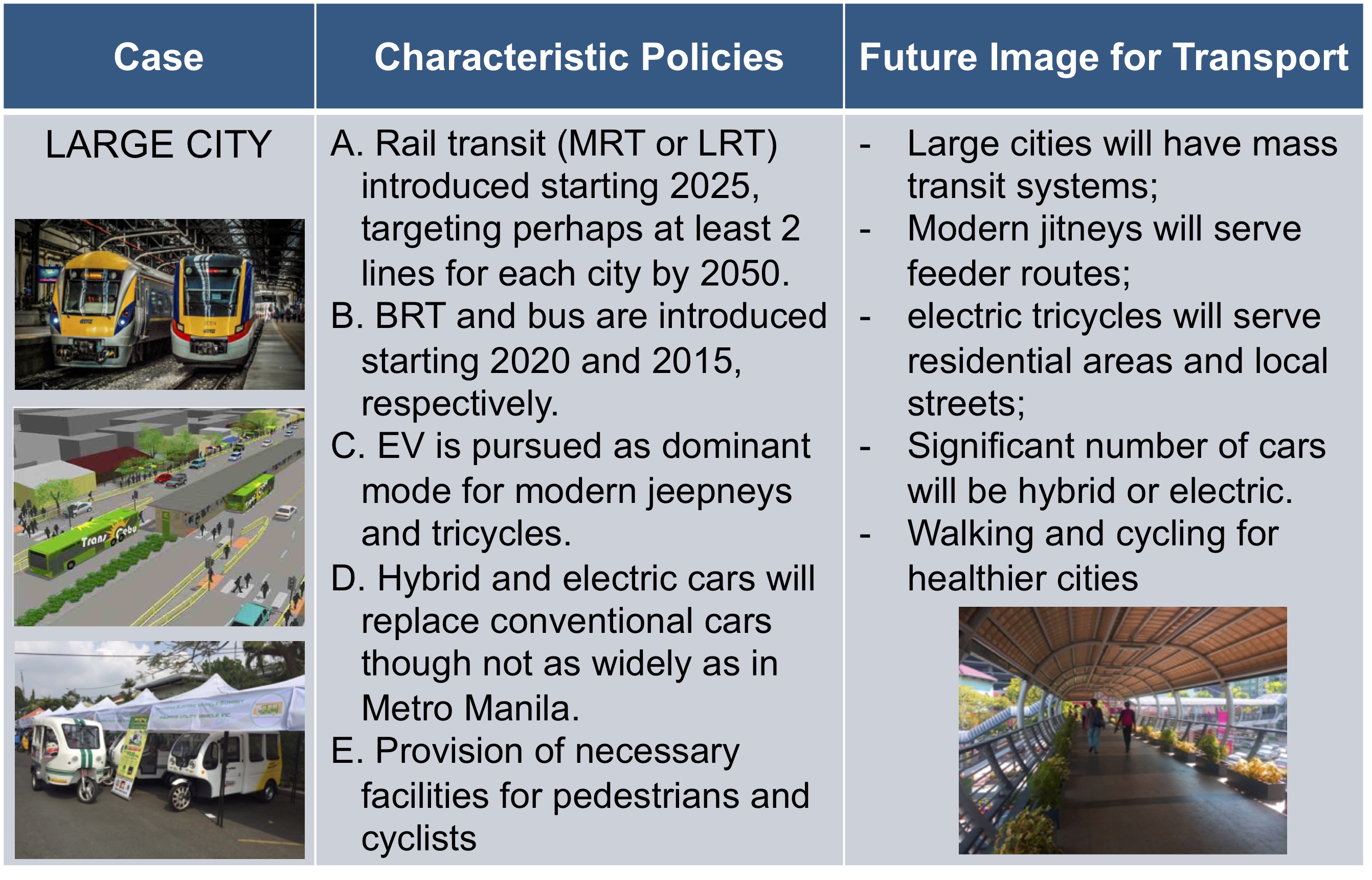
Here’s a slightly updated slide on the future image for a large city in the Philippines:
–
Mobilizing sustainable transport for development
The United Nations (UN) has recently published a new report on “Mobilizing sustainable transport for development” authored by a High Level Advisory Group on Sustainable Transport formed by the UN. The report and other resources may be found at the following website:
Secretary General’s High Level Advisory Group on Sustainable Transport
This is under the UN’s Sustainable Development Knowledge Platform. You can check out the other materials at the website. The UN has many initiatives on sustainable transport and has been very active in promoting or advocating for sustainable transport for a long time now. It is through the UN Centre for Regional Development (UNCRD), for example, that the Philippines and other ASEAN countries were able to formulate their national EST strategies. The new report continues on the UN’s commitment to promote sustainable transport to improve people’s lives around the world.
–
 Caught (up) in traffic