
Home » Posts tagged 'experiments'
Tag Archives: experiments
Still on the Katipunan zipper lane
I’ve occasionally arrived at Katipunan with the experimental zipper lane still in use. I usually take Major Dizon from Marcos Highway in order to have a chance of using the zipper lane. That is, I take the left-most lane of C5 so I am in a good position in case the lane was available when I get to the Ateneo area. Perhaps it is already assumed that the right most lanes are already dedicated to vehicles bound for Ateneo or Miriam (mostly Ateneo I suppose).
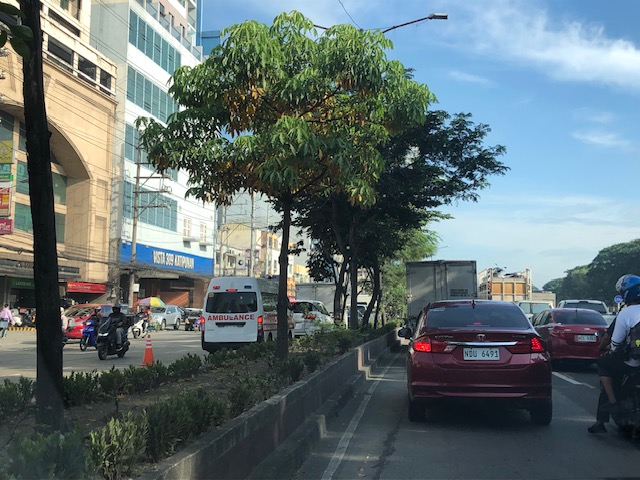
So far, I’ve been able to use the zipper lane only once. On the other times, I stay on the left-most lane (beside the island) of Katipunan/C5. The zipper is relatively short as vehicles return to the correct side of the road at Ateneo Gate 3. The merging there means slower movement of both the zipper lane and the median lane traffic. So is the zipper lane a success? I would say the experiment is just above “marginal success” (or pasang awa) given its limited application. It doesn’t hurt to implement the scheme as traffic along the southbound side of Katipunan is generally light anyway.
–
On experiments and crowd-sourcing for solutions
If you didn’t notice, the government (national agencies and local government units) has implemented and successfully employed experimentation and crowd-sourcing to find solutions for transport and traffic problems. In the case of experimentation with traffic, this has been going for a while now but not at the level of those conducted during Bayani Fernando’s stint at the MMDA. At the time, full scale experiments were undertaken as the agency dabbled with the U-turn scheme. The ultimate product of that time are the twin U-turn flyovers at C5-Kalayaan. I say ultimate because it involved both experimentations and traffic simulation, where the latter was used to justify the U-turn flyovers over what was originally proposed as an underpass along C-5. As I recall, the model was not calibrated or validate contrary to the agency’s claims. I say so because I personally saw how the model ran and the presentations were more like demonstration of the software used. Meanwhile, the DPWH at the time made their own simulation models and did the necessary calibration and validation to come up with sound models for other projects including the Quezon Avenue-Araneta Avenue underpass.
Crowd-sourcing, mainly through social media is a more recent approach. It is not an entirely new animal because prior to social media, there were a lot of inter-agency committees that included people from various stakeholders (some invited, some not) who were the primary “sources”. The crown now is larger and perhaps more diverse. Whether this is a conscious or unconscious effort is uncertain. And this can easily be denied or shrugged-off. But in this age of social media, there are just so many enablers or influencers for crowd-sourcing each of whom have their own agenda. Some mainly to promote or prop up the current administration. Some to mainly criticize without offering solutions. And others to invite constructive scrutiny or assessment while also providing options to address problems and issues. It is the latter group whose opinions and recommendations should carry more weight if indeed the administration is fishing for solutions from the so-called crowd.
Consider the following recent examples (not in any order):
a) Closing U-turn slots along EDSA
b) Requiring face masks for all who are outdoors including cyclists
c) EDSA carousel
d) Resumption of public transport with mostly air-conditioned vehicles
e) Bike lanes along major roads
f) Public transport reform (in general)
There are others but the six listed above have been discussed a lot on social media after government picked up an idea or two about them, and implemented each seemingly without conducting due diligence or paying attention to the details including potential glitches. They ended up with mixed results, many very costly (I wouldn’t say disastrous at this point). However, in all cases, they seem to welcome (though at times begrudgingly or feigning resistance) crowd-sourced solutions particularly those from organized groups who are only too happy for themselves to be in the limelight.*
One thing is for sure and that is that there is still a lack of capabilities among government agencies and LGUs when it comes to transportation. Don’t get me wrong. National government and many LGUs have the resources and capacity to address transport problems. However, their capabilities are in question here because they seem to be unable to harness their capacities and resources to come up with sound and suitable solutions. In the end, they appear to buckle under the pressure of their own crowd-sourced schemes only to emerge as manipulators after they are able get what they want with the willing assistance of the naive.
–
*Some of these are true advocates who have worked hard to make transport better for all while others are the bandwagon types (nakikisakay lang) who are content dropping key words that now sound cliche at every opportunity. I leave it up to my readers to determine which are which. 🙂
 Caught (up) in traffic