
Home » Posts tagged 'fare collection'
Tag Archives: fare collection
Cashless payment methods for public transportation
It took some time but finally there are even more options to pay for your transit fare, at least for MRT Line 3 for now. Here is the graphic from the announcement by the DOTr:
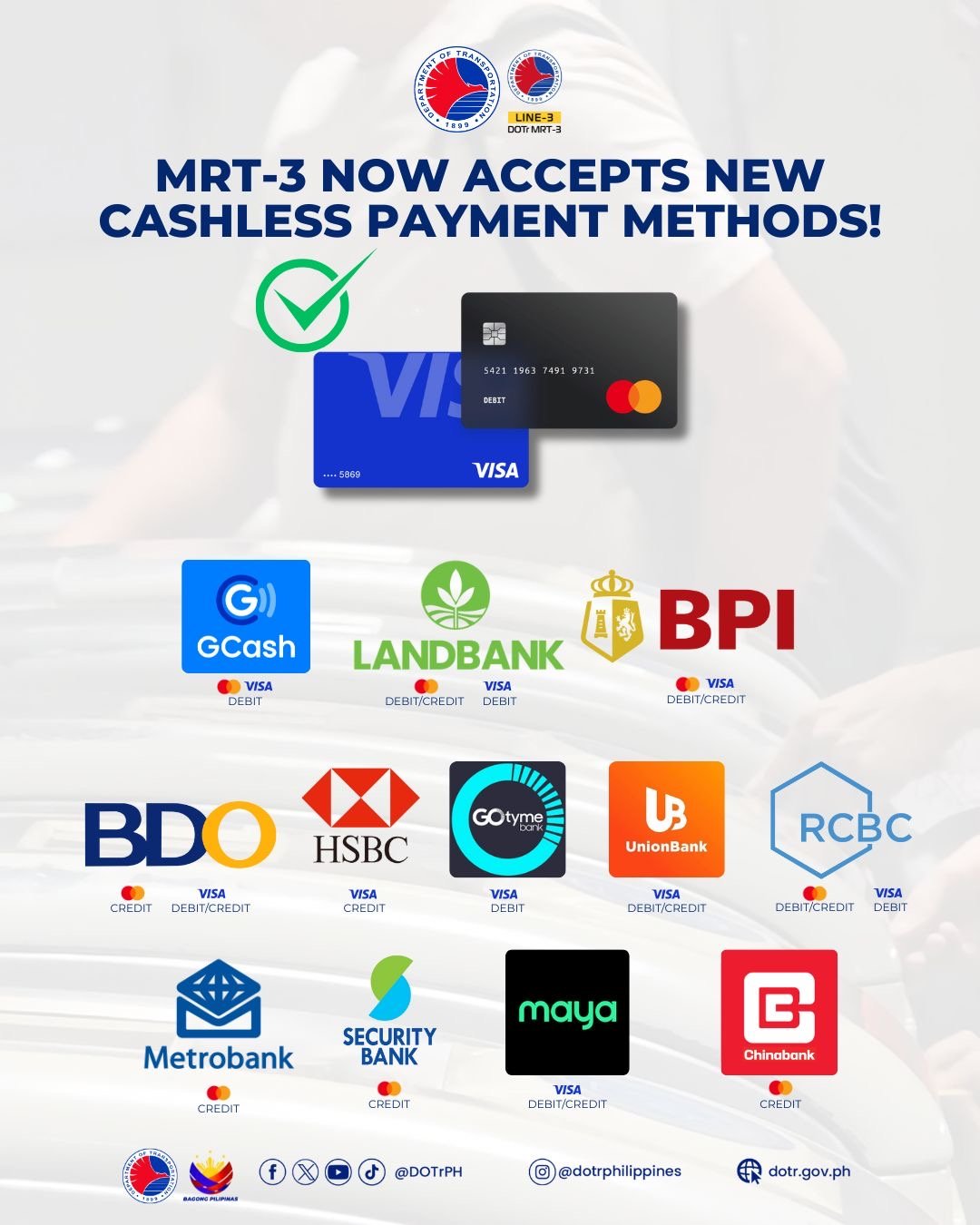
Hopefully, these methods will be available to all rail lines including the PNR. Hopefully, too, these options will be available in buses and perhaps at least on modern jitneys. This will make it easier to pay public transport fares for the regular transit users.
–
On “levelling-up” on fare collection
I found this article on how Japan Railways East (JR East) plans to upgrade its Suica card so passengers don’t need to swipe them at the stations. That will mean practically seamless entries and exits at the stations and perhaps the elimination of most queues related to this part of rail operations. Here is the article published on Medium:
To quote from the article:
“You can currently use Suica to pay for goods and services at around 2.26 million locations in Japan. However, JR East has only issued around 31.47 million mobile Suica cards. That lags behind the two most popular cashless payment options — PayPay (66 million) and d-Barai (63 million).
The move comes as transportation cards, long a staple of travel inside of Japan, seem to be going out of style. More train companies are introducing QR code and credit card touch payment options, making the one cutting-edge technology obsolete.”
I have a Suica card as well as others like it from Bangkok, Kuala Lumpur and Singapore. Suica has really been a convenient way to pay transport fares as well as to purchase items such as drinks or snacks particularly at train stations in Japan. We are not yet at the level of the Suica card of more than ten years ago but there are lessons to be learned here in case we finally have something like it and others that make travel or commuting easier.
–
Conventional vs. hi tech – the case of train tickets
Here’s an interesting (for me) read on something we usually assume could be improved by means of technology – transit fare collection:
Unseen Japan (May 27, 2024) “Japan Railways tried replacing tickets with tech., It didn’t go well,” Medium.com, https://unseenjapan.medium.com/japan-railways-tried-to-replace-tickets-with-tech-it-didnt-go-well-1e151f9a400f [Last accessed: 6/10/2024]
To quote from the article:
“So what went wrong? Some experts say that JR East’s major fault was forcing a cutover to online and automated systems before those systems were ready for prime time.”
As with others like this that seek to ‘disrupt’ the conventional or status quo, a hastily implemented system will likely face trouble and a barrage of complaints from users. This would be especially true if the current-old system is already efficient and requires only minor tweaking or improvements and an abrupt phase out or scale down of the old is not necessary.
–
On payment schemes for public transport services
Here is a nice article about paying for your fares:
Weinstein, Z. (2018) “Why do so many public transit agencies make it so difficult to… pay for public transit,” http://www.medium.com, https://medium.com/@z_75510/why-do-so-many-public-transit-agencies-make-it-so-difficult-to-pay-for-public-transit-c5ae98ae2571 [Last accessed: 11/28/2018].
This is interesting for us as we are just starting to come up with more efficient and innovative ways for paying for public transport services. This is in the form of the Beep card that is now being used for rail transit services as well as for some buses and jeepneys (electric?). Still, we have a lot of catching up to do in the Philippines compared to, for example, Japan and Singapore where it’s possible to go cashless in paying for public transport. We don’t even have a pass (e.g., there’s a monthly, quarterly and even annual pass that Japanese railway companies sell to students and employees that gives them a substantial discount for travels between their home station and work or school station) for regular transit users. Hopefully, the use of Beep will expand and perhaps other modes of payment may be introduced for the convenience of public transport users.
–
Future fare collection for jeepneys and other modes?
In the last Electric Vehicle Summit held in late February this year, I noticed a conspicuous device installed in the electric jeepney unit that was on display at the venue. The device is for electronic payment of fares; using a card much like the ones being used in other countries like Singapore and Japan, and soon, hopefully, for the LRT and MRT in Metro Manila. Such a capability has a lot of potential including a very convenient way to pay fares for public transport in Metro Manila. Other potential uses would be for payments of items bought at stores or shops (or vending machines) like Japan’s Suica card. Users would just have to “top up” or load their cards for these to be used in their commutes or purchases.
 The latest e-jeepney model features a side door instead of one at the rear.
 Boarding passengers will encounter device upon entering the vehicle. The current technology available should soon enable passengers to use “tap” cards to pay for their fares.
 Such a device will leas to a more efficient fare collection and eliminate the need for “conductors” or persons assisting the driver in taking passengers’ fares. These should also allow the driver to focus on driving rather than be distracted by fare collection including trying to keep track of who has paid and who has change due. This would likely translate into safer travel for most people.
 Electronic boards at the top behind the driver can provide travel information such as the next stop or traffic conditions along the transit route. Such information can be derived from various sources including the MMDA or local governments as well as from crowd-sourcing.
–
 Caught (up) in traffic