
Home » Posts tagged 'government'
Tag Archives: government
Words of wisdom from the back of a taxicab
I was driving home from work one evening last week and was behind this taxi. As we were practically stopped due to the evening rush traffic jam, I was able to take this photo of a quote from the Bible that was displayed on a board installed behind the cab:
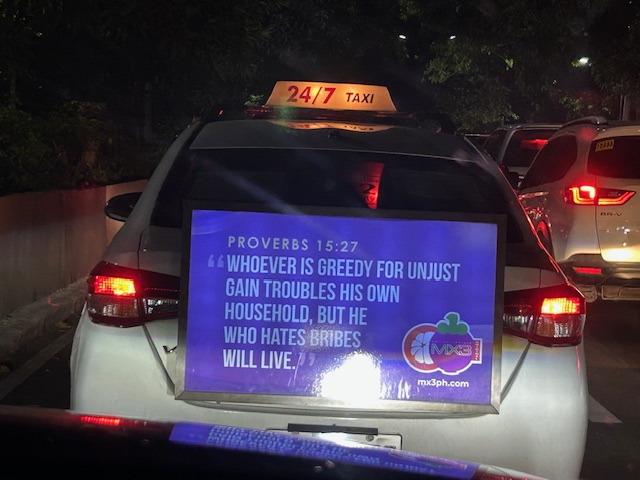 It is a very apt quote especially in these times when corruption is everywhere in the news.
The quote also reminded me of the families of those alleged to have been involved in corrupt practices. All those social media posts by the so-called nepo children of politicians, government officials and contractors bring these relatives in the fray, in the forefront of discussions. Are they innocent or be treated as so (based on the opinions of some people)? Or are they themselves guilty and even complicit of the corruption their parents are involved in? My take is that if the children are of toddler age or younger, then they shouldn’t be involved or shamed. They definitely do not know and not aware of what’s going on. But for the older children who are traveling, shopping and enjoying ill-gotten wealth, that’s a different story, even if they are still below 18 years old. They are aware. They already know of their excesses. Perhaps they have already been indoctrinated by their elders about their status and privilege, and think these are okay. Indeed, entire households can be liable and should suffer the consequences of their actions and excesses.
–
Sins of omission at DPWH
I’ve been quite busy the past weeks due to various commitments including deadlines. Nevertheless, I have tried to be updated on the current events pertaining to the flood control scandal many government officials are now being linked to. These include the personalities involved, the projects and the amounts that are now the basis for a lot of people being horrified enough to be called into action. Apparently, many people have not been convinced enough of past misdeeds that have been reported; including the ones pertaining to abuses of uses of confidential funds.
I have hesitated to post on my thoughts about the mess at DPWH as I have many friend including past and present students who are with the Department. Some if not all I know to be sensitive to the corruption issues around the flood control projects. The latter apparently blew up in the faces of the officials of the agency and exposed them and their staff to a lot of ridicule (both warranted and not) and even harassment. Recently, I’ve been seeing a lot of posts from people who are supposedly with the DPWH. These posts are obviously apologists for certain officials considering the content of their writing. These are basically attempts to absolve those who claim to be clean among the DPWH staff and officials, and yet they have not done anything to correct these wrongdoings. This is what is called commiting ‘sins of omission’. By not doing anything for whatever reasons including being afraid to be a whistleblower (considering the consequences) means one is enabling or even encouraging the acts of corruption. In essence, they are being complicit by turning their blind eyes to the rotten eggs. This applies anywhere and not just to DPWH employees. And perhaps so many in government agencies are guilty of this.
–
Our clear and present problem with DPWH and certain contractors
I was going to write about the new taxi service and TNVS I used recently during this long weekend. Unfortunately, I lost focus and “gana” after reading about the collusion among DPWH officials and certain contractors about flood control projects. Here are my sentiments today that I shared on my social media account:
“Bakit walang pasok bukas? Kasi may nagbabadyang masamang panahon. Baka bumaha? Bakit babaha? Alam na siguro natin ang sagot sa tanong na ito? Damay-damay na yan. Resilience na lang ba ng mga taong nagbabayad ng buwis ang kasagutan? Di ba dapat may managot sa kung bakit patuloy tayong binabaha samantalang bilyones o trilyones ng kaban ng bayan ang ginagastos? Naiisip ba natin na yung pinagpaguran, pinagpapaguran at pagpapaguran natin ay napupunta sa mga nanlalamang? Wala nga siguro silang nararamdaman at napapansin habang nakasakay sa kabilang magagarang sasakyan. Tayo naman, hanggang tiis sa paglusong sa baha at mag ‘abangers’ sa anunsyo ng walang pasok.”
With the recent revelations of these contractors having the propensity to purchase luxury items like expensive vehicles, do we still wonder why these people cannot feel what ordinary people experience during these times of inclement weather? Hindi nga siguro maramdaman ang baha o ang mga lubak sa daan pag naka SUV ka. To be quite direct about this, I would like to personally drag them to experience the floods and maybe submerge their homes for a few days so we’re even. I am probably not alone with my sentiments.
Flood control is probably just the tip of the proverbial iceberg. There are just so many other projects including roads and bridges that also need to be investigated for anomalies. Will the current administration act on this? Or are we just being taken for a ride with all these lip service and grandstanding by politicians and government officials?
–
Article share: Picking it up as we go: how transportation agencies can learn from university research
Here’s a quick share of an article on the JTA Research Lab. This is a good example of how transportation agencies can learn from university research and also how they can collaborate or cooperate with academe to formulate solutions to various transport problems or issues.
JTA Research Lab has been created to identify critical transportation policy questions, and get academics to help solve them. Pencils sharpened? Nathaniel P. Ford explains…
Source: Picking it up as we go: how transportation agencies can learn from university research
On data on mobility trends
There are actually a lot of data available on mobility if you know how to look for them. One good source is Apple. Yes, Apple has access to thousands of smart phones that allow them to track individuals (oh you didn’t know that?) movements. Here is the link to Apple’s data:
https://www.apple.com/covid19/mobility
And here is a graph showing mobility trends in the Philippines from that resource:


Some politicians and political appointees are now saying that we are in this predicament about COVID-19 because of a lack of discipline. That is bullshit. Many stayed home and/or reduced their movements. And then there’s that study showing 90% wore masks when they go out. No, it’s not lack of discipline that’s the problem but the lack of essential services and goods that are supposed to be delivered by those who are suppose to govern and the deficiencies from the start in addressing the spread of the virus especially from abroad. Perhaps these people criticizing Filipinos should look at their mirrors more closely and look left, right and across from they comfy seats to see what’s wrong with the way government has been handling the pandemic?
–
Build, build, build, and the cost of pursuing legacies among our leaders
Much has been written about the current administration’s Build, Build, Build program including it being billed as a “Golden Age of Infrastructure”. Many infrastructure projects though can be classified as “nice to have but not necessary”. They might become necessary in the future but then there are other projects that are more urgently needed now and need to be prioritised given the limited resources that we have. A good example of these “nice to have” projects would be the bridges proposed to connect Panay, Negros, Cebu and Bohol islands. The reality is that it is quite easy to manipulate studies in order to obtain results to support the construction of these bridges including justifying loans that will bring us deeper into unnecessary (for now) debt. You get more bang for the buck if you build instead mass transit systems and transform transportation in major cities of these same islands to favour active transport rather than be dependent on cars. Cebu, Iloilo, Bacolod and other highly urbanised cities now require better public transportation and people-oriented systems. That’s where money should go and that will have a bigger impact from now to the long-term. The government’s infrastructure build-up is linked to the new tax scheme (TRAIN) but also requires a lot of borrowing from various entities including one country that has been documented to take full advantage (i.e., very disadvantageous to the borrower) of countries taking out loans from them (you know which one – China). Do we really want to get mired in such debt?
We all are in the lookout for opportunities that would probably give us something we will be remembered for. This is not limited to the leaders of our country, whether they be politicians or department heads or even district engineers, who perhaps want to be remembered for something they built, or, something they contributed in making a reality. Perhaps this can be in the form of a mass transit line, an expressway, or an iconic bridge? Perhaps for others it is in the form of a nuclear power plant or even a space program. We all have that dream project we want to be associated with.
Why are certain good people not critical of the government’s disastrous war on drugs or the proliferation of what appears to be government sponsored fake news and propaganda? It’s simple. Many of these “good” people are benefitting from the very same government particularly in pursuit of their own legacies (which are their main agenda). If you were an engineer, planner or scientist in government and your projects were funded one way or another, would you dare bite the proverbial hand that feeds you? “Complicit” seems to be a word used by the more hardline among us in terms of the socio-political-economic situation we are in now. But we have to remember that during the regime of Marcos, this was also the situation. The so-called best and the brightest were all employed by the administration back then including prominent names in industry and the academe, who perhaps enjoyed the privileges, perks and funding support for their programs and projects. Never mind martial law and its outcomes.
That is why history and its understanding is important. So we may learn from it and not relive the wrongs made in the past. We are not good in history or its application. Perhaps we only know how to memorise. And memory has its limits. That is among the costs of our current predicament. We withhold history, and memory, in exchange for what we think would be our legacies. At what cost? At what price? Human rights, freedoms, justice, financial stability, and dignity are just a few we can mention. Perhaps the biggest loss will be our humanity as we have become de-sensitized to the well-being of others.
–
Emergency powers to solve PH transport problems? – A long list of projects
I am sharing the long list of projects submitted by the Department of Transportation (DoTr) to the Senate Committee on Public Services chaired by Sen. Grace Poe. This is a public document and I think should be circulated for transparency and so people will know what projects are proposed to be covered
List of sectoral projects that the Department of Transportation intends to implement and draft bill for emergency powers: dotr-list-of-projects-and-draft-bill
I leave it up to my readers to determine which among the projects listed really require emergency powers. Many I think do not require emergency powers especially since the period requested for such powers is 2 years and not the duration of the current administration’s term. Perhaps those requiring emergency powers would be programs and projects aiming to overhaul our public transport system, which is currently much dependent on road-based modes. Public transportation services do not follow the suitable hierarchy as seen along major corridors served by low capacity modes. An overhaul (i.e., rationalisation) will touch the very sensitive nerves of bus, jeepney, UV express and tricycle operators and drivers and could trigger an avalanche of TROs to prevent or discourage government from doing what should have been done decades ago to bring order to our chaotic transport. I believe emergency powers coupled with the current admin’s political capital (and the “action man” image of Pres. Duterte) can help bring about genuine reform (and change!) to transport in our cities.
–
 Caught (up) in traffic