
Home » Posts tagged 'Grab' (Page 2)
Tag Archives: Grab
The other TNCs – Wunder and Angkas
The Land Transportation Franchising & Regulatory Board (LTFRB) recently issued a couple of press releases pertaining to two Transport Network Companies (TNCs). The issuances were for Wunder and Angkas to cease operations. Copies of the press releases were posted at the Department of Transportation (DOTr) Facebook page and are reproduced here:


Prior to these press releases, both Angkas and Wunder have been aggressively promoting themselves in social media. Wunder is the more established entity and is actually based in Germany. Its operations are basically carpooling and match drivers with passengers traveling about the same time and along their likely routes between homes and workplaces/schools.
Angkas appears to be a locally developed app. The big difference here though is that it is for motorcycle taxi services. While it is clear that tricycles (3-wheelers = usually a motorcycle plus a sidecar) used as public transportation are under the jurisdiction of local government units, their operations are governed by national laws. These include tricycles supposedly being banned from operating along national highways. Motorcycle taxis are regulated along the same lines with LGUs having the responsibilities over their operations (refer to my previous posts on habal-habal and Skylab) and are generally tolerated in rural areas where there is a lack of motorized transport services available. As far as the national government is concerned though, motorcycle taxis are prohibited and this is due primarily to safety concerns.

I don’t know where Angkas gets the “professional motor taxi” tag since it is most likely that riders offering their services are not at all trained or experienced to provide public transport services and on a 2-wheeled vehicles. Such operations are risky especially to passengers. Even in countries like Thailand and Vietnam where motorcycle taxis are generally legal, it is established that such transport modes are unsafe with motorcycles being involved in more crashes compared to other vehicles. Motorcycles also have a higher fatality rate compared to other vehicles.
I think Wunder is different and could actually be closer to the classic (or conventional) carpooling idea compared to ridesharing/carsharing leaders Grab and Uber. Wunder clearly states that its aim is to maximize the available seats for the two likely trips people make with their vehicles. These two trips are usually one in the morning (i.e., to the workplace or to school) and another in the afternoon or evening (i.e., to home). As such, the income derived from Wunder is limited to the 2 trips although a driver can maximize income by accepting multiple passengers. In contrast, many (not all) Uber and Grab drivers in the Philippines operate practically the whole day and are basically taxis. I would recommend that the LTFRB look into the operations and business model of Wunder and perhaps reconsider their decision against it.
–
Do people understand what Uber and Grab really are?
Over the holidays, I’ve read a lot of posts about Uber and Grab. Mostly, these were complaints about the surge pricing scheme of Uber. A lot of people cited the exorbitant rates Uber charged for trips even short ones like Ortigas to Center to Greenhills and Trinoma to Katipunan. Though the complaints are legitimate ones, I also try to see the other side of the coin considering Uber and Grab do tell potential passengers how much it will cost them for such commutes during peak periods (i.e., when roads are congested). Potential riders do have a choice whether they should take the rider (and therefore agree with the fare stated by the app) or take another transport mode instead. The issue here should not be entirely Uber’s or Grab’s fault. Our public transport system, particularly in Metro Manila, sucks. And that includes the conventional taxis that could have provided better services if regulations were strictly implemented or if the operators managed their drivers and maintained their vehicles well. Based on my experience, taxis in Cebu, Iloilo and Davao, for example, are better managed and regulated, and provide better service quality than those in Metro Manila.
Then there were the joint LTFRB and DOTr advisory for Uber and Grab units and the LTFRB order on surge pricing and fare rates.

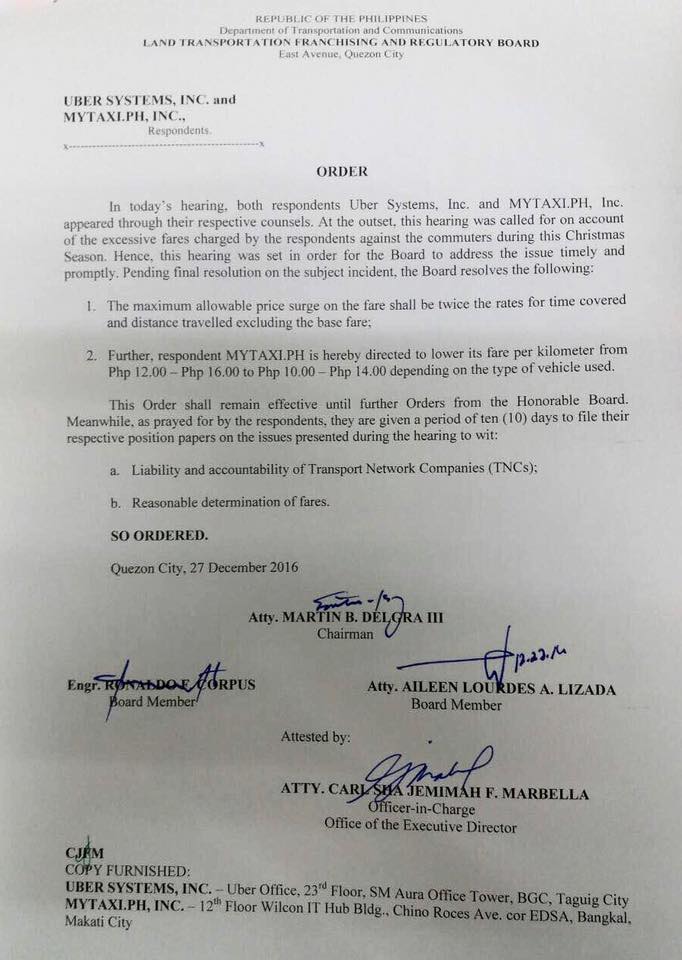
From both cases, it is clear that car-sharing or ridesharing services like Uber and Grab are treated as taxis rather than as premium services that likely entail higher fares but are subject to prospective passengers’ willingness to pay for such services.
Such opens the door for more questions than answers: Is this a misunderstanding or perhaps a deliberate action on the part of Philippine regulators (LTFRB and DOTr)? Why can’t they impose the same standards for vehicles, operators and drivers of conventional taxis? Wouldn’t it be in the best interest of the general riding public for LTFRB to clamp down on conventional taxis in order to reduce dilapidated vehicles as well as unqualified drivers? Surely, conventional taxis will become more attractive if they provide better services including significant reductions in the incidence of typical complaints against taxis like negotiating fares and refusing passengers because of their destinations.
Here are some more questions that need clear and objective answers for one to have a fair assessment of these services:
- Do these show how much we (both commuters and regulators) understand how these car-sharing modes are supposed to operate?
- Do officials at DOTr and LTFRB, who are supposed to be regulators of public transport services know how Uber and Grab are supposed to operate?
- How do they really fit in considering all the other modes of transport available to commuters?
–
Grab vs Uber: the ridesharing services battle for supremacy?
I have made it a custom to share articles here on my blog. One reason for me to do this is so I have an archive of sorts for articles that caught my attention that I have either read or not that I want to get back to. Here is another article on ridesharing, this time from a popular magazine:
Grab vs Uber: Who’s getting the riders and making money?
This is relevant material for ongoing studies we are doing about ridesharing. I am also writing a couple of papers on this topic that we intend to present and publish next year.
–
Uber as a Ponzi scheme?
I came upon this article posted by an acquaintance on his social media account. The article appears to be click-bait given its title but reading through it, the author leads you to other articles of what seems to be a series about Uber’s operations. I won’t give any assessment here as we are also doing research on ridesharing (although for now its mostly about the passengers perspective and characteristics). I will let my readers digest the content and context of the following article:
Excellent, deep series on Uber’s Ponzi-scheme economics
–
 Caught (up) in traffic