
Home » Posts tagged 'hybrid'
Tag Archives: hybrid
“Coding exempt” vehicles and the demise of the coding scheme
I saw this car ahead of me during my commute. I knew this was an electric vehicle and these as well as hybrid ones were given an incentive in Metro Manila. They are “coding exempt” meaning these vehicles can be driven any day and ay hour during the weekdays.
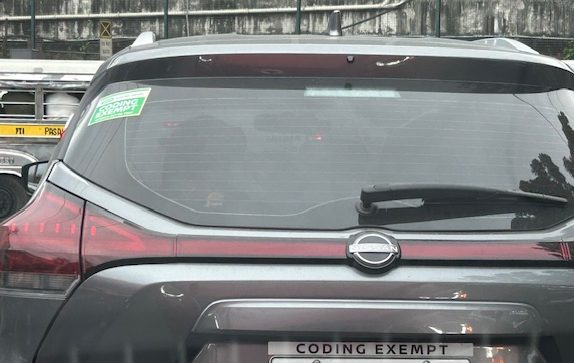 Are they selling these ‘coding exempt’ accessories or do these go free when you buy these cars?
People ask if the number coding scheme (UVVRP) in Metro Manila is still effective or relevant. Well, the answer is a ‘no’ and that is because over time, people have adjusted to it. Car owners have bought a second, even third vehicle that they call their ‘coding’ vehicle. Others opted to purchase motorcycles. And so that’s what we generally see along most roads in Metro Manila. It didn’t help that hybrid and electric vehicles are given exemption from the coding scheme. Those who can afford to buy yet another vehicle or perhaps replace their conventional ones are already buying these as evident from their increasing presence along our roads. While there is the perceived benefits with less emissions and air pollution, we still lose with congestion and its derivatives. Perhaps we should already have a congestion pricing scheme implemented for Metro Manila like the one in New York City. And proceeds should go to the improvement of public transportation to help arrest the erosion of its mode share in favor of private vehicles.
–
The wrong message for electric and hybrid vehicles
There are two billboards along Katipunan Avenue, each displayed to face either the northbound or southbound traffic along the busy thoroughfare. The ad by a major Japanese automaker is a sales pitch for one of its electric vehicle models. The ad states one of the incentives or come-ons for electric and hybrid vehicles granted by government (in this case the Metro Manila Development Authority) to encourage people to buy electric or hybrid vehicles; ideally to replace their fossil fuel-powered vehicles.
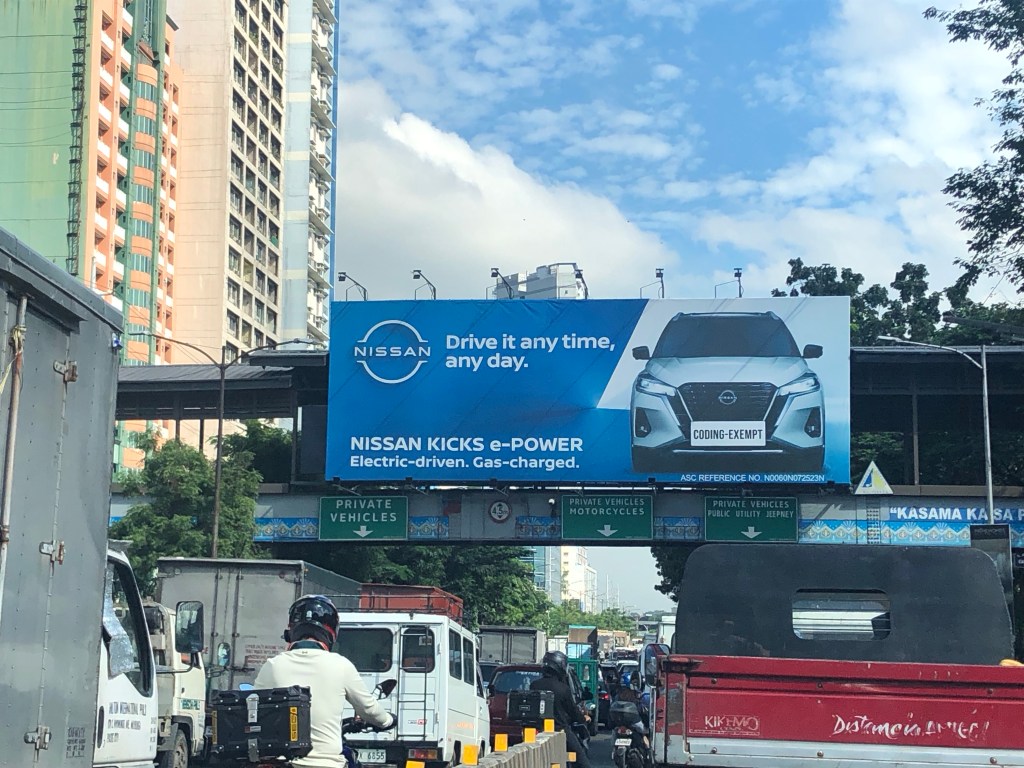 Electric and hybrid vehicles in Metro Manila are exempt from the MMDA’s number coding scheme. The ad is clear about that especially as a selling point for the vehicle featured.
At this point, more electric and hybrid vehicles would probably translate to more traffic congestion. They will just be replacing the conventional vehicles if not adding to them. The incentive will actually backfire vs. the MMDA since the number coding scheme will eventually be rendered ineffective (di pa ba?) with the addition of these coding-exempt vehicles.
–
On electric vehicles overshadowing public transportation
There seems to be much ado about electric vehicles. Here in the Philippines, there is much hype about hybrid and electric cars as incentives are now in place for people to purchase them at reduced prices and in Metro Manila at least, there is that additional incentive of these vehicles being exempted from the number coding (vehicle restraint) scheme. Here’s an article
Woodhouse, S. and Mohsin, S. (January 26, 2023) “EV Hype Overshadows Public Transit as a Climate Fix,” Bloomberg, https://www.bloomberg.com/news/articles/2023-01-25/public-transit-gets-left-behind-in-us-climate-change-conversation [Last accessed: 1/28/2023]
Some quotes from the article pretty much describes why we must focus on improving public transportation to increase or at least retain riderships:
“If we want to reduce carbon emissions we can’t just have technology-focused answers…
“Buses and trains have a fraction of the greenhouse gas impact of private cars, whether internal combustion or battery-powered, according to the International Transport Forum. A 2021 study from the National Academies of Sciences, Engineering, and Medicine concluded that the energy saved by passengers in the US using public transit rather than personal vehicles saved 63 million metric tons of carbon dioxide in 2018 — roughly the equivalent of taking 16 coal-fired power plants offline for a year…
“In the postwar era, the US prioritized building out its road network, leaving transit behind. For decades, highways and roads have consumed about 80% of federal transportation funding, with transit getting only 20%. In 2019 state and local governments spent $203 billion on highways and roads alone, with a quarter of expenditures coming from federal transfers. At the local level, continued car use is fueled by suburban development patterns and land-use practices like minimum parking requirements, which require developers to set aside space for vehicles. Outside of major cities, transit options are often limited, and historically low level of public support translate into poor convenience and reliability…
“We’re not going to be able to successfully fight climate change — and prevent more damage to the climate — without heavily investing in mass transit and specifically public transit.”
Here is something I shared last year:
https://d0ctrine.com/2022/09/16/on-bicycles-vs-self-driving-cars/
You’ve probably seen the image that evolved from the original comparison of 50 people on cars, bus and motorcycles from Munster, Germany. The variant is 50 people on conventional cars, 50 people on electric cars and 50 people on self-driving cars. That is another perspective (road capacity and congestion-wise) of how electric vehicles will affect traffic.
–
Failed experiments? On the DOST’s hybrid train and AGT
Our staff were implementing surveys in relation to the proposed railway projects supported by the Government of Japan. They came across this scene showing the DOST’s (through its MIRDC) hybrid electric train.
 The hybrid electric train at the PNR Calamba Station. It looks like its being maintained or checked although I’m not sure the crude set-up is appropriate for such undertaking.
The DOST had a much hyped program during the last administration about the development of Philippine-made transport. Among these were the two Automated Guideway Transport (AGT) train sets that were developed by the MIRDC – one with two 60-passenger (seated and standing) cars and a test track in UP Diliman, and another with two 120-passenger cars with test track at the MIRD compound in Bicutan. While both had what were claimed as extensive tests, these were mainly done by DOST/MIRDC personnel with no independent inspections or validations. At one time, I recall that we at UP had discussions with representatives of Mitsubishi Heavy Industries who offered to explore arranging for a technical cooperation project to have a full-scale testing of the AGT’s using their facilities in Japan. We referred them to MIRDC and that didn’t turn out well as the agency (or perhaps under the the instructions of a higher official?) was supposed to have rejected the offer preferring it to be tested locally. That was a major problem because there were no suitable testing facilities or qualified persons or institutions to grant certification for the AGT to be used as public transport.
The last time I checked with folks at DOST and UP, the AGT prototype set-up in Diliman was already being scheduled for dismantling. This probably comes as a welcome development for those who opposed the project from the start. However, there is potential here for continuing research if only funding could be secured and proponents kept open minds and objectivity in the way researches could be done. There was the perception before that the people behind the AGT projects were so engrossed with what they thought were their babies that they blocked critical but objective comments and recommendations about the prototypes and their applications.
As for the hybrid electric train, there is now supposed to be a cooperative project between the MIRDC and PNR. I recall a few months ago that they even had some test runs to show the hybrid train to be running on PNR tracks; even hyping that this could be part of the future of a rehabilitated PNR. Is this true or just PR? Hopefully, the DOST could get the context right, and the DOTr and PNR can support such initiatives for Philippine-made transport. This is especially as the current administration continues to pursue its Build, Build, Build program that has as major features several railway projects.
–
 Caught (up) in traffic