
Home » Posts tagged 'LTFRB' (Page 5)
Tag Archives: LTFRB
City bus layout
At the European Motor Show last weekend at Bonifacio High Street in Bonifacio Global City, there were obviously a lot of European made vehicles on display including the usual attractions from Italy and Germany. What also caught my attention was the new MAN bus currently being used Froehlich Tours for their P2P bus services. Here are some photos of the interior of the bus.


Note the low floor for entry and exits and the layout of the seats that could maximise the number of passengers carried by the bus. The layout maximises the space for standing passengers and seats can be assigned to those with special needs such as persons with disabilities, pregnant women, and senior citizens. Those traveling over longer distances can be seated at the back in order for them not to block those who would be boarding and alighting over shorter distances (i.e., with the likelihood for more frequent movements). This layout should be the standard for city buses in Metro Manila and other cities considering bus services (e.g., Cebu and Davao). In fact, I think the DOTC and LTFRB should seriously consider coming out with a policy/memo requiring bus companies to transition into these buses. That means replacing non-compliant buses over a grace period (i.e., to account for the investments of bus operators/companies). This is one way of modernising bus fleets as most buses for city operations you see now, especially along EDSA, are configured for long distance (provincial?) trips with their narrow aisles and maximising the number of seats as well as the baggage compartments at the buses’ bellies.
–
Tire conditions
While stopped at an intersection, my eyes wandered to look at the vehicles around me. I took a photo of the rear tires of a truck stopped beside me. Following are some observations about the tires:
- Most if not all the tires were re-treads
- Most of the tires are worn out
- One tire is already damaged and should not have been used in the first place

Such conditions of trucks’ tires reflect the state of many commercial vehicles in the country. The same observation applies to public utility vehicles. I guess there have been many instances of tire blow-outs involving trucks and jeepneys. These have not been reported as they often lead to traffic congestion (i.e., when a vehicle is forced to stop and block traffic), which is not at all an uncommon experience to many. Few perhaps have led to high profile road crashes featuring fatalities. Still, the potential for major crashes is there and it is contributory to disasters that are always just waiting to happen in many of our roads.
–
Good intentions and knee jerk reactions
Social media is again abuzz with stories about Uber and how Philippine government agencies like the Department of Transportation and Communications (DOTC) and the Land Transportation Franchising and Regulatory Board (LTFRB) are hassling Uber, Grab and similar companies into complying with government regulations covering their services. Is it really a hassle and are these “Transport Network Companies” or TNCs the real deal in terms of solving part of Metro Manila’s transport woes?
I believe Uber and other services like it have good intentions towards providing high quality, on-demand transport services. However, based on what I’ve read about the service in other countries (particularly in the US and Europe), the intention (original?) was to take advantage of surplus or excess capacity of vehicles being driven by “owner-drivers” between origins and destinations such as their homes and offices. That means an improvement of sorts for traffic as, instead of having one vehicle per person, two or more can share a single car. The main differences with conventional carpools is that the driver and his passengers practically do not know each other, and the passengers pay the driver a fee that is agreed upon at the start of the transaction. This works well in car-oriented cities as well as those with less than satisfactory public transport services especially when it comes to taxis.
The last sentence seems to be the right description for Metro Manila and other rapidly growing Philippine cities. And so, Uber, Grab Car and other shared service attracted many users who can afford them and providers willing to share their rides with total strangers. I stated “owner-drivers” in the previous paragraph as this was supposed to be an essential part of the set-up where Uber and others didn’t add to the cars already on the roads. Problem is, apparently and allegedly, some enterprising people who had the resources thought it would be a good idea to deploy all their vehicles (and even purchase additional ones) by hiring drivers they could register with Uber or Grab Car. That way, they thought they could bypass the typically bureaucratic process of getting a franchise for taxi or rental car franchises that also include all those business permits and, of course, taxes. The result of this would not be the utilization of excess capacity but the addition of more cars on the roads and therefore contribute to worsening congestion.
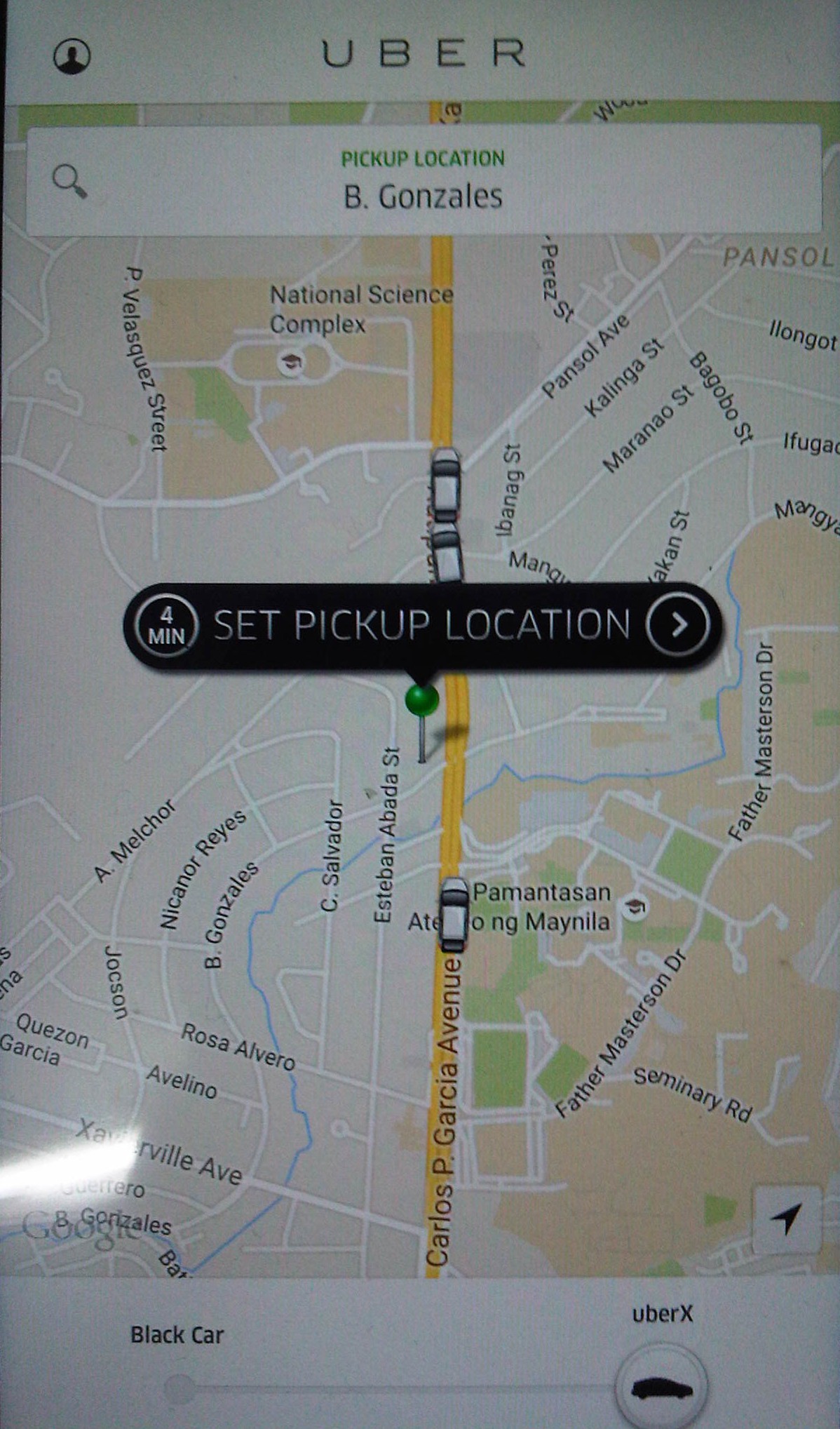
As far as the LTFRB is concerned, like it or not, they are just doing what they are mandated to do and are supposed to do with any transport service provider that is not purely private (i.e., services with a fee). It just so happens that the DOTC and LTFRB have been on the receiving end of a lot of flak from the public and especially in social media for what is perceived as the agencies’ ineptitude in dealing with major issues in public transportation. These include the continuing saga that is EDSA-MRT 3 and the perceived low quality services provided by buses and jeepneys in general that leave people at the mercy of taxis and UV express if they opt not or cannot afford to purchase their own vehicles.
The main issue is not whether DOTC and LTFRB should pay attention to Uber and others like it. The agencies should as per their mandates. However, there are a lot of other more serious and more urgent issues/problems including the much delayed mass transit projects and the low quality of service being provided by buses, jeepneys, UV express and conventional taxis that the DOTC and its attached agencies need to act on and now. I know it is a generalization (There are many good bus, jeepney, UV express and taxi drivers and operators out there who are also working their butts off to earn a living.) but then when you combine unsafe driving, with high fuel consumption and a lot of harmful emissions then you get a cocktail that’s definitely bad for all travelers.
How many people use Uber or Grab Car or taxis? Do they outnumber those taking the LRT/MRTs, buses, jeepneys and UV express? They don’t and therefore only represent a small percentage of the trips being taken everyday in Metro Manila and adjacent areas. And so the more pressing issues are really those pertaining to mass transit and the dire need to construct these systems once and for all in order to achieve a more sustainable and inclusive transport system for this still growing megalopolis.
–
On the new transport categories by the DOTC
An article came out recently about the four new transport categories introduced by the Department of Transportation and Communications (DOTC).
These are:
- Transportation Network Vehicle Service (TNVS),
- Premium Taxi,
- Airport Bus, and
- Bus Rapid Transit
To quote from the article from Rappler, TNVS are:
“Vehicles of application-based, ride-sharing service providers, like Uber, GrabTaxi, Tripda, and EasyTaxi, will now fall under the category TNVS.
TNVS will cover vehicles that provide pre-arranged transportation services for compensation, using an online-enabled application or platform technology to connect passengers with drivers using their personal vehicles, Abaya said.
These new rules will also allow ride-sharing service providers to accept regular passengers heading to any point of destination in the country, Abaya added.
Operators of TNVS, called Transportation Network Companies, are also required to screen and accredit drivers and register them with the Land Transportation Franchising and Regulatory Board (LTFRB).
All TNVS vehicles will also be required to install and use global positioning system (GPS) tracking and navigation devices. Only sedans, Asian Utility Vehicles, Sports Utility Vehicles, vans, or similar vehicles will be allowed, and these should not be older than 7 years.
The new framework makes the Philippines the first country to have nationwide rules on ride-sharing, according to both the Philippine transport department and Uber. Previously, only local and city governments have regulated the services…”
Premium Taxis are described as:
“…vehicles with a 7-year age limit under this new category will be equipped with GPS, online and smartphone booking capability, and cashless transactions through credit or debit card payments.
Like TNVS, premium taxis will be allowed to accept regular passengers heading to any point of destination in the country…”
And Airport Buses are:
“…should have fixed schedules and off-street stops, low-floor height and adequate luggage space, CCTV cameras, GPS device, free WiFi, and must run on Euro V or clean alternative fuel.”
Abaya pointed out that Green Frog has expressed interest in the airport bus service that would ply three areas including Makati City, Mall of Asia (MOA) as well as Bonifacio Global City (BGC) or Ortigas business centre…”
I won’t mention the BRT anymore. It deserves its own feature (as if the previous ones on it are not enough to describe the system), and is the only mass transit among the 4 categories “introduced” by the DOTC.
These new transport categories are obviously a step in the right direction. These are not new ideas and the institution of these categories by the DOTC is long overdue considering that the agency had to go through this process in order to address legal issues pertaining to such services. In the case of TNVS and Uber, for example, much has been mentioned about franchise issues and how Uber was illegal under the prevailing set-up. It is good to have another option to the regular taxis but then weren’t GrabTaxi and EasyTaxi were supposed to have enhanced services?
As for airport buses, such limousine services have been in operation in many other countries. Unfortunately, in Metro Manila’s case, these buses would have to contend with worsening traffic conditions along most major roads connecting the airport terminals to the various points of interest mentioned in the article (e.g., Makati CBD, BGC, Ortigas CBD, etc.). It is good though that Green Frog was mentioned in the article as the new category provides an opportunity for cleaner and more efficient technologies to be applied to transport services. Still, if these services will be operated by reckless drivers then they won’t be much better than what we already have at present.
–
Still on license plates
I can’t seem to get over this pet peeve of mine that is the earlier move of the Land Transportation Office (LTO) for all new vehicles to adopt the same license plate design. It was an illogical move even as the LTO claimed the new plates had security features that allowed easy verification of vehicle registration. Common sense tells us that the easiest verification of whether a vehicle is for private or public utility is by simple vision. You don’t need high tech equipment to tell you that a van sporting a private plate and picking up passengers for fares is operating illegally. You didn’t need to exert a lot of effort to read the very small lettering on the new license plate for where the vehicles is registered because the first letter of the old license plates already indicated the region (i.e., the first letter corresponds to a region – ‘B’ for Region 2, ‘F’ for Region 6, and so on).
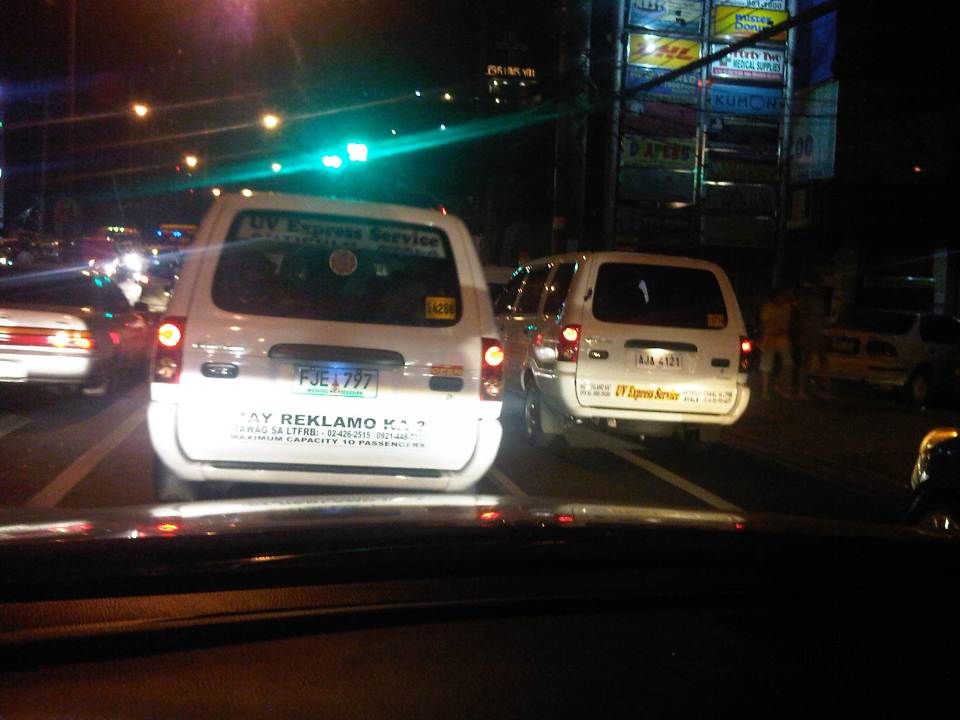 Two UV Express vehicles bearing plates that are supposed to be for private vehicles. The one on the left didn’t even make the cut for the new plates, being issued the older green plates.
I really hope that this is corrected ASAP considering that the LTO has rescinded the earlier policy and is supposed to issue yellow plates again for public utility vehicles.
–
Resistance is futile? The case against electric jeepneys
There is a strong sentiment against electric jeepneys along the route where the COMET is currently operating. This opposition has always been there even before the COMET came about. I would like to think that this is partly due to the perception among many operators and drivers that conventional jeepneys would be phased out and replaced by e-jeepneys. But then isn’t this replacement supposed to be an upgrade in terms of having a more energy efficient and therefore economical vehicle that had a significant bonus of being low emission as well.
I finally got a photo of the sign Katipunan jeepney operators and drivers put up at the terminal below the Aurora Blvd. flyover.
 Protest against electric jeepneys written on Manila paper and posted on overpass column at the Katipunan jeepney terminal
Given the recent innovations and the rapid advances in electric and other fuel vehicles, it should come as no surprise that more reliable and more efficient models of these vehicles will be available in the market. In the case of the Philippines where the thrust for e-vehicles is focused on public transport, there will eventually be a model that will comprehensively beat conventional jeepneys in every aspect. That is, if there is not yet a model that good. Arguably, the COMET and the latest e-jeepney model (BEEP) are already better than conventional jeepneys. However, their acceptability is pending with operators and drivers who seem uninterested with the case against conventional jeepneys. Perhaps these people are being fed false information by another party? Hopefully, they will open their eyes and mind to the reality that will eventually catch up with them if they do not embrace change.
–
Another example of mismatched plates
My most recent post was on the inappropriateness of the new license plates issued by the LTO to public utility vehicles. New taxis, UV express and jeepneys suddenly had the back and white license that’s supposed to be issued only to private vehicles. This meant that it would be difficult to distinguish the legitimate PUVs from colorum or illegally operating ones. In the last post, I was able to show an example each for these license plates on a taxi and a UV Express van. Yesterday, I was able to get a photo of a jeepney bearing this “anomalous” plate as I was caught in an unexpected traffic jam along an otherwise free-flowing road in Rizal.
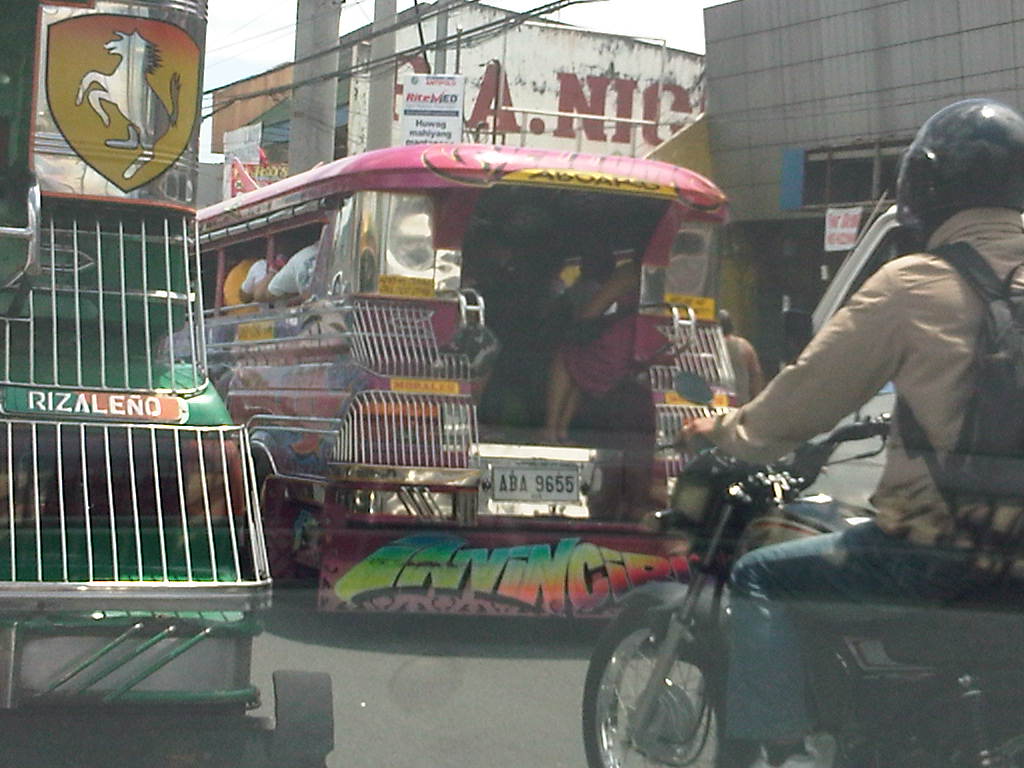 Jeepney bearing the black and white license plate issued to private vehicles
–
Legit or kabit? Follow-up
I wrote about the “kabit” system last February. I mentioned that the EMBC bus I saw was actually operated by another company (RRCG) that seems to have also engaged another company (Jasper Jean) to provide bus units operating the EMBC routes. Unfortunately, I was not able to get a photo showing information on the original operator of this bus company and its lines to Rizal and Laguna via the eastern route through Antipolo. I was finally able to get a photo of an EMBC bus bearing information on the original operator/company for comparison with the information on the bus in the previous post. It clearly states here that EMBC is the operator of this bus.
 Information printed on the bus as required by law
–
“No” to additional jeepneys?
I finally got a photo of a banner that I’ve seen on many jeepneys plying the Katipunan route. This appeared on jeepneys a couple of weeks ago and the message on it is clear: “No to more jeeps, to more traffic in Katipunan.” I became curious about this as I noticed that list of transport groups that had their names printed at the bottom of the tarpaulin. Noticeable is the absence of one group, Pasang Masda, among the list that includes, among others, LTOP, ALTODAP and the party list group 1-Utak, which used to have a seat in the Philippines House of Representatives.
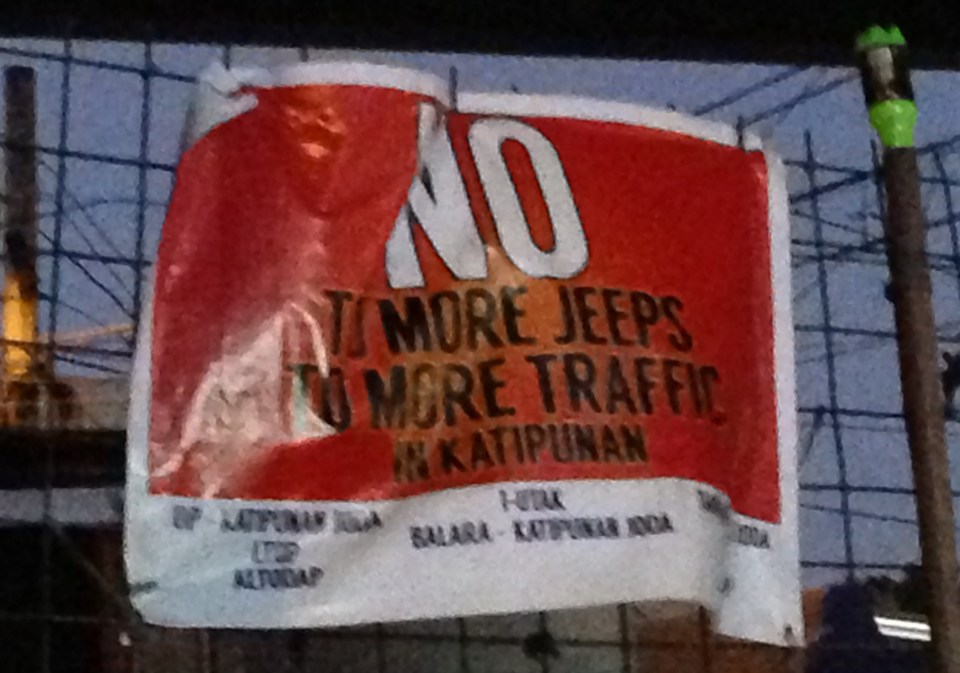 Tarpaulin sign hanging at a wire fence at the Katipunan jeepney terminal under the Aurora Blvd. flyover.
Pasang Masda is supporting the Comet jitneys currently plying the North EDSA-Aurora Boulevard route (via Mindanao Ave., Congressional Ave., Luzon Ave. and Katipunan Ave.). In fact, the head of the group is reported to have bought a few units, likely convinced of it as a good investment. Is it? Only time will tell considering its route is not necessarily the best for it, overlapping with several jeepney routes including the UP-Katipunan route. Is the Comet a game changer? So far, it isn’t and that’s mainly because of its single roue that’s not exactly favorable for a demonstration of the vehicle’s capability and claimed advantage over the conventional jeepneys. A colleague even says that it seems the route approved for it doomed its operation in the first place. But that’s an entirely different story from the opposition to it that’s stated in the tarps at the Katipunan jeepney terminal and some of the jeepneys plying the route.
So, is it a “no” to more jeepneys because their numbers are really already excessive OR is it a “no” because the additional jeepneys are from other groups or those not affiliated or in league with the undersigned? It seems that the latter case applies here and this should be taken as an example of what to expect along the way as initiatives to phaseout or replace conventional jeepneys get going. It is a bit complicated due to mainly to the social aspects of a phaseout or replacement but it gets more complex with the personalities involved including and especially the leaderships of various transport groups.
–
Resurrected bus companies
I posted something recently on an old bus line plying routes between Rizal and Metro Manila. I mentioned there about bus companies somehow being resurrected many years after what I thought were my last sightings of their buses. Of course, it is known that some bus companies have closed shop for one reason or another including what was a government-owned and operated Metro Manila Transit Corporation that used to operate the popular Love Bus. One of the major causes for bus companies folding up is labor problems. Among those that reportedly succumbed to this were Philippine Rabbit, Pantranco and BLTB Co. A few years ago, however, we was surprised to see a familiar bus along the South Luzon Expressway but upon closer look, we found that it wasn’t the old BLTB Co. that was written in the livery but DLTB Co.
BLTB Co. stood for Batangas, Laguna, Tayabas Bus Co. The name alludes to the provinces served by their buses including Tayabas, which eventually became Quezon and Aurora provinces. Their terminal was landmark along EDSA in Pasay City. It is still there along the southbound side and near the junction with Tramo. That will be just beside the left turn overpass from EDSA to Tramo and towards NAIA.
 The livery on this bus is very familiar to many who rode on the old BLTB Co. buses many years ago. Was this deliberate from the owner/operator who obviously wanted to use this to their advantage? People are still familiar with the BLTBCo logo and brand so seeing these buses evoke memories of long distance travel back in the day.
There were few large bus companies in the old days. Among them were Victory Liner, Dangwa, Philippine Rabbit, Pantranco and BLTB Co. Victory, Dangwa and Philippine Rabbit served routes to the north of Manila while Pantranco plied both northern and southern routes. The latter company eventually split into Pantranco and Philtranco, with the northern routes under Pantranco (whose terminal was along Quezon Avenue where Fisher Mall now is located) and the southern routes under Philtranco (terminal is still there along EDSA in Pasay City). Pantranco is no more but Philtranco survives despite the current competition from many other bus companies plying routes south of Metro Manila.
Dangwa’s terminal was in what is still now being referred to as Dangwa in Manila, where you can get all the flowers you’ll need for all occassions. It was, after all, the “bagsakan” of flowers from the north, particularly from Baguio City. Victory’s old terminal is still the one in Pasay though it now has a couple in Cubao. It has expanded its points of destination and is perhaps the largest firm now operating north of Metro Manila.
The Philippine Rabbit Bus Co.’s terminal was at the northbound side of EDSA in the Balintawak area. It has a curious story about it; the stuff of urban legends. The name of the bus company is supposed to be Philippine Rapid Transit (another and real bus company). One time they asked their new buses to be painted, the instructions were misunderstood. “Rapid” sounded like “Rabbit” and that stuck to this day. They also had a labor problem and did not operate for a while until they resolved these issues with their drivers and conductors.
–
 Caught (up) in traffic