
Home » Posts tagged 'MMDA' (Page 4)
Tag Archives: MMDA
Crowdsourcing solutions to traffic problems?
Some government agencies seems to have resorted to crowdsourcing via social media to either find or assess solutions for the worsening transport and traffic problems in Philippine cities, more specifically Metro Manila. This includes posts by the Department of Transportation (DOTr) and the Metropolitan Manila Development Authority (MMDA) about various topics ranging from public transport reform to travel demand management (TDM) schemes. From one perspective, the approach can be seen as something like a participatory approach towards finding a solution that is acceptable to most. I say so since the proposals or ideas come from what are supposed to be official accounts of these agencies and thus can be claimed as something that aims to engage the public in discourse towards finding solutions.
Following are screenshots from a public social media account and examples of the responses/comments he got for the post:


What do you think? Did MMDA do its part in analyzing or evaluating their proposal? I suspect that they did not perform an in-depth analysis despite the resources available to them. They do have technical staff and tools to do the analysis. Note that the agency acquired simulation software during the time of Bayani Fernando that they used to justify projects like the elevated U-turns at Kalayaan and the widening of Commonwealth Avenue. Their technical staff have also been training locally and abroad on transportation planning. A crowdsourcing exercise such as this seems more like a “trial and error” approach where those monitoring the responses/comments may opt instead to summarize the responses for the analyses and then determine whether to refine, push through or withdraw the proposal that was floated. I think the MMDA should do its part first (i.e., evaluate the proposal at both macro and micro levels) and then present the pros and cons of their proposal in both quantitative (e.g., improvement in travel speeds and travel times) and qualitative terms (i.e., improved productivity or quality of life for commuters).
–
Consultation on EDSA decongestion – September 24, 2015
There will be a public consultation tomorrow entitled “EDSA Decongestion Consultation” at the GT Toyota Auditorium at the Asian Center of the University of the Philippines Diliman from 1:30 – 3:30PM. The consultation will tackle transport and traffic in Metro Manila but particularly along EDSA. The consultation will be facilitated by the TWG headed by Sec. Almendras who is the cabinet secretary put in-charge of addressing (solving?) the traffic mess in Metro Manila. The TWG includes DPWH, DOTC, DTI, MMDA, LTO, LTFRB, and the PNP-HPG.
This would be a good venue for stakeholders to articulate their concerns as well as offer their ideas towards alleviating transport and traffic problems. Invitations are supposed to have been extended to academic institutions, transport groups and other interested parties. Hopefully, this event will be a productive and constructive one. Pointing fingers and playing the blame game will not get us anywhere.
–
Capability building for traffic management in Metro Manila
The Metropolitan Manila Development Authority (MMDA) has been on the news lately due to the perceived shortcomings of the agency on traffic management in the metropolis. The current administration has designated the Philippine National Police – Highway Patrol Group (PNP-HPG) to take charge of traffic management/enforcement at six identified choke points along EDSA. EDSA or Circumferential Road 4 has been a battleground of sorts for Metro Manila, representing the capital’s transport and traffic woes with just about all the conceivable problems including severe traffic congestion, high incidence of road crashes and a malfunctioning rail line (MRT Line 3) along the corridor.
The agency was criticized when its head went to Cebu City with a team of enforcement personnel in an apparent effort to augment that city’s traffic personnel. Cebu City has its own traffic management unit in the Cebu City Traffic Operations Management (CITOM), which has been managing traffic in that city for quite some time now. They have been actually ahead of Metro Manila with their own traffic engineering center already integrated with CITOM way back in the late 1980s. The traffic signals around the city were already under CITOM when Metro Manila’s Traffic Engineering Center (TEC) was still under the DPWH. It was only in the last decade that the TEC was formally transferred to MMDA and modernised to the current modern facility beside the MMDA headquarters at EDSA-Orense St. in Makati City. People observed that Cebu was already ahead of Metro Manila on this part and that the MMDA already had their hands full with Metro Manila’s traffic woes. The joke among major cities is that they were learning about traffic management and enforcement from Metro Manila by checking what the MMDA was doing. They will do the opposite. These cities in on the joke include Cebu, Davao and Iloilo, which are all highly urbanized cities looking to alleviate their own transport and traffic problems before these become the level of Metro Manila’s.
The MMDA has the capacity for traffic management as it has the resources including staff to manage traffic around Metro Manila. It even has people to spare that the agency can deploy to assist or supplement traffic personnel in adjacent local governments (e.g., in Rizal, Cavite, Laguna and Bulacan). However, capacity does not mean capability. And MMDA clearly has limited capabilities despite the resources at its disposal. In fact, their traffic management group should be integrated if not closely working with their planning group. Transport engineering, planning and enforcement should go together, working cooperatively in order to come up with comprehensive schemes and solutions that address problems that are progressive in nature.
The old Transport Training Center (TTC) of the University of the Philippines was established to build both capacity and capability for government agencies that included the then Constabulary Highway Patrol Group (CHPG) that was under the then Philippine Constabulary/Integrated National Police (PC/INP) headed by the then Gen. Fidel V. Ramos. The PC/INP became the PNP and the CHPG became the Traffic Management Group (TMG) (later becoming the current HPG) but they all trained under the TTC, which became the National Center for Transportation Studies (NCTS).
The MMDA trained under the NCTS since the 1990s but most of those who did so over the years are now out of the agency and working elsewhere (including those who have migrated to other countries). The remaining training graduates have limited capability and some have quite a bit of overconfidence (this probably is a by-product of the BF era when the agency and its staff were basically taught that they were better than their DPWH and DOTC counterparts and everything they did was right). Mix this with what seems to be confusion about what they need to do and the result is quite amusing.
The MMDA recently established an Institute for Traffic Management (ITM) with the intent of providing training for their own staff and those from local government units. This is apparently with the instigation of their consultants who include a few academics without transport planning and engineering expertise and experience yet dabble in it anyway. I think the ITM is not necessary at this point and it is actually not in the agency’s mandate to provide training programs other than to their own staff. MMDA should focus instead on capability building. If not under NCTS or other local entities they can probably get the knowledge and skills required to manage Metro Manila traffic elsewhere and abroad. In fact, I would recommend that they explore programs offered by the Land Transportation Authority Academy (LTA Academy) of Singapore. These are professional programs that have been developed in cooperation with leading institutions in Singapore like the National University of Singapore (NUS) that can provide a fresh infusion of knowledge to the MMDA. But attendance in such programs is not an assurance that the agency can be better afterwards. The key ingredient would still have to be an effective and progressive leadership that is not under the influence of politics and is committed to no-nonsense traffic management even without the media covering these activities.
–
The worst traffic of the year on Dec. 19?
The Metropolitan Manila Development Authority (MMDA) issued a statement a couple of days ago in reaction to comments online and offline about how transport and traffic have gone from bad to worse in December and especially in the past week. The agency warned people about the worst traffic congestion of the year happening today, December 19, and media immediately branded it as traffic armageddon. Reactions on social media varied from the hostile, desperate, to resignation about their plight for their commute today.
The worsening congestion this time of year is actually part of a pattern, a cycle of ups and downs in terms of person, freight and vehicular traffic. In our case in the Philippines, we usually expect traffic to be bad during certain times of the year and in many cases along specific routes or roads. During the Undas period (All Saints and All Souls holidays), for example, we expect congestion along the expressways and other major roads connecting Metro Manila to the provinces to its north, east and south. During the first days of classes around June (for most schools), it is also expected that congestion will be severe along roads leading to and in the vicinity of schools, especially the big private schools that generate a lot of private vehicle traffic.
December is usually the worst month for traffic because of the increase in economic activity this time of year as people travel more like to earn a bit more income and for shopping. The end of the year also brings about a lot of culminating or concluding activities for offices and even schools so trip generation tends to increase for all types of trips. However, traffic has naturally increased every year and this refers to person, freight and, consequently, vehicle traffic. And so it is inevitable that transport and traffic becomes worse every year unless a major intervention is made in the form of a mass transit system along a specific corridor.
I am not sure if the MMDA or the DPWH keeps records of daily traffic so that we can have a quantitative basis for this. The LRTA and MRTC should have data on this based on ticket sales and the tollway operators would also have data on this based on their toll collections. Such information can provide a strong indication of which dates are the most likely for severe traffic congestion and perhaps allow for prediction and the provision of ample advice for commuters.
Will today be worse than the past few days and will it be the worst day of the year in terms of traffic? Or will Dec. 22, 23 or even 24 turn out to be worse than today’s traffic? Perhaps the statement from the MMDA is a way of psyching people about what could be the worst traffic of the year. This application of psychology may make people more aware of and therefore conscious about traveling today. This may actually lead to less traffic to the relief of many people. Or this may be a way for the MMDA to escape from blame considering they did make the statement ahead of today and this manner of “I told you so” basically excuses them from the public’s ire.
–
The return of traffic signals at Katipunan
It’s been more than a decade since the MMDA implemented what was formally called the Grand Rotunda Scheme. To most, it will always be the U-turn scheme that was implemented all around Metro Manila. After seeing what seemed like success along roads like Commonwealth and Quezon Avenue, it was concluded that the U-turns were the answer to Metro Manila’s traffic woes or at least the part that’s blamed on signalized intersections. The perception by many at the time was that traffic signals were not working and caused so much congestion as evidenced by the long queues at intersections. This is not entirely false as intersections with in-optimal settings would definitely bring about congestion especially along corridors or networks where signals are not coordinated. It was, however, a generalization at a large scale and led to more experiments of opening and closing slots in order to determine which would be the most effective combinations. These experiments and their outcomes include drivers becoming more aggressive in order to maneuver ahead of others at the U-turn slots. Weaving has become the norm and in many cases have increased the risk of road crashes.
 Traffic signals have been installed and the section of the median island has been removed across Ateneo’s Gate 3. This will become a three-leg intersections once again but I hope the signals will not favor Ateneo over through traffic along C5.
 Traffic lights are already installed along the southbound side of Katipunan at the approach to the junction with Miriam College’s Main Gate. This will be a four-leg intersection as across Miriam is B. Gonzales Street that connects to Esteban Abada.
The signals are supposed to be operational starting September 13, which is a Saturday. Perhaps this is to try it out first during that weekend and for the MMDA to do some tweaks before the real deal that is traffic on Monday. But then how can you simulate traffic generated by the two schools in the area except maybe if there is significant enough traffic on Saturday? Did the MMDA or its consultants do some simulation using their computers and the VISSIM software they acquired many years ago? Or will we see more of the experiments as signals are fine-tuned according to the conditions along Katipunan?
We are hopeful that the signals along Katipunan will help improve the traffic along this very busy corridor. The results for sections of C5 from Libis (QC) to Ugong (Pasig) are promising and many people I know have told me that traffic has improved. Of course, this may also be partly due to the one-lane policy the MMDA has implemented for trucks. It’s never just one scheme or measure that will work wonders for Metro Manila traffic. It will always be a combination that will alleviate traffic woes in the metropolis. We’ll soon know what will become of traffic along Katipunan. We should, however, temper expectations at least for the 6:30 – 7:30 AM period during weekdays when traffic peaks in the vicinity of Ateneo and Miriam. The sheer volume of vehicles generated by the schools will overwhelm any system that is put up in the area. Nevertheless, for the rest of the day at least traffic flow should improve when signals are operational once again for Katipunan.
–
What’s causing traffic congestion along Katipunan?
An article came out today on a popular online news site stating that the Metropolitan Manila Development Authority (MMDA) blames the Land Transportation Franchising and Regulatory Board (LTFRB) for the severe traffic congestion that is experienced daily along Katipunan Avenue (part of Circumferential Road 5). The article may be found in the following link:
MMDA: LTFRB to blame for Katipunan traffic
Reading the article, I would like to think that the MMDA likely misunderstood the advisory from the LTFRB extending the “non-apprehension policy” for trucks that have not renewed their franchises. This policy is not the same as the truck ban scheme being implemented in Metro Manila by the MMDA and LGUs. The trucks using Katipunan Avenue during the prescribed period that they are allowed travel along this and other roads are not violating any laws or regulations. Meanwhile, the increase in the volume of trucks can only be attributed to an increasing demand for goods that translate into freight movement. There are very limited alternatives to Katipunan Ave., which is a truck route (note: most of EDSA is not a truck route), and there are few wide roads that can accommodate the volume of trucks carried by C5.
I use Katipunan everyday as it is the main road between my home and my office. I can say that traffic has worsened along this stretch of C5 and one can always see the long queue of vehicles caught in traffic along the northbound side of Katipunan especially from the afternoon to night periods. There are many causes of traffic congestion along Katipunan Ave. and during times when trucks are banned from traveling, it is still congested due to the sheer number of private vehicles using the road. C5, after all, is a major road connecting Quezon City with Pasig, Makati and Taguig, which host major CBDs (Ortigas, Makati and Bonifacio Global City).
In the mornings, much private vehicle traffic is generated by the exclusive schools along Katipunan and the northbound side of the road is usually congested from C.P. Garcia all the way to Blue Ridge. Meanwhile the southbound side is full of vehicles from B. Gonzales (across Miriam College’s main gate) to Tandang Sora. In the afternoons and evenings, traffic congestion is caused mainly by traffic returning from Ortigas, Makati, BGC, etc. to Quezon City and elsewhere where their passengers reside. Road capacity is usually reduced by the parked and standing vehicles that usually occupy a couple or more lanes along Katipunan southbound.
I guess the MMDA would just have to do a better job of managing traffic along this corridor. However, they can only do so much given the sheer volume of private and freight traffic using Katipunan and the limited options for reducing traffic over the immediate to short terms. Only an efficient mass transit system (including walking and cycling for short trips) and a significant mode shift from private to public transport can provide a long term solution to traffic congestion along Katipunan. Until then, congestion along Katipunan will continue to worsen and this will further be exacerbated by the full development and operation of the U.P. Town Center and other high rise developments along the road. Good luck to all of us using Katipunan Ave.!
–
“Pwede na yan” bikeways?
The recent clamor for bicycle facilities have led to several initiatives in Metro Manila and other Philippines cities (most notable recently is Iloilo) to support the demand for cycling facilities. While Marikina City already has a network of off-street bikeways segregated from motorised traffic, there are few other examples of such facilities elsewhere. The more recent initiatives in Metro Manila involved the Metropolitan Manila Development Authority (MMDA) establishing bikeways in several areas along major roads in the metropolis. I say establish because the MMDA did not construct new bikeways like the ones in Marikina or Iloilo. What the agency did was to designate sidewalks and other existing paths for cycling by painting these over. Unfortunately, these so-called bikeways did not take into consideration the needs of pedestrians with whom cyclists must share this limited space. And so few people use them despite a high profile launch that brought together government officials and NGOs including cycling and mobility advocates and enthusiasts. I guess the big test was really not whether advocates and enthusiasts would really use the bikeways (Don’t count on the officials to use them. They have chauffeur-driven vehicles.). Would the regular commuter use them instead of the roads, despite the risk or dangers posed by motor vehicles?
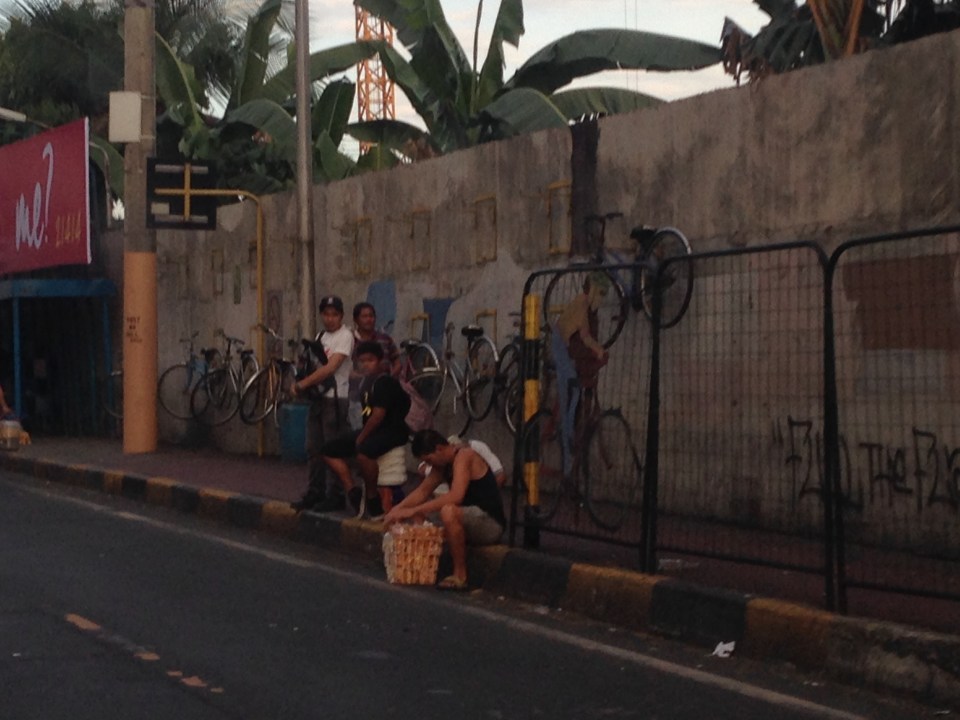 Commuters waiting for a bus ride along EDSA with suspended bicycle racks behind them. The sidewalks along EDSA have been painted red, designating them for bicycle use. The big question now is how cyclists will interact with pedestrians given the very limited space they should be sharing.
 Bicycles hanging on racks attached to the perimeter wall of an exclusive subdivision along EDSA.
 Cyclist using the curb side lane of EDSA – these people run the risk of being sideswiped by buses operating along the yellow (bus) lanes of this busy thoroughfare. It is quite obvious in the photo that there is no space on the sidewalks to accommodate cyclists and even pedestrians. Column for the MRT-3 stations are right on the sidewalks and makes one wonder how this flawed design was approved in the first place. MMDA enforcers usually appear as if they are only bystanders and seem to be generally helpless when it comes to managing traffic.
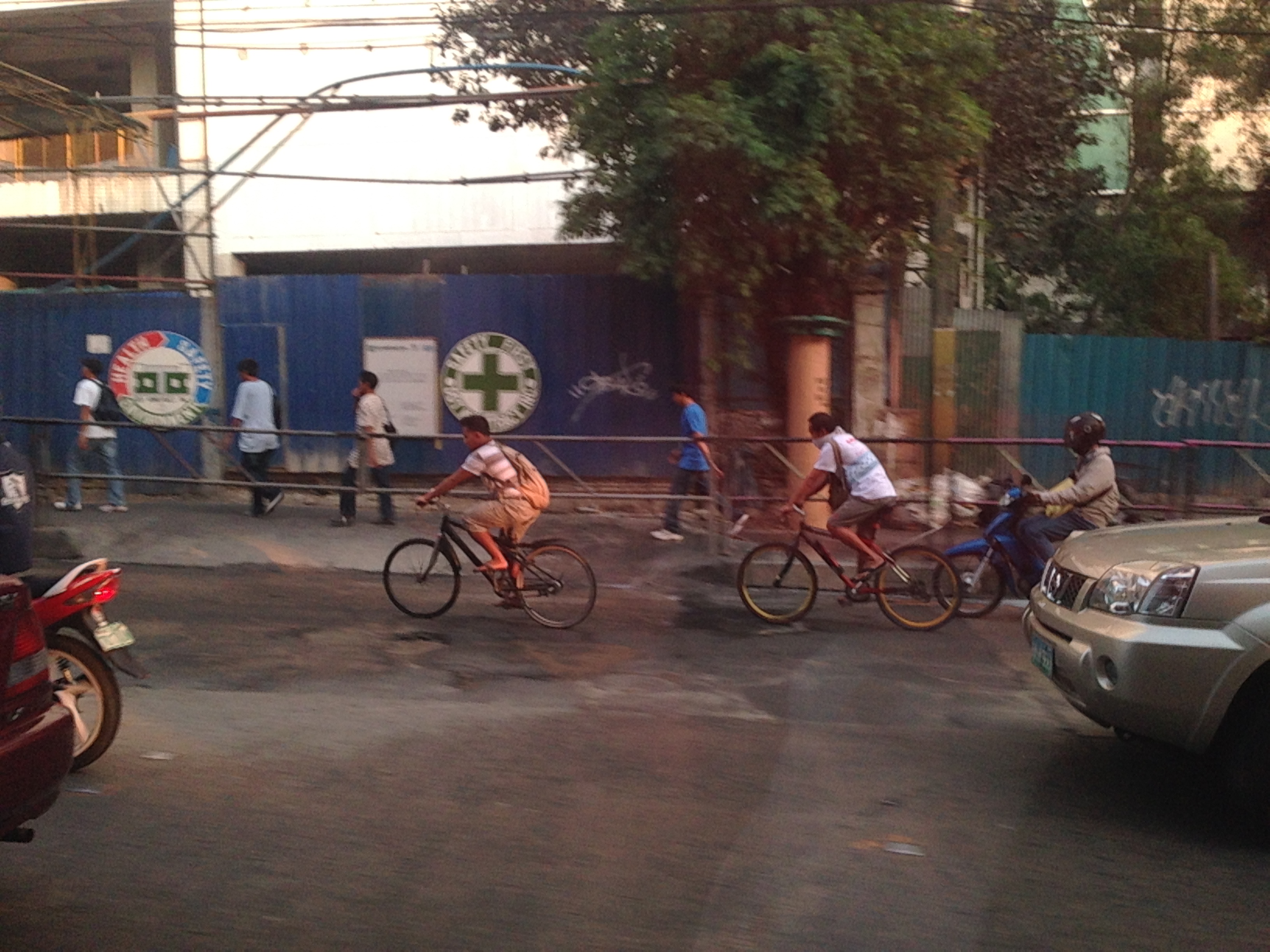 Workers cycling back to their homes after a day’s work. Many people have opted to take bicycles for their daily commutes even if they have to travel long distances in order to save money that would otherwise be paid as fares for buses, jeepneys, UV Express or tricycles. Note that the cyclists use the outermost lane of the road as the sidewalks pose many obstacles including pedestrians as shown in the photo. Some cyclists though want more than a share of the sidewalk or a lane of the road for their use regarding pedestrians and motor vehicles as nuisance for them. Surely, some pedestrians also regard cyclists as nuisance to walking and would prefer to have the sidewalks for themselves.
Cycling is in a way an emancipation from motorized transport commutes, and savings translate to money they could allocate for other needs of their families. While there are raw data for family expenditures from census surveys, there are few studies and publications focused on transport. It would be interesting to see how much a typical Filipino family spends for transport in absolute terms as well as a percentage of their total incomes. Such information would be essential for understanding the needs of travelers, especially for daily commutes for work and school (other trips include those for purposes of shopping, recreational, social and others). Long commutes are associated with higher expenses (e.g., in terms of fares or fuel costs) and reducing such costs through shorter commutes should free up money for necessities like food, housing and clothing. Ultimately, this would help solve issues relating to poverty and health, which can easily be related to commuting behavior and characteristics.
It is in that context that transport systems should be planned and implemented carefully along with the housing developments. This underlines the essence of the relationship between transport and land use that has been the topic of discussions for quite some time now that apparently, a lot of people in this country, especially officials and the private sector have chosen to ignore or apply selectively (i.e., according to their own advantage and not really for the general welfare of the public). A transport system is not cycling alone, or roads or railways alone. It is, by definition, a network, a set of interacting, integrated elements and each of these components of the system are essential for it to function well. It is the interaction and integration that are the key elements that we often forget as we advocate one transport mode over others as if they are independent from each other. They are not and we should complement rather than compete in our advocacies for transport so we can finally achieve an efficient, effective system for everyone.
–
“Sharing the road” – bandwagons and fads? Let’s hope not!
There seems to be a lot of talk about “sharing the road” and the initiatives to have more bikeways. I hope I am proven wrong but it seems to me as if these current programs and projects are more of a fad. A lot of people (and local governments) join the bandwagon with little understanding of what needs to be done. It’s usually because of the good PR they get out of these that they agree to coming up with the token carless street or the haphazardly implemented bicycle lanes. More than PR, some cities are aware of the opportunities that come with such initiatives as international agencies and groups are willing to spend money to support such programs and projects. The question really is on sustainability and doing the right thing not only on initiating things or coming up with programs but on the substance itself. And by substance I mean that programs should also go into the details of designs. Too often, the “pwede na yan” approach is taken and this just won’t do.
 The MMDA painted the sidewalks in White Plains and designated them as bikeways, in a way alienating pedestrians.
A vision for what people want to have is there but it is ultimately how the achieve the vision that needs a lot of work. For example, bills are being filed in congress to force the creation of bicycle lanes along major highways. (And mind you there are a lot of similar bills filed in congress that upon closer inspection actually have little substance.) The premise here seems to be that if you build them then people will start cycling. That was not the experience in Marikina, which boasts of the country’s only bikeways network that includes many off-street sections. These bikeways were built at a time when the perception and analysis pointed to a critical mass of cyclists in that city that was thought to be surely the tipping point in terms of non-motorised transport. Nowadays, the same bikeways are used by motorcycles and tricycles and most cyclists we see are not commuters (e.g., cycling between home and work/school) but recreational cyclists. It would take Marikina some effort to promote commuting by bicycles and much effort in enforcement to correct the misuse of the bikeways. The “new” bikeways in Quezon City appear to be poorly conceptualised as the MMDA decided to paint the sidewalks along EDSA northbound without addressing the obstacles like electric posts. Still, it is an effort to put NMT in the consciousness or awareness of the general public (thanks in part to media’s making these news worthy items).
Cities like Pasig and Taguig like to show-off Ortigas Center and Bonifacio Global City, respectively, as their faces when in fact the cities have not done much in their original cores. The running joke is that the real Taguig is not the areas to the west of C-5 but the old Taguig, which is to the east. This Taguig is the one plagued by narrow streets and the proliferation of tricycles. It was not so long ago that a former mayor imposed e-tricycles on BGC (where they were not suitable) while not doing much to lift a finger in the mayhem of tricycles in old Taguig (e.g., along Gen. Luna). As for Pasig, you just have go along the Pasig River and the Manggahan Floodway to see what it has accomplished so far in those areas.
There are no quick fixes to the transport and traffic problems our cities are facing. In the case of Metro Manila, much is at stake for the long-delayed mass transit projects. And the DOTC’s announcements of projects being formulated or proposed are no longer taken seriously as they have not delivered on any of these despite 4 years of this current administration. For other cities, it is important to learn the hard lessons from the experience of Metro Manila. There is also a need for a drastic change in transport and traffic policies in our cities. Iloilo, for example, has built an expensive bike lane along Ninoy Aquino Avenue (Diversion Road) and has marketed its Esplanade as a haven for pedestrians and cyclists. Yet the city has not acted on the clamour to revisit the overpasses along Gen. Luna (Infante and Jalandoni flyovers). The latest information I got from the city is that there are issues in the design of the bikeway along the Diversion Road as the surface (they used pavers) is not suitable for cycling. It seems, also, that the city and cyclists were not consulted by the DPWH when the bikeway was designed and constructed resulting in many cyclists using the Diversion Road itself for traveling. This last example is a lesson for our local governments and national agencies that they need to cooperate with each other and turfing has no place in transport and traffic if we are really serious about bringing solutions to problems we encounter everyday.
–
Some thoughts on the issues on bus bans and terminals in Metro Manila
I had originally wanted to use “Clarifying issues on bus bans and terminals in Metro Manila” as the title for this post. However, I felt it was too strong a title, and one that would be more appropriate for a government agency like the MMDA or DOTC, or an LGU like Manila. More than fault-finding and criticizing government agencies and local governments, I believe we should take a closer and more objective look at the issues (or non issues?) pertaining to the Manila bus ban and the opening of the southwest provincial bus terminal for Cavite-bound buses. Following are my comments on issues raised the past weeks about the two initiatives.
Issue 1: There were no or few announcements about the implementation of the bus ban in Manila and the southwest terminal in Cavite.
Comments: While the bus ban in Manila came as a surprise to many, the move was actually a consequence of a Manila City Council resolution. Normally, such resolutions would take time to implement and would entail announcements for stakeholders. Though we will probably never know the truth or who is saying the truth about the resolution and its implementation, it is likely that bus operators already knew about the implications but decided to call Manila’s bluff and play the media and public appeal cards rather than comply with Manila’s requirements for franchised buses and terminals as they have done before in other issues like fuel prices and fare hikes.
I find it difficult to believe that the MMDA did not do its part in announcing the opening of the southwest terminal. Perhaps people thought the announcement was over a very short period? Or maybe people didn’t mind the announcement and are also at fault for paying no or little attention to the announcement? If so, then the public is also partly to blame for disregarding the announcement from the MMDA, assuming the agency won’t push through with its initiatives to implement central terminals for buses. Next up will be another southern terminal at Alabang and a northern one near Trinoma.
Issue 2: Poor transfer facilities and services including a lack of pedestrian facilities between the bus terminal and transfer point, and lack of public transport like jeepneys to ferry passengers to their destinations.
Comments: I think it’s quite clear that the MMDA and LGUs are at fault here. Despite the construction and scheduled opening of the southwest terminal, there have been limited effort in improving pedestrian facilities. Such facilities needed to be in place prior to or upon the opening of the southwest terminal and requiring all provincial buses to terminate at the facility instead of continuing to Metro Manila. People-friendly facilities could have helped people in adjusting to the new policy though walking from 100 to 200 meters is certainly not for all, especially during this rainy season. Senior citizens and persons with disabilities (PWDs) would have specific needs that could have been addressed from day one of operation of the terminal. One approach to “bridge the gap” between the terminal and where people could take city bus and jeepney rides could have been to modify some city bus and jeepney routes to make these closer to the terminal. Ideally, the terminal could have been an intermodal facility providing efficient, seamless transfers between modes of transport.
In the case of Manila, the jeepneys were already there with routes overlapping with buses but their numbers and capacity could not cope with the demand from the buses. Since the main objective of Manila was to weed out colorum buses, it could have coordinated with the LTFRB to check the registration and franchises of buses rather than generalizing among all buses. Perhaps Manila just wanted to make a big statement? But then this was at the expense of the riding public, which obviously got the attention of many including the media. Coordination among agencies and LGUs, however, has not been a strong suit for these agencies, and this thought leads us to the next issue.
Issue 3: Lack of coordination among LGUs and agencies in implementing transport schemes.
Comments: This issue is an enduring one and has been the topic of discussions, arguments and various fora for as long as we can remember. On one hand, the DOTC and the LTFRB should provide guidelines and guidance to local governments on transport planning and services. The agencies should be proactive in their engagement of LGUs in order to optimize transport services under the jurisdiction of national agencies and local governments. On the other hand, LGUs must accept the fact that most if not all of them are ill equipped or do not have the capacity nor capability to do transport planning much less addressing issues regarding public transport. Citing the Local Government Code and its devolution of local transport to LGUs everytime there’s a transport issue certainly won’t help LGUs solve their problems.
Issue 4: Terminals required for city buses in Manila.
Comments: There should be a terminal for city buses in Manila but not a terminal for each company. There should only be one or maybe two terminals where buses can make stops prior to making the turnaround for the return trip. There is actually a terminal in Manila, which the city can start with for city buses. This is the one just beside the Metropolitan Theater and near City Hall, which can be utilized by city buses. It is also close to the LRT Line 1 Central Station so the facility can be developed as a good intermodal terminal for land transport.
Issue 5: Colorum or illegal public transport vehicles in Manila
Comments: This is actually a problem not just for Manila but for the rest of Metropolitan Manila and the rest of the country. The colorum problem is there for both conventional and paratransit services as there are illegal buses, jeepneys, UV express, multicabs, taxis, tricycles and pedicabs everywhere. Many of these are allegedly being tolerated by national agencies and local governments with many allegedly being fielded or owned by public transport operators themselves.
–
In most cases, the best time to evaluate a traffic policy or scheme is NOT during its first days or weeks of implementation but after a significant time, say at least a month, after it was implemented. This is because the stakeholders, the people involved would take some time to adjust to any scheme or policy being implemented. This adjustment period will vary according to the magnitude or scope of the scheme/policy and can be quite “painful” to many who have gotten used to the old ways. Usually, a lot of comments and criticisms are quite emotional but it is clear that the collective sentiment is the result years or decades of poor transport services and fumbling by government agencies. Transport in Metro Manila is already quite complicated with routes overlapping and services competing with each other for the same passengers. Perhaps it is time to simplify transport while also in the process of optimizing and rationalizing services. I have written about this in this previous post.
More transport issues in Manila will come about should the city train its attention on other modes of transport including jeepneys, UV express vehicles, tricycles, pedicabs and kuligligs. If the city is really intent on reforming transport services within its jurisdiction, it should consider the needs of all stakeholders and especially and particularly the riding public. Transport should be inclusive, people-friendly as well as environment-friendly and there are many good practices in other cities that Manila could refer to and study for adaption and adoption for the city. If it is successful in improving transport, then perhaps Manila could be the country’s model for transformation from being the “Gates of Hell” to being a “Portal to Heaven” to residents and visitors alike.
–
 Caught (up) in traffic